Listen to this Post
Introduction:
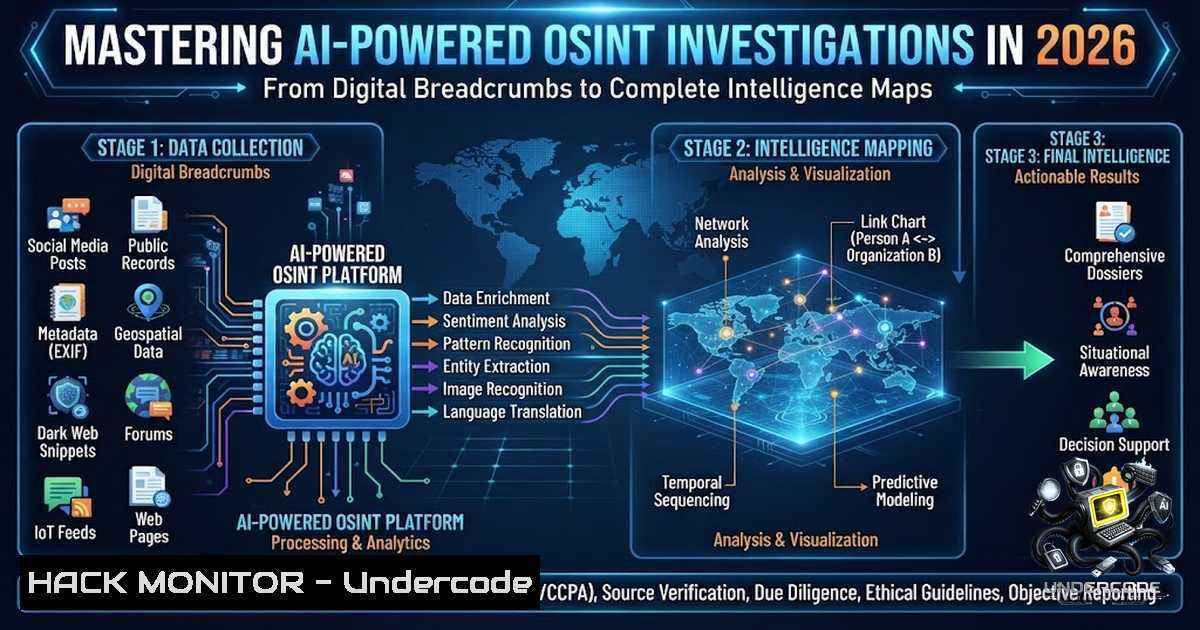
Every hacker leaves a trail—a wallet address, a Telegram username, a breached email, a shell company, a sanction record. Individually, none of these tell the full story. The biggest challenge in modern cybersecurity investigations isn’t finding more data; it’s connecting thousands of scattered data points before the person behind them disappears. In 2026, the future of investigations belongs to those who can connect intelligence faster than criminals can hide it, leveraging AI-powered OSINT (Open-Source Intelligence) to transform fragmented digital breadcrumbs into complete, actionable intelligence maps.
Learning Objectives:
- Master the art of connecting disparate data points (wallets, usernames, emails, dark web activity) to build comprehensive threat actor profiles.
- Learn to deploy AI-driven OSINT tools and workflows that reduce investigation timelines from days to minutes.
- Acquire practical command-line and scripting skills for automating intelligence gathering, blockchain analysis, and threat correlation.
You Should Know:
- The OSINT Investigation Pipeline: From Data to Intelligence
The foundation of any successful investigation is a repeatable, structured workflow. A repeatable investigation workflow matters as much as the individual tools in your stack. The modern OSINT investigation pipeline consists of five core phases: Discovery, Collection, Correlation, Analysis, and Reporting.
In the Discovery phase, investigators cast a wide net using tools like Shodan for internet-facing assets, Have I Been Pwned for credential breaches, and SpiderFoot for automated footprinting. The Collection phase involves gathering raw data from social media, forums, blockchain explorers, and dark web sources. Correlation is where the magic happens—linking a cryptocurrency wallet to a Telegram handle, an email address to a breached database entry, and a username to multiple social platforms. Analysis transforms correlated data into intelligence, identifying patterns, relationships, and threat actor behaviors. Finally, Reporting produces actionable insights and courtroom-ready documentation.
To operationalize this pipeline, investigators can leverage the OSINT Bible 2026, a comprehensive guide featuring 450+ tools across 35 categories, including dedicated sections for blockchain/crypto investigations, email/phone investigation, and AI intelligence.
- Connecting the Digital Dots: Username and Identity Correlation
One of the most powerful techniques in OSINT is username correlation. A single username can unlock a treasure trove of intelligence across hundreds of platforms. Sherlock is an open-source OSINT tool designed to find usernames across more than 400 websites and social networks. It enables investigators to quickly determine where a username is active, revealing the digital footprint of a target.
Step‑by‑step guide: Deploying Sherlock for Username Correlation
1. Installation (Linux/macOS):
 Install via pip (recommended)
pip install sherlock-project

Or use the official Docker image
docker pull sherlock/sherlock
2. Basic Usage:
 Search for a single username across all supported sites
sherlock target_username

Search multiple usernames
sherlock alice bob charlie

Use the {?} helper to try common separators (_ - .) between name parts
sherlock john{?}doe
3. Advanced Options:
 Only print positive results (found accounts)
sherlock target_username --print-found

Export results to CSV for further analysis
sherlock target_username --csv

Limit search to specific sites
sherlock target_username --site twitter.com --site github.com

Use Tor for anonymity
sherlock target_username --tor
4. Bulk Investigation (Windows/Linux):
 Input usernames from a JSON file
sherlock --input usernames.json
Sherlock does not require API keys or login credentials; it simply constructs expected profile URLs and observes responses, accessing only publicly available information. This makes it an essential, zero-cost entry point for any investigation.
3. Blockchain Forensics: Tracing the Crypto Trail
Cryptocurrency transactions are pseudonymous, not anonymous. Every transaction leaves an indelible trail on the blockchain. Connecting a wallet address to a real-world identity is often the critical breakthrough in financial crime investigations. In 2026, AI-powered blockchain analytics tools have revolutionized this process.
Chainalysis Rapid is an AI-powered crypto triage tool that delivers plain-language summaries of wallet activity, including balances, transaction history, and potential counterparties. It eliminates the need for specialized crypto expertise, allowing any investigator to quickly assess the relevance of a crypto address.
For open-source, scriptable blockchain forensics, cryptotrace provides a powerful free-tier solution for Ethereum and Bitcoin investigations, offering address clustering, sanctions screening, and laundering pattern detection.
Step‑by‑step guide: Using cryptotrace for On-Chain Investigation
1. Installation:
pip install cognis-cryptotrace
- Screen a Transaction List for Sanctions and Suspicious Activity:
Screen a JSON transaction list for OFAC sanctions hits and indirect exposure
cryptotrace screen txs.json --max-hops 2
3. Check a Single Address Against Sanctions Lists:
 Check a Bitcoin address against the OFAC SDN list
cryptotrace check 1A1zP1eP5QGefi2DMPTfTL5SLmv7DivfNa

List all bundled OFAC SDN crypto addresses
cryptotrace sdn
4. Advanced Analysis:
 Cluster addresses into single-entity wallets
cryptotrace cluster txs.json

Propagate value-weighted taint from sanctioned sources
cryptotrace taint txs.json

Detect peeling-chain laundering patterns
cryptotrace peel txs.json
5. Pipeline Integration:
 Pipe transaction data and process results
cat txs.jsonl | cryptotrace screen - --format json | jq '.max_severity'
The tool exits with code `1` when sanctioned exposure is found, making it ideal for CI/CD pipelines and automated alerting.
4. AI-Powered Intelligence: Automating Correlation at Scale
Artificial Intelligence is not replacing analysts; it is giving them the complete picture in minutes instead of days. The integration of AI with OSINT systems has revolutionized the monitoring and analysis of cyber events by automating the processing of massive datasets. In 2026, the question isn’t whether we can find the data—it’s whether we can trust it.
AI OSINT is a curated collection of Google dorks, Shodan queries, GitHub dorks, and techniques for discovering exposed AI infrastructure, including LLM endpoints, leaked API keys, and misconfigured vector databases. It addresses the critical reality that organizations are deploying AI faster than they can secure it, with over 187,000 Ollama servers exposed and AI credential leaks up 81% year-over-year.
Step‑by‑step guide: Leveraging AI OSINT for Threat Discovery
1. Google Dorks for Exposed AI Endpoints:
 Find exposed Ollama servers
intitle:"Ollama" "running models"

Discover exposed Jupyter notebooks with AI code
"jupyter" "api" "token" "ai" "model"

Locate leaked ChatGPT conversation logs
"chat.openai.com" "conversation" "share"
2. Shodan Queries for AI Infrastructure:
 Find exposed MLflow tracking servers
http.title:"MLflow"

Discover vector databases without authentication
port:6333 "collections" "qdrant"
3. GitHub Dorks for Leaked API Keys:
 Search for exposed OpenAI API keys
"sk-" "api_key" "openai" extension:env

Find exposed Anthropic API keys
"sk-ant-" "api_key" extension:json
4. Automated Scanning with AI OSINT Tools:
 Use the AI OSINT framework for comprehensive reconnaissance
git clone https://github.com/7WaySecurity/ai_osint.git
cd ai_osint
 Replace KEYWORD with your target domain or project name
grep -r "KEYWORD" . --include=".dork" | while read dork; do
echo "Searching: $dork"
 Execute search (using googlesearch-python or similar)
done
5. Unified Intelligence Platforms: Bringing It All Together
The most effective investigations are conducted on unified platforms that connect financial intelligence with open-source intelligence. IntelHawk is a powerful intelligence platform that brings blockchain analytics, dark web monitoring, and social media intelligence together in one system. Users can link phone numbers, email addresses, usernames, and wallet addresses to online profiles and digital footprints, uncovering hidden relationships that might otherwise go unnoticed.
Step‑by‑step guide: Building a Unified Investigation Workflow
- Centralize Data Sources: Aggregate data from blockchain explorers (Etherscan, Blockchain.com), breach databases (Have I Been Pwned, DeHashed), social media platforms, and dark web monitoring feeds.
-
Correlate Identifiers: Use tools like Maltego, SpiderFoot, or i2 Analyst’s Notebook to map relationships between wallets, usernames, emails, and phone numbers. For example:
– Link a Bitcoin address to a Telegram username found in a dark web forum.
– Correlate a breached email with a social media profile and a wallet address used in a DeFi protocol.
- Automate Correlation: Implement automated correlation scripts using Python and APIs. Here’s a sample Python snippet using the `cryptotrace` and `sherlock` libraries:
import subprocess
import json

def investigate_wallet(wallet_address):
 Check wallet against sanctions
result = subprocess.run(
['cryptotrace', 'check', wallet_address],
capture_output=True, text=True
)
if result.returncode == 1:
print(f"[!] Sanctions hit: {wallet_address}")

Extract usernames from wallet metadata (simplified)
 In practice, use blockchain APIs and OSINT tools
return {"wallet": wallet_address, "sanctioned": result.returncode == 1}

def investigate_username(username):
 Run Sherlock to find accounts
result = subprocess.run(
['sherlock', username, '--print-found'],
capture_output=True, text=True
)
return result.stdout.split('\n')

Example: Investigate a target
wallet = "1A1zP1eP5QGefi2DMPTfTL5SLmv7DivfNa"
username = "target_user"

wallet_data = investigate_wallet(wallet)
username_data = investigate_username(username)

print(f"Wallet Investigation: {json.dumps(wallet_data, indent=2)}")
print(f"Username Investigation: {username_data}")
- Generate Reports: Compile findings into structured reports with clear visualizations of relationships, timelines, and risk assessments.
6. Defensive OSINT: Protecting Your Own Organization
OSINT is a double-edged sword. Attackers are already running open source intelligence operations against your organization. Before writing a single line of exploit code, they are mapping your exposed infrastructure, harvesting employee credentials from breach databases, and fingerprinting unpatched systems.
Step‑by‑step guide: Implementing Defensive OSINT
- Continuous Attack Surface Monitoring: Use Shodan, Censys, and SOCRadar to continuously monitor your external exposure.
Example: Query Shodan for your organization's IP range
shodan search "net:192.0.2.0/24"
-
Credential Leak Monitoring: Subscribe to Have I Been Pwned for Enterprise or use the API to monitor for employee email breaches.
import requests</p></li> </ol> <p>def check_breach(email): url = f"https://haveibeenpwned.com/api/v3/breachedaccount/{email}" response = requests.get(url, headers={"hibp-api-key": "YOUR_API_KEY"}) return response.json() if response.status_code == 200 else []- Dark Web Monitoring: Deploy tools like IntelHawk to track activity on underground marketplaces, forums, and data leak sites.
-
Automated Threat Intelligence: Integrate OSINT feeds into your SIEM or threat intelligence platform to automatically enrich alerts with external context.
What Undercode Say:
- Key Takeaway 1: The power of OSINT lies not in individual tools but in the ability to correlate disparate data points into a unified intelligence picture. A wallet, a Telegram username, a breached email, and a shell company are meaningless in isolation—but together, they reveal the complete threat actor profile.
- Key Takeaway 2: AI is not replacing human analysts; it is augmenting them. By automating data collection, correlation, and initial analysis, AI enables investigators to focus on high-value tasks: interpreting intelligence, making strategic decisions, and building cases. The future belongs to those who can connect intelligence faster than criminals can hide it.
Analysis:
The convergence of AI, automation, and expanded dark web monitoring has dramatically increased the value and velocity of OSINT in 2026. However, this also means that attackers are using the same tools and techniques against defenders. The key differentiator is not the tools themselves but the methodology—the ability to operationalize a repeatable investigation workflow that transforms raw data into actionable intelligence. Organizations that invest in unified intelligence platforms, AI-powered automation, and continuous OSINT training will be better positioned to detect, investigate, and disrupt threat actors before they can cause significant damage. The challenge is no longer finding data; it’s connecting it faster than adversaries can cover their tracks.
Prediction:
- +1 The integration of AI agents into OSINT workflows will reduce investigation timelines from days to minutes, enabling law enforcement and corporate security teams to respond to threats in near real-time.
- +1 Unified intelligence platforms that combine blockchain analytics, dark web monitoring, and social media intelligence will become the standard for financial crime and cyber investigations, driving a new era of cross-agency collaboration.
- -1 The proliferation of AI-generated content and deepfakes will create new challenges for OSINT practitioners, making verification and source validation more critical than ever.
- -1 As AI-powered OSINT tools become more accessible, malicious actors will also leverage them at scale, leading to an asymmetric threat landscape where defenders must constantly adapt to keep pace.
- +1 The development of explainable AI (XAI) for blockchain forensics, such as SHAP-based classifiers for illicit address detection, will enhance the transparency and admissibility of digital evidence in court.
- -1 The growing reliance on AI for intelligence correlation introduces new risks, including algorithmic bias, false positives, and the potential for adversaries to poison training data or exploit AI vulnerabilities.
- +1 The democratization of OSINT tools and training—through resources like the OSINT Bible, SANS courses, and open-source frameworks—will empower a new generation of investigators and threat hunters worldwide.
- -1 Regulatory and privacy concerns surrounding OSINT collection, particularly under GDPR and similar frameworks, will continue to create legal and ethical complexities for investigators.
- +1 The future of cybersecurity investigations lies in the human-AI co-pilot model, where AI handles the heavy lifting of data processing and correlation, while human analysts provide context, judgment, and strategic direction.
- -1 Organizations that fail to adopt AI-powered OSINT capabilities will find themselves at a significant disadvantage, unable to keep pace with adversaries who are already leveraging these technologies to plan and execute attacks.
▶️ Related Video (82% Match):
🎯Let’s Practice For Free:
🎓 Live Courses & Certifications:
Join Undercode Academy for Verified Certifications
🚀 Request a Custom Project:
Secure, high-velocity infrastructure and disruptive technological engineering. Contact our engineering team for high-tier development and proprietary systems:
[email protected]
💎 Smart Architecture | 🛡️ Secure by Design | ⭐ Trusted by ThousandsIT/Security Reporter URL:
Reported By: Bhavy Thakrar – Hackers Feeds
Extra Hub: Undercode MoN
Basic Verification: Pass ✅🔐JOIN OUR CYBER WORLD [ CVE News • HackMonitor • UndercodeNews ]
📢 Follow UndercodeTesting & Stay Tuned:


