Listen to this Post
Introduction:
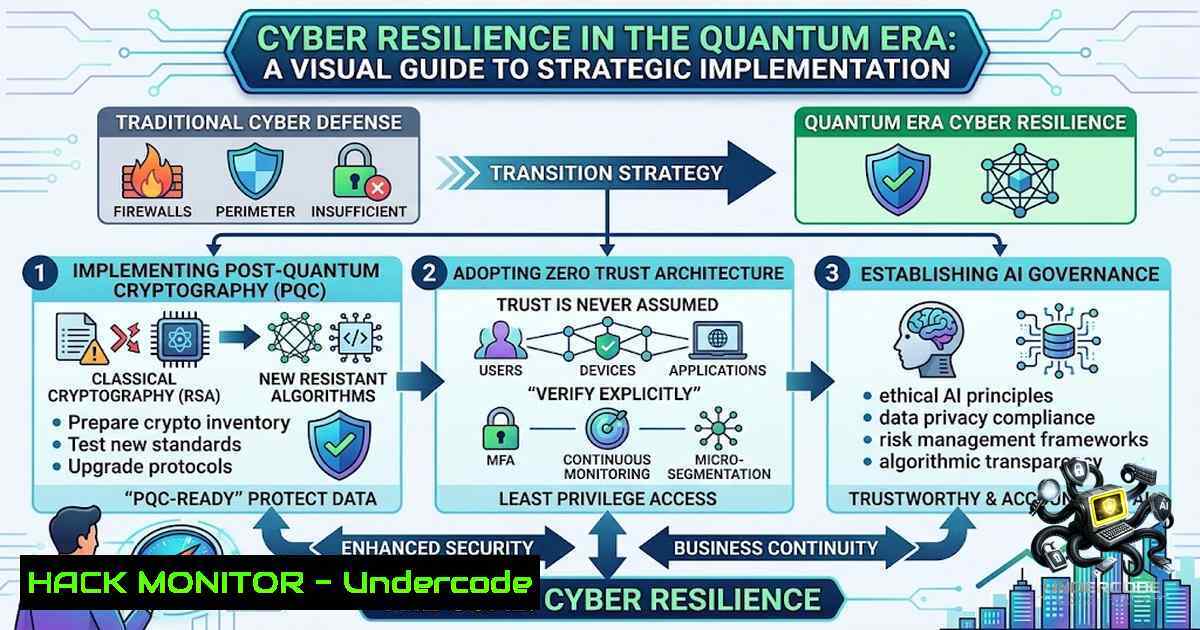
The cybersecurity paradigm has fundamentally shifted from a reactive defense posture to proactive cyber resilience. As highlighted at the Future Crime Summit 2026, organizations can no longer afford to focus solely on preventing attacks; they must anticipate, withstand, recover from, and continuously adapt to inevitable breaches. This transformation is driven by converging forces: the standardization of post-quantum cryptography (PQC) by NIST, the enforcement of India’s Digital Personal Data Protection (DPDP) Act, the rise of AI-powered threats requiring robust governance, and the urgent need for Zero Trust Architecture (ZTA) implementation. This article provides a comprehensive technical guide for security professionals to operationalize these critical frameworks, with hands-on commands, configuration examples, and step-by-step implementation strategies.
Learning Objectives:
- Master the operationalization of NIST PQC standards (FIPS 203, 204, 205) and execute cryptographic inventory and migration strategies.
- Implement Zero Trust Architecture (ZTA) following NIST SP 800-207, including policy engine configuration and continuous validation.
- Operationalize DPDP Act compliance through data flow mapping, consent architecture, and breach response mechanisms.
- Deploy AI governance frameworks (NIST AI RMF) to manage risks in AI-enabled systems.
- Execute digital forensics and incident response using Linux audit logs and MITRE ATT&CK threat-informed defense.
You Should Know:
- Post-Quantum Cryptography Migration: From Standards to Operational Reality
NIST finalized its first three post-quantum cryptography standards on August 13, 2024, concluding an eight-year selection process. These standards are no longer theoretical—they are procurement requirements, compliance deadlines, and contractual obligations. The three core algorithms are:
- FIPS 203 ML-KEM (Module-Lattice-Based Key-Encapsulation Mechanism, formerly CRYSTALS-Kyber): The key exchange workhorse protecting TLS handshakes and VPN tunnels.
- FIPS 204 ML-DSA (Module-Lattice-Based Digital Signature Algorithm, formerly CRYSTALS-Dilithium): The default replacement for RSA and ECDSA signatures.
- FIPS 205 SLH-DSA (Stateless Hash-Based Digital Signature Algorithm, formerly SPHINCS+): A conservative, hash-based signature scheme with no lattice assumptions—slower and larger but serves as a hedge against potential lattice weaknesses.
NIST IR 8547 establishes a two-stage sunset: quantum-vulnerable algorithms (RSA-2048, ECC P-256) are slated for deprecation around 2030 and disallowed in NIST-aligned systems by 2035. The NSA’s CNSA 2.0 framework is more aggressive, expecting quantum-safe algorithms in new national security systems beginning in 2027.
Step-by-Step PQC Migration Guide:
Step 1: Cryptographic Inventory
Before migration, you must know what cryptography you use. Deploy discovery tools to scan your infrastructure:
 Linux: Scan for TLS certificates and their algorithms
openssl s_client -connect example.com:443 -showcerts 2>/dev/null | openssl x509 -text | grep "Public-Key"

Use nmap to enumerate crypto across your network
nmap --script ssl-enum-ciphers -p 443 192.168.1.0/24

Check SSH host key algorithms
ssh -Q key  List supported key types
ssh -Q cipher  List supported ciphers
For Windows environments, use PowerShell to audit certificates:
Get-ChildItem -Path Cert:\LocalMachine\My | Format-Table Subject, NotAfter, SerialNumber
Get-TlsCipherSuite | Format-Table Name, Certificate, Exchange, Cipher
Step 2: Prioritize High-Risk Assets
Focus on long-lived data (financial records, intellectual property, personal data) vulnerable to “Harvest Now, Decrypt Later” attacks—where adversaries exfiltrate encrypted data today to decrypt with future quantum computers.
Step 3: Implement Hybrid Mode
Deploy PQC algorithms alongside classical cryptography during transition:
 OpenSSL 3.x with quantum-safe provider (example using liboqs)
openssl s_client -connect server:443 -groups kyber768
Step 4: Establish Crypto-Agility
Design systems to swap algorithms without infrastructure rebuilds. The NIST NCCoE Migration to PQC project emphasizes cryptographic visibility and risk management as the foundation. Maintain a centralized cryptographic inventory with metadata on algorithm type, key length, purpose, and sunset date.
- Zero Trust Architecture: Implementing “Never Trust, Always Verify”
NIST SP 800-207 defines Zero Trust Architecture as a paradigm that shifts defenses from static, network-based perimeters to a model focused on users, assets, and resources. The core principle: no implicit trust is granted to any user, device, or network segment based solely on location. Every access request is authenticated, authorized, and continuously validated.
Step-by-Step ZTA Implementation:
Step 1: Establish the Policy Engine (PE), Policy Administrator (PA), and Policy Enforcement Point (PEP)
The PE makes access decisions based on policy and threat intelligence. The PA executes the decision. The PEP enforces it.
Step 2: Implement Continuous Validation
Configure identity providers with real-time device health checks:
 Linux: Check system integrity and compliance status
sudo aide --check  File integrity monitoring
systemctl status auditd  Ensure auditing is active
grep -E "pam_unix|pam_sss" /etc/pam.d/common-auth  Verify MFA configuration
For Windows, use PowerShell to assess device compliance:
Get-WindowsCapability -Online | Where-Object { $_.Name -like "DeviceGuard" }
Get-ComputerInfo | Select-Object CsDomain, OsName, WindowsVersion, WindowsEdition
Step 3: Implement Micro-Segmentation
Use network policies to restrict lateral movement:
 Linux: iptables for micro-segmentation
iptables -A INPUT -p tcp --dport 22 -s 10.0.0.0/24 -j ACCEPT  Allow SSH only from management subnet
iptables -A INPUT -p tcp --dport 22 -j DROP

Using nftables for advanced segmentation
nft add rule ip filter input ip saddr 192.168.1.0/24 tcp dport 443 accept
nft add rule ip filter input tcp dport 443 drop
Step 4: Implement Least Privilege Access
Use role-based access control (RBAC) with just-in-time (JIT) privilege elevation:
 Linux: Configure sudo with granular controls
visudo
 Add: %devops ALL=(ALL) /usr/bin/systemctl restart nginx, /usr/bin/journalctl
For cloud environments, implement Zero Trust with service mesh (e.g., Istio) or overlay networks (e.g., NetBird) aligned with NIST SP 800-207. The CISA Zero Trust Maturity Model (ZTMM) Version 2.0 provides a roadmap across five pillars: Identity, Devices, Networks, Applications and Workloads, and Data.
3. AI Governance: Operationalizing the NIST AI RMF
The NIST AI Risk Management Framework (AI RMF) is the de facto US federal AI governance baseline, adopted by 57-67% of CISOs—higher than any competing framework. It is structured around four core functions:
- Govern: Establish culture, accountability, and governance structures for AI.
- Map: Understand context, identify risks, and document AI system scope.
- Measure: Analyze, assess, and evaluate AI risks using quantitative and qualitative methods.
- Manage: Respond to and monitor AI risks throughout the lifecycle.
Step-by-Step AI Governance Implementation:
Step 1: Map AI Systems and Data Flows
Document all AI systems, their training data sources, model types, and deployment contexts. Create a risk register for each AI use case.
Step 2: Implement AI-Specific Security Controls
 Monitor AI model endpoints for anomalies
sudo journalctl -u nginx -f | grep -E "POST /predict|GET /infer"
 Capture API request patterns for anomaly detection
tcpdump -i eth0 -1n -A 'tcp port 443 and (tcp[((tcp[12:1] & 0xf0) >> 2):4] = 0x504f5354)'
For Windows, monitor AI workloads:
Get-WinEvent -LogName "Microsoft-Windows-Sysmon/Operational" | Where-Object { $_.Message -match "python|tensorflow|pytorch" }
Step 3: Establish AI Red Teaming
Conduct adversarial testing to identify model vulnerabilities: prompt injection, data poisoning, and model extraction attacks.
Step 4: Align with EU AI Act and ISO 42001
Map NIST AI RMF subcategories to regulatory requirements. The Hitch Partners’ 2026 Global CISO Leadership Report recommends a crosswalk between NIST AI RMF’s 47 subcategories and major regulatory frameworks.
- Digital Forensics and Incident Response: Mastering Linux Audit Logs
When a security alert fires, standard logs (auth.log, syslog) tell only a partial story. They document successful logins but rarely capture the granular “how” of a post-compromise environment. Linux audit logs (managed by auditd) record system-level activity, including specific syscalls, file modifications, and command executions.
Step-by-Step Forensic Investigation:
Step 1: Identify the Entry Point
 Search for USER_LOGIN events
ausearch -m USER_LOGIN -ts today -i
 Identify the auid (Audit User ID) - this is your "golden thread"
 Even if the attacker runs sudo su -, the auid remains the same
Step 2: Follow the Attacker’s Trail
 Track all actions by a specific auid
ausearch -ua 1001 -i
 Sample output shows EXECVE events with full command lines
Step 3: Detect Sensitive File Changes
 Check for modifications to critical files
ausearch -f /etc/sudoers -i
ausearch -f /etc/passwd -i
ausearch -f /etc/shadow -i
ausearch -f ~/.ssh/authorized_keys -i
Step 4: Investigate Privilege Escalation
 Look for sudo execution
ausearch -m EXECVE -i | grep -E "sudo|pkexec"
 Look for setuid transitions
ausearch -m SETUID -i
 Check for cron modifications
ausearch -f /var/spool/cron -i
For Windows forensic artifacts, use tools like Chainsaw for rapid threat identification within Event Logs and MFT files.
- Cyber Resilience: Operationalizing NIST SP 800-160 Vol. 2
NIST SP 800-160 Vol. 2 defines cyber resiliency through four strategic goals:
– Anticipate: Understand threats before they materialize.
– Withstand: Maintain essential functions during attacks.
– Recover: Restore operations after compromise.
– Adapt: Continuously improve defenses based on lessons learned.
The MITRE ATT&CK framework provides the threat-informed defense foundation. The April 2026 (v19) ATT&CK release includes 12 Tactics, 79 Techniques, and 18 Sub-Techniques. Organizations should map their controls to ATT&CK techniques to identify coverage gaps.
Step-by-Step Cyber Resilience Implementation:
Step 1: Conduct Threat Modeling with ATT&CK
Map your environment to ATT&CK techniques relevant to your industry and threat actors.
Step 2: Implement Defense-in-Depth
 Linux: Harden SSH configuration
echo "Protocol 2" >> /etc/ssh/sshd_config
echo "PermitRootLogin no" >> /etc/ssh/sshd_config
echo "MaxAuthTries 3" >> /etc/ssh/sshd_config
systemctl restart sshd

Configure fail2ban for brute force protection
sudo systemctl enable fail2ban
sudo systemctl start fail2ban
For Windows:
 Disable insecure protocols
Set-ItemProperty -Path "HKLM:\SYSTEM\CurrentControlSet\Control\SecurityProviders\SCHANNEL\Protocols\TLS 1.0\Server" -1ame "Enabled" -Value 0
 Configure Windows Defender
Set-MpPreference -DisableRealtimeMonitoring $false
Set-MpPreference -SubmitSamplesConsent 2
Step 3: Establish Continuous Monitoring and Response
Implement SIEM with correlation rules mapped to ATT&CK techniques. Use the Pyramid of Pain concept: detect at higher levels (TTPs, tools) rather than low-level indicators (hashes, IPs).
- DPDP Act Compliance: Building Trust Through Data Protection
India’s Digital Personal Data Protection Act 2023 (DPDP Act) and Rules 2025, notified on November 13, 2025, establish the country’s first comprehensive privacy regime. Substantive provisions come into force 18 months after notification (May 13, 2027), with intermediate deadlines in 2026.
Core Compliance Obligations:
- Compliant Notice: Any consent request must include an itemized list of data collected, specific purposes, withdrawal mechanisms, and grievance procedures.
- Granular Consent: Consent must be free, specific, informed, unconditional, and unambiguous—separate toggles for each purpose.
- Data Mapping: Map every data flow across the organization.
- Data Principal Rights: Support access, correction, and erasure within 90 days.
- Breach Notification: Notify the Data Protection Board and affected individuals promptly.
Step-by-Step DPDP Implementation:
Step 1: Conduct Gap Assessment
Compare existing processes against DPDP requirements.
Step 2: Redesign Data and Log Systems
Implement record retention requirements:
 Linux: Implement log rotation with retention policies
cat > /etc/logrotate.d/dpdp-compliance << EOF
/var/log/.log {
daily
rotate 90
compress
delaycompress
notifempty
create 0640 root adm
sharedscripts
postrotate
systemctl reload rsyslog > /dev/null 2>&1 || true
endscript
}
EOF
Step 3: Implement Breach Response Mechanisms
Update incident response playbooks to include DPDP-specific notification requirements.
Step 4: Rebuild Consent Flows
Implement consent managers by November 13, 2026, as required by Phase 2 of the implementation timeline.
What Undercode Say:
- Cyber Resilience Is the New Cybersecurity: Organizations must shift from prevention-only to anticipate-withstand-recover-adapt models. The NIST SP 800-160 Vol. 2 framework provides the engineering approach to achieve this transformation.
- The Quantum Clock Is Ticking: With RSA-2048 and ECC P-256 slated for deprecation around 2030 and CNSA 2.0 requiring quantum-safe algorithms in new systems by 2027, organizations must start cryptographic inventory and migration now. The “Harvest Now, Decrypt Later” threat means your encrypted data may already be compromised.
Analysis:
The convergence of PQC standardization, DPDP enforcement, and AI governance represents a pivotal moment for cybersecurity professionals. The Future Crime Summit 2026 reinforced that technology, governance, privacy, compliance, and business strategy can no longer operate in silos. Building secure and trustworthy digital ecosystems requires collaboration across every function. The practical insights from the summit—ranging from cryptographic migration strategies to Zero Trust implementation—provide a roadmap for organizations to navigate this complex landscape. The key takeaway is that waiting is no longer an option; proactive resilience building must begin today. Organizations that delay PQC migration risk data exposure through harvest-1ow-decrypt-later attacks. Those that ignore DPDP compliance face penalties up to ₹250 crore ($30 million USD). And those that fail to implement AI governance expose themselves to regulatory, reputational, and operational risks.
Prediction:
- +1 Post-quantum cryptography will become a standard procurement requirement by 2027, driving a multi-billion dollar market for crypto-agility solutions and PQC migration services.
- +1 The DPDP Act will catalyze a privacy-tech ecosystem in India, with consent managers, data mapping tools, and breach response platforms becoming essential enterprise investments.
- -1 Organizations that delay PQC migration will face significant data exposure risks as quantum computers advance, with “Harvest Now, Decrypt Later” attacks becoming a primary threat vector by 2028.
- -1 The AI governance landscape will become increasingly fragmented as jurisdictions (EU, US, China, India) adopt divergent frameworks, creating compliance complexity for global enterprises.
- +1 Zero Trust Architecture will become the de facto security model for cloud-1ative organizations, with NIST SP 800-207 serving as the foundational reference architecture.
- -1 Cyber resilience gaps will persist in organizations that treat compliance as a checkbox exercise rather than embedding resilience into system engineering lifecycles.
▶️ Related Video (72% Match):
🎯Let’s Practice For Free:
🎓 Live Courses & Certifications:
Join Undercode Academy for Verified Certifications
🚀 Request a Custom Project:
Secure, high-velocity infrastructure and disruptive technological engineering. Contact our engineering team for high-tier development and proprietary systems:
[email protected]
💎 Smart Architecture | 🛡️ Secure by Design | ⭐ Trusted by Thousands
IT/Security Reporter URL:
Reported By: Sushantrathor003 Cybersecurity – Hackers Feeds
Extra Hub: Undercode MoN
Basic Verification: Pass ✅


