Listen to this Post
Introduction
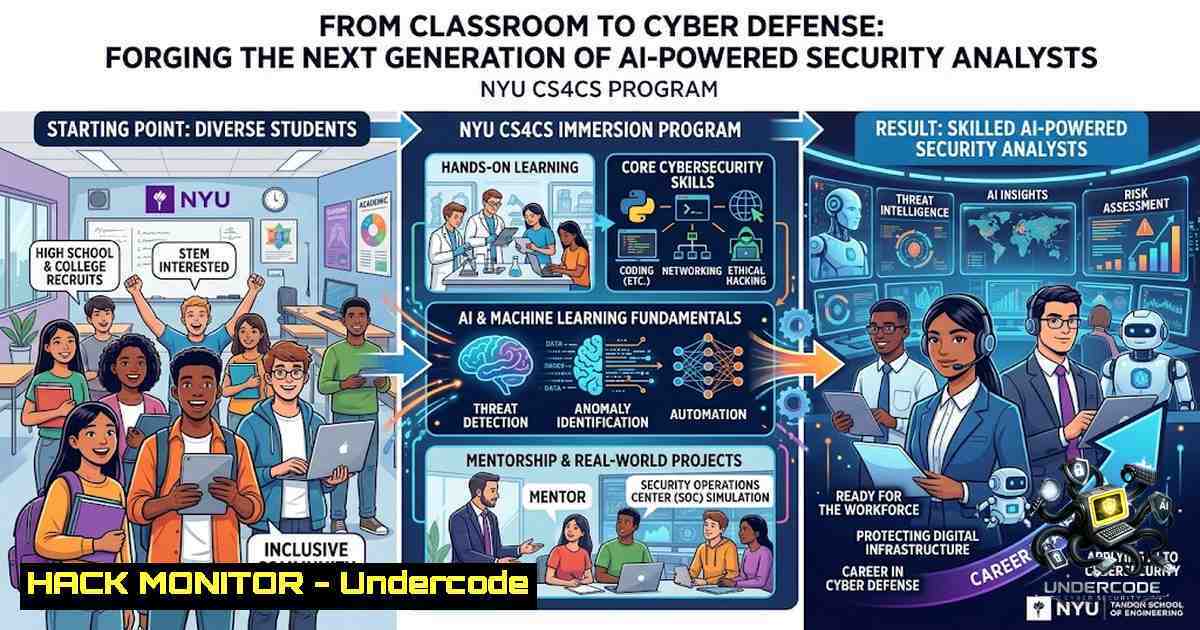
The cybersecurity landscape is undergoing a seismic shift as artificial intelligence (AI) transitions from a futuristic concept to a frontline defense mechanism—and simultaneously, a weapon in the hands of adversaries. The NYU Tandon School of Engineering’s Computer Science for Cyber Security (CS4CS) program exemplifies how immersive, hands-on education is critical to preparing the next generation of security professionals. By blending foundational topics like cryptography, digital forensics, and ethical hacking with cutting-edge AI-driven threat detection, the program equips students with the practical skills needed to combat modern cyber threats. This article distills the core technical curriculum from such intensive programs into a practical guide, providing actionable commands, configuration steps, and AI methodologies for security practitioners and enthusiasts alike.
Learning Objectives
- Objective 1: Understand the foundational pillars of cybersecurity, including network security, cryptography, and digital forensics, and their application in real-world scenarios.
- Objective 2: Master the application of AI and machine learning models—such as XGBoost, LSTM, and BERT—for detecting and mitigating sophisticated threats like phishing and AI-generated attacks.
- Objective 3: Develop hands-on proficiency with industry-standard tools (Wireshark, YARA, SpamAssassin) and command-line utilities to automate threat detection and incident response.
You Should Know
- Laying the Groundwork: Building a Security Lab Environment
Before diving into AI-driven analysis, establishing a controlled and isolated laboratory environment is paramount for safe testing and analysis. This setup prevents accidental compromise of production systems and allows for the free exploration of malware and phishing samples.
Step-by-Step Guide:
- Virtualization Setup: Begin by installing a hypervisor such as VMware Workstation or Oracle VirtualBox. Create a virtual machine (VM) with Ubuntu 22.04 LTS, allocating at least 4GB of RAM and 20GB of storage. This VM will serve as your primary analysis workstation.
- System Update and Tool Installation: Open a terminal in your Ubuntu VM and execute the following commands to update the system and install essential security tools:
sudo apt update && sudo apt upgrade -y
sudo apt install python3 python3-pip wireshark spamassassin yara -y
– `python3` and
python3-pip: The foundation for writing and running analysis scripts.
– wireshark: A network protocol analyzer used to capture and inspect SMTP/IMAP traffic for malicious email patterns.
– spamassassin: A powerful, open-source spam filter that uses a wide range of heuristic and statistical tests to identify spam and phishing emails.
– yara: A tool used to identify and classify malware samples by creating rules that match textual or binary patterns.
3. Network Configuration: Configure your VM’s network adapter in “NAT” or “Host-Only” mode to ensure it remains isolated from your primary network while retaining internet access for tool downloads and updates.
2. Implementing AI-Powered Phishing Detection with Open-Source Tools
Phishing remains one of the most prevalent and effective attack vectors. Modern AI techniques, particularly Natural Language Processing (NLP) and machine learning, offer robust methods to detect these threats by analyzing email headers, content, and embedded URLs. The following guide demonstrates how to set up a basic AI-powered phishing detection pipeline using free, open-source tools.
Step-by-Step Guide:
- Data Collection: Acquire a dataset of legitimate and phishing emails. Public sources such as PhishTank and the SpamAssassin public corpus provide excellent, labeled datasets for training and testing. Create a directory to store these samples:
mkdir ~/phishing_emails && cd ~/phishing_emails
- Header Analysis (Rule-Based Heuristics): Before applying complex AI models, perform initial rule-based analysis to extract key indicators. Use `grep` to pull critical header fields:
cat email_sample.eml | grep -E "From:|Subject:|Received:|Return-Path:"
Look for discrepancies, such as a “From” address that doesn’t match the “Return-Path” or unusual “Received” chains, which often indicate spoofing.
- Content Analysis with YARA Rules: Create YARA rules to detect patterns commonly found in AI-generated text, such as unnaturally perfect grammar or repetitive phrasing. Save the following rule as
ai_phishing.yar:rule AI_Generated_Phishing { meta: description = "Detects potential AI-generated phishing text" strings: $a = /urgent.action.required/i $b = /click.here.verify/i $c = /account.suspended/i condition: any of them }
Scan an email file with this rule:
yara ai_phishing.yar email_sample.eml
4. Advanced Machine Learning (XGBoost): For more sophisticated detection, implement a machine learning model. The `XGBoost` algorithm has proven highly effective for network anomaly and email phishing detection, often outperforming other models like Random Forest in balanced accuracy. A basic Python script would involve:
– Extracting features from emails (e.g., frequency of suspicious words, number of URLs, presence of attachments).
– Training an XGBoost classifier on a labeled dataset.
– Using the trained model to classify new, unseen emails.
- Mastering Capture The Flag (CTF) Skills for Practical Security
Capture The Flag (CTF) competitions are an invaluable method for applying theoretical knowledge to practical, often gamified, security challenges. They cover domains ranging from cryptography and web exploitation to reverse engineering and forensics.
Step-by-Step Guide:
- Essential Linux Commands: CTF challenges frequently require navigating and manipulating the Linux filesystem. Master these fundamental commands:
– ls -la: List all files, including hidden ones, with detailed information.
– find / -1ame "flag.txt" 2>/dev/null: Search the entire filesystem for a file named “flag.txt”, suppressing permission errors.
– grep -r "picoCTF{" /: Recursively search for the beginning of a typical picoCTF flag format within all files.
2. Network Reconnaissance and Enumeration: Understanding network configurations and services is crucial. Use the following commands for initial reconnaissance:
– `ifconfig` or ip a: Display network interface configurations.
– ping <target_ip>: Test connectivity to a target host.
– nmap -sS <target_ip>: Perform a stealth SYN scan to discover open ports on a target machine.
3. Automated Flag Extraction: During competitions, time is of the essence. Tools like `ctfcli` and custom scripts can automate flag extraction and submission. For example, the `ctf` command-line utility can extract flags from files or text using predefined or custom regular expressions:
 Extract a flag from a challenge file
./ctf.sh find --file challenge.txt
 Extract a flag using a custom regex pattern
./ctf.sh find --regex "CUSTOM{[A-Za-z0-9_-]+}" "CUSTOM{example_flag}"
This automation allows security analysts to focus on complex problem-solving rather than manual data parsing.
- Vulnerability Exploitation and Mitigation: The SQL Injection Lab
Understanding how vulnerabilities are exploited is essential for building effective defenses. A common and critical vulnerability is SQL Injection (SQLi), which allows attackers to manipulate database queries through unsanitized user input.
Step-by-Step Guide:
- Setting Up the Lab: Create a simple web application (e.g., using PHP and MySQL) with a login form that is vulnerable to SQL injection. The backend code should directly concatenate user input into the SQL query without sanitization.
- Exploitation: As an attacker, you can bypass authentication by entering a malicious SQL payload into the username or password field. A classic example is:
' OR '1'='1
If the application constructs a query like
SELECT FROM users WHERE username = '$username' AND password = '$password', this payload will cause the query to always return true, granting unauthorized access. - Mitigation (Parameterized Queries): The primary defense against SQL injection is the use of parameterized queries (prepared statements) . This technique separates the SQL logic from the data, ensuring that user input is treated as data, not as executable code. In Python with SQLite, for example:
cursor.execute("SELECT FROM users WHERE username = ? AND password = ?", (username, password))
This practice is non-1egotiable in secure application development.
- Cloud Hardening and API Security in the AI Era
As organizations rapidly adopt AI, the underlying cloud infrastructure and APIs become prime targets. Attackers are increasingly targeting AI infrastructure and using AI to accelerate vulnerability identification.
Step-by-Step Guide:
- API Security Assessment: Use tools like `Postman` or `Burp Suite` to intercept and analyze API traffic. Look for common issues such as:
– Broken Object Level Authorization (BOLA): Test if you can access resources belonging to other users by changing ID parameters in API requests.
– Excessive Data Exposure: Verify that API responses do not return more data than necessary (e.g., returning full user profiles when only a username is needed).
2. Cloud Configuration Auditing: Utilize cloud provider tools (e.g., AWS Inspector, Azure Security Center) to audit your cloud environment for misconfigurations. Key areas to review include:
– Publicly Accessible Storage Buckets: Ensure S3 buckets or Azure Blob containers are not inadvertently exposed to the public.
– Overly Permissive IAM Roles: Apply the principle of least privilege—grant only the permissions necessary for a task.
3. AI-Specific Threat Modeling: Consider threats unique to AI applications, such as prompt injection attacks where malicious inputs are crafted to manipulate an AI model’s output. Implement input validation and sanitization at the API gateway to filter out potentially malicious payloads before they reach the AI model.
What Undercode Say
- Key Takeaway 1: The democratization of cybersecurity education through programs like CS4CS is critical. By providing free, high-quality, hands-on training to a diverse group of students, we are building a more robust and inclusive cyber workforce capable of tackling future challenges.
- Key Takeaway 2: The integration of AI into cybersecurity is a double-edged sword. While AI dramatically enhances our ability to detect threats—with 49% of organizations now using it for threat detection—it also equips attackers with powerful tools, as evidenced by the 2.5 times increase in AI agent-driven attack activity. Defenders must adopt a proactive, AI-augmented posture to stay ahead.
The CS4CS experience underscores a vital truth: cybersecurity is not a spectator sport. It demands continuous learning, hands-on practice, and a forward-thinking mindset. The skills developed—from crafting YARA rules to exploiting SQL vulnerabilities—are the building blocks of a resilient digital future.
Prediction
- +1: The increasing accessibility of AI-powered security tools will lead to a “democratization of defense,” enabling smaller organizations and even individual developers to deploy enterprise-grade threat detection capabilities, significantly narrowing the security gap between large and small enterprises.
- -1: The velocity of AI-driven attacks will outpace traditional, human-led defense mechanisms. With 88% of exploits now being weaponized within 48 hours of a public proof-of-concept release, the window for patching and response will shrink to near zero, forcing a fundamental shift towards automated, AI-driven incident response.
- +1: The surge in AI-related threats will catalyze the development of new security paradigms, such as “Adversarial Machine Learning” and “AI Supply Chain Security,” creating entirely new specializations and career opportunities within the cybersecurity field.
▶️ Related Video (72% Match):
🎯Let’s Practice For Free:
🎓 Live Courses & Certifications:
Join Undercode Academy for Verified Certifications
🚀 Request a Custom Project:
Secure, high-velocity infrastructure and disruptive technological engineering. Contact our engineering team for high-tier development and proprietary systems:
[email protected]
💎 Smart Architecture | 🛡️ Secure by Design | ⭐ Trusted by Thousands
IT/Security Reporter URL:
Reported By: Tan Jayden – Hackers Feeds
Extra Hub: Undercode MoN
Basic Verification: Pass ✅


