Listen to this Post
Introduction:
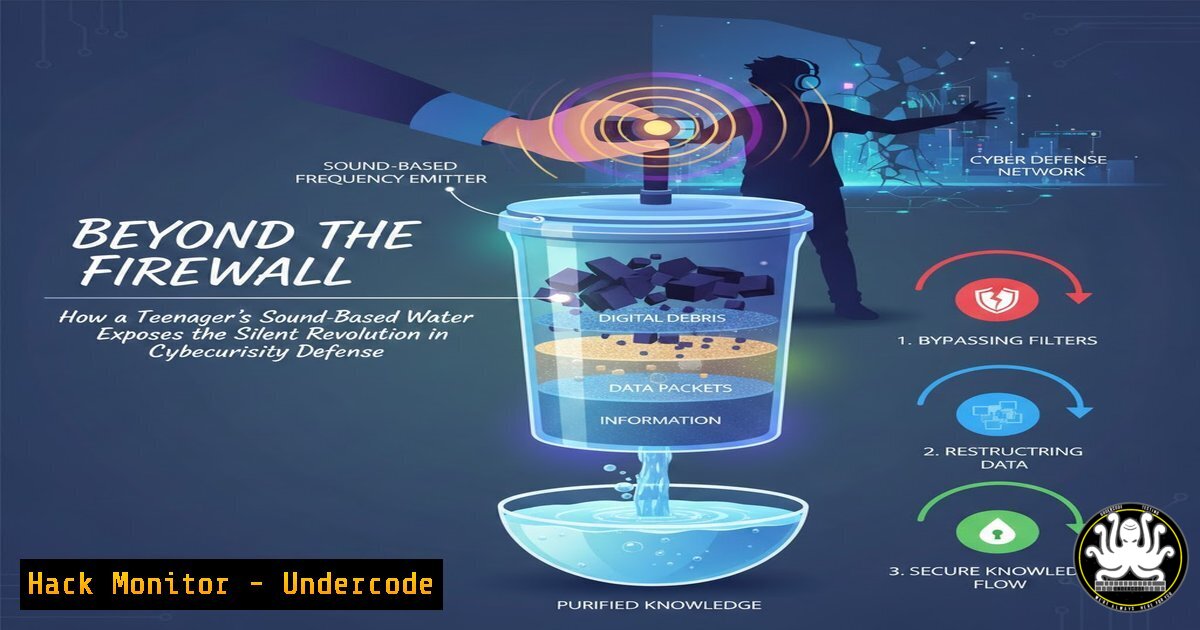
The groundbreaking acoustic microplastic filter developed by teenagers Victoria Ou and Justin Huang represents more than an environmental innovation; it embodies a paradigm shift directly applicable to modern cybersecurity. By replacing physical filtration with targeted sound waves, their approach mirrors the industry’s transition from static, perimeter-based defenses to dynamic, intelligent containment systems that isolate threats using unconventional means. This principle of using precision energy (acoustic or digital) to neutralize diffuse threats is reshaping how we combat increasingly microscopic and pervasive cyber risks like zero-day exploits and fileless malware.
Learning Objectives:
- Understand the core physics of acoustic filtration and its conceptual parallel to behavioral AI threat detection.
- Learn how to implement “signal isolation” techniques in network monitoring using open-source tools.
- Explore command-line and scripting methods for simulating and defending against “low-and-slow” attacks that evade traditional filters.
- Configure logging and analysis systems to detect anomalous “digital particles” (malicious packets, suspicious processes).
- Develop a proactive security mindset focused on fundamental principles over legacy infrastructure.
You Should Know:
- The Physics of Acoustic Filtration & The Principle of Signal Isolation
The teenagers’ device uses high-frequency ultrasound to create a pressure node, forcing microplastics into a concentrated stream. In cybersecurity, this translates to using algorithmic “waves” (AI models) to herd and identify anomalous network traffic or processes away from critical data flows.
Step-by-step guide:
Concept: Instead of only blocking at a firewall (membrane), deploy an internal monitoring system that analyzes process behavior.
Linux Implementation (using `auditd` for behavioral herding):
 1. Install and configure auditd to 'listen' to process execution
sudo apt install auditd
sudo systemctl enable auditd && sudo systemctl start auditd

<ol>
<li>Create a rule to watch a sensitive directory, logging all executions
sudo auditctl -w /opt/critical_app/bin/ -p x -k critical_process_exec</p></li>
<li><p>Generate a report, herding all execution events for analysis
sudo ausearch -k critical_process_exec | sudo aureport -f -i
What it does: This sets up a continuous audit “field” that captures all process executions in a specified directory. The logs are then concentrated into a report (aureport), analogous to particles being gathered for analysis, allowing you to spot unauthorized or suspicious activity.
- From Single Pass Efficiency to Real-Time Packet Inspection
Achieving 84-94% removal in one pass underscores the power of efficient, inline processing. In network security, this equates to real-time packet inspection without debilitating latency.
Step-by-step guide:
Concept: Use `nftables` (successor to iptables) for efficient, stateful packet filtering and inspection.
 1. Create a table and chain for inbound traffic
sudo nft add table inet filter
sudo nft add chain inet filter input { type filter hook input priority 0; policy drop; }

<ol>
<li>Add rules to accept established connections and SSH, but log and drop suspicious fragmented packets
sudo nft add rule inet filter input ct state established,related accept
sudo nft add rule inet filter input tcp dport 22 accept
sudo nft add rule inet filter input ip frag-off & 0x3fff != 0 log prefix "Suspicious-Fragment: " drop
What it does: This configuration provides a high-performance filtering base. The final rule acts as an “acoustic node,” identifying and isolating malformed (potentially evasive) packet fragments in real-time, logging them for review before dropping.
- Low-Power, Affordable Design Principles for Scalable Sensor Networks
The pen-sized, low-power prototype highlights the need for scalable, distributed sensing. In cybersecurity, this translates to lightweight agents and pervasive logging.
Step-by-step guide:
Concept: Deploy a lightweight file integrity monitor using `inotify-tools` on critical systems.
 1. Install inotify-tools
sudo apt install inotify-tools

<ol>
<li>Create a simple monitoring script for /etc/passwd and /etc/shadow
cat > /usr/local/bin/monitor_auth_files.sh << 'EOF'
!/bin/bash
inotifywait -m /etc/passwd /etc/shadow -e modify,access,create,delete 2>/dev/null | \
while read path action file; do
echo "$(date) - Security Alert: $file was $action" >> /var/log/file_integrity.log
Optional: Trigger an alert via systemd or email
done
EOF
sudo chmod +x /usr/local/bin/monitor_auth_files.sh
sudo systemctl edit --force --full file_monitor.service
Add to service file:
[bash]
Description=Lightweight File Integrity Monitor
[bash]
ExecStart=/usr/local/bin/monitor_auth_files.sh
Restart=always
[bash]
WantedBy=multi-user.target
sudo systemctl enable --now file_monitor.service
What it does: This creates a low-overhead, persistent sensor that watches for critical changes, acting as a distributed detection node across your infrastructure.
- Concentration for Analysis: Aggregating Logs with the ELK Stack
Once microplastics are concentrated, they can be analyzed. Similarly, security logs must be aggregated to reveal patterns.
Step-by-step guide:
Concept: Use `filebeat` to ship logs to a central ELK (Elasticsearch, Logstash, Kibana) stack for analysis.
 On a Linux client (Ubuntu/Debian example):
 1. Install and configure Filebeat to send syslog and auth logs
wget -qO - https://artifacts.elastic.co/GPG-KEY-elasticsearch | sudo apt-key add -
echo "deb https://artifacts.elastic.co/packages/7.x/apt stable main" | sudo tee /etc/apt/sources.list.d/elastic-7.x.list
sudo apt update && sudo apt install filebeat
sudo filebeat modules enable system
sudo filebeat setup --index-management -E output.logstash.enabled=false -E 'output.elasticsearch.hosts=["<your-elastic-ip>:9200"]'
sudo systemctl enable filebeat && sudo systemctl start filebeat
What it does: This collects system and authentication logs, concentrating them in Elasticsearch. In Kibana, you can then create visualizations to spot attack trends, much like analyzing the concentrated microplastic sample.
- Bypassing Traditional Infrastructure: API Security as a New Perimeter
The acoustic filter bypasses expensive membranes. Modern security must similarly evolve to protect API endpoints, which bypass traditional network perimeters.
Step-by-step guide:
Concept: Use a tool like `OWASP ZAP` (Zed Attack Proxy) to perform automated security testing on your APIs.
 Using ZAP's Docker image for baseline API scanning
docker run -v $(pwd):/zap/wrk/:rw -t owasp/zap2docker-stable zap-api-scan.py \
-t http://your-test-api.com/openapi.json \
-f openapi \
-r zap_report.html \
-d
What it does: This command launches an automated scan against an API defined by an OpenAPI specification. It tests for common vulnerabilities (injection, broken auth) that slip past traditional web firewalls, focusing defense on the application layer.
What Undercode Say:
- Fundamental Physics Trump Legacy Engineering: The most elegant security solutions often come from applying first principles (like acoustic standing waves) rather than layering on legacy controls. Question the fundamental assumptions of your security architecture.
- Curiosity is the Ultimate Detection Tool: The project began with a simple, overlooked question. Foster a culture where teams are encouraged to ask, “What if our threat model is wrong?” or “What are we not filtering for?” This mindset uncovers blind spots.
Prediction:
The “acoustic filtration” approach foreshadows the next era of cybersecurity: Precision Active Defense. We will move beyond blunt traffic blocking to systems that use targeted AI-driven countermeasures—like deceptive network noise, micro-segmentation through behavioral profiling, or even electromagnetic interference in physical hardware attacks—to actively isolate and neutralize threats in real time. Just as sound can clean water, engineered digital “energy fields” will become standard for purifying data flows, rendering many current signature-based and perimeter-centric models obsolete. The battleground will shift from the perimeter to the continuous, intelligent modulation of the internal environment itself.
▶️ Related Video (76% Match):
🎯Let’s Practice For Free:
IT/Security Reporter URL:
Reported By: Drmarthaboeckenfeld Two – Hackers Feeds
Extra Hub: Undercode MoN
Basic Verification: Pass ✅


