Listen to this Post
Introduction:
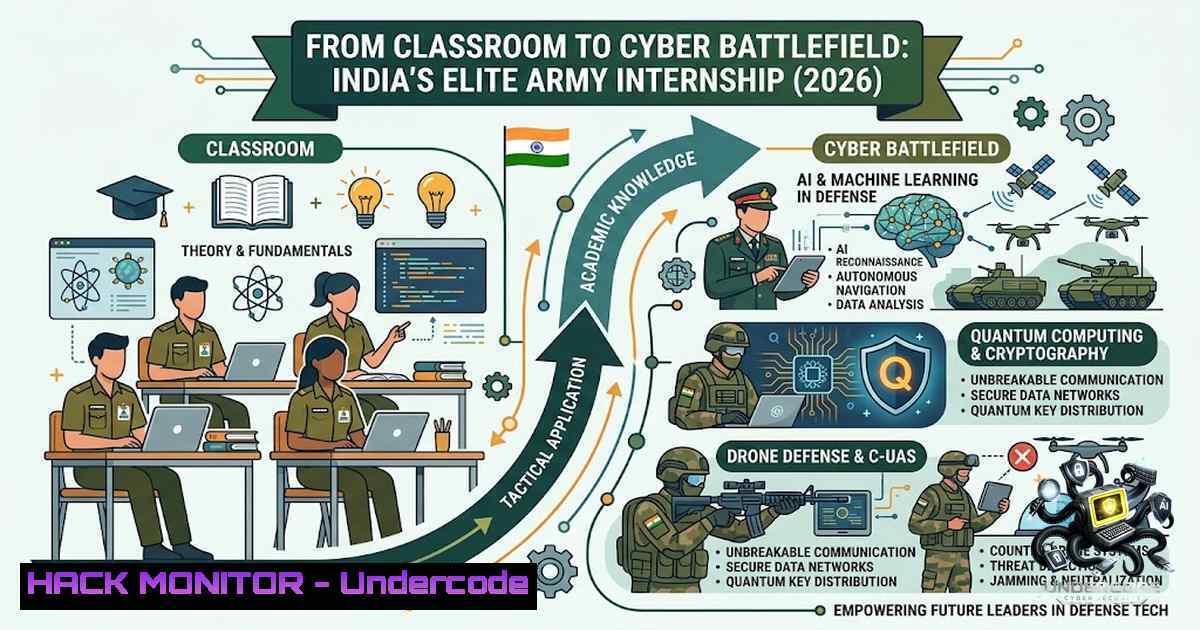
The Indian Army Internship Programme (IAIP) 2026, hosted on the AICTE National Internship Portal, represents a pivotal convergence of national defense and cutting-edge technology, offering a stipend of up to ₹75,000 for a 75-day intensive immersion. This initiative is not merely a career opportunity; it is a strategic pipeline for developing a skilled workforce in critical domains such as AI-driven surveillance, quantum-resistant cryptography, and autonomous drone defense systems. By bridging academic knowledge with the operational challenges of the defense ecosystem, IAIP serves as a real-world testbed where future engineers can apply advanced technical skills to safeguard national security.
Learning Objectives:
- Objective 1: Implement an AI-powered RAG (Retrieval-Augmented Generation) pipeline for real-time intelligence analysis, simulating defense data processing.
- Objective 2: Configure and harden a Linux-based security operations center (SOC) environment against cyber threats, incorporating quantum-safe cryptographic protocols.
- Objective 3: Develop a basic drone telemetry analysis tool using Python and FastAPI to detect anomalies in UAV communication channels.
You Should Know:
- Building AI-Powered Intelligence Systems (RAG Pipelines & LLMs)
The internship’s emphasis on Artificial Intelligence and Machine Learning aligns with the military’s growing reliance on data-driven decision-making. A core component of this is the Retrieval-Augmented Generation (RAG) pipeline, which enhances LLM outputs by grounding them in specific, verified datasets, such as technical manuals or threat intelligence feeds. This mitigates the risk of hallucinations and ensures that the AI provides contextually accurate strategic recommendations.
Step-by-step guide to building a basic RAG pipeline for document analysis:
First, ensure you have Python installed. This process involves loading documents, splitting them into chunks, generating embeddings, storing them in a vector database, and querying them with an LLM. Below is a command sequence for setting up the environment and a Python script example.
Linux Commands:
 Create a virtual environment
python3 -m venv rag_env
source rag_env/bin/activate
 Install required libraries
pip install langchain chromadb huggingface-hub sentence-transformers
Python Script (rag_defense.py):
from langchain.document_loaders import TextLoader
from langchain.text_splitter import CharacterTextSplitter
from langchain.embeddings import HuggingFaceEmbeddings
from langchain.vectorstores import Chroma
from langchain.llms import HuggingFacePipeline
from langchain.chains import RetrievalQA

Load and split a defense document (e.g., a military communication protocol)
loader = TextLoader("defense_protocols.txt")
documents = loader.load()
text_splitter = CharacterTextSplitter(chunk_size=500, chunk_overlap=50)
texts = text_splitter.split_documents(documents)

Create embeddings and vector store
embeddings = HuggingFaceEmbeddings(model_name="sentence-transformers/all-MiniLM-L6-v2")
vector_store = Chroma.from_documents(texts, embeddings)

Setup a local LLM (using a smaller model for demonstration)
llm = HuggingFacePipeline.from_model_id(model_id="google/flan-t5-base", task="text-generation")
qa_chain = RetrievalQA.from_chain_type(llm, chain_type="stuff", retriever=vector_store.as_retriever())

Query the system
print(qa_chain.run("What are the communication protocols for aerial surveillance?"))
2. Cybersecurity and Quantum Cryptography Hardening
Cyber threats in the defense sector are evolving with the advent of quantum computing, which threatens traditional RSA and ECC encryption. IAIP’s inclusion of Quantum Computing & Cryptography highlights the need for post-quantum cryptographic algorithms (PQC). Hardening systems against cyber attacks is not just about patching; it’s about implementing a zero-trust architecture and preparing for quantum-resistant algorithms.
Step-by-step guide to implement a quantum-resistant SSH configuration and Linux firewall hardening:
Start by updating your system and installing necessary tools. Then, configure OpenSSH to use a hybrid key exchange that includes a post-quantum algorithm like NTRU or Kyber (available in OpenSSH 9.0+). Finally, tighten iptables rules to restrict access.
Windows (WSL) / Linux Commands:
 Update system and install OpenSSH server
sudo apt update && sudo apt install openssh-server -y
 Check OpenSSH version (should be >= 9.0)
ssh -V
 Edit SSH configuration to enable hybrid post-quantum key exchange
sudo nano /etc/ssh/sshd_config
Add the following lines to the `sshd_config` file:
KexAlgorithms [email protected],[email protected]
HostKeyAlgorithms ssh-ed25519,ssh-rsa
Ciphers [email protected],aes256-ctr
MACs [email protected],[email protected]
Then, restart the service and configure the firewall to allow SSH only from specific IPs:
sudo systemctl restart ssh
 Configure iptables for defense (allow SSH from a trusted subnet)
sudo iptables -A INPUT -p tcp --dport 22 -s 192.168.1.0/24 -j ACCEPT
sudo iptables -A INPUT -p tcp --dport 22 -j DROP
 Save rules to persist after reboot
sudo apt install iptables-persistent -y
sudo netfilter-persistent save
3. Drone & UAV Security and Telemetry Analysis
The Drone & Unmanned Aerial Vehicles domain requires securing telemetry and control links. Vulnerabilities such as GPS spoofing and deauthentication attacks are critical. Setting up a Python-based FastAPI service to ingest and analyze telemetry data can help in anomaly detection.
Step-by-step guide to set up a FastAPI service for monitoring drone telemetry:
This involves creating a REST API to receive GPS, altitude, and battery data, and then performing basic anomaly detection using statistical methods. Run this on a Linux server that acts as a ground control station.
Linux Commands for setup:
mkdir drone_api && cd drone_api
python3 -m venv drone_env
source drone_env/bin/activate
pip install fastapi uvicorn pandas scipy
Python Script (telemetry_anomaly.py):
from fastapi import FastAPI, HTTPException
from pydantic import BaseModel
import pandas as pd
import numpy as np
from scipy import stats

app = FastAPI()

In-memory data store
telemetry_data = []

class TelemetryModel(BaseModel):
drone_id: str
lat: float
lon: float
altitude: float
battery: int

@app.post("/telemetry/")
async def ingest_telemetry(data: TelemetryModel):
global telemetry_data
telemetry_data.append(data.dict())
 Anomaly detection: check if altitude is an outlier based on Z-score
if len(telemetry_data) > 10:
altitudes = [d['altitude'] for d in telemetry_data[-10:]]
z_scores = np.abs(stats.zscore(altitudes))
if z_scores[-1] > 2:  Threshold for anomaly
print(f"Anomaly detected: Drone {data.drone_id} altitude {data.altitude}")
return {"status": "logged"}

@app.get("/telemetry/")
async def get_telemetry():
return {"data": telemetry_data}
To run the server: uvicorn telemetry_anomaly:app --host 0.0.0.0 --port 8000.
4. Infrastructure Hardening and API Security
Given the deployment of defense applications, securing the underlying infrastructure and APIs is paramount. This includes using Docker for containerization, implementing robust authentication (e.g., OAuth2 with JWT), and applying CIS benchmarks for cloud hardening.
Step-by-step guide to secure a FastAPI application using OAuth2 and Docker:
Implementing an authorization layer ensures that only authenticated clients can access the telemetry endpoints. Additionally, running the application within a Docker container isolates it and provides an immutable deployment environment.
Dockerfile (Dockerfile):
FROM python:3.10-slim
WORKDIR /app
COPY requirements.txt .
RUN pip install --1o-cache-dir -r requirements.txt
COPY . .
CMD ["uvicorn", "telemetry_anomaly:app", "--host", "0.0.0.0", "--port", "8000"]
requirements.txt:
fastapi==0.95.0
uvicorn==0.21.1
pandas==1.5.3
scipy==1.10.1
python-jose[bash]==3.3.0
passlib[bash]==1.7.4
Building and running the container:
 Build the Docker image
docker build -t drone-telemetry-api .
 Run the container with port mapping and restart policy
docker run -d -p 8000:8000 --restart unless-stopped --1ame telemetry_api drone-telemetry-api
For API security, you can implement dependency injection in FastAPI to validate JWT tokens. This ensures that only clients with valid tokens can post telemetry data.
5. 5G/6G Communication Security Analysis
With the rollout of 5G and emerging 6G networks, the attack surface for defense communications expands. Security professionals must analyze the vulnerabilities in the radio access network (RAN) and the core network. Linux tools like Wireshark for protocol analysis and Python libraries for PCAP parsing are essential.
Step-by-step guide to capture and analyze 5G signaling traffic (simulated using Diameter or SCTP packets):
Use `tcpdump` to capture traffic on the network interface. Then, use Scapy or a similar library to parse the PCAP file for anomalies such as malformed packets or duplicate authentication requests.
Linux Commands:
 Install tcpdump and wireshark
sudo apt install tcpdump wireshark -y
 Capture packets on interface eth0 for 5G protocol analysis (filter for SCTP port 3868 for Diameter)
sudo tcpdump -i eth0 -s 0 -w 5g_traffic.pcap port 3868
 Analyze the capture file for authentication bursts
tshark -r 5g_traffic.pcap -Y "diameter.cmd == 272 && diameter.auth_request_type == 1" | wc -l
This command counts the number of authentication requests, which could indicate a potential brute-force attack on the network.
What Undercode Say:
- Key Takeaway 1: IAIP 2026 is a strategic initiative to bridge the talent gap in defence tech, requiring hands-on proficiency in AI model deployment, cybersecurity hardening, and autonomous systems programming. The integration of post-quantum cryptography, as demonstrated by the SSH configuration, is not optional but essential for future-proofing military communications.
- Key Takeaway 2: The internship’s value extends beyond the stipend; the 15 academic credits and professional exposure provide a tangible career launchpad. However, candidates must proactively develop skills in containerization (Docker), API security (JWT), and network analysis (Wireshark) to meet the rigorous demands of the projects.
Analysis: The programme places equal emphasis on offensive and defensive capabilities. While the AI and drone domains focus on innovation and data manipulation, the cybersecurity and quantum tracks are inherently defensive, aiming to protect India’s digital sovereignty. Prospective applicants should note the competitive nature; acceptance rates will likely be low, requiring a robust technical portfolio. The 75-day duration is intensive, and successful candidates will emerge with a deep understanding of the full software development lifecycle in a high-stakes environment. The emphasis on `police verification` and specific eligibility conditions implies that the projects might involve sensitive data, requiring a high degree of professionalism and integrity.
Prediction:
- +1 India’s investment in youth through the IAIP will yield a generation of engineers proficient in dual-use technologies, accelerating indigenous development of systems like the 5G stack and quantum-safe encryption, reducing reliance on foreign vendors by 2030.
- -1 The concentration of such high-value internships in Delhi and listed AICTE portals may create a “brain drain” from tier-2 and tier-3 cities to the capital, exacerbating regional technological disparities unless virtual or decentralized projects are mandated.
- +1 The integration of 15 academic credits ensures that university curricula will adapt to include more defence-grade AI and cybersecurity modules, creating a sustainable academic-military-industrial complex that strengthens national security and technological leadership.
▶️ Related Video (74% Match):
🎯Let’s Practice For Free:
🎓 Live Courses & Certifications:
Join Undercode Academy for Verified Certifications
🚀 Request a Custom Project:
Secure, high-velocity infrastructure and disruptive technological engineering. Contact our engineering team for high-tier development and proprietary systems:
[email protected]
💎 Smart Architecture | 🛡️ Secure by Design | ⭐ Trusted by Thousands
IT/Security Reporter URL:
Reported By: https://lnkd.in/p/eefr9CeM – Hackers Feeds
Extra Hub: Undercode MoN
Basic Verification: Pass ✅


