Listen to this Post
Introduction:
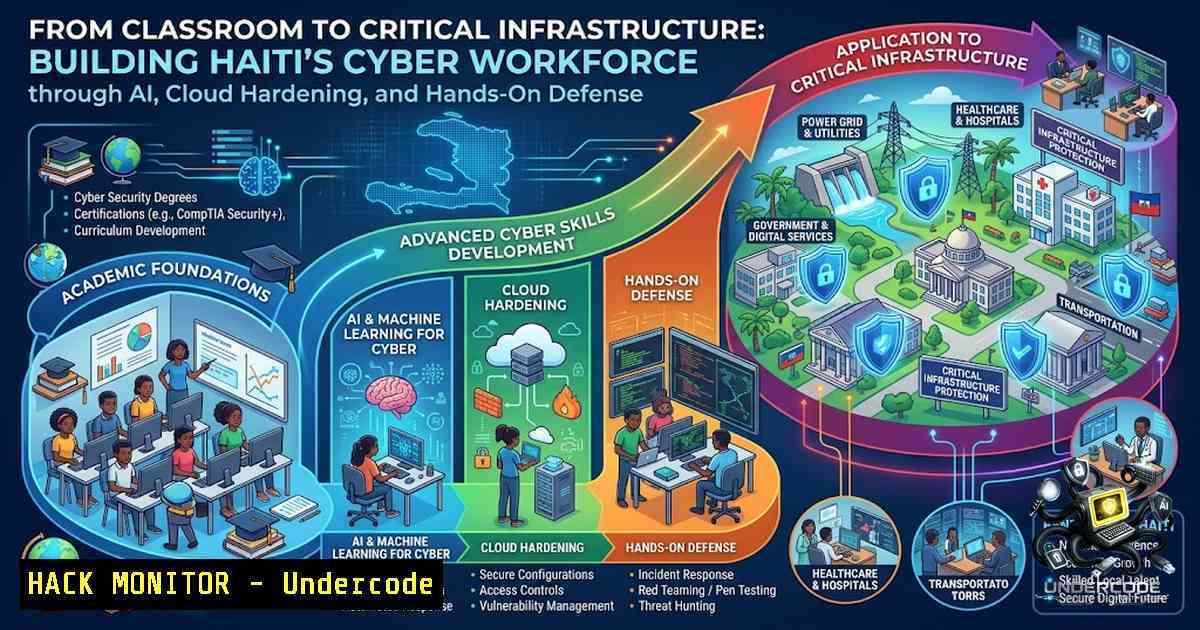
In an era where digital transformation is both an opportunity and a vulnerability, developing nations face a dual challenge: building the technical infrastructure for economic growth while simultaneously defending it against increasingly sophisticated cyber threats. Haiti’s recent initiative—a collaborative program between the Université de Technologie d’Haïti (Unitech) and the Banque de la République d’Haïti (BRH)—represents a critical step toward addressing this challenge by equipping the next generation with advanced skills in artificial intelligence, cybersecurity, and network defense. This article examines the technical curriculum that underpins such workforce development programs and provides actionable commands, configurations, and best practices for security practitioners operating in resource-constrained environments.
Learning Objectives:
- Master essential Linux and Windows hardening commands to secure cloud and on-premises infrastructure against common attack vectors.
- Implement AI-driven threat detection and defensive AI model protection techniques using open-source tools.
- Configure API security controls including rate limiting, JWT validation, and input sanitization.
- Apply CIS-aligned security controls across logging, encryption, backup validation, and incident response.
You Should Know:
- Linux and Windows System Hardening: The Foundation of Cyber Defense
System hardening is the first line of defense in any security architecture. Whether you are securing a cloud instance in Port-au-Prince or a data center in Montreal, the following commands represent essential baseline controls.
Linux Hardening Commands:
 1. Update and patch the system
sudo apt update && sudo apt upgrade -y  Debian/Ubuntu
sudo yum update -y  RHEL/CentOS

<ol>
<li>Configure firewall with iptables (allow SSH, block everything else)
sudo iptables -A INPUT -p tcp --dport 22 -j ACCEPT
sudo iptables -A INPUT -j DROP
sudo iptables-save > /etc/iptables/rules.v4</p></li>
<li><p>Disable root SSH login and enforce key-based authentication
sudo sed -i 's/PermitRootLogin yes/PermitRootLogin no/' /etc/ssh/sshd_config
sudo sed -i 's/PasswordAuthentication yes/PasswordAuthentication no/' /etc/ssh/sshd_config
sudo systemctl restart sshd</p></li>
<li><p>Set strict file permissions on sensitive directories
sudo chmod 600 /etc/shadow
sudo chmod 644 /etc/passwd
sudo chmod 600 /etc/ssh/ssh_host__key</p></li>
<li><p>Install and configure fail2ban to prevent brute-force attacks
sudo apt install fail2ban -y
sudo systemctl enable fail2ban && sudo systemctl start fail2ban
Windows Hardening Commands (PowerShell):
 1. Enable Windows Defender and real-time protection
Set-MpPreference -DisableRealtimeMonitoring $false

<ol>
<li>Configure Windows Firewall (allow RDP only from specific IPs)
New-1etFirewallRule -DisplayName "Allow RDP" -Direction Inbound -Protocol TCP -LocalPort 3389 -Action Allow -RemoteAddress 192.168.1.0/24</p></li>
<li><p>Disable SMBv1 (legacy protocol with known vulnerabilities)
Set-SmbServerConfiguration -EnableSMB1Protocol $false -Force</p></li>
<li><p>Enforce strong password policies
Set-ADDefaultDomainPasswordPolicy -MinPasswordLength 12 -ComplexityEnabled $true -LockoutThreshold 5</p></li>
<li><p>Enable Windows Audit Policies for security monitoring
auditpol /set /subcategory:"Logon" /success:enable /failure:enable
Step‑by‑step guide: Begin by inventorying all servers in your environment. Apply patches first, as unpatched systems account for approximately 60% of successful breaches. Next, configure firewalls to restrict inbound traffic to only necessary ports. Disable unnecessary services and enforce principle of least privilege for user accounts. Finally, implement logging and monitoring to detect anomalies.
- AI-Powered Threat Detection and Defensive AI Model Protection
Artificial intelligence is transforming cybersecurity from reactive to predictive defense. However, AI models themselves are vulnerable to adversarial attacks, model inversion, and data poisoning. Security practitioners must learn both how to use AI for defense and how to defend AI systems.
Using Python for Anomaly Detection with Scikit-learn:
 Basic anomaly detection using Isolation Forest
from sklearn.ensemble import IsolationForest
import numpy as np

Simulated network traffic features (packet size, connection duration, bytes transferred)
X = np.array([[1500, 120, 1024], [64, 10, 512], [90000, 5, 2048], [1200, 110, 980]])

Train Isolation Forest model
model = IsolationForest(contamination=0.1, random_state=42)
model.fit(X)

Predict anomalies (-1 indicates outlier/anomaly)
predictions = model.predict(X)
print(f"Anomaly detection results: {predictions}")
Protecting AI Models from Adversarial Attacks:
 Implement input validation and sanitization for ML models
import re

def sanitize_input(user_input):
 Remove potentially malicious characters
sanitized = re.sub(r'[^\w\s]', '', user_input)
 Implement rate limiting per user
 Apply differential privacy noise addition
return sanitized

Differential privacy example (adding calibrated noise)
import numpy as np
def add_differential_privacy(data, epsilon=0.1):
noise = np.random.laplace(0, 1/epsilon, len(data))
return data + noise
Step‑by‑step guide: Start by identifying security-relevant data sources (network logs, system events, authentication attempts). Preprocess this data to extract meaningful features. Train anomaly detection models on baseline “normal” behavior. Continuously retrain models as new data arrives to adapt to evolving threats. Simultaneously, implement safeguards around your AI pipeline: validate all training data sources, monitor model drift, and apply differential privacy to prevent data leakage.
3. Cloud Infrastructure Security Hardening
As organizations migrate to cloud environments (AWS, Azure, Google Cloud), securing cloud instances becomes paramount. The shared responsibility model means that while the cloud provider secures the physical infrastructure, customers are responsible for securing their operating systems, applications, and data.
AWS Security Group Configuration (CLI):
 Create a security group with least-privilege rules
aws ec2 create-security-group --group-1ame "web-server-sg" --description "Allow HTTP/HTTPS and SSH"

Allow HTTP (port 80) from anywhere
aws ec2 authorize-security-group-ingress --group-1ame "web-server-sg" --protocol tcp --port 80 --cidr 0.0.0.0/0

Allow HTTPS (port 443) from anywhere
aws ec2 authorize-security-group-ingress --group-1ame "web-server-sg" --protocol tcp --port 443 --cidr 0.0.0.0/0

Allow SSH (port 22) only from your office IP
aws ec2 authorize-security-group-ingress --group-1ame "web-server-sg" --protocol tcp --port 22 --cidr YOUR_OFFICE_IP/32
Azure Network Security Group (CLI):
 Create NSG and deny all inbound by default
az network nsg create --resource-group myRG --1ame web-1sg

Allow HTTPS inbound
az network nsg rule create --resource-group myRG --1sg-1ame web-1sg --1ame AllowHTTPS --priority 100 --direction Inbound --access Allow --protocol Tcp --destination-port-ranges 443 --source-address-prefixes Internet

Deny RDP from public internet
az network nsg rule create --resource-group myRG --1sg-1ame web-1sg --1ame DenyRDP --priority 200 --direction Inbound --access Deny --protocol Tcp --destination-port-ranges 3389 --source-address-prefixes Internet
Step‑by‑step guide: Begin by auditing your cloud provider’s default configurations—many are not secure by default. Implement network segmentation using security groups or network ACLs. Enable cloud-1ative security services (AWS GuardDuty, Azure Security Center, Google Cloud Security Command Center). Encrypt data at rest and in transit. Enable detailed logging and integrate with SIEM solutions. Regularly review and rotate access keys and credentials.
4. API Security: Protecting the Digital Front Door
APIs are the backbone of modern applications, but they are also a primary attack vector. Securing APIs requires a multi-layered approach encompassing authentication, authorization, rate limiting, and input validation.
Implementing JWT Authentication with RS256 (Node.js/Express):
const jwt = require('jsonwebtoken');
const fs = require('fs');

// Load RSA private key (keep this secure!)
const privateKey = fs.readFileSync('private.key');

// Generate JWT with RS256
function generateToken(userId, role) {
return jwt.sign(
{ userId: userId, role: role },
privateKey,
{ algorithm: 'RS256', expiresIn: '1h' } // Short-lived tokens
);
}

// Middleware to verify JWT
function verifyToken(req, res, next) {
const token = req.headers['authorization']?.split(' ')[bash];
if (!token) return res.status(401).json({ error: 'No token provided' });

jwt.verify(token, publicKey, { algorithms: ['RS256'] }, (err, decoded) => {
if (err) return res.status(403).json({ error: 'Invalid token' });
req.user = decoded;
next();
});
}
Rate Limiting with Express-Rate-Limit:
const rateLimit = require('express-rate-limit');

// Apply rate limiting to prevent brute force and DoS
const limiter = rateLimit({
windowMs: 15  60  1000, // 15 minutes
max: 100, // limit each IP to 100 requests per windowMs
message: 'Too many requests from this IP, please try again later.'
});

app.use('/api/', limiter);

// Stricter limits for authentication endpoints
const authLimiter = rateLimit({
windowMs: 15  60  1000,
max: 5, // Only 5 login attempts per 15 minutes
message: 'Too many login attempts, please try again later.'
});

app.use('/api/login', authLimiter);
Input Validation and Sanitization:
const { body, validationResult } = require('express-validator');

app.post('/api/user',
body('email').isEmail().normalizeEmail(),
body('password').isLength({ min: 8 }).matches(/[A-Z]/).matches(/[a-z]/).matches(/[0-9]/),
(req, res) => {
const errors = validationResult(req);
if (!errors.isEmpty()) {
return res.status(400).json({ errors: errors.array() });
}
// Process validated input
}
);
Step‑by‑step guide: Audit all API endpoints for exposed sensitive data. Implement OAuth 2.0 or OpenID Connect for authentication. Use RS256 (asymmetric) over HS256 for JWT signatures to prevent key compromise. Set access token expiration to a maximum of 1 hour with refresh tokens for extended sessions. Store secrets in secure vaults (HashiCorp Vault, AWS Secrets Manager) rather than hardcoding them. Enable HTTPS/TLS for all API communication.
- Incident Response and Logging for Rapid Threat Containment
Even with robust prevention, breaches will occur. A well-designed incident response capability minimizes damage and accelerates recovery.
Centralized Logging with rsyslog (Linux):
 Configure rsyslog to forward logs to centralized server
echo ". @@192.168.1.100:514" >> /etc/rsyslog.conf
systemctl restart rsyslog

Enable auditd for system call auditing
auditctl -e 1
auditctl -w /etc/passwd -p wa -k identity_changes
auditctl -w /etc/shadow -p wa -k identity_changes
auditctl -w /var/log/auth.log -p r -k authentication_logs
Windows Event Forwarding (PowerShell):
 Configure Windows Event Forwarding (WEF)
wecutil qc /q
wecutil cs "http://winserver.domain.com:5985/wsman/SubscriptionManager/WEC"
Basic Incident Response Checklist:
- Identification: Detect the breach through SIEM alerts, user reports, or anomaly detection.
- Containment: Isolate affected systems (network segmentation, firewall rules, disabling accounts).
- Eradication: Remove the threat (malware removal, patching vulnerabilities, resetting credentials).
- Recovery: Restore systems from clean backups and verify integrity.
- Lessons Learned: Conduct post-incident review and update security controls.
Step‑by‑step guide: Establish a formal incident response plan before an incident occurs. Define roles and responsibilities. Deploy SIEM (Splunk, ELK Stack, Wazuh) for log aggregation and correlation. Perform regular tabletop exercises to test response procedures. Maintain offline backups for ransomware recovery.
What Undercode Say:
- “The future of cybersecurity in emerging economies depends not on imported solutions, but on cultivated talent—professionals who understand both global threats and local context.”
- “Hands-on, lab-based training transforms theoretical knowledge into operational capability. Simulation labs, cyber ranges, and interactive competitions give professionals direct experience responding to threats under pressure.”
Analysis: The Unitech-BRH initiative exemplifies a critical model for cybersecurity workforce development: public-private partnerships that align academic training with national strategic priorities. However, sustaining this momentum requires ongoing investment in infrastructure, continuous curriculum updates to keep pace with evolving threats, and pathways for graduates to apply their skills within Haiti’s economy. The enthusiasm of Haitian students demonstrated at the recent colloquium is encouraging, but translating that energy into a resilient national cybersecurity posture demands systemic commitment from government, private sector, and international partners. The technical skills covered in this article—system hardening, AI defense, cloud security, API protection, and incident response—represent the core competencies that such programs must instill to build a self-sustaining cybersecurity ecosystem.
Prediction:
- +1 Haiti’s investment in digital skills through programs like TIC-Haïti-BRH will create a pipeline of locally-trained cybersecurity professionals, reducing reliance on foreign consultants and building sovereign cyber defense capabilities.
- +1 As AI-powered security tools become more accessible, Haitian organizations will leapfrog traditional security models, adopting predictive analytics and automated threat response.
- -1 Without sustained funding and political stability, early gains in cybersecurity workforce development risk erosion, leaving critical infrastructure vulnerable to increasingly sophisticated attacks.
- -1 The physical security challenges facing Haiti’s telecommunications infrastructure will continue to complicate cyber defense efforts, requiring integrated physical-and-cyber security strategies.
- +1 The model demonstrated by Unitech and BRH—combining academic rigor with practical, lab-based training—offers a replicable framework for other developing nations seeking to build cybersecurity capacity.
- -1 The global cybersecurity skills gap means Haiti will compete with wealthier nations for talent, necessitating competitive compensation and career development pathways to retain trained professionals.
- +1 Regional collaboration through organizations like CARICOM and partnerships with international cybersecurity firms can accelerate knowledge transfer and provide Haitian professionals with global exposure and certification opportunities.
▶️ Related Video (76% Match):
🎯Let’s Practice For Free:
🎓 Live Courses & Certifications:
Join Undercode Academy for Verified Certifications
🚀 Request a Custom Project:
Secure, high-velocity infrastructure and disruptive technological engineering. Contact our engineering team for high-tier development and proprietary systems:
[email protected]
💎 Smart Architecture | 🛡️ Secure by Design | ⭐ Trusted by Thousands
IT/Security Reporter URL:
Reported By: Blaisearbouet Il – Hackers Feeds
Extra Hub: Undercode MoN
Basic Verification: Pass ✅


