Listen to this Post
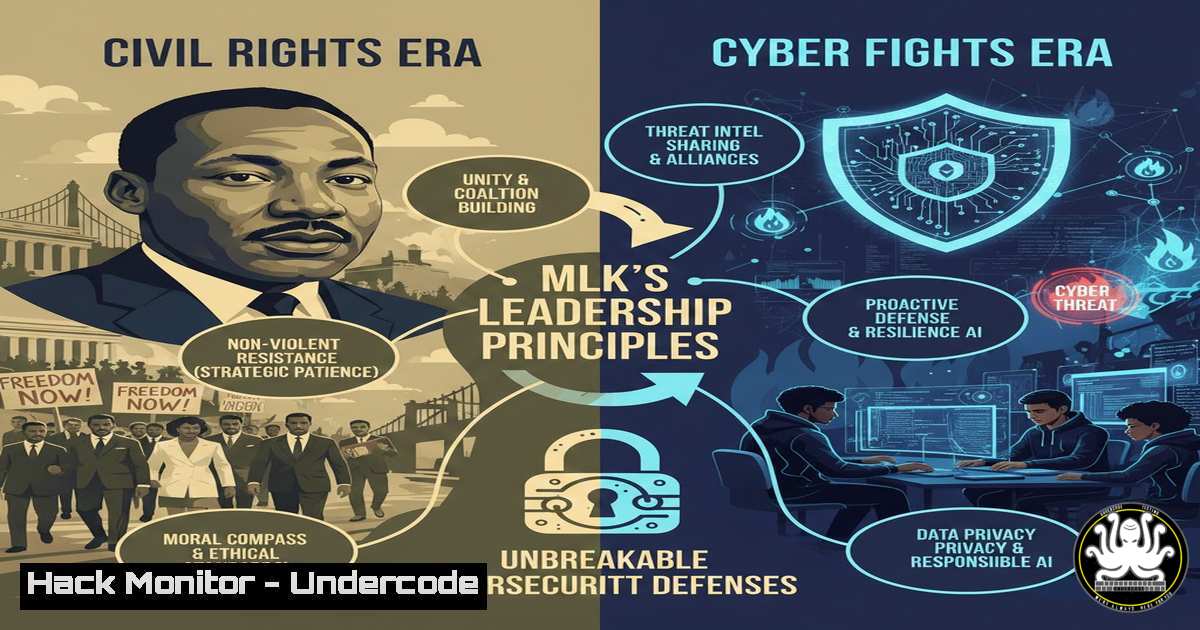
Introduction:
In an era defined by digital threats and relentless cyber adversaries, the principles demonstrated by history’s greatest leaders provide an unexpected but critical blueprint for modern cybersecurity strategy. Just as Martin Luther King Jr. stepped into a leadership vacuum during the Montgomery Bus Boycott with courage and a clear vision, today’s security professionals must embrace responsibility in the face of uncertainty to protect their digital domains. This article translates timeless lessons of ethical leadership, preparedness, and collective action into a concrete technical framework for hardening defenses, responding to incidents, and building a resilient security culture.
Learning Objectives:
- Translate leadership principles of courage and vision into actionable cybersecurity protocols and proactive threat hunting.
- Implement technical controls that embody the ethos of preparedness, just as King prepared his sermons, to reduce mean time to detection (MTTD) and response (MTTR).
- Architect a security culture that champions justice and righteousness in data handling, access control, and ethical AI deployment, creating a “mighty stream” of collective defense.
You Should Know:
- Step Up Before You’re Ready: The Incident Response Commander’s Mindset
Martin Luther King Jr. accepted a monumental leadership role with only 20 minutes to prepare a seminal speech. Similarly, in a breach scenario, the first responder must often act decisively before all facts are known. This step-by-step guide outlines the initial technical triage to stabilize a situation.
Step‑by‑step guide:
- Isolate & Contain (The Immediate “Call to Action”): Immediately segment affected systems to prevent lateral movement.
Linux: Use `iptables` or `nftables` to block suspicious IPs at the host level. `sudo iptables -A INPUT -s-j DROP`
Windows: Isolate the host from the network via PowerShell: `Set-NetFirewallProfile -All -Enabled True` (ensures firewall is on), then block specific threats. - Preserve Evidence (The “Ledger for Posterity”): Create forensic artifacts before rebooting or altering system state.
Linux: Use `dd` to image memory:sudo dd if=/proc/kcore of=/secure_location/memory.img. Capture network connections:ss -tunap > /secure_location/network_snapshot.txt.
Windows: Dump RAM using built-in tools or trusted third-party utilities. Capture process list:tasklist /v > C:\evidence\processes.txt. - Assume & Verify (The “Unappealing Responsibility”): Assume compromise is broader than initially seen. Initiate enterprise-wide threat hunting using IOC (Indicators of Compromise) scanners and EDR (Endpoint Detection and Response) queries.
-
Build Your Sermon Before the Podium: Proactive Security Hardening
King typically spent 15 hours crafting a sermon. Proactive security requires the same dedication to preparation. This involves system hardening beyond baseline configurations.
Step‑by‑step guide:
- Implement Least Privilege Access (The Foundation of Justice): Ensure users and systems operate with only the permissions they absolutely need.
Linux: Use `sudo` privileges judiciously. Review `/etc/sudoers` withsudo visudo. Implement groups and specific command permissions.
Windows: Leverage Group Policy Objects (GPOs) to enforce least privilege across the domain. Regularly audit local administrator group memberships. - Harden Network Services (The “Mighty Stream” of Righteousness): Every exposed service is an attack vector. Harden them relentlessly.
SSH Hardening (Linux): Edit/etc/ssh/sshd_config. SetProtocol 2,PermitRootLogin no, `PasswordAuthentication no` (use key-based auth), and `AllowUsers` to a specific list.
Cloud Hardening (AWS Example): Use AWS Security Hub and Inspector for automated compliance checks. Ensure S3 buckets are not publicly writable and all data in transit is TLS 1.2+ encrypted. -
Automate Compliance & Configuration Management: Use tools like Ansible, Puppet, or Chef to enforce hardened configurations as code, ensuring consistency and eliminating configuration drift.
-
The Dream is in the Data: Ethical AI and Data Governance
King’s “I Have a Dream” speech envisioned a just future. In tech, we must ensure our use of data and AI is ethical, fair, and secure, preventing biases that can lead to discriminatory outcomes or security blind spots.
Step‑by‑step guide:
- Secure Your AI/ML Pipeline: Protect training data, models, and inferences from poisoning, theft, or manipulation.
Data Sanitization: Use differential privacy or synthetic data generation for training when possible. Encrypt training datasets at rest and in transit.
Model Security: Employ tools like Microsoft’s Counterfit or IBM’s Adversarial Robustness Toolbox to test models for adversarial vulnerabilities. - Implement Ethical Data Logging & Monitoring: Ensure your security monitoring (SIEM) does not infringe on privacy unjustly and follows regulations like GDPR.
Log Anonymization (Linux with Logstash): Use a Logstash filter to hash or remove PII before indexing in Elasticsearch: `filter { mutate { gsub => [“message”, “%{EMAIL_PATTERN}”, “[bash]”] } }`
3. Bias Testing & Mitigation: Integrate fairness auditing libraries (e.g., `fairlearn` for Python, `AIF360` from IBM) into your MLOps lifecycle to detect and mitigate bias in algorithmic decision-making.
4. Call and Response: Building a Security-Aware Culture
The powerful “call and response” during King’s speeches created unity. In cybersecurity, fostering a culture where every employee feels responsible and empowered to respond to threats is critical.
Step‑by‑step guide:
- Implement Phishing Simulation & Training: Use platforms like KnowBe4 or Proofpoint to run regular, realistic phishing campaigns. Provide immediate, constructive feedback to those who click.
- Create Clear Reporting Channels: Establish and promote an easy, non-punitive way to report suspicious emails or activity (e.g., a dedicated Slack channel, email alias, or phishing report button).
- Conduct “Tabletop” Exercises: Regularly simulate breach scenarios with cross-functional teams (IT, Legal, Comms, Execs) to practice the “call and response” of real incident management, refining your IR plan.
-
No Finish Line: Continuous Vulnerability Management and Threat Hunting
Forming a “more perfect Union” in cybersecurity is a continuous process. There is no final state of “secure,” only continuous adaptation and improvement.
Step‑by‑step guide:
- Prioritized Patching: Go beyond automated updates. Use a risk-based approach with a tool like Tenable.io or Qualys to prioritize patching critical vulnerabilities (CVSS >= 7.0) in internet-facing systems within 72 hours.
- Proactive Threat Hunting: Don’t just wait for alerts. Actively search for IOCs and TTPs (Tactics, Techniques, and Procedures) from MITRE ATT&CK.
Hunt Command Example (Linux – looking for hidden processes): `ps -ef | grep -E “(\./|/tmp/|/dev/shm)”` to find processes running from unusual directories.
Hunt Command Example (Windows – looking for anomalous scheduled tasks): `schtasks /query /fo LIST /v | findstr /i “password\|crypto\|update”`
3. Integrate Threat Intelligence: Subscribe to credible threat intelligence feeds (e.g., AlienVault OTX, CrowdStrike Intel) and automate their integration into your SIEM and firewall blocklists.
What Undercode Say:
- Leadership is a Technical Discipline: True cybersecurity leadership is demonstrated not just in strategy, but in the precise execution of commands, the architecture of secure systems, and the courage to initiate containment before total clarity is achieved.
- Ethics is the Ultimate Control Framework: The most sophisticated technical controls fail without an ethical foundation. Ensuring justice, fairness, and righteousness in how you collect data, deploy AI, and manage access is the highest-order security principle, protecting both your organization and society.
The analysis of Dr. King’s legacy through a cybersecurity lens reveals that the core challenge is human, not technological. The tools and commands are merely instruments of our will. The 20-minute preparation for a historic speech mirrors the chaotic first moments of a breach. The 15-hour sermon preparation maps directly to the disciplined, ongoing work of system hardening. The “dream” of a just society finds its parallel in the ethical imperative of our digital constructs. By embracing the responsibility to lead, to prepare, and to act ethically—even under pressure—we forge defenses that are not just technically sound, but morally resilient. This transforms cybersecurity from an IT cost center into a cornerstone of organizational integrity.
Prediction:
The future of cybersecurity will increasingly be shaped by leaders who can synthesize ethical vision with deep technical execution. Organizations that treat security as a purely technical compliance exercise will continue to fall victim to sophisticated attacks. Conversely, those that embed leadership principles—courage in response, diligence in preparation, and justice in operation—into their security DNA will develop an adaptive, human-centric resilience. This will be the defining differentiator, turning security teams from gatekeepers into enablers of trustworthy innovation. The next major evolution in our field will not be a new firewall technology, but the widespread recognition that the most critical vulnerability to patch is the gap between technical capability and ethical, courageous leadership.
▶️ Related Video (78% Match):
🎯Let’s Practice For Free:
IT/Security Reporter URL:
Reported By: Scottwindonluton Mlk – Hackers Feeds
Extra Hub: Undercode MoN
Basic Verification: Pass ✅


