Listen to this Post
Introduction:
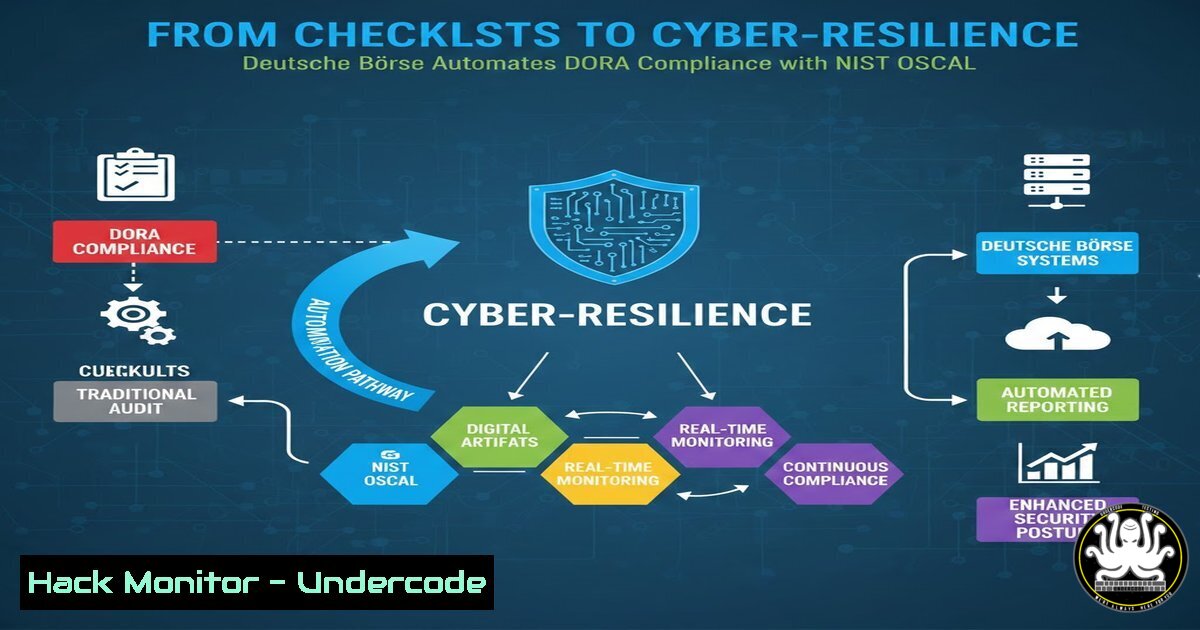
The financial sector’s digital resilience is being redefined by stringent regulations like the Digital Operational Resilience Act (DORA). For major financial entities like Deutsche Börse Group, compliance has evolved from a box-ticking exercise to a strategic imperative requiring deep integration of ICT Risk Management with Enterprise Risk Management (ERM). The key to this transformation lies in the automation of control assessments using frameworks like the National Institute of Standards and Technology (NIST) Open Security Controls Assessment Language (OSCAL), a approach actively endorsed by national bodies such as Germany’s Federal Office for Information Security (BSI).
Learning Objectives:
- Understand the role of DORA and OSCAL in modernizing ICT Risk Management.
- Learn the technical steps to initiate control assessment automation using OSCAL.
- Discover how to integrate siloed ICT risk data into a unified Enterprise Risk Management platform.
You Should Know:
- The DORA Mandate and the Shift to Intelligent Risk Management
The Digital Operational Resilience Act (DORA) sets a unified regulatory framework for ICT risk across the EU financial sector. It demands proactive, evidence-based risk management, moving far beyond static compliance checklists. Intelligent risk management, as implemented by leading firms, involves continuous monitoring, automated evidence collection, and data-driven decision-making. This shift requires a foundational change in how controls are documented and assessed.
Step‑by‑step guide:
- Gap Analysis: Map your existing ICT controls (e.g., from ISO 27001, COBIT) against DORA’s requirements. Identify which controls are manual, semi-automated, or fully automated.
- Define Metrics: For each control, define measurable metrics. Instead of “Patches are applied,” define “98% of critical systems patched within 14 days of release, evidenced by automated scans.”
- Tool Selection: Identify tools that can provide automated evidence. This includes Configuration Management Databases (CMDB), vulnerability scanners (e.g., Tenable, Qualys), SIEM platforms (e.g., Splunk, Elastic), and cloud security posture management (CSPM) tools.
-
Automating Controls with NIST OSCAL: A Technical Deep Dive
NIST OSCAL is a machine-readable XML, JSON, or YAML-based language that allows organizations to define their control catalogs, system configurations, and assessment results in a standardized format. It acts as the “API for compliance,” enabling the automation of evidence gathering and assessment workflows. The BSI’s support underscores its importance for regulatory alignment.
Step‑by‑step guide:
- Model Your Control Catalog: Start by expressing your control framework (like DORA-derived controls) in OSCAL. Use the OSCAL `catalog` model.
Example OSCAL Catalog Snippet (YAML) for a DORA-inspired control
catalog:
uuid: df9b58f8-833b-441c-a9e7-41f2c6f8f8e1
metadata:
title: DBG DORA ICT Control Catalog
controls:</li>
</ol>

<p>- id: dora-ict-01
title: Automated Vulnerability Management
props:
- name: deadline
value: "14d"
2. Define System Implementation (
component): Create an OSCAL `component` definition for a key asset (e.g., a Linux server cluster). Link implemented controls to it.
3. Automate Evidence Collection: Write scripts that pull data from technical tools and populate the OSCAL `assessment-results` model.Example Linux command to gather patch evidence, formatting for OSCAL last_patch_date=$(rpm -qa --last | head -1 | awk '{print $NF, $(NF-1), $(NF-2)}') echo " - uuid: $(uuidgen) description: Kernel patch status props: - name: last_patch_date value: \"$last_patch_date\" - name: control-id value: \"dora-ict-01\""4. Continuous Validation: Use an OSCAL processor (e.g., OpenControl, commercial solutions) to continuously validate that the evidence in `assessment-results` meets the criteria defined in the
catalog.- Breaking Silos: Integrating ICT Risk into Enterprise Risk Management (ERM)
Vertical, data-driven risk management means ICT risk findings must flow seamlessly into the organization’s overall ERM framework. This involves translating technical vulnerabilities (CVSS score) into business impact (financial, reputational) for the board.
Step‑by‑step guide:
- Establish a Unified Risk Taxonomy: Align ICT risk ratings (e.g., Critical, High) with enterprise risk appetite levels. Ensure both technical and business teams use the same language.
- Build API Integrations: Configure your GRC (Governance, Risk, and Compliance) platform to consume the machine-readable OSCAL
assessment-results. Most modern GRC tools (e.g., ServiceNow, RSA Archer) offer REST APIs for this purpose.Pseudo-code for pushing OSCAL assessment results to a GRC API import requests import json</li> </ol> with open('oscal-assessment-results.json') as f: oscal_data = json.load(f) grc_api_endpoint = "https://grc.internal.company/api/risks" headers = {'Authorization': 'Bearer YOUR_TOKEN', 'Content-Type': 'application/json'} Transform OSCAL data to GRC payload format payload = transform_oscal_to_grc(oscal_data) response = requests.post(grc_api_endpoint, json=payload, headers=headers)3. Visualize in Dashboards: Create executive dashboards that overlay technical control health (from OSCAL) with key risk indicators (KRIs) from the ERM system, providing a single pane of glass for digital resilience.
4. Cloud Security Hardening as a Core Control
For a financial entity, cloud environments (IaaS, PaaS) are critical. DORA explicitly requires rigorous third-party risk management, including cloud providers. Automated controls here are non-negotiable.
Step‑by‑step guide:
- CSPM Configuration: Deploy a Cloud Security Posture Management tool. Configure it to continuously check against benchmarks like CIS AWS/Azure Foundations.
- Implement Remediation Playbooks: Automate the fix for common misconfigurations.
AWS CLI example to remediate an S3 bucket with public read access
aws s3api put-bucket-acl --bucket my-bucket-name --acl private
- Map to OSCAL: Ensure the CSPM findings are tagged with your internal control IDs (
dora-ict-01) and can be exported or integrated in an OSCAL-compatible format. -
The Human Factor: Cultivating Vision, Determination, and Collaboration
Technology is an enabler, but success hinges on people. Building an intelligent risk practice requires a cultural shift where security and risk teams are embedded business partners, not gatekeepers.
Step‑by‑step guide:
- Cross-Functional Workshops: Regularly convene technical teams (cloud, network, app dev) with risk and compliance officers to co-design automated control procedures.
- Transparent Communication: Use the dashboards from Step 3.2 in joint reviews to discuss risk posture in business terms, fostering shared ownership.
- Continuous Upskilling: Invest in training for risk professionals on OSCAL, APIs, and cloud fundamentals, and for engineers on DORA requirements and risk principles.
What Undercode Say:
- Automation is the Only Path to Scale: Manual control assessments cannot keep pace with cloud-native development and evolving threats. OSCAL provides the critical, standardized lingua franca to make automation possible at an enterprise scale.
- Risk is a Business Dialogue, Not a Technical Report: The ultimate value of integrating ICT risk with ERM is the ability to articulate technical vulnerabilities in terms of financial impact and strategic business risk, enabling informed decision-making at the highest levels.
The journey undertaken by Deutsche Börse highlights a fundamental truth: future-proof compliance is not about hiring more auditors, but about building smarter systems. By leveraging machine-readable standards like OSCAL, organizations can transform regulatory burden from a static, costly overhead into a dynamic, data-driven component of their overall cybersecurity and business resilience strategy. This creates a feedback loop where compliance activities directly enhance security posture, rather than just documenting it.
Prediction:
Within the next 2-3 years, the adoption of machine-readable compliance frameworks like OSCAL will become the de facto standard for regulated industries beyond finance, including healthcare and critical infrastructure. Regulators themselves will begin to accept or even require submissions in these formats, significantly accelerating audit cycles. This will birth a new ecosystem of “RegTech” tools focused on real-time compliance monitoring, shifting the industry from periodic, snapshot-based audits to a state of continuous, verifiable compliance and resilience.
▶️ Related Video (80% Match):
🎯Let’s Practice For Free:
IT/Security Reporter URL:
Reported By: Rajcani Ictrisk – Hackers Feeds
Extra Hub: Undercode MoN
Basic Verification: Pass ✅🔐JOIN OUR CYBER WORLD [ CVE News • HackMonitor • UndercodeNews ]
📢 Follow UndercodeTesting & Stay Tuned:
- Breaking Silos: Integrating ICT Risk into Enterprise Risk Management (ERM)


