
Listen to this Post
Introduction:
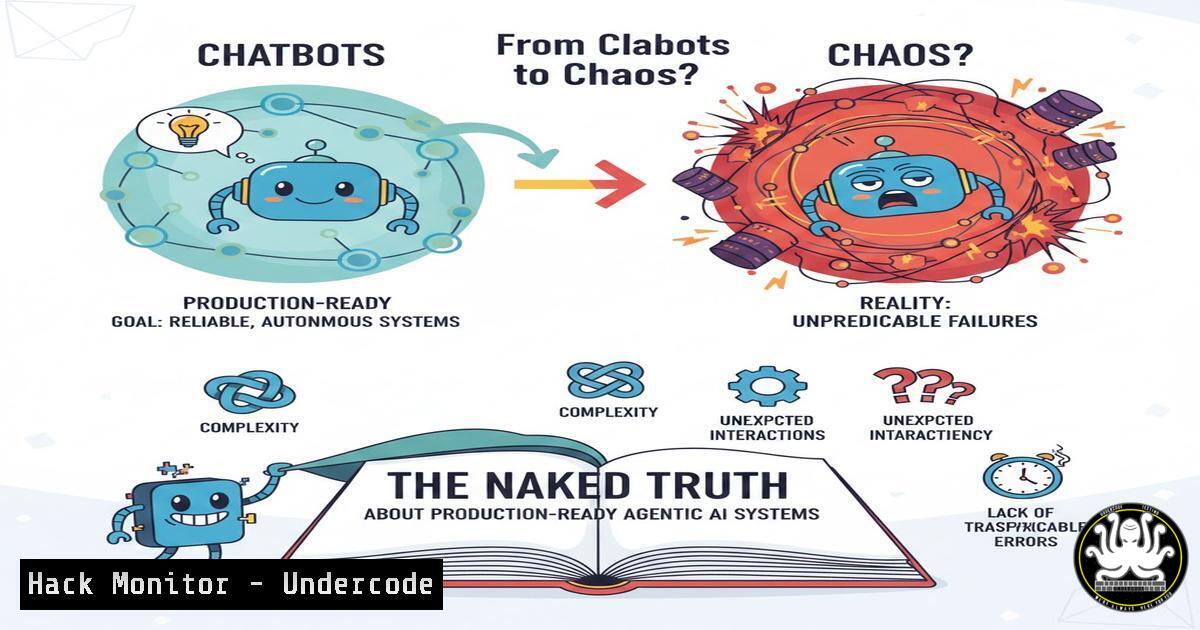
The transition from conversational AI chatbots to autonomous, goal-oriented Agentic AI represents the most significant operational shift in enterprise technology since cloud migration. These systems don’t just respond to prompts; they execute multi-step workflows, make independent decisions, and own business outcomes across departments. This article deconstructs the architecture, security implications, and practical implementation of production-grade Agentic AI.
Learning Objectives:
- Understand the core architectural components of a multi-agent AI system and their orchestration.
- Implement foundational security and monitoring for autonomous AI agents interacting with tools and APIs.
- Deploy a basic, secure orchestration layer to manage agent workflows and prevent conflicts.
You Should Know:
- The Agentic Architecture: Beyond a Single LLM Call
Agentic systems move from a single LLM call to a complex architecture involving planning, execution, and learning loops. At its core, an agent consists of a reasoning engine (often an LLM), a tool-use framework, and a memory system. The real complexity emerges in multi-agent systems where coordination is key.
Step‑by‑step guide explaining what this does and how to use it.
Conceptual Model: A `Supervisor Agent` breaks down a high-level goal (e.g., “Generate Q3 Sales Report”) into tasks. It delegates these to `Specialist Agents` (DataFetcher, Analyzer, ReportGenerator).
Orchestration Layer: This is the central nervous system. Open-source frameworks like `LangGraph` or `AutoGen` are used to define agent interactions as a state machine or graph.
Basic LangGraph Setup (Python):
from langgraph.graph import StateGraph, END
from typing import TypedDict

class AgentState(TypedDict):
goal: str
tasks: list
results: dict

def supervisor_node(state: AgentState):
 Logic to decompose goal into tasks
state['tasks'] = ["fetch_data", "analyze", "format"]
return state

def data_fetcher_node(state: AgentState):
 Call tool to query database
state['results']['raw_data'] = query_sales_db(state)
return state

workflow = StateGraph(AgentState)
workflow.add_node("supervisor", supervisor_node)
workflow.add_node("data_fetcher", data_fetcher_node)
workflow.set_entry_point("supervisor")
workflow.add_edge("supervisor", "data_fetcher")
 ... add more nodes and conditional edges
app = workflow.compile()
2. The Orchestration Engine: Preventing Agent Collision
As noted in the comments, “Clear boundaries and orchestration layers keep systems stable.” Without it, multiple agents attempting to update the same CRM record or infrastructure setting will cause chaos.
Step‑by‑step guide explaining what this does and how to use it.
Implement Resource Locking: Use a centralized store (like Redis) for pessimistic or optimistic locking when agents access shared resources.
Redis Lock Command Example:
 Linux/macOS: Using redis-cli to set a lock with a 30-second timeout
redis-cli SETNX agent:lock:crm_lead_12345 <agent_id>
redis-cli EXPIRE agent:lock:crm_lead_12345 30
Define Clear Agent Roles & Permissions: Architecturally, a `Sales Ops Agent` should have read-write access to the CRM but only read access to the billing system. This is enforced in the orchestration layer’s routing logic, not just in the agent’s prompt.
- Tool Integration & API Security: The Attack Surface Expands
Each tool an agent can call (SQL database, CRM API, deployment script) is a new potential attack vector. An agent manipulated by a malicious user prompt could trigger destructive actions.
Step‑by‑step guide explaining what this does and how to use it.
Sandbox Tool Execution: Never grant agents direct access. Use a tightly controlled proxy layer that validates, logs, and rate-limits all outgoing requests.
Implement Parameterized Queries & Input Sanitization: Prevent prompt injection from becoming SQL injection or OS command injection.
 BAD: Agent directly formatting a string
query = f"DELETE FROM orders WHERE user_id = {user_input}"
 GOOD: Using parameterized queries via a secure tool
safe_tool.execute_sql("DELETE FROM orders WHERE user_id = %s", (sanitized_user_input,))
Windows Command Auditing: If an agent triggers a PowerShell script, ensure full command logging is enabled.
 Enable PowerShell Script Block Logging (Windows Admin)
Set-ItemProperty -Path "HKLM:\SOFTWARE\Policies\Microsoft\Windows\PowerShell\ScriptBlockLogging" -Name "EnableScriptBlockLogging" -Value 1
4. Monitoring & Observability: The “Human-in-the-Loop” Safety Rail
The comment on “human validation loops to be safe” is critical. Production monitoring must capture the agent’s chain of thought, tool calls, and outcomes.
Step‑by‑step guide explaining what this does and how to use it.
Log the Agent’s Reasoning Trace: Every decision and the evidence for it must be logged to an immutable audit trail (e.g., Elasticsearch, DataDog). This is non-negotiable for finance or HR ops agents.
Implement Automated Sentinel Rules: Create alerts for anomalous behavior (e.g., agent making 100+ API calls in a minute, agent attempting to access a forbidden tool).
Example Sentinel Log Query (Linux-based SIEM):
 Grep logs for high-frequency tool calls by a specific agent instance
tail -f /var/log/agent_orchestrator.log | grep "tool_call" | awk -F'agent_id=' '{print $2}' | sort | uniq -c | sort -nr | head -5
- Continuous Learning & Feedback Loops: Mitigating Model Drift
Agents that “learn from feedback” must do so in a controlled, secure manner. Allowing live updates from unstructured feedback is a recipe for corruption or poisoning.
Step‑by‑step guide explaining what this does and how to use it.
Use a Closed-Loop Evaluation System: Deploy a shadow mode or canary analysis where the agent’s decisions are compared against a gold standard or human reviewer.
Secure the Fine-Tuning Pipeline: If agents generate training data, that pipeline must be isolated and the data rigorously validated before updating any model.
 Isolate your training environment from production agents
 Use network policies in Kubernetes
kubectl apply -f - <<EOF
apiVersion: networking.k8s.io/v1
kind: NetworkPolicy
metadata:
name: deny-training-to-production
spec:
podSelector:
matchLabels:
role: training-job
policyTypes:
- Egress
egress:
- to:
- podSelector:
matchLabels:
role: production-agent
ports:
- protocol: TCP
port: 80
EOF
What Undercode Say:
– Key Takeaway 1: Agentic AI is an architectural and security challenge first, an AI challenge second. The major risk shifts from model hallucination to unauthorized autonomous action, requiring infrastructure-level controls.
– Key Takeaway 2: The “orchestration layer” is the most critical piece of technology in this stack. It is the command-and-control center that enforces governance, security, and stability. Building it ad-hoc is a massive liability.
The analysis from the post highlights a shift from tasks to outcomes, but undersells the immense operational burden this creates. While use cases like customer support and reporting are “early wins,” they often mask the underlying complexity of permissions, data lineage, and audit compliance that must be solved at the platform level. The comment about this being an “operating model change” is the most prescient; technology leaders who focus solely on the agent capabilities without restructuring their DevOps, SecOps, and governance teams for this new reality are building a house on sand.
Prediction:
Within 18-24 months, the first major cybersecurity incident attributed to an “Agentic AI System compromise” will occur, not through traditional code exploitation, but through prompt injection or corrupted feedback loops leading to large-scale fraudulent transactions or data destruction. This will trigger the development of a new cybersecurity sub-discipline focused on Autonomous System Security (ASS), with specialized tools for runtime agent behavior analysis, intent verification, and guaranteed kill switches. The organizations that succeed will be those that integrated security, observability, and orchestration from day zero, not as an afterthought.
▶️ Related Video (84% Match):
🎯Let’s Practice For Free:
IT/Security Reporter URL:
Reported By: Greg Coquillo – Hackers Feeds
Extra Hub: Undercode MoN
Basic Verification: Pass ✅


