Listen to this Post
Introduction:
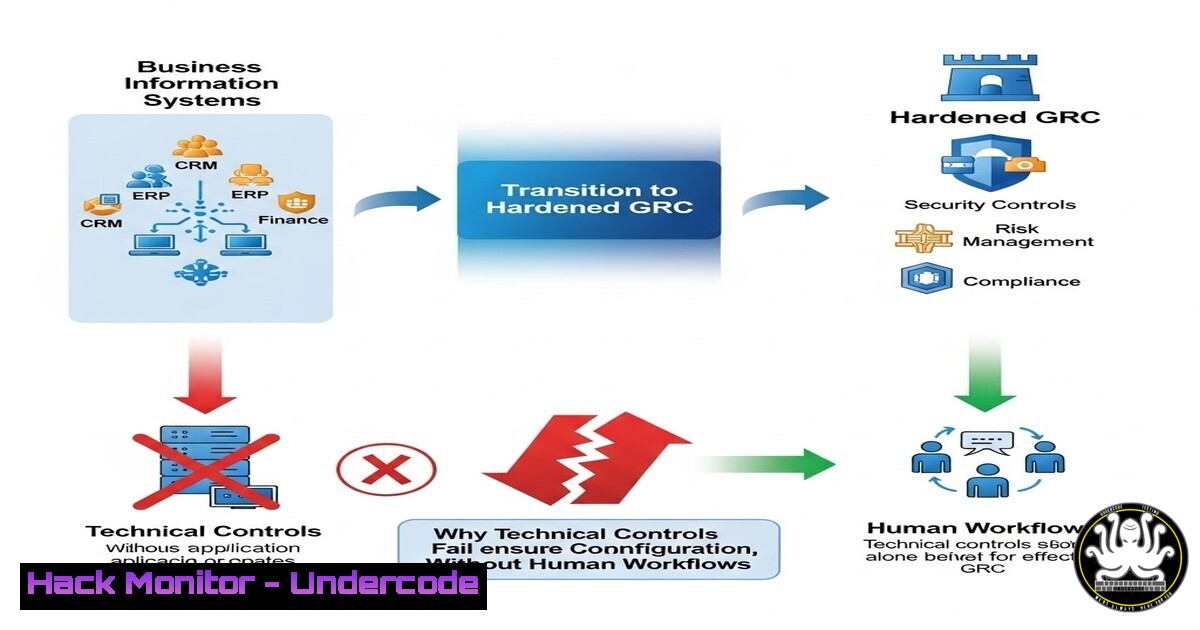
Modern Governance, Risk, and Compliance (GRC) is often mistaken for a pure documentation exercise, yet the most devastating security gaps emerge where technology ignores human behavior. Sharaden Cole’s insight—that “a technically sound control still creates risk if it disrupts workflows or depends on perfect human behavior”—anchors a fundamental shift in cybersecurity architecture. This article translates that governance philosophy into executable hardening procedures, audit automation, and cross‑platform command sets that bridge the gap between compliance checklists and operational reality.
Learning Objectives:
- Objective 1: Automate evidence collection for NIST 800‑53 controls without disrupting end‑user productivity.
- Objective 2: Harden Linux and Windows endpoints against common misconfigurations that auditors flag as “people‑dependent” risks.
- Objective 3: Implement API security policies that balance strict validation with seamless business integration.
You Should Know:
1. Auditing the “Human Factor” with Process‑Aware Commands
Step‑by‑step guide: Identifying controls that rely on perfect human behavior.
A control that requires a user to manually encrypt a file before emailing it is destined to fail. Instead of punishing non‑compliance, use system telemetry to automate the safeguard.
Linux – Monitor for SCP/SFTP transfers without encryption wrapper:
sudo auditctl -w /usr/bin/scp -p x -k unencrypted_file_transfer
sudo ausearch -k unencrypted_file_transfer --format text
What this does: Audits every execution of scp. If your policy mandates PGP or Vault‑wrapped transfers, this reveals which users circumvent the process. Use this data to justify deploying forced encryption at the gateway rather than blaming staff.
Windows – Detect USB drive usage that bypassed DLP:
Get-WinEvent -FilterHashtable @{LogName='Microsoft-Windows-Partition/Diagnostic'; ID=1006} | Select-Object TimeCreated, Message
What this does: Pulls USB insertion events. Cross‑reference with DLP logs; if a device was mounted but no DLP scan occurred, the control is failing because the user found a “faster” workflow. Remediate by blocking USB write via Group Policy, not by additional training.
2. Automating Compliance Evidence Without Burdening Operations
Step‑by‑step guide: Using Infrastructure as Code (IaC) to generate audit‑ready reports.
Cole’s post emphasizes that “controls should support the business, not slow it down.” Hard‑coding manual screenshots is unsustainable. Instead, use automated configuration management to prove control efficacy.
Ansible playbook snippet – CIS Benchmark reporting (Linux):
- name: Gather CIS compliance data
hosts: all
tasks:
- name: Check password aging
ansible.builtin.shell: "grep ^PASS_MAX_DAYS /etc/login.defs | awk '{print $2}'"
register: pass_max_days
- name: Generate evidence file
ansible.builtin.copy:
content: "PASS_MAX_DAYS={{ pass_max_days.stdout }}"
dest: "/audit/cis_5.4.1.1_{{ ansible_date_time.date }}.txt"
Why this matters: Auditors need proof. This playbook dumps configuration state daily into a secured share. The developer is never asked to “remember” to save evidence; the system does it.
- API Security That Does Not Break the Frontend
Step‑by‑step guide: Throttling and input validation with zero false positives.
A common GRC failure is deploying a Web Application Firewall (WAF) rule so strict it blocks legitimate API traffic, causing the business to demand the rule be disabled. Sustainable security requires granular rate limiting.
Nginx configuration for API gateway – realistic burst handling:
limit_req_zone $binary_remote_addr zone=api_limit:10m rate=30r/s;
server {
location /api/ {
limit_req zone=api_limit burst=20 nodelay;
proxy_pass http://backend;
}
}
What this does: Allows bursts of up to 20 requests beyond the 30‑per‑second rate. This accommodates legitimate spikes (e.g., a CRM sync) while still protecting against credential stuffing. The business keeps functioning; the control stays active.
- Cloud Hardening: Moving from “Click Ops” to Policy‑as‑Code
Step‑by‑step guide: Preventing storage bucket exposure without inhibiting development.
Cole’s “people, processes, and technology” triad is nowhere more fragile than in cloud IAM. Instead of relying on engineers to mark buckets private, enforce it via Service Control Policies (SCP) in AWS.
AWS CLI – Enforce bucket‑only encryption via SCP:
aws organizations create-policy \
--name "DenyUnencryptedS3" \
--type SERVICE_CONTROL_POLICY \
--content '{
"Version": "2012-10-17",
"Statement": [
{
"Effect": "Deny",
"Action": "s3:PutBucketPublicAccessBlock",
"Resource": "",
"Condition": {
"Bool": {"aws:SecureTransport": "false"}
}
}
]
}'
What this does: Denies any S3 action that does not enforce encryption in transit. The developer receives a clear permission error—they must fix the API call, not request an exception. The control is technical, self‑documenting, and requires zero human intervention from the GRC team.
5. Windows Group Policy That Prioritizes User Workflow
Step‑by‑step guide: Implementing least privilege without admin fatigue.
Standard advice is “remove local admin rights.” Yet when users cannot install approved VPN clients or printer drivers, help desk tickets explode. Sustainable GRC uses just‑in‑time (JIT) elevation.
PowerShell – Deploy AutoElevate‑like behavior via AppLocker and scheduled tasks:
 Allow specific publishers to elevate silently
$rule = Get-AppLockerPolicy -Local | Set-AppLockerRule -User Everyone -RuleType Publisher -PublisherCondition "CN=, O=Adobe, L=San Jose, S=California, C=US" -Action Allow
Set-AppLockerPolicy -Policy $rule -Merge
What this does: Pre‑approves Adobe Reader and other vetted apps to install updates without admin credentials. All other elevation attempts trigger a temporary, audited admin group membership that expires after 15 minutes. The user stays productive; the attack surface remains minimal.
- Vulnerability Mitigation: Patching the Process, Not Just the CVE
Step‑by‑step guide: Prioritizing remediation based on exploitability in your specific environment.
A list of 500 CVEs is not risk management—it is noise. Cole’s systems perspective requires filtering vulnerabilities against actual software usage.
Linux – Map running processes to CPE names:
sudo dpkg-query -l | grep openssl | awk '{print $2"="$3}' > installed_versions.txt
Cross‑reference with NVD data feed:
grep -f installed_versions.txt nvd_cpe_dictionary.xml | grep "cpe:2.3:a:openssl"
What this does: Eliminates CVEs for libraries that are installed but never actually executed. Free up the engineering team to patch only what is loaded into memory. This is GRC that respects development velocity.
- Immutable Audit Logs – The Final Control Against Insider Tampering
Step‑by‑step guide: Forwarding logs to S3 with Object Lock.
Auditors love to ask: “Can an administrator delete their own tracks?” If yes, the control is governance theater.
Rsyslog forwarding to AWS S3 bucket with compliance lock:
 In /etc/rsyslog.conf
. action(type="omprog" binary="/usr/local/bin/s3_upload.sh")
s3_upload.sh script:
!/bin/bash
read log_line
aws s3 cp - s3://secure-log-bucket/$(hostname)/$(date +%Y/%m/%d)/syslog.log \
--storage-class GOVERNANCE \
--object-lock-mode GOVERNANCE \
--object-lock-retain-until-date $(date -d '+7 years' +%Y-%m-%dT%H:%M:%SZ)
What this does: Every log line is immediately written to an immutable object in AWS. Neither the developer nor the sysadmin can delete it. The process is automated; the governance is persistent.
What Undercode Say:
- Key Takeaway 1: Sustainable security engineering treats the employee as a constraint, not a variable. Commands and policies must be designed to succeed despite normal human shortcuts.
- Key Takeaway 2: Audit evidence is not a post‑event scramble—it is a continuous, automated artifact of standard system operations. If you are manually screenshotting configs, you are building technical debt.
- Analysis: Cole’s LinkedIn reflection articulates what seasoned GRC practitioners know but rarely implement: perfect technical controls are an illusion. The real mastery lies in building systems that are resilient to imperfect execution. The code snippets above demonstrate that Linux, Windows, and cloud environments can be hardened and remain usable—if the engineer starts from the premise that the user is not the problem, but the system’s designer is. This mindset separates cybersecurity theater from operational resilience.
Prediction:
Within three years, “GRC Engineer” job descriptions will explicitly require Infrastructure as Code and CI/CD pipeline skills. The governance professional who cannot write an Ansible playbook or interpret a Wireshark trace will be as obsolete as the network engineer who never moved to the cloud. The convergence of compliance and DevOps—DevSecGRC—will become the default, driven by the simple fact that manual controls cannot keep pace with software‑defined infrastructure. Firms still hiring pure policy writers will find themselves audited into extinction by regulators who expect machine‑readable evidence.
▶️ Related Video (80% Match):
🎯Let’s Practice For Free:
IT/Security Reporter URL:
Reported By: Sharadencole From – Hackers Feeds
Extra Hub: Undercode MoN
Basic Verification: Pass ✅


