
Listen to this Post
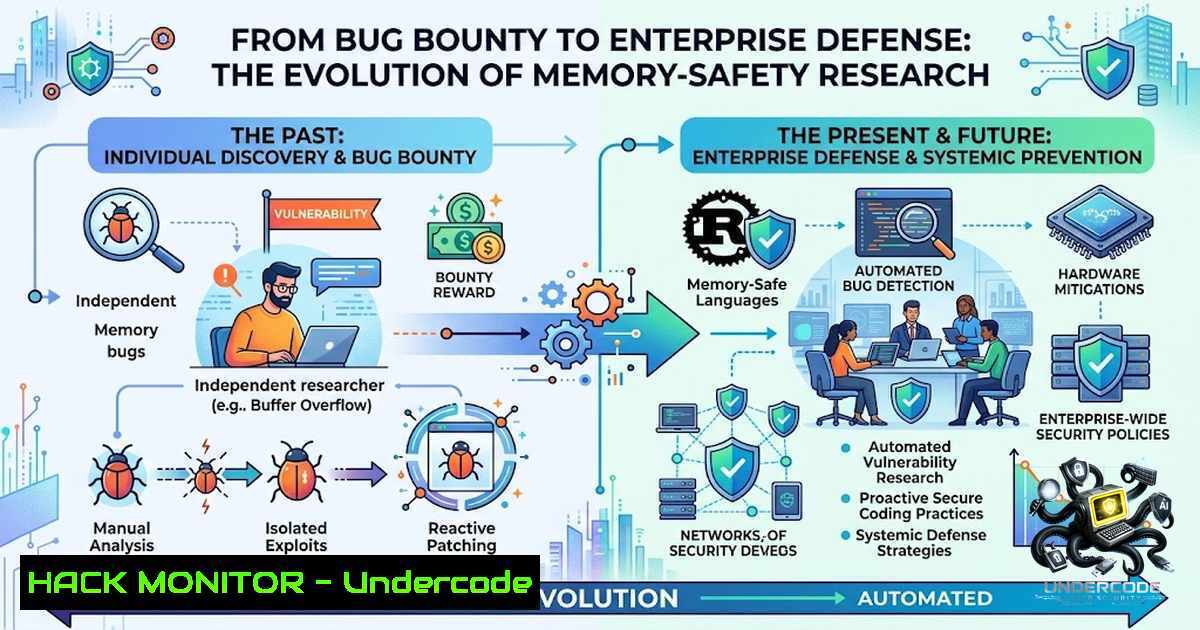
Introduction:
The transition from independent security research to enterprise-grade vulnerability discovery represents a critical maturation point in any cybersecurity professional’s career. As C/C++ codebases powering AI frameworks, browser engines, and embedded systems continue to expand, the demand for researchers who can systematically identify memory corruption vulnerabilities at scale has never been greater. The convergence of traditional fuzzing techniques with AI-powered detection agents is fundamentally reshaping how organizations approach application security, moving from reactive patching to proactive, engine-level vulnerability eradication.
Learning Objectives & Secrets:
- Objective 1: Master Memory-Safety Assessment at Scale – Develop a phased methodology for memory-corruption hunting that combines theory, fuzzing, taint analysis, and crash triage to systematically uncover buffer overflows and use-after-free vulnerabilities across C/C++ targets.
-
Objective 2 Secret Tip: AI-Powered UAF Detection – Leverage AI agents like Google’s “Big Sleep” to identify use-after-free vulnerabilities in complex rendering engines—the same technique that uncovered critical Chrome ANGLE vulnerabilities that traditional static analysis missed.
-
Objective 3 Secret Tip: Coverage-Guided Fuzzing Optimization – Deploy AFL++ with corpus optimization strategies that prioritize inputs reaching new code paths, dramatically improving crash discovery rates in large codebases like Chromium and TensorRT.
You Should Know:
1. Memory Corruption Analysis in C/C++ Codebases
Memory corruption vulnerabilities remain among the most dangerous weaknesses in modern software, with out-of-bounds writes, out-of-bounds reads, and use-after-free consistently ranking in the Top 10 Most Dangerous Weaknesses. These vulnerabilities are particularly prevalent in C/C++ codebases due to manual memory management, making them prime targets for bug bounty researchers and red teams alike.
To systematically identify memory corruption, researchers employ a multi-layered approach combining static analysis, dynamic fuzzing, and manual code review. Compiler-based static analysis using GCC and Clang enables deep interprocedural checks, while dedicated analyzers like Cppcheck, Semgrep, and CodeQL automate vulnerability detection at scale. For dynamic analysis, coverage-guided fuzzing frameworks like AFL++ and libFuzzer mutate input corpora and retain inputs that reach new code paths.
Step-by-Step Guide: Memory Corruption Assessment
 Linux: Install CodeQL for static analysis
wget https://github.com/github/codeql-cli-binaries/releases/latest/download/codeql-linux64.zip
unzip codeql-linux64.zip
export PATH=$PATH:/path/to/codeql

Create CodeQL database for C/C++ project
codeql database create ./db --language=cpp --command="make"

Run security queries
codeql database analyze ./db --format=sarif-latest --output=results.sarif codeql/cpp-queries

Windows: Use Clang static analyzer
clang --analyze -Xanalyzer -analyzer-output=text target.c
2. Advanced Fuzzing with AFL++ for C/C++ Targets
AFL++ (American Fuzzy Lop Plus Plus) has become the industry-standard coverage-guided fuzzer for security researchers, consistently outperforming its predecessor in head-to-head benchmarks. The tool mutates input corpora, runs the harness, and retains inputs that discover new code paths—a process that systematically explores program execution states to uncover edge cases and crashes.
For C/C++ targets, AFL++ supports various instrumentation modes including LLVM-based instrumentation via afl-clang-fast, which provides superior performance compared to traditional GCC instrumentation. The fuzzing process typically involves building a harness that exercises the target code, compiling with AFL++ instrumentation, and running the fuzzer with a minimal seed corpus.
Step-by-Step Guide: AFL++ Fuzzing Setup
 Linux: Install AFL++
git clone https://github.com/AFLplusplus/AFLplusplus
cd AFLplusplus
make distrib
sudo make install

Compile target with AFL++ instrumentation
afl-clang-fast -o fuzz_target fuzz_target.c

Create seed corpus directory
mkdir seeds
echo "test input" > seeds/seed1.txt

Run fuzzer with corpus optimization
afl-fuzz -i seeds -o findings -m none -t 1000 -- ./fuzz_target @@

Monitor crashes and triage
afl-collect -d findings/ output/ -- ./fuzz_target @@
For complex C++ codebases, fuzzing harnesses must be carefully designed to initialize objects, manage memory, and handle exceptions properly. Integration into CI/CD pipelines enables continuous fuzzing, catching regressions before they reach production.
3. Use-After-Free Detection with AI Agents
The discovery of Google’s “Big Sleep” AI agent identifying a use-after-free vulnerability in Chrome’s ANGLE rendering engine marked a paradigm shift in vulnerability research. This AI-powered approach combines large language model reasoning with directed fuzzing to autonomously detect complex memory safety issues that traditional tools often miss.
UAF vulnerabilities occur when memory is freed but subsequently accessed, leading to potential code execution or sandbox escape. Modern AI agents can analyze code semantics, extract constraints, and generate targeted test cases that trigger these vulnerabilities with unprecedented efficiency. The FuzzingBrain V2 system, for example, achieved a 90% detection rate on C/C++ datasets and discovered 41 zero-day vulnerabilities in real-world deployments.
Step-by-Step Guide: UAF Detection Workflow
 Linux: Use AddressSanitizer for runtime UAF detection
g++ -fsanitize=address -g -o target target.cpp
./target

Use Valgrind for memory error detection
valgrind --tool=memcheck --leak-check=full ./target

Windows: Use Application Verifier
appverif /enable Heaps Exceptions Handles Locks Memory TLS /for target.exe

Chromium-specific: Enable ASAN build
gn gen out/asan --args="is_debug=false is_asan=true"
ninja -C out/asan chrome
4. Vulnerability Chaining and Privilege Escalation
Modern bug bounty hunting requires more than finding individual vulnerabilities—it demands the ability to chain multiple weaknesses into a complete exploit path. At events like Pwn2Own Automotive 2026, researchers demonstrated this by exploiting 37 zero-day vulnerabilities in Tesla’s infotainment system, chaining memory corruption bugs with logic flaws to achieve root-level access.
Privilege escalation often involves combining memory corruption with broken access controls. For instance, researchers have demonstrated how API authentication bypasses can be chained with IDOR (Insecure Direct Object Reference) vulnerabilities to gain unauthorized access to vehicle systems. The key to successful chaining lies in understanding how different components interact and identifying trust boundaries that can be crossed.
Step-by-Step Guide: Vulnerability Chaining Methodology
 Linux: Identify privilege escalation vectors
find / -perm -4000 -type f 2>/dev/null  Find SUID binaries
sudo -l  Check sudo permissions

Windows: Check privilege escalation paths
whoami /priv  List current privileges
accesschk.exe -uwcqv "Authenticated Users"   Check writable services

Network: Test for IDOR vulnerabilities
curl -X GET "https://api.target.com/user/123" -H "Authorization: Bearer $TOKEN"
curl -X GET "https://api.target.com/user/124" -H "Authorization: Bearer $TOKEN"  Test unauthorized access

Chain exploitation: Combine memory corruption with privilege escalation
 1. Trigger UAF to gain memory read/write
 2. Overwrite function pointer to redirect execution
 3. Escalate privileges via compromised process
- API Security and Cloud Hardening for AI/ML Pipelines
As organizations increasingly deploy AI and machine learning frameworks like NVIDIA TensorRT and Meta FAISS, securing the underlying infrastructure becomes paramount. CVE-2026-24268, a heap-based buffer overflow in TensorRT’s ONNX model parsing, demonstrates how memory corruption in AI frameworks can lead to remote code execution. Similarly, FAISS deserialization vulnerabilities can lead to arbitrary file reads and out-of-bounds memory access.
Securing AI/ML pipelines requires a defense-in-depth approach: validating input data before processing, sandboxing model execution, implementing strict memory safety practices, and continuously fuzzing parsing components. Organizations should also implement API rate limiting, authentication, and input validation to prevent exploitation of vector search APIs and model serving endpoints.
Step-by-Step Guide: API Security and Cloud Hardening
 Linux: Implement API rate limiting with iptables
iptables -A INPUT -p tcp --dport 443 -m hashlimit --hashlimit-1ame api \
--hashlimit-above 100/sec --hashlimit-burst 200 -j DROP

Configure WAF rules for API protection (ModSecurity example)
SecRule REQUEST_URI "@contains /api/v1/model" "id:1001,phase:1,deny,status:403,\
msg:'API abuse detected'"

Kubernetes: Implement Pod Security Standards
kubectl apply -f - <<EOF
apiVersion: policy/v1
kind: PodSecurityPolicy
metadata:
name: restricted
spec:
privileged: false
allowPrivilegeEscalation: false
requiredDropCapabilities: ["ALL"]
runAsUser:
rule: MustRunAsNonRoot
EOF

Validate ONNX model files before parsing
python3 -c "
import onnx
try:
model = onnx.load('model.onnx')
onnx.checker.check_model(model)
except Exception as e:
print(f'Invalid model: {e}')
exit(1)
"
6. Red Team Operations and Application Security Integration
Modern red team operations increasingly focus on memory-safety vulnerabilities and application-layer attacks. C++ remains a primary language for both defensive and offensive security tooling, with techniques ranging from memory manipulation and shellcode execution to reflective DLL injection. Understanding how attackers exploit memory corruption is essential for building effective defenses.
Application security teams must adopt a proactive stance, implementing memory-safe coding practices, conducting regular fuzzing campaigns, and integrating security testing into CI/CD pipelines. Tools like CodeQL, Semgrep, and custom fuzzing harnesses should be part of every development workflow to catch vulnerabilities before they reach production.
Step-by-Step Guide: Red Team Tooling and Defenses
 Linux: Set up memory protection mechanisms
echo 2 > /proc/sys/kernel/randomize_va_space  Enable ASLR
echo 1 > /proc/sys/kernel/ptr_erobust  Enable pointer encryption

Windows: Enable exploit protection
Set-ProcessMitigation -1ame target.exe -Enable DEP,ASLR,CFG

Deploy CodeQL in CI/CD pipeline
 .github/workflows/codeql.yml
name: "CodeQL Analysis"
on:
push:
branches: [bash]
jobs:
analyze:
runs-on: ubuntu-latest
steps:
- uses: actions/checkout@v3
- uses: github/codeql-action/init@v2
with:
languages: cpp
- uses: github/codeql-action/analyze@v2
What Undercode Say:
- Key Takeaway 1: The transition from independent bug bounty hunting to enterprise vulnerability research represents a natural career progression that leverages deep C/C++ expertise, fuzzing methodologies, and AI-powered detection tools to address memory corruption at its root cause.
-
Key Takeaway 2: The convergence of traditional fuzzing (AFL++, libFuzzer) with AI agents (Big Sleep, FuzzingBrain) is creating unprecedented capabilities for automated vulnerability discovery, with AI-powered systems now matching or exceeding human researchers in certain detection scenarios.
The security researcher’s journey from solo bug bounty hunter to enterprise team member reflects a broader industry trend: organizations are recognizing that memory-safety vulnerabilities in C/C++ codebases require specialized expertise that goes beyond conventional application security. The ability to analyze complex architectures at the RFC and engine level, develop custom fuzzing tools, and chain multiple vulnerabilities into working exploits is increasingly valuable. As AI frameworks like TensorRT and FAISS become critical infrastructure, the demand for researchers who can identify and mitigate memory corruption at scale will only intensify. The future belongs to those who can combine deep technical knowledge with systematic, methodological approaches to vulnerability discovery and remediation.
Prediction:
- +1 AI-powered vulnerability detection agents will become standard components of enterprise security toolchains within 18-24 months, reducing time-to-discovery for critical memory corruption vulnerabilities by 60-80%.
-
+1 The demand for C/C++ memory-safety specialists will surge as AI/ML frameworks become prime attack surfaces, with organizations offering premium compensation for researchers who can systematically identify and mitigate memory corruption at scale.
-
-1 Without widespread adoption of memory-safe languages and rigorous fuzzing practices, the AI/ML supply chain will become a primary vector for large-scale compromises, with attackers weaponizing deserialization vulnerabilities in vector databases and model parsing libraries.
-
+1 Integration of fuzzing into CI/CD pipelines will become mandatory for organizations handling sensitive data, with regulatory frameworks beginning to mandate coverage-guided fuzzing for critical infrastructure software.
-
-1 The sophistication of vulnerability chaining attacks will increase, with attackers combining memory corruption, API security flaws, and authentication bypasses to achieve complete system compromise—as demonstrated by the 37 zero-day chain against Tesla at Pwn2Own Automotive 2026.
▶️ Related Video (80% Match):
https://www.youtube.com/watch?v=8hjKRJPWKK0
🎯Let’s Practice For Free:
🎓 Live Courses & Certifications:
Join Undercode Academy for Verified Certifications
🚀 Request a Custom Project:
Secure, high-velocity infrastructure and disruptive technological engineering. Contact our engineering team for high-tier development and proprietary systems:
[email protected]
💎 Smart Architecture | 🛡️ Secure by Design | ⭐ Trusted by Thousands
IT/Security Reporter URL:
Reported By: https://lnkd.in/p/eJb_dzk4 – Hackers Feeds
Extra Hub: Undercode MoN
Basic Verification: Pass ✅


