
Listen to this Post
Introduction:
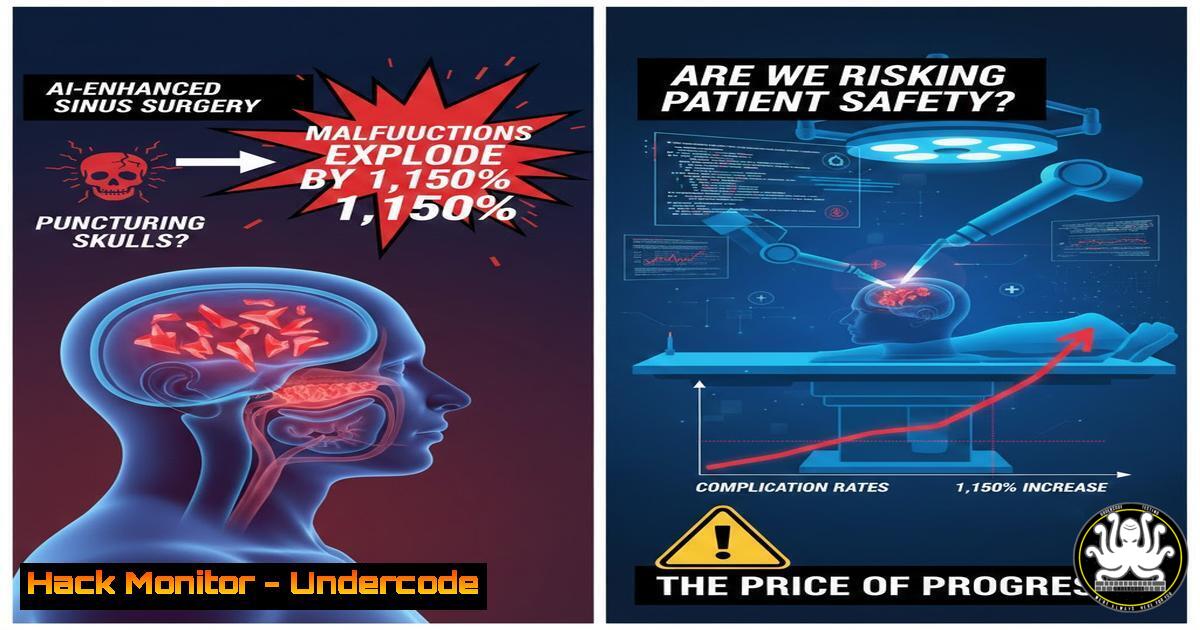
The integration of Artificial Intelligence into medical devices is intended to enhance precision and patient outcomes, but a recent investigation into the TruDi sinus surgery system reveals a starkly different reality. After Acclarent added AI algorithms to the device, malfunction reports skyrocketed from a manageable eight incidents to over 100, including horrifying accounts of skull puncturing. This dramatic failure highlights a critical intersection between software supply chain security, AI model validation, and the physical dangers of cyber-physical systems (CPS). For cybersecurity professionals, this is not just a medical error; it is a case study in how insecure AI integration can turn life-saving tools into life-threatening weapons.
Learning Objectives:
- Understand the risks associated with integrating third-party AI algorithms into legacy medical and industrial devices.
- Analyze the regulatory and technical failures that allowed an unsafe AI model to reach production.
- Learn how to apply basic security and validation checks to ensure the integrity of AI-driven systems.
You Should Know:
- The Anatomy of the Failure: When Software Updates Turn Lethal
The core issue with the TruDi system lies in the “enhancement” process. Initially, the device operated on deterministic software, resulting in only eight malfunctions over three years. Post-AI integration, that number jumped to at least 100 adverse events.
From a technical perspective, this suggests a failure in the Non-Deterministic nature of the AI model. Unlike traditional code, AI decision-making is based on probabilistic weights, which can lead to unpredictable outputs if the training data does not perfectly match real-world surgical scenarios.
What to Verify (Security & Integrity Checks):
To prevent such incidents in critical infrastructure, we must verify the integrity of the system before and after updates.
Linux Command (for Embedded Linux systems – checking system logs for anomalies):
 Check for kernel errors or driver issues post-update
dmesg | grep -i error

Verify the integrity of the new AI model files against a known good hash
sha256sum /path/to/ai_model.bin
 Compare this output to the official hash provided by the vendor
Windows Command (for connected workstations):
 Check Application logs for errors related to the surgical software
Get-EventLog -LogName Application -EntryType Error -Newest 50 | Where-Object { $_.Source -like "TruDi" }

Verify digital signature of the AI module to ensure it wasn't tampered with
Get-AuthenticodeSignature -FilePath "C:\Program Files\Acclarent\TruDi\ai_module.dll"
2. Network Segmentation: Isolating the Surgical Suite
If the TruDi system is connected to a hospital network for updates or data sharing, a compromised device could act as a pivot point for attackers, or simply fail due to network latency or packet loss affecting the AI’s real-time feedback.
Step‑by‑step guide: Isolating Critical Medical Devices (Network Hardening)
- VLAN Segmentation: Place all surgical devices on a dedicated VLAN with strict access control lists (ACLs).
- Firewall Rules: On a Cisco or similar enterprise firewall, restrict traffic.
Example Cisco IOS ACL to allow only specific update servers
access-list 101 permit tcp host [bash] host [bash] eq 443
access-list 101 deny ip any any log
- Monitor for Beaconing: Use Wireshark or tcpdump to check if the device is phoning home to unauthorized endpoints, which could indicate a compromised AI model phoning out data.
tcpdump command to capture traffic from the device for analysis
sudo tcpdump -i eth0 -n host [bash] -w surgical_traffic.pcap
3. AI Model Validation: The “Black Box” Problem
The report mentions the Sonio Detect analyzer misidentifying fetal structures due to a “faulty algorithm.” This is a classic case of Model Drift or poor training data. In cybersecurity terms, we need to treat the AI model as code and subject it to runtime protection.
Verification Techniques:
- Adversarial Testing: Input edge-case data into the system to see if it fails.
- Output Validation: Ensure the AI’s output is within acceptable safety bounds.
Conceptual Python Script for Boundary Checking (simulating a safety layer):
 Pseudo-code for a safety wrapper around an AI surgical output
def surgical_ai_safety_wrapper(ai_output):
 ai_output contains coordinates for surgical tool (x, y, depth_mm)
max_safe_depth = 5.0  Maximum safe depth in mm to avoid skull puncture

if ai_output['depth_mm'] > max_safe_depth:
 Trigger alarm and halt operation
print("CRITICAL: AI suggests unsafe depth. Halting.")
log_event("AI_SAFETY_VIOLATION", ai_output)
return False
else:
return True
4. Incident Response for Cyber-Physical Failures
When a malfunction occurs, especially one that causes physical harm (like skull puncture), it must be treated as a Cyber-Physical Incident.
Step‑by‑step guide: Initial Triage
- Isolate: Immediately disconnect the device from the network to prevent data loss or further corruption.
- Capture Volatile Data: If possible, capture the RAM of the device to analyze what the AI was processing.
Linux: `sudo cat /dev/mem > mem_dump.bin` (Caution: This is risky and system-specific)
Windows: Use FTK Imager or DumpIt to capture memory. - Log Collection: Securely copy all logs (surgical logs, system logs, AI inference logs) to a secure analysis server using SCP.
scp user@device_ip:/var/log/surgical/ ./incident_logs/
- Hash Preservation: Generate hashes of all collected data to maintain the chain of custody.
sha256sum ./incident_logs/ > hashes.txt
5. Regulatory and Compliance Gaps (FDA Approval)
The article notes that the FDA approved these AI integrations. This highlights a gap in regulatory frameworks regarding software validation. For professionals, this means conducting your own Risk Assessment Framework (like NIST SP 800-30) before deploying AI updates.
Checklist for AI Device Approval:
- [ ] Has the vendor provided an SBOM (Software Bill of Materials) for the AI model?
- [ ] What is the Mean Time Between Failures (MTBF) for the AI logic?
- [ ] Is there a human-in-the-loop override that functions independently of the AI?
- [ ] Has the device been tested against the OWASP IoT Top 10 vulnerabilities?
6. Exploitation and Mitigation: Sensor Spoofing
Could the spike in malfunctions be due to a cybersecurity incident? Possibly. AI models are susceptible to adversarial attacks. If an attacker could spoof the sensor data feeding the AI (e.g., camera or LiDAR used for guidance), they could cause the system to “see” a safe path when there is danger.
Mitigation Strategy: Sensor Data Integrity
- Implement cryptographic signing of sensor data streams to ensure they haven’t been tampered with in transit from the sensor to the AI processor.
- Use redundant sensors and a consensus mechanism (voting) to validate environmental data.
What Undercode Say:
- The Convergence of Safety and Security: This incident proves that software security is no longer just about data breaches; it is about public safety. A malfunctioning AI in a surgical device is equivalent to a zero-day exploit in the physical world.
- Validation is Key: The assumption that an AI update is “safe” simply because it passed vendor testing is dangerous. Organizations must implement runtime application self-protection (RASP) for AI and demand explainability from vendors to audit these “black box” decisions.
The dramatic rise from 8 to 100 malfunctions is a stark warning. We are integrating probabilistic systems into deterministic, life-critical environments without sufficient guardrails. Until we treat AI models with the same rigor as medical-grade software—including source code review, penetration testing, and adversarial validation—these “nightmare” scenarios will become the norm.
Prediction:
Within the next 18 months, we will see a surge in regulatory action specifically targeting AI in critical infrastructure. The FDA or equivalent global bodies will mandate “kill switches” and independent, third-party red teaming of medical AI algorithms before deployment. Furthermore, litigation against device manufacturers for “software-induced medical malpractice” will rise, forcing a shift in liability from the surgeon to the software vendor, ultimately slowing down the reckless rush to integrate unproven AI into life-or-death systems.
▶️ Related Video (76% Match):
🎯Let’s Practice For Free:
IT/Security Reporter URL:
Reported By: Michael Tchuindjang – Hackers Feeds
Extra Hub: Undercode MoN
Basic Verification: Pass ✅


