Listen to this Post
Introduction:
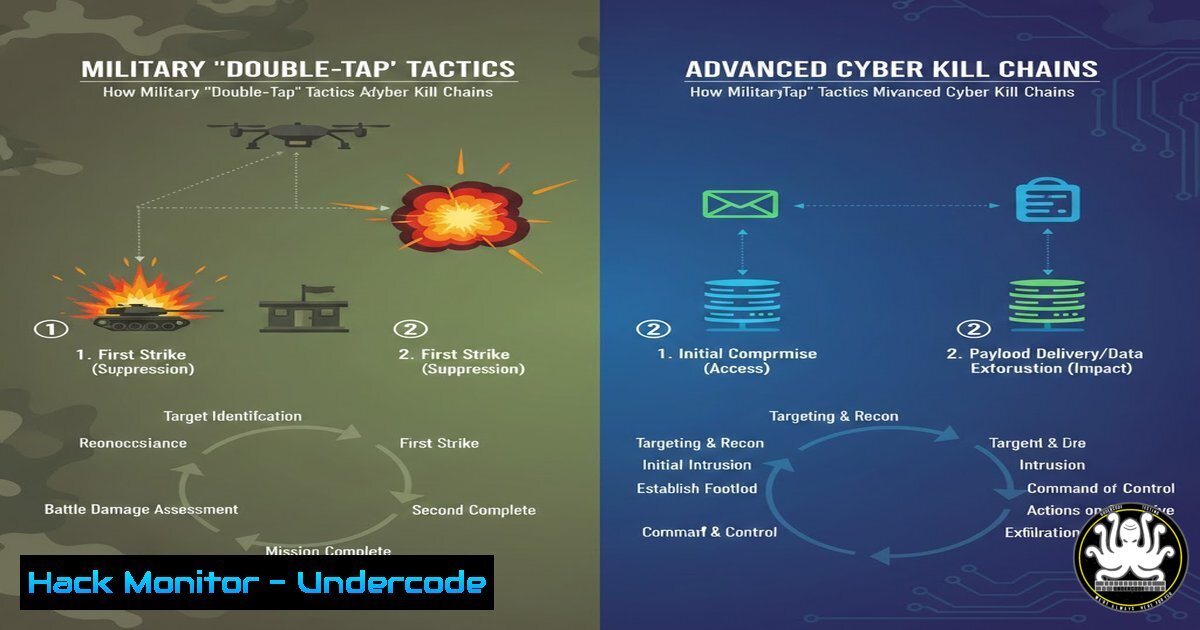
The controversial military concept of a “double-tap” strike, targeting initial responders and survivors, finds a chilling parallel in modern cybersecurity. Advanced Persistent Threats (APTs) and sophisticated ransomware groups employ similar layered attack strategies to ensure maximum damage, evade detection, and eliminate recovery options. This article decodes these multi-stage cyber kill chains, translating battlefield tactics into actionable defensive protocols for IT professionals.
Learning Objectives:
- Understand the “Cyber Double-Tap” metaphor: initial compromise followed by targeted follow-up attacks on defenders and backups.
- Learn to implement enhanced logging, immutable backups, and deceptive defense (honeypots) to detect and thwart layered intrusions.
- Master critical command-line and tool-based forensics to identify evidence of persistence and lateral movement before the “second tap” occurs.
You Should Know:
1. The Initial Strike: Reconnaissance and Weaponization
The first “tap” is the initial breach. Attackers conduct extensive reconnaissance, often using open-source intelligence (OSINT) and automated scanning to identify vulnerabilities, much like identifying a target. Phishing campaigns weaponized with malicious documents or links serve as the initial ordnance.
Step-by-step guide explaining what this does and how to use it.
Reconnaissance Simulation (Defensive Perspective): Use defensive tools to see what attackers see.
On Linux, use `nmap` to scan your own perimeter: `sudo nmap -sV -O –script vuln
On Windows, use `netstat` to monitor connections: `netstat -ano | findstr ESTABLISHED` to spot unusual outbound calls.
Log Aggregation: Centralize logs using a SIEM (Security Information and Event Management) system. For a quick audit, on Linux, examine authentication logs: `sudo tail -f /var/log/auth.log` or `/var/log/secure` for failed login attempts.
- The Digital “No Quarter”: Destroying Backups and Recovery Options
A true cyber “double-tap” aims to destroy the victim’s ability to recover. This involves targeted encryption or deletion of backups, both on-site and in the cloud. Ransomware like LockBit now includes commands to locate and wipe Volume Shadow Copies on Windows and snapshot repositories on NAS devices.
Step-by-step guide explaining what this does and how to use it.
Implement Immutable Backups: Configure backups that cannot be altered or deleted for a retention period. With AWS S3, enable Object Lock: aws s3api put-object-lock-configuration --bucket <bucket-name> --object-lock-configuration ObjectLockEnabled=Enabled. For on-prem, use dedicated backup appliances with air-gapping or WORM (Write-Once-Read-Many) functionality.
Harden Backup Servers: Isolate backup management interfaces from general network access. Use strict firewall rules (e.g., `iptables` on Linux) to allow connections only from the backup application server.
- Targeting First Responders: Compromising Security Tools and Admin Accounts
Sophisticated attackers will “target the medics.” They disable or compromise endpoint detection and response (EDR) agents, uninstall antivirus software, and hijack administrative accounts used by IT security teams for remediation.
Step-by-step guide explaining what this does and how to use it.
Monitor Integrity of Security Tools: Create a cron job or scheduled task to check the status of critical services.
Linux: `systemctl is-active –quiet osqueryd || echo “Osquery is down!” | mail -s “Alert” [email protected]`
Windows (PowerShell): `Get-Service “WinDefend” | Select-Object Status, Name`
Use Privileged Access Workstations (PAWs): Mandate that all administrative tasks on critical systems be performed from dedicated, hardened workstations with no internet browsing or email access to avoid credential phishing.
4. Covering Tracks: Forensic Anti-Forensics and Log Wiping
After the attack, the adversary seeks to erase evidence. This involves clearing Windows Event Logs, deleting specific Linux `bash_history` entries, and using tools like `timestomp` to alter file metadata.
Step-by-step guide explaining what this does and how to use it.
Enable Forwarded Logging: Ensure logs are sent in real-time to a centralized, read-only server. For Linux using rsyslog, configure: . @<secure-log-server-IP>:514. This prevents local log deletion from destroying evidence.
Hunt for Evidence of Log Clears: In your SIEM, create alerts for Event ID 1102 (Windows log cleared) on Windows systems. On Linux, monitor for abrupt truncation of log files using integrity checking tools like `auditd` or tripwire.
- The Legal Framework: Preparing for the “Investigation” – Your Incident Response Plan
Just as the political post demands an investigation, a cyber attack requires a structured, legally-sound response. Having an Incident Response (IR) plan that includes forensic data preservation is non-negotiable.
Step-by-step guide explaining what this does and how to use it.
Create a Forensic Disk Image: Use `dd` on Linux to create a bit-for-bit copy of a compromised system’s drive for analysis: sudo dd if=/dev/sda1 of=/mnt/secure_evidence/disk_image.img bs=4M status=progress. On Windows, use FTK Imager or the built-in `diskcopy` command.
Document Chain of Custody: Maintain a strict log of who accessed evidence, when, and why. This is crucial if legal proceedings follow the breach. A simple chain-of-custody form tracked in a secure system is essential.
What Undercode Say:
- The Paradigm is Hybrid: The most significant modern threats blend cyber and psychological warfare, aiming to create chaos and paralyze response capabilities, not just steal data. The “double-tap” is a mindset of total disruption.
- Defense Requires Deception and Resilience: Static defenses fail. Security must incorporate deception technology (honeypots masquerading as backup servers) and resilient, automated recovery processes that can operate even if the security team is under attack.
Analysis: The LinkedIn post, while geopolitical, perfectly frames the escalation philosophy of top-tier cyber adversaries. They are not satisfied with a single point of failure. Modern defense must therefore be holistic, assuming breach and focusing on survivability. The “kill chain” must be broken at multiple stages, with particular emphasis on protecting the tools and processes used for response and recovery. Investing in immutable backups and centralized, hardened logging is the equivalent of enforcing the Geneva Conventions in your digital territory—it establishes rules for recovery and accountability after a devastating attack.
Prediction:
The convergence of AI and automated exploitation will accelerate the “cyber double-tap” into a near-simultaneous event. Future attacks will leverage AI to perform real-time reconnaissance, vulnerability matching, and automated lateral movement, followed by AI-driven counter-response measures that specifically target defensive AI algorithms in a machine-speed duel. The “investigation” phase will increasingly rely on AI-assisted forensics to parse through the overwhelming data generated by these hyper-fast attacks. The organizations that will survive are those building autonomous defense systems capable of contained self-recovery while maintaining a human-over-the-loop for strategic decisions.
🎯Let’s Practice For Free:
IT/Security Reporter URL:
Reported By: Hanslak Breaking – Hackers Feeds
Extra Hub: Undercode MoN
Basic Verification: Pass ✅


