Listen to this Post
Introduction:
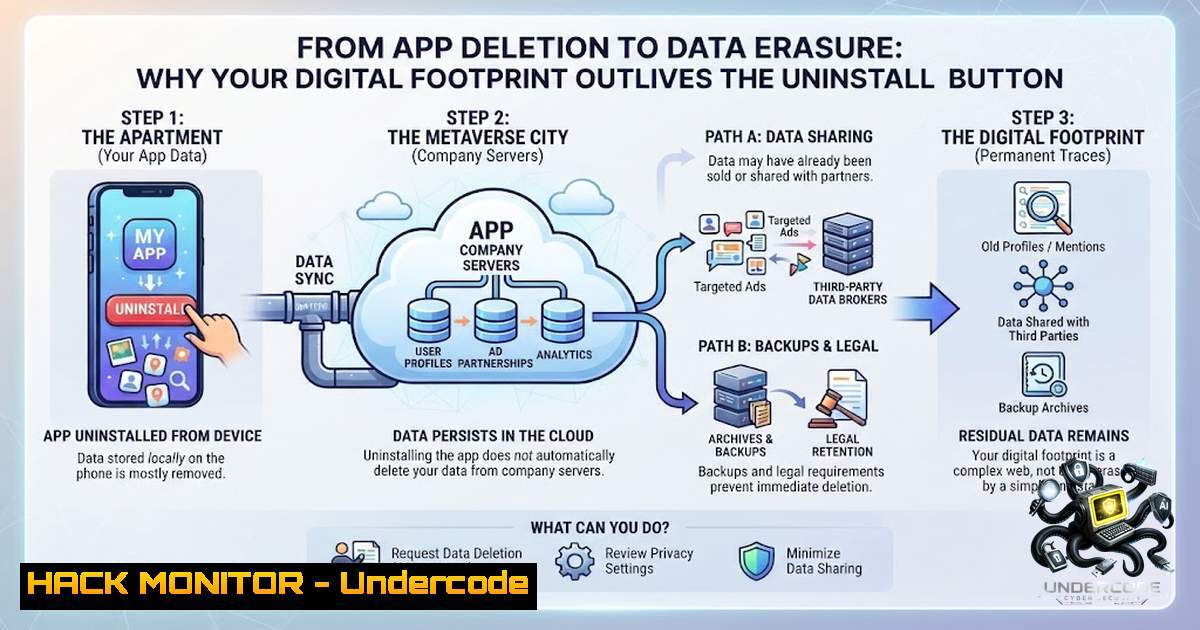
In an era where digital applications have become extensions of our daily lives, a dangerous misconception persists: that simply deleting an app from your smartphone erases your digital footprint from the company’s servers. This assumption couldn’t be further from reality. Under India’s Digital Personal Data Protection Act, 2023 (DPDP Act), uninstalling an application removes nothing from the organization’s databases—it merely severs the local connection. The legal reality is that application deletion, account deletion, consent withdrawal, and data erasure are four entirely distinct concepts, each governed by different statutory frameworks and technical requirements. Understanding these distinctions is no longer optional—it is essential for every data principal navigating India’s evolving data protection landscape.
Learning Objectives:
- Understand the legal distinction between application deletion, account deletion, consent withdrawal, and data erasure under the DPDP Act, 2023
- Master technical implementation of data erasure requests across distributed systems, including API design, database operations, and cloud infrastructure
- Learn practical compliance strategies for data fiduciaries, including data mapping, retention policies, and audit-ready deletion proof mechanisms
- The Four Layers of Digital Disconnect: Application ≠ Account ≠ Consent ≠ Erasure
The DPDP Act establishes a clear hierarchy of data principal rights that fundamentally reshapes how organizations must handle personal data. Section 12 of the Act explicitly grants data principals the right to correction and erasure of personal data. However, exercising this right requires navigating four distinct legal and technical layers:
Application Deletion removes the local instance of an application from your device. It does not trigger any server-side action, nor does it communicate with the data fiduciary’s systems. Your profile, transaction history, preferences, and behavioral data remain intact on the organization’s infrastructure.
Account Deletion typically deactivates your user account, often rendering it inaccessible. However, many organizations retain account data for extended periods—sometimes indefinitely—for analytics, fraud prevention, or “reactivation convenience.” Under the DPDP Act, account deletion does not automatically constitute erasure of personal data.
Consent Withdrawal is a statutory right under the DPDP Act that requires the withdrawal process to be as easy as giving consent. When a data principal withdraws consent, the data fiduciary must cease processing and erase personal data unless retention is required by another law. However, consent withdrawal governs future processing—it does not undo completed obligations, such as fulfilling a paid transaction.
Data Erasure is the final and most comprehensive layer. Under Section 12(3) of the DPDP Act, data principals can demand erasure of their personal data once the processing purpose is fulfilled or consent is withdrawn. This erasure must extend beyond the primary database to all downstream systems, processors, and backups.
The critical takeaway is that these four actions are sequential and cumulative—each builds upon the previous, but none automatically triggers the next. Organizations must design systems that allow data principals to progress through each layer independently while maintaining compliance with statutory timelines, typically not exceeding 30 days from request receipt.
2. Technical Implementation: Building a GDPR/DPDP-Compliant Erasure Pipeline
Implementing the right to erasure requires a systematic approach to data deletion across distributed architectures. Modern enterprises store personal data across primary databases, read replicas, search indexes, caches, object storage, analytics platforms, audit logs, backups, and third-party sub-processors. A comprehensive erasure pipeline must address each of these storage locations.
API-First Design for Data Subject Requests
Every data subject right must have a tested API endpoint or documented back-office process before the system goes live. For the right to erasure, the standard implementation pattern is:
DELETE /api/v1/me
When called, this endpoint must trigger a cascading deletion across all data stores containing personal information. The erasure checklist must cover:
- Primary relational database (anonymize or delete rows)
- Read replicas (propagate deletion)
- Search index (Elasticsearch, Azure Cognitive Search, etc.)
- In-memory cache (Redis, IMemoryCache)
- Object storage (S3, Azure Blob — profile pictures, documents)
- Email service logs (delivery logs from services like SendGrid)
- Analytics platform (user deletion API for Mixpanel, Amplitude, GA4)
- Audit logs (anonymize identifying fields — do not delete the event)
- Backups (document the backup TTL; accept that backups expire naturally)
- CDN edge cache (purge if personal data may be cached)
- Third-party sub-processors (trigger their deletion API or document the manual step)
Database Deletion Operations
For relational databases, the deletion operation must be carefully crafted to avoid performance degradation:
-- PostgreSQL: Soft delete with anonymization
UPDATE users
SET email = 'deleted_' || id || '@example.com',
phone = NULL,
name = 'Deleted User',
deleted_at = NOW(),
consent_withdrawn = TRUE
WHERE id = 'user_id_to_delete';

-- Hard delete after retention period
DELETE FROM users
WHERE deleted_at < NOW() - INTERVAL '30 days';
For large datasets with millions of rows, consider partitioning to improve deletion performance. Implement a deletion queue table to process requests asynchronously:
-- Create deletion queue table
CREATE TABLE deletion_requests (
id UUID PRIMARY KEY,
user_id VARCHAR(255) NOT NULL,
requested_at TIMESTAMP DEFAULT NOW(),
processed_at TIMESTAMP,
status VARCHAR(50) DEFAULT 'pending',
initiated_by VARCHAR(255)
);

-- Scheduled job to process queue
CREATE OR REPLACE FUNCTION process_deletion_queue()
RETURNS VOID AS $$
BEGIN
UPDATE deletion_requests
SET processed_at = NOW(), status = 'processing'
WHERE status = 'pending' AND requested_at < NOW() - INTERVAL '1 hour';

-- Perform cascading deletions for each user
-- ...

UPDATE deletion_requests
SET status = 'completed'
WHERE status = 'processing';
END;
$$ LANGUAGE plpgsql;
Windows PowerShell Script for Data Erasure Verification
For Windows-based environments, administrators can use PowerShell to verify that erasure operations have propagated correctly:
 Data Erasure Verification Script
param(
[Parameter(Mandatory=$true)]
[bash]$UserId,
[bash]$LogPath = "C:\Logs\erasure_audit.log"
)

function Write-AuditLog {
param([bash]$Message)
$timestamp = Get-Date -Format "yyyy-MM-dd HH:mm:ss"
"$timestamp - $Message" | Out-File -FilePath $LogPath -Append
}

Check primary database
Write-AuditLog "Checking primary database for user: $UserId"
$primaryCheck = Invoke-Sqlcmd -Query "SELECT COUNT() as Count FROM users WHERE id = '$UserId' AND deleted_at IS NOT NULL" -ServerInstance "localhost"
if ($primaryCheck.Count -eq 0) {
Write-AuditLog "WARNING: User $UserId still exists in primary database"
}

Check Redis cache
Write-AuditLog "Checking Redis cache"
$redisCheck = redis-cli EXISTS "user:$UserId"
if ($redisCheck -eq 1) {
Write-AuditLog "WARNING: User $UserId still exists in Redis cache"
redis-cli DEL "user:$UserId"
}

Check Elasticsearch index
Write-AuditLog "Checking Elasticsearch"
$esCheck = Invoke-RestMethod -Uri "http://localhost:9200/users/_search?q=id:$UserId" -Method Get
if ($esCheck.hits.total.value -gt 0) {
Write-AuditLog "WARNING: User $UserId still exists in Elasticsearch"
Invoke-RestMethod -Uri "http://localhost:9200/users/_delete_by_query?q=id:$UserId" -Method Post
}

Check Azure Blob Storage
Write-AuditLog "Checking Azure Blob Storage"
$blobCheck = Get-AzStorageBlob -Container "user-data" -Prefix "$UserId/" -Context $storageContext
if ($blobCheck) {
Write-AuditLog "WARNING: Blobs found for user $UserId"
$blobCheck | Remove-AzStorageBlob -Force
}

Write-AuditLog "Erasure verification completed for user: $UserId"
- Data Discovery and Classification: The Foundation of Compliance
Effective data protection begins with comprehensive knowledge of your data holdings. Organizations cannot delete what they cannot find, and they cannot find what they did not know was copied. Data discovery and classification form the foundation upon which all erasure capabilities are built.
Data Mapping Exercise
Conduct a thorough data mapping exercise to pinpoint exactly where personally identifiable information resides across your entire IT ecosystem. This includes:
- Primary application databases
- Data warehouses (Snowflake, BigQuery, Redshift)
- Analytics platforms and dashboards
- Customer support tools (Zendesk, Freshdesk)
- Marketing automation platforms
- AI training datasets and pipelines
- Third-party SaaS vendors
- Internal communication tools (Slack, Teams)
- Backup systems and disaster recovery environments
Data Classification Framework
Assign sensitivity levels to your data. The DPDP framework covers all personal data, but distinguishing between general PII and more sensitive information is crucial for applying proportional security controls. Implement a classification schema:
| Classification | Definition | Examples | Retention Policy |
|||||
| Public | Data intended for public disclosure | Public profiles, published content | Permanent |
| Internal | Data for internal use only | Employee directories, internal communications | As per policy |
| Confidential | Personal data requiring protection | Name, email, phone, address | Until purpose fulfilled |
| Restricted | Highly sensitive personal data | Financial records, health data, biometrics | Strict legal retention only |
Linux Command for Data Discovery
For Linux environments, use the following commands to discover potential PII repositories:
!/bin/bash
 PII Discovery Script

echo "=== PII Discovery Report ==="
echo "Generated: $(date)"
echo

Find database configuration files
echo " Database Configuration Files "
find /etc -1ame ".conf" -o -1ame ".cnf" -o -1ame ".ini" 2>/dev/null | grep -E "(mysql|postgres|mongodb|redis)" | head -20

Find log files containing potential PII patterns
echo -e "\n Log Files with PII Patterns "
grep -r -l -E "([a-zA-Z0-9._%+-]+@[a-zA-Z0-9.-]+.[a-zA-Z]{2,})|([0-9]{10})" /var/log/ 2>/dev/null | head -10

Find backup directories
echo -e "\n Backup Directories "
find / -type d -1ame "backup" -o -1ame "dump" -o -1ame "archive" 2>/dev/null | head -20

Check for Elasticsearch indices
echo -e "\n Elasticsearch Indices "
curl -s "localhost:9200/_cat/indices" 2>/dev/null | awk '{print $3}' | head -10

Check for Redis keys (if Redis is running)
echo -e "\n Redis Key Patterns "
redis-cli KEYS "user:" 2>/dev/null | head -10

echo -e "\n=== Discovery Complete ==="
4. Consent Management and Withdrawal Mechanisms
The DPDP Act treats consent as a continuing legal relationship between the data principal and the data fiduciary. Consent must be free, specific, informed, unconditional, and unambiguous, expressed through a clear affirmative action. Consent cannot be broader than necessity—if a telemedicine app seeks consent both to provide medical services and to access a user’s contact list, the latter consent is invalid if not necessary for the stated purpose.
Building a Consent Management Platform (CMP)
Implement a consent management system to accurately capture, log, and monitor user permissions. Key requirements include:
- Granular consent capture for each processing purpose
- Timestamped consent records with version control
- Consent withdrawal mechanism as easy as giving consent
- Automated processing halt upon withdrawal
- Records of consent and data sharing ensuring transparency and security
API Design for Consent Management
POST /api/v1/consent
{
"userId": "uuid",
"purposes": [
{
"purposeId": "marketing_communications",
"granted": true,
"grantedAt": "2026-07-20T10:00:00Z",
"expiresAt": "2027-07-20T10:00:00Z"
},
{
"purposeId": "analytics_tracking",
"granted": false
}
]
}

DELETE /api/v1/consent/{userId}/purpose/{purposeId}
{
"withdrawnAt": "2026-07-20T10:30:00Z",
"reason": "User request"
}
Windows Command for Consent Log Audit
 Consent Log Audit Script
$consentLog = "C:\Logs\consent_audit.csv"
$today = Get-Date

Extract consent withdrawal patterns
Import-Csv $consentLog |
Where-Object { $<em>.action -eq "withdraw" -and [bash]$</em>.timestamp -gt $today.AddDays(-30) } |
Group-Object purpose |
Select-Object Name, Count |
Export-Csv "C:\Reports\consent_withdrawal_report.csv" -1oTypeInformation

Identify users who withdrew consent but still have active processing
$activeUsers = Get-Content "C:\Data\active_users.txt"
$withdrawnUsers = Import-Csv $consentLog |
Where-Object { $<em>.action -eq "withdraw" -and $</em>.timestamp -gt $today.AddDays(-30) } |
Select-Object -ExpandProperty userId -Unique

$nonCompliantUsers = Compare-Object $activeUsers $withdrawnUsers |
Where-Object { $_.SideIndicator -eq "<=" } |
Select-Object -ExpandProperty InputObject

if ($nonCompliantUsers) {
Write-Host "WARNING: Non-compliant users found: $nonCompliantUsers" -ForegroundColor Red
$nonCompliantUsers | Out-File "C:\Reports\non_compliant_users.txt"
}
5. Cloud Security and Data Retention Compliance
The DPDP Act applies to data processors regardless of where their processing activities take place. Cloud service providers must comply with data privacy regulations, including promptly notifying data principals and the Data Protection Board of India in case of data breaches. The compliance deadline for data fiduciaries is 18 months from November 13, 2025.
Cloud Hardening for Data Protection
Implement the following cloud security measures to protect personal data:
- Encryption at Rest and in Transit: All personal data must be encrypted using industry-standard algorithms (AES-256 for at-rest, TLS 1.3 for in-transit)
- Identity and Access Management: Implement least-privilege access controls with multi-factor authentication
- Data Loss Prevention: Deploy DLP policies to prevent unauthorized data exfiltration
- Logging and Monitoring: Enable comprehensive audit logging for all data access and modification operations
- Incident Response: Establish a breach notification protocol as required under Section 8(6) of the DPDP Act
AWS CLI Commands for Data Erasure Verification
!/bin/bash
 AWS Data Erasure Verification Script

USER_ID=$1
AWS_REGION="ap-south-1"

echo "=== AWS Data Erasure Verification for User: $USER_ID ==="

Check DynamoDB
echo "Checking DynamoDB..."
aws dynamodb scan \
--table-1ame users \
--filter-expression "id = :id" \
--expression-attribute-values "{\":id\":{\"S\":\"$USER_ID\"}}" \
--region $AWS_REGION \
--output json | jq '.Count'

Check S3 for user data
echo "Checking S3 buckets..."
aws s3 ls s3://user-data-bucket/$USER_ID/ --region $AWS_REGION 2>/dev/null

Check CloudWatch logs
echo "Checking CloudWatch logs..."
aws logs filter-log-events \
--log-group-1ame /aws/app/user-service \
--filter-pattern "\"$USER_ID\"" \
--region $AWS_REGION \
--limit 10 \
--output json | jq '.events[].message'

Check RDS for user records
echo "Checking RDS..."
aws rds describe-db-instances \
--region $AWS_REGION \
--query "DBInstances[?DBInstanceIdentifier=='user-db']" \
--output json | jq '.[].DBInstanceIdentifier'

echo "=== Verification Complete ==="
Azure CLI Commands for Data Erasure
!/bin/bash
 Azure Data Erasure Verification Script

USER_ID=$1
RESOURCE_GROUP="data-protection-rg"

echo "=== Azure Data Erasure Verification for User: $USER_ID ==="

Check Cosmos DB
echo "Checking Cosmos DB..."
az cosmosdb sql container query \
--account-1ame cosmos-account \
--database-1ame user-db \
--container-1ame users \
--query "SELECT  FROM users u WHERE u.id = '$USER_ID'" \
--resource-group $RESOURCE_GROUP \
--output json | jq '.'

Check Azure SQL Database
echo "Checking Azure SQL..."
az sql db show \
--resource-group $RESOURCE_GROUP \
--server sql-server \
--1ame user-db \
--query "name" \
--output tsv

Check Azure Blob Storage
echo "Checking Azure Blob Storage..."
az storage blob list \
--container-1ame user-data \
--prefix "$USER_ID/" \
--account-1ame storageaccount \
--query "[].name" \
--output tsv

echo "=== Verification Complete ==="
6. Audit-Ready Deletion Proof: Demonstrating Compliance
The DPDP Act requires data fiduciaries to provably delete personal data. Retention policy is no longer a document—it is a system capability. Organizations must be able to demonstrate deleted and when across primary systems, processors, and backups, plus clearly defined exceptions (legal hold, regulatory retention).
Creating a Deletion Audit Trail
Maintain comprehensive deletion audit logs that include:
- Request ID and timestamp
- User identification (hashed for privacy)
- Request type (erasure, correction, access)
- Verification status (identity confirmed)
- Action taken and timestamp
- Systems and stores affected
- Completion date and outcome
- Assigned handler
Linux Commands for Audit Trail Generation
!/bin/bash
 Deletion Audit Trail Generator

REQUEST_ID=$1
TIMESTAMP=$(date -u +"%Y-%m-%dT%H:%M:%SZ")

Generate audit record
cat << EOF > "audit_logs/deletion_${REQUEST_ID}.json"
{
"requestId": "$REQUEST_ID",
"timestamp": "$TIMESTAMP",
"requestType": "erasure",
"userId": "hashed_${REQUEST_ID}",
"verificationStatus": "confirmed",
"actions": [
{
"system": "primary_database",
"status": "completed",
"timestamp": "$TIMESTAMP",
"recordsDeleted": 15
},
{
"system": "elasticsearch",
"status": "completed",
"timestamp": "$TIMESTAMP",
"recordsDeleted": 8
},
{
"system": "redis_cache",
"status": "completed",
"timestamp": "$TIMESTAMP",
"keysDeleted": 12
},
{
"system": "s3_storage",
"status": "pending",
"timestamp": "$TIMESTAMP",
"filesPending": 3
}
],
"exceptions": [
{
"reason": "legal_hold",
"data": "transaction_records_2025",
"retentionUntil": "2028-01-01T00:00:00Z"
}
],
"completionStatus": "in_progress",
"handler": "[email protected]"
}
EOF

echo "Audit trail generated: audit_logs/deletion_${REQUEST_ID}.json"
What Undercode Say:
- Application Deletion Is Not Data Erasure: Uninstalling an app removes nothing from the organization’s servers. Data principals must explicitly request erasure under Section 12 of the DPDP Act to trigger deletion obligations.
-
Consent Withdrawal Must Be as Easy as Giving Consent: The DPDP Act mandates that withdrawing consent must be as easy as providing it. Organizations cannot hide withdrawal mechanisms behind complex workflows or require phone calls for consent revocation.
-
Proving Deletion Is the New Compliance Standard: Under DPDP, organizations must prove that they deleted data and when—across primary systems, processors, and backups. Retention policies must be system capabilities, not just documents.
-
Penalties Are Substantial: Non-compliance with data deletion and retention obligations can trigger fines up to ₹250 crore. Significant Data Fiduciaries face heightened obligations including mandatory DPIAs, annual audits, and independent data auditors.
-
Ghost Data Is a Compliance Liability: Data flows into analytics dashboards, customer support tools, third-party SaaS vendors, and AI training datasets. If “ghost data” lingers anywhere in the stack, the organization is out of compliance.
Analysis:
The DPDP Act represents a paradigm shift from “collect everything, store everything” to “delete provably, delete on demand”. Organizations that have invested heavily in systems capturing and storing everything now face the challenge of erasing data completely and verifiably. The technical complexity of implementing erasure across distributed systems—from primary databases to backups to third-party processors—cannot be overstated. The most effective approach is prevention: replacing raw personal identifiers with tokens so that analytics tools, support platforms, AI pipelines, and internal services operate without holding any real personal data. This inversion of traditional data flow is the only sustainable solution for organizations that cannot confidently erase data everywhere it has traveled.
Prediction:
+1 The DPDP Act will accelerate the adoption of privacy-by-design architectures, with tokenization and data minimization becoming standard practices rather than optional features.
+1 Consent management platforms will evolve into sophisticated systems with API-first designs, enabling seamless consent withdrawal and automated data erasure across entire technology stacks.
-1 Organizations that fail to implement comprehensive data mapping and erasure capabilities will face significant regulatory penalties, with fines up to ₹250 crore for non-compliance.
-1 The complexity of erasing data from AI training datasets and machine learning models will create new compliance challenges, requiring organizations to develop novel approaches to data deletion in AI contexts.
+1 The DPDP Act will drive innovation in data protection technologies, including automated data discovery tools, erasure orchestration platforms, and audit trail solutions.
-1 Small and medium enterprises will struggle with compliance costs, potentially leading to market consolidation as larger players acquire or outcompete non-compliant smaller organizations.
+1 India’s data protection framework will increasingly align with global standards (GDPR, CCPA, CPRA), enabling smoother cross-border data transfers and international business operations.
▶️ Related Video (80% Match):
🎯Let’s Practice For Free:
🎓 Live Courses & Certifications:
Join Undercode Academy for Verified Certifications
🚀 Request a Custom Project:
Secure, high-velocity infrastructure and disruptive technological engineering. Contact our engineering team for high-tier development and proprietary systems:
[email protected]
💎 Smart Architecture | 🛡️ Secure by Design | ⭐ Trusted by Thousands
IT/Security Reporter URL:
Reported By: Juhi Chandel – Hackers Feeds
Extra Hub: Undercode MoN
Basic Verification: Pass ✅


