Listen to this Post
Introduction:
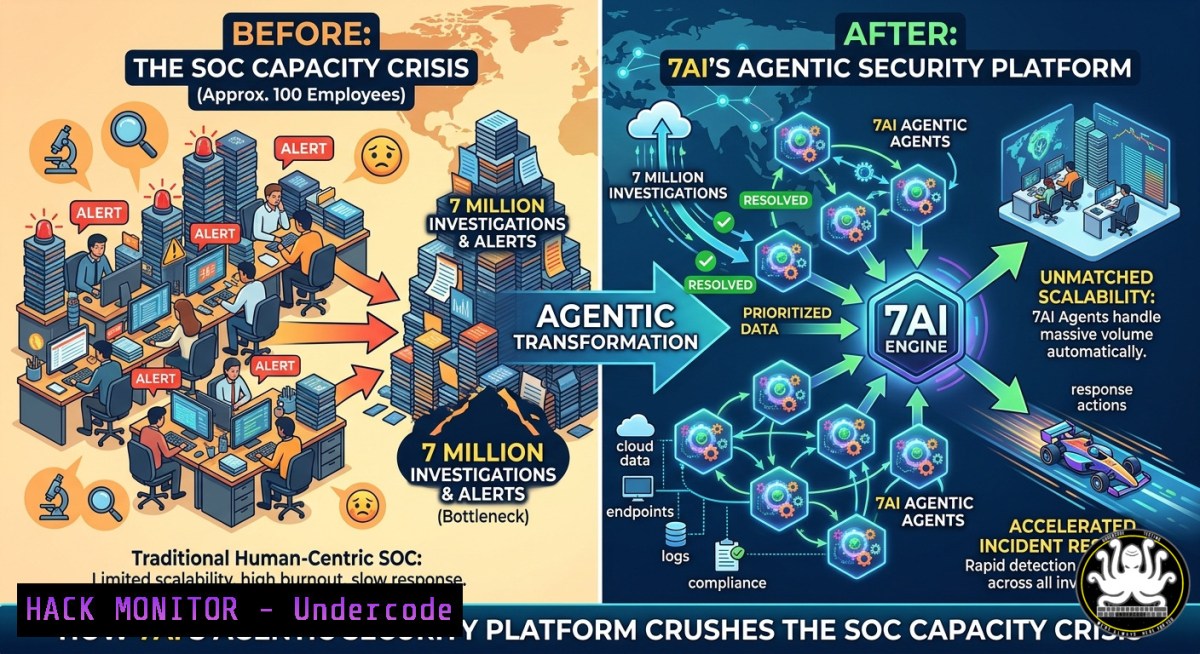
The global cybersecurity talent shortage has reached a breaking point, with SOC analysts drowning in a sea of false positives while sophisticated AI-powered attacks accelerate at machine speed. Agentic security represents a fundamental paradigm shift where autonomous AI agents—not just passive tools—actively investigate threats, correlate telemetry, and execute response actions, freeing human analysts for strategic decision-making. 7AI, a Boston-based startup that recently surpassed 100 employees and has processed over 7 million autonomous investigations in production, stands at the forefront of this revolution, demonstrating that AI agents can compress investigation times from hours to minutes while eliminating 95–99 percent of false positives.
Learning Objectives:
- Understand how agentic AI differs from traditional SOAR and SIEM, and why autonomous agents represent the next evolution in security operations
- Master practical implementation techniques, including deploying local LLMs for log analysis, integrating AI agents with existing SIEM/SOAR stacks, and building Python-based security automation scripts
- Learn how to measure ROI through key metrics such as false positive reduction rates, mean time to respond (MTTR) compression, and analyst productivity gains
You Should Know:
- From Playbooks to Reasoning: What Makes Agentic AI Different
Agentic AI represents a fundamental departure from traditional security automation. Where legacy SOAR platforms execute pre-written, deterministic playbooks, agentic systems possess autonomous reasoning capabilities—they can interpret natural language, make context-aware decisions, and adapt their investigation strategy based on what they discover. Lior Div, CEO of 7AI, notes that for two decades, security operations faced a losing battle: “More alerts than people, more attacks than analysts, more telemetry than time. Every cycle, the answer was the same: hire more, integrate more tools, write more rules, run more dashboards. The math never worked. For the first time in my career, the math is working”.
The distinction manifests in real-world SOC workflows. A traditional SOAR playbook might be triggered by a specific alert ID and execute a fixed sequence: query a threat intelligence feed, isolate an endpoint, and create a ticket. An agentic system, by contrast, receives a high-level instruction like “investigate this potential ransomware indicator.” It then autonomously decides which log sources to query, what threat intelligence to retrieve, how to correlate findings across systems, and whether to escalate or auto-remediate—all while adapting its approach based on intermediate results.
Industry analysts predict that by 2026, AI automation will autonomously handle over 90% of Tier 1 alerts, managing everything from initial triage and enrichment to categorization and basic containment actions. This shift is already underway, with Google Cloud releasing three agentic AI capabilities for its security operations platform, and companies like Stellar Cyber, Securonix, and Datadog introducing autonomous SOC features that dramatically reduce investigation times.
Step-by-step guide: Implementing a Local AI Agent for Log Analysis
Before deploying enterprise-grade agentic security platforms, security teams can experiment with local LLM-based agents for log analysis. This approach allows analysts to understand AI agent behavior in a controlled environment.
Step 1: Install Ollama for Local LLM Serving
 Linux (Ubuntu/Debian)
curl -fsSL https://ollama.com/install.sh | sh

macOS
brew install ollama

Windows (via WSL2 or native)
 Download installer from ollama.com/download
Step 2: Pull a lightweight model suitable for log analysis
ollama pull llama3.2:3b
 or for better performance with larger logs
ollama pull qwen2.5:7b
Step 3: Create a Python script for AI-powered log correlation
import requests
import json
import sys

def analyze_logs(log_file_path, query):
"""Send log excerpts to local LLM for threat analysis"""
with open(log_file_path, 'r') as f:
logs = f.read()[-10000:]  Last 10k characters for context window

prompt = f"""
You are a security analyst. Analyze these logs and answer: {query}

Logs:
{logs}

Provide your analysis in JSON format with fields:
- threat_detected (boolean)
- confidence_score (0-100)
- affected_systems (list)
- recommended_actions (list)
"""

response = requests.post('http://localhost:11434/api/generate',
json={
'model': 'llama3.2:3b',
'prompt': prompt,
'stream': False
})

return response.json()['response']

if <strong>name</strong> == "<strong>main</strong>":
result = analyze_logs("/var/log/auth.log",
"Identify any failed SSH attempts or brute force patterns in the last hour")
print(json.dumps(json.loads(result), indent=2))
2. Building the Agentic SOC: Architecture and Integration
Implementing agentic security requires more than deploying an AI tool—it demands rethinking SOC architecture. 7AI’s platform functions as what CEO Lior Div describes as a “full operating system for the Security Operations Center,” incorporating SIEM, SOAR, autonomous threat hunting, and other key capabilities into a unified agentic framework. The company has processed more than 7 million investigations in production, with agents autonomously completing end-to-end investigation work, demonstrating that enterprise-scale deployment is not just possible but already delivering measurable results.
The technical architecture typically comprises several layers: an ingestion layer that normalizes telemetry from diverse sources (EDR, firewall logs, identity systems, cloud APIs), a reasoning layer where LLMs analyze and correlate findings, an action layer that executes responses through APIs or infrastructure-as-code, and a governance layer that enforces access controls and maintains audit trails. Unlike traditional SIEM deployments that prioritize data aggregation, agentic systems prioritize actionability—every piece of ingested data serves a potential investigation path.
Industry benchmarks from Hack The Box’s 2026 study reveal a 70% productivity gap between AI-augmented and human-only security teams, with AI-augmented teams solving 27% of challenges compared to 16% for human-only teams. The Global Cybersecurity Outlook 2026 report further notes that 94% of respondents consider AI a key factor in transforming the industry, while the U.S. Bureau of Labor Statistics forecasts 29% growth in information security employment over the next decade—a shortage that agentic AI is uniquely positioned to address.
Step-by-step guide: Integrating an AI Agent with Existing SOAR/SIEM
For organizations with existing security stacks, layering agentic capabilities on top of current tools provides a pragmatic path forward. The open-source approach below demonstrates how to add AI reasoning to a Wazuh + Shuffle SOAR deployment.
Step 1: Set up LogSentinelAI for declarative log analysis
 Install LogSentinelAI (LLM-powered security log analyzer)
pip install logsentinelai

Configure API endpoint (OpenAI compatible)
export LLM_API_BASE="http://localhost:1234/v1"
export LLM_API_KEY="your-key"
Step 2: Define a Pydantic schema for threat detection
from pydantic import BaseModel
from typing import List, Optional
from logsentinelai import LogAnalyzer

class SecurityAlert(BaseModel):
"""Schema for AI-extracted security alerts"""
alert_type: str  e.g., "brute_force", "data_exfil", "lateral_move"
severity: str  "critical", "high", "medium", "low"
source_ip: Optional[bash]
target_host: Optional[bash]
timestamp: str
evidence: List[bash]
mitre_technique: str  e.g., "T1110" for brute force

Initialize analyzer
analyzer = LogAnalyzer(
model="llama3.2:3b",
output_schema=SecurityAlert
)

Analyze log file
results = analyzer.analyze("/var/log/secure")
for alert in results:
print(f"Alert: {alert.alert_type} | Severity: {alert.severity}")
Step 3: Create a webhook trigger for automated response
from flask import Flask, request
import subprocess

app = Flask(<strong>name</strong>)

@app.route('/webhook/soar', methods=['POST'])
def trigger_soar():
alert = request.json
if alert['severity'] == 'critical':
 Trigger SOAR playbook via API
subprocess.run([
'curl', '-X', 'POST',
'http://your-soar-instance/api/playbooks/run',
'-H', 'Content-Type: application/json',
'-d', json.dumps({'alert_id': alert['id']})
])
return {'status': 'triggered'}

if <strong>name</strong> == '<strong>main</strong>':
app.run(host='0.0.0.0', port=5000)
3. Hardening Agentic Deployments: Governance and Security Controls
As AI agents gain deeper access to enterprise systems, security teams must confront a new set of risks. Autonomous agents hold privileged access to sensitive data, can execute remediation actions across environments, and operate at machine speed—creating potential for cascading failures if not properly governed. The industry is rapidly developing frameworks for agentic security governance, including identity management, capability-based access controls, and real-time monitoring of agent behavior.
Tamnoon’s recent expansion of its AI engine into a skill-based orchestrator highlights the importance of generating customer-specific remediation skills tailored to each enterprise environment, rather than applying generic responses. Similarly, Microsoft’s 2026 updates introduced stringent circuit-breaking mechanisms to prevent Copilot from accessing or processing documents labeled as confidential—a recognition that AI agents require explicit boundaries.
Key governance principles for agentic deployments include:
- Principle of least privilege: Agents should receive minimal necessary permissions, with access revoked after investigation completion
- Human-on-the-loop for critical actions: Autonomous investigation can proceed independently, but containment or remediation should require analyst approval
- Complete audit trails: Every agent decision, API call, and data access must be logged in tamper-evident format
- Regular red-teaming: Security teams should actively attempt to manipulate or evade agentic systems to identify vulnerabilities
Step-by-step guide: Implementing Agent Behavior Monitoring
Step 1: Export AI agent logs to SIEM for security monitoring
 Configure agent logging with structured output
 Example: Configure 7AI or custom agent to send JSON logs to SIEM
{
"log_format": "json",
"siem_forwarding": {
"enabled": true,
"endpoint": "https://your-siem-instance:8088/services/collector",
"token": "your-splunk-or-elastic-token",
"index": "agent_security_logs"
}
}
Step 2: Create detection rules for anomalous agent behavior (Sigma format)
title: Suspicious Agent Privilege Escalation
status: experimental
description: Detects AI agents requesting elevated permissions beyond baseline
logsource:
product: agentic_security
service: agent_audit
detection:
selection:
event_type: "permission_request"
requested_scope:
- "admin:"
- "iam:create"
- "ec2:terminate"
baseline_permissions: "readonly"
condition: selection
tags:
- attack.privilege_escalation
- attack.t1078
level: high
Step 3: Build a Python monitoring daemon for agent telemetry
import asyncio
from elasticsearch import AsyncElasticsearch
import pandas as pd

class AgentMonitor:
def <strong>init</strong>(self, es_host='localhost:9200'):
self.es = AsyncElasticsearch([bash])

async def detect_anomalies(self, agent_id, time_window_minutes=60):
"""Detect anomalous agent behavior using statistical analysis"""
query = {
"query": {
"bool": {
"filter": [
{"term": {"agent_id": agent_id}},
{"range": {"@timestamp": {"gte": f"now-{time_window_minutes}m"}}}
]
}
}
}

response = await self.es.search(index="agent_audit_logs", body=query)
actions = [hit['_source']['action'] for hit in response['hits']['hits']]

Detect unusual action patterns
action_counts = pd.Series(actions).value_counts()
avg_actions = action_counts.mean()
std_actions = action_counts.std()

anomalies = []
for action, count in action_counts.items():
if count > avg_actions + 3  std_actions:
anomalies.append({
'action': action,
'count': int(count),
'z_score': (count - avg_actions) / std_actions
})

return anomalies

Run monitoring
monitor = AgentMonitor()
anomalies = asyncio.run(monitor.detect_anomalies('agent-7ai-prod-01'))
print(f"Detected {len(anomalies)} anomalous behavior patterns")
- Measuring Success: Key Metrics for Agentic Security ROI
For security leaders evaluating agentic AI investments, quantifiable metrics are essential. 7AI reports that its platform reduces false positives by 95–99 percent and compresses investigation times from hours to minutes. These improvements directly address SOC burnout and talent retention—two of the industry’s most persistent challenges.
The 2026 cybersecurity landscape is defined by three converging forces: the explosion of telemetry data (industry telemetry reached 308 petabytes in 2025, producing nearly 30 million investigative leads), the acceleration of AI-powered attacks, and the persistent talent shortage. Against this backdrop, agentic AI delivers measurable ROI through several vectors:
- Alert volume reduction: Autonomous triage eliminates false positives before they reach human analysts
- Mean time to respond (MTTR): Autonomous investigation and correlation dramatically compress response windows
- Analyst productivity: Freed from Tier 1 triage, analysts focus on high-value strategic work and threat hunting
- Coverage expansion: AI agents provide continuous “follow-the-sun” coverage without scaling headcount
One year into operating at enterprise scale, 7AI has processed more than 7 million investigations with agents autonomously completing investigation work end-to-end. This scale would be impossible with traditional SOC models, highlighting the fundamental efficiency gains of agentic approaches.
Step-by-step guide: Building a Real-time Alert Triage Dashboard
 alert_triage_dashboard.py
import streamlit as st
import pandas as pd
import plotly.express as px
from datetime import datetime, timedelta

class AlertDashboard:
def <strong>init</strong>(self):
self.data = self.load_alerts()

def load_alerts(self):
 Simulate SIEM data - replace with actual API call
return pd.DataFrame({
'timestamp': pd.date_range(start='2026-05-26', periods=1000, freq='1min'),
'severity': ['high']100 + ['medium']300 + ['low']600,
'agent_decision': ['auto_closed']700 + ['escalated']200 + ['auto_remediated']100,
'investigation_time_seconds': np.random.exponential(scale=60, size=1000)
})

def display_metrics(self):
col1, col2, col3 = st.columns(3)
with col1:
st.metric("Total Alerts (24h)", len(self.data))
with col2:
auto_resolved = len(self.data[self.data['agent_decision'] != 'escalated'])
st.metric("Auto-Resolved", f"{auto_resolved/len(self.data)100:.0f}%")
with col3:
avg_mttr = self.data['investigation_time_seconds'].mean() / 60
st.metric("Avg MTTR (minutes)", f"{avg_mttr:.1f}")

def plot_trends(self):
fig = px.line(self.data.set_index('timestamp').resample('1H').size(),
title='Alert Volume Trend - Last 24 Hours')
st.plotly_chart(fig)

if <strong>name</strong> == "<strong>main</strong>":
st.title("Agentic Security Operations Dashboard")
dashboard = AlertDashboard()
dashboard.display_metrics()
dashboard.plot_trends()
What Undercode Say:
- Key Takeaway 1: Agentic AI represents the most significant shift in security operations since the introduction of SIEM—moving from passive detection to autonomous action, from rules-based playbooks to reasoning-driven investigation, and from human-led triage to machine-speed response at scale.
- Key Takeaway 2: The economics of agentic security are compelling: 95–99% false positive reduction, investigation times compressed from hours to minutes, and the ability to process millions of investigations annually without proportional headcount growth—metrics that fundamentally change the ROI calculus for SOC modernization.
- Analysis: The cybersecurity industry stands at an inflection point. The transition from security “Copilots” (assistive tools) to security “Agents” (autonomous actors) mirrors the evolution from manual to automated manufacturing—not eliminating human roles but transforming them from operators to supervisors. Security analysts will increasingly function as AI trainers, anomaly investigators, and strategic decision-makers, while autonomous agents handle the high-volume, repetitive work that currently drives burnout. Organizations that fail to adopt agentic capabilities face an impossible math problem: accelerating attack surfaces, shrinking response windows, and a talent pool that cannot scale to meet demand. However, agentic deployment requires careful governance—privilege boundaries, audit trails, and human oversight for critical actions—to prevent autonomous systems from becoming new attack vectors. The next 18 months will separate early adopters who build governance frameworks alongside technical deployment from laggards who treat agentic AI as just another tool integration.
Prediction:
By 2028, agentic security platforms will be mandatory components of enterprise SOC architectures, with regulatory frameworks requiring autonomous investigation capabilities for compliance with emerging breach notification standards. The SOC analyst role will bifurcate: Tier 1 triage positions will largely disappear, replaced by AI agent management roles, while strategic threat hunting and incident command functions will command premium compensation. The competitive advantage will accrue to organizations that master the human-AI collaboration model—where agents handle speed and scale while humans provide judgment, business context, and creative problem-solving. The companies that crack this code will achieve what has eluded security leaders for two decades: a defense that scales faster than the attack surface.
▶️ Related Video (72% Match):
🎯Let’s Practice For Free:
IT/Security Reporter URL:
Reported By: Allen Lieberman – Hackers Feeds
Extra Hub: Undercode MoN
Basic Verification: Pass ✅
🎓 Live Courses & Certifications:
Join Undercode Academy for Verified Certifications
🚀 Request a Custom Project:
Secure, high-velocity infrastructure and disruptive technological engineering. Contact our engineering team for high-tier development and proprietary systems:
[email protected]


