Listen to this Post
Introduction:
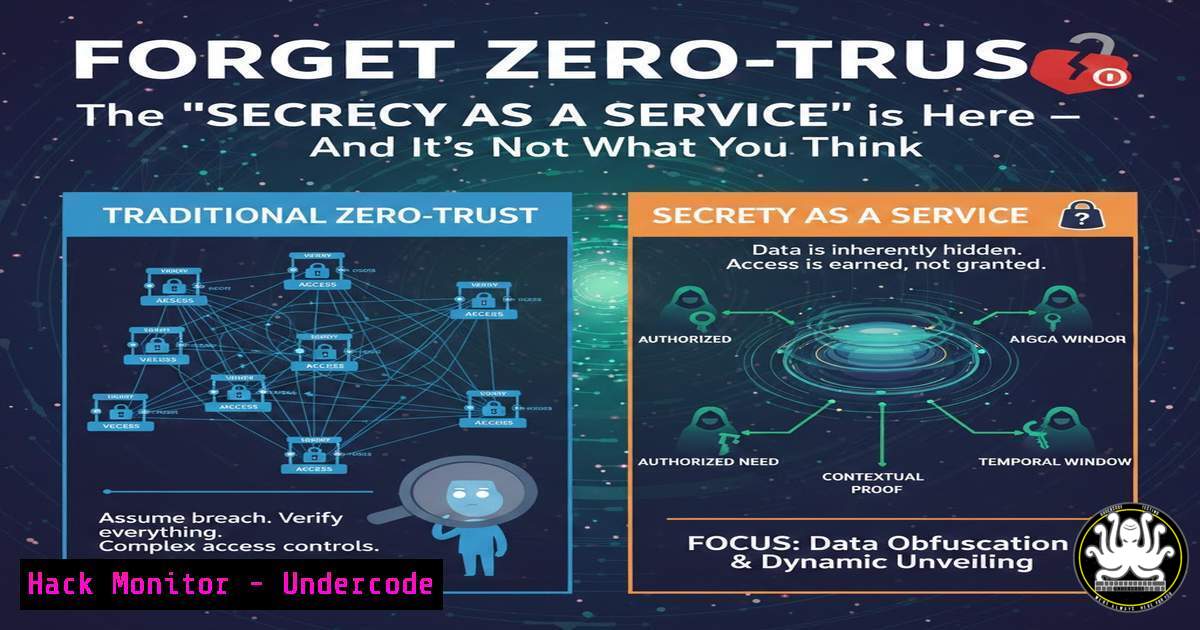
The digital battlefield is evolving beyond reactive defense. A new paradigm, hinted at by pioneers like Mil Williams, argues that traditional cybersecurity is failing because it protects secrets rather than selling secrecy itself. This concept shifts the focus from guarding perimeters to architecting systems where opacity and asymmetrical information advantage are foundational, built-in features, moving us from cyber defense to cyber resilience through inherent obscurity.
Learning Objectives:
- Understand the core distinction between protecting “secrets” and architecting “secrecy” as a service model.
- Learn practical steps to implement a “No-Cloud” cloud strategy to eliminate architectural vulnerabilities.
- Gain actionable skills in API obfuscation, endpoint hardening, and network deception to create asymmetrical advantages.
You Should Know:
1. From Defense to Deception: Architecting Secrecy
The core thesis is a fundamental shift: instead of spending resources to protect a valuable secret (data, code, IP), you architect the entire system so that its operational truth is secret by default. This is proactive, not reactive. It leverages principles from Zero-Trust but extends them into active deception and information masking.
Step‑by‑step guide:
- Step 1: Inventory Critical Data Flows. Map every API call, database query, and inter-service communication that touches sensitive logic. Use tools like `tcpdump` or Wireshark for analysis.
Linux Command: `sudo tcpdump -i any -w traffic.pcap ‘port 443 or port 80’` to capture web traffic for review. - Step 2: Implement Universal Encryption-in-Transit. Ensure all internal traffic is encrypted, not just north-south. Use mutual TLS (mTLS).
Example (OpenSSL to generate certs): `openssl req -newkey rsa:2048 -nodes -keyout server.key -x509 -days 365 -out server.crt`
– Step 3: Deploy Deception Tokens. Seed your codebase and databases with fake API keys, placeholder credentials, and decoy data structures that look real to an attacker but trigger alerts when touched.
2. Building the “No-Cloud” Cloud: Outcome Without Vulnerability
The “no-cloud” cloud isn’t about avoiding cloud providers; it’s about building cloud-native applications that do not depend on or expose the provider’s standard architectural patterns (like predictable metadata services, shared tenancy risks, or standard role assumptions). It’s about achieving cloud outcomes—scalability, resilience—without its common vulnerabilities.
Step‑by‑step guide:
- Step 1: Disable or Harden Cloud Metadata Services. These are prime attack vectors (e.g., AWS IMDSv1, Azure Instance Metadata Service).
Linux Command (for AWS IMDSv2 enforcement script):
 Use IMDSv2 and block IMDSv1
sudo apt-get install -y iptables-persistent
sudo iptables --insert FORWARD 1 --in-interface eth0 --destination 169.254.169.254 --protocol tcp --dport 80 --jump DROP
sudo netfilter-persistent save
– Step 2: Implement Custom, Ephemeral IAM. Avoid static, long-lived cloud IAM roles. Use tools like HashiCorp Vault to generate short-lived, task-specific credentials.
– Step 3: Encrypt Everything at Rest with Customer-Managed Keys (CMK). Never rely solely on provider-managed default encryption. Use your own key management system (KMS).
3. API Security as an Asymmetrical Weapon
APIs are the new perimeter. Instead of just hardening them, weaponize their obscurity. Create asymmetrical complexity for the attacker.
Step‑by‑step guide:
- Step 1: Dynamic API Endpoints. Use a rotating gateway layer that changes non-critical endpoint paths periodically based on a seeded algorithm known only to authorized clients.
- Step 2: Request Signing with Time-Based Salts. Mandate all API requests include a signature derived from a shared secret + the current UTC hour.
Example Python Snippet:
import hashlib
import time
def generate_api_signal(secret, payload):
current_hour = int(time.time() // 3600)
to_hash = f"{secret}:{current_hour}:{payload}"
return hashlib.sha256(to_hash.encode()).hexdigest()
– Step 3: Deploy API Deception. For unauthorized requests, return realistic but fake data (honeytokens) and log the attempt for threat hunting.
4. Endpoint Hardening: Beyond Antivirus
Endpoints must become black boxes. Limit information leakage and standardize a ultra-hardened base image.
Step‑by‑step guide (Windows Example):
- Step 1: Disable Unnecessary Services. Reduce attack surface.
PowerShell Command: `Get-Service | Where-Object {$_.StartType -eq ‘Auto’ -and $_.Name -notin @(‘Audiosrv’, ‘EventLog’)} | Stop-Service -Force; Set-Service -StartupType Disabled`
– Step 2: Enable Hardware-Based Isolation. Use Windows Defender Credential Guard and Hypervisor-Protected Code Integrity (HVCI).
Command: Use Group Policy or MDM:Device Guard > Turn On Virtualization Based Security. - Step 3: Implement Application Control (Allowlisting). Use Windows Defender Application Control (WDAC) to only allow authorized executables.
Command (to create a base policy): `New-CIPolicy -Level SignedVersion -FilePath C:\policy.xml`
- Operational Secrecy: Logging and Monitoring for Anomaly Detection
Your logs should be designed to detect the absence of normalcy, not just the presence of known bad. Structure them to reveal secrecy breaches.
Step‑by‑step guide:
- Step 1: Centralized Logging with Immutable Storage. Use a SIEM (e.g., Elastic Stack, Splunk) with write-once-read-many (WORM) storage.
- Step 2: Baseline Normal Behavior. Create statistical profiles for user logins, data access volumes, and network flows. Use tools like Zeek (formerly Bro) for network analysis.
Linux Command (Zeek quick start): `zeek -i eth0 -C` (runs Zeek on interface eth0, without checking MAC addresses) - Step 3: Alert on Low-Probability Events. Set alerts for actions that are possible but highly improbable, like a developer accessing a financial database at 3 AM from a new country.
What Undercode Say:
- Key Takeaway 1: The future of elite cybersecurity is not better castle walls, but making the castle’s very layout a mystery. The “Secrecy as a Service” model proposes selling this architectural opacity as the primary product.
- Key Takeaway 2: The “No-Cloud” cloud concept is a critical evolution of cloud security, advocating for using cloud infrastructure while systematically nullifying its predictable attack surfaces through custom hardening and ephemeral architectures.
Analysis:
This post points to a profound dissatisfaction with the commercial and governmental cybersecurity establishment. The mention of entities like MI5 and the struggle to post content suggests a narrative of censorship or suppression of advanced security concepts that threaten existing power structures. The technical concepts hinted at—asymmetrical, hybrid warfare—are not just tools but a philosophy. It frames cybercrime as cyberwarfare, necessitating wartime tactics: deception, secrecy, and asymmetrical advantage. This isn’t a product launch; it’s a manifesto for a paradigm shift where the defender stops playing catch-up and starts defining a new, opaque battlefield.
Prediction:
Within the next 3-5 years, we will see the rise of commercial cybersecurity firms explicitly selling “Secrecy by Design” and “Asymmetrical Defense” frameworks as core offerings. These will integrate AI not just for threat detection, but for managing dynamic infrastructure that constantly morphs its apparent attack surface. Nation-state Advanced Persistent Threat (APT) groups will increasingly find their standard reconnaissance tools failing against organizations that have adopted these principles, leading to a new arms race in automated cyber deception and infrastructure obfuscation. The line between cyber defense and active cyber counterintelligence will blur permanently.
▶️ Related Video (76% Match):
🎯Let’s Practice For Free:
IT/Security Reporter URL:
Reported By: Mil Williams – Hackers Feeds
Extra Hub: Undercode MoN
Basic Verification: Pass ✅


