Listen to this Post
Introduction:
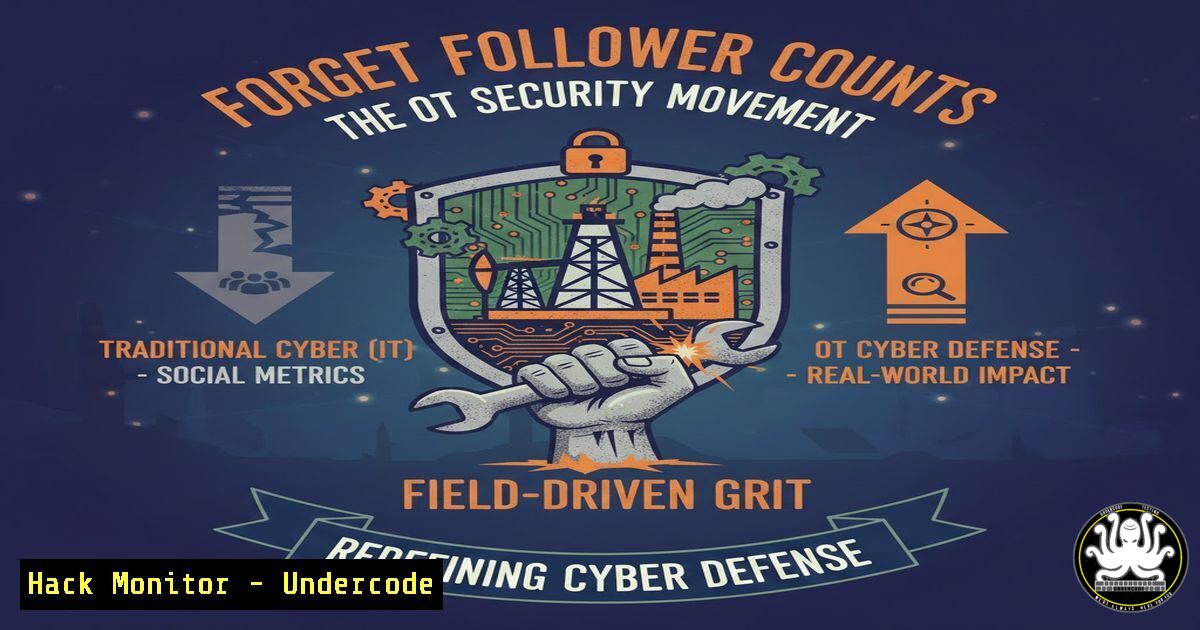
In a digital landscape obsessed with vanity metrics and consultant-led models, a seismic shift is emerging from the trenches of Operational Technology (OT) security. The OT Security Professionals (OTSecPro) community, founded on the principle of “protecting physics, not just data,” champions a field-driven approach where real-world impact trumps online impressions. This movement prioritizes the safeguarding of industrial control systems (ICS), SCADA, and critical infrastructure from evolving cyber-physical threats that can have catastrophic real-world consequences.
Learning Objectives:
- Understand the critical difference between IT and OT security and why OT requires a “physics-first” mindset.
- Learn practical, actionable steps for initial OT network segmentation and monitoring.
- Discover key resources and community-driven initiatives for continuous skill development in industrial cybersecurity.
You Should Know:
1. OT vs. IT Security: The Physics-First Mindset
The core tenet of OTSecPro is protecting the physical world—industrial processes, machinery, and human safety. Unlike IT, where confidentiality is often king, OT prioritizes availability and integrity. A compromised water treatment PLC or turbine controller isn’t just a data breach; it’s a public health or safety crisis.
Step‑by‑step guide explaining what this does and how to use it.
Action: Asset Inventory & Classification.
- Discover: Use passive network monitoring tools on OT network segments. A tool like `Wireshark` with careful filtering can identify OT protocols (e.g., MODBUS/TCP, DNP3, S7comm) without disrupting processes.
Command (Linux, using tshark):
tshark -i eth1 -Y "tcp.port == 502 or tcp.port == 20000" -T fields -e ip.src -e ip.dst -e frame.protocols -V | head -20
This captures traffic on port 502 (MODBUS) or 20000 (Siemens S7), showing source, destination, and protocols.
2. Classify: Catalog every device (PLCs, RTUs, HMIs, engineering workstations). Tag them with criticality levels based on their function in the physical process.
3. Baseline: Document normal communication patterns, protocol usage, and device behavior. This baseline is crucial for anomaly detection.
- Implementing Foundational OT Network Segmentation (The Purdue Model)
You cannot secure what you cannot segment. The Purdue Model provides a conceptual framework for isolating IT and OT networks and creating defensive layers within OT.
Step‑by‑step guide explaining what this does and how to use it.
Action: Deploy an OT Firewall / Data Diode.
- Identify Boundary: Pinpoint the key convergence point between Level 3 (Site Operations) and Level 3.5 (DMZ) or Level 4 (IT).
- Policy Configuration: On your OT firewall (e.g., Tofino, Cisco FTD), create rules that are explicitly allow-listed.
Example Rule Logic: “Allow TCP traffic from IT historian server (IP: 10.0.4.10) to OT historian (IP: 192.168.1.10) on port 1433 (MSSQL) ONLY. Deny all other traffic from IT to OT.” - Test: Use a safe, non-critical segment for testing. Generate test traffic from the IT side using `nmap` from a controlled assessment machine.
Command (from IT assessment box, with authorization):
nmap -sS -Pn -p 502,102,443 192.168.1.0/24 --script banner
This scans for open MODBUS, Siemens S7, and HTTPS ports on the OT segment. It should only succeed on the explicitly allowed historian IP, proving the firewall rules work.
3. Passive OT Protocol Analysis for Anomaly Detection
Active scanning can crash delicate OT devices. Passive monitoring is your eyes and ears.
Step‑by‑step guide explaining what this does and how to use it.
Action: Set up a SPAN port and analyze traffic.
1. Mirror Traffic: Configure a SPAN/mirror port on your OT layer switch to copy traffic to a monitoring station.
2. Use OT-Aware Tools: Deploy a tool like Zeek (Bro) with OT protocol parsers or a dedicated OT monitoring solution.
3. Create Detection Rules: Write signatures for malicious behavior. Example Zeek script snippet to detect unauthorized MODBUS function codes:
event modbus_message(c: connection, headers: ModbusHeaders, is_orig: bool) {
if (headers$func_code == 0x05 && c$id$orig_h != authorized_plc_ip) {
NOTICE([$note=OT::Unauthorized_Write,
$msg=fmt("Unauthorized Force Single Coil command from %s", c$id$orig_h),
$conn=c]);
}
}
This triggers an alert if a non-authorized IP tries to send a “Force Single Coil” command.
4. Building an OT-Specific Incident Response Playbook
OT IR is different. Rebooting a server is one thing; safely halting a chemical process is another.
Step‑by‑step guide explaining what this does and how to use it.
Action: Draft a “Cyber-Physical Incident” containment step.
- Immediate Action: Isolate affected systems in coordination with operations staff. This may mean network isolation via firewall block OR controlled physical shutdown procedures.
- Forensic Preservation: If possible, capture network traffic (PCAP) from SPAN ports and memory dumps from infected engineering workstations using tools like `FTK Imager` or
Belkasoft Live RAM Capturer.
Command (On Windows workstation, run as admin):
 Using built-in tools for initial triage
netstat -ano | findstr :502  Find what's connected to MODBUS ports
wmic process get Caption,ProcessId,CommandLine | findstr /i "explorer winlog"  Look for suspicious parent processes
3. Recovery: Restore from known-good, offline backups of PLC logic and HMI configurations. Test in a isolated environment before redeploying.
5. Leveraging Community Intelligence & Continuous Learning
The OTSecPro model emphasizes peer-to-peer knowledge sharing from asset owners and integrators.
Step‑by‑step guide explaining what this does and how to use it.
Action: Engage with the community for threat intelligence.
- Follow Shared Advisories: Communities often share early warnings on ICS-CERT advisories or vendor patches.
- Participate in Technical Chats: Use platforms like their WhatsApp community to ask about specific PLC vulnerabilities (e.g., “How are you patching Schneider Electric Modicon M580?”).
- Practice: Engage with `OTSecurityProQuiz` and set up your own lab using simulated OT environments like CPwE from Cisco or open-source tools ICS Testbed to practice attacks and defenses safely.
What Undercode Say:
- Key Takeaway 1: The future of effective OT defense is decentralized and experience-based. Trust is built not through social media clout, but through verifiable field expertise and shared context in secure forums.
- Key Takeaway 2: True resilience requires bridging the IT-OT knowledge gap. IT pros must learn process constraints, and OT engineers must adopt fundamental cyber hygiene. Communities built around `FieldDrivenNotConsultantDriven` principles are the crucible for this essential fusion.
The OTSecPro movement represents a maturation of industrial cybersecurity. It moves beyond fear-based selling and checkbox compliance toward a collaborative, defense-in-depth culture rooted in shared operational reality. By valuing signal over noise and context over clout, it creates a more trustworthy and actionable intelligence ecosystem. This model empowers defenders at the asset level, making critical infrastructure inherently harder to target and reducing the overall attack surface for nations. Its growth indicates a sector moving from reactive compliance to proactive, collective resilience.
Prediction:
Within five years, this field-driven, community-based model will become the dominant paradigm for OT security knowledge exchange and talent development globally. We will see a formalized “peer credentialing” system emerge, where endorsements from within these verified communities hold more weight than traditional certificates for operational roles. This will force a convergence between OEM cybersecurity offerings and community-shared hardening guides, leading to more secure-by-default industrial products. Simultaneously, nation-state APT groups will increasingly target these communities for infiltration, recognizing them as high-value intelligence sources, elevating the need for robust operational security (OPSEC) within the platforms they use.
🎯Let’s Practice For Free:
IT/Security Reporter URL:
Reported By: Otsecurityprofessionals Otsecurityprotechtalk – Hackers Feeds
Extra Hub: Undercode MoN
Basic Verification: Pass ✅


