Listen to this Post
Introduction:
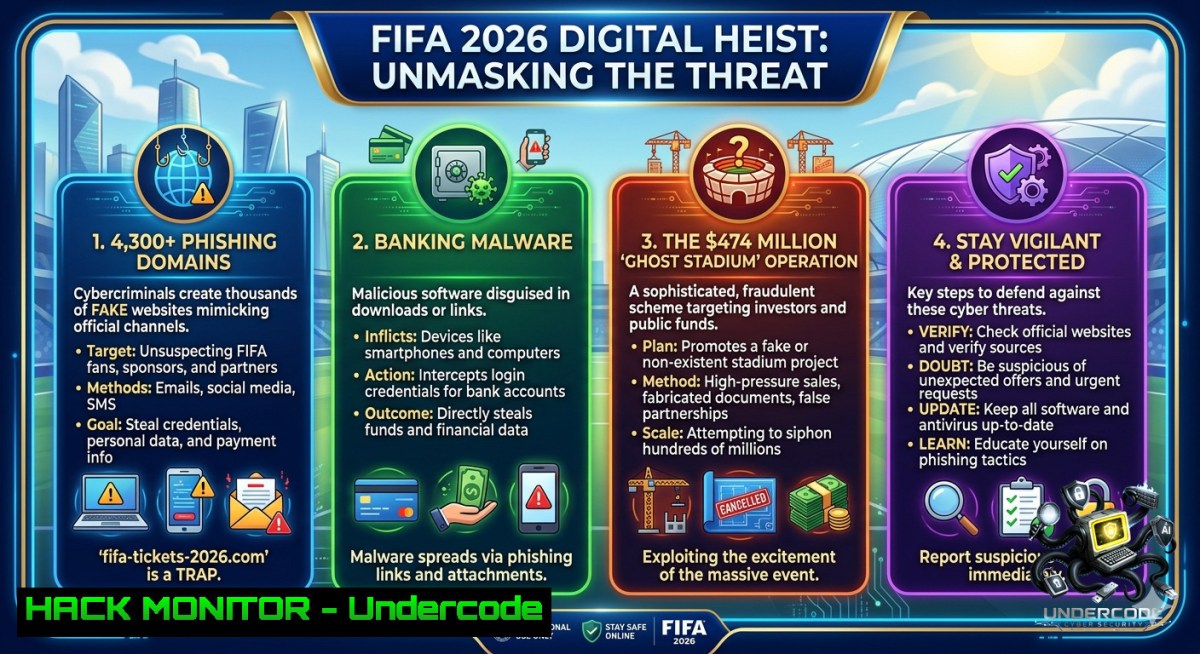
With over 150 million ticket requests for just six million seats, the FIFA World Cup 2026 has created the perfect storm for cybercriminals to exploit scarcity and urgency. Security researchers have uncovered a sophisticated, multi-layered fraud ecosystem comprising more than 4,300 fraudulent domains, Android banking trojans hidden inside streaming apps, and a Chinese-speaking operation dubbed “GHOST STADIUM” running a unified phishing kit across over 300 cloned FIFA sites. This article dissects the technical anatomy of these attacks, provides actionable detection and mitigation strategies, and offers a step-by-step guide for security professionals and fans to defend against the coming wave of event-driven cyber threats.
Learning Objectives:
– Analyze the technical infrastructure of large-scale event phishing campaigns, including domain registration patterns, typosquatting, and phishing kit reuse.
– Identify and mitigate Android banking trojans (Massiv, Perseus) and credential-harvesting attacks targeting FIFA accounts.
– Apply Linux/Windows command-line tools and OSINT techniques to detect, investigate, and block malicious domains and applications.
You Should Know:
1. Advanced Phishing Infrastructure Analysis & GHOST STADIUM Takeover
The most sophisticated threat actor currently exploiting the World Cup is GHOST STADIUM, a financially motivated, Chinese-speaking operation identified by Group-IB. This group has registered over 4,300 fraudulent FIFA domains since August 2025 and runs a single, highly effective phishing kit across more than 300 of them. What makes GHOST STADIUM particularly dangerous is the technical quality of its forgery. The fake login page is a near-perfect copy of `fifa.com`, mimicking FIFA’s genuine single sign-on (SSO) system run by PingIdentity, down to copying the live site’s client ID. It even loads images directly from FIFA’s own servers to evade detection tools that flag copied assets. The operation drives traffic primarily through Facebook ads (with reused tracking codes), Telegram, WhatsApp, and search results.
Step-by-step guide to analyzing and defending against such phishing infrastructure:
Linux Command Line OSINT & Detection:
 1. Bulk WHOIS lookup to check domain registration age (new domains are suspicious)
for domain in $(cat fifa_suspect_domains.txt); do
whois $domain | grep -E "Creation Date|Registrar|Registrant Country"
done

 2. Use dnstwist to generate typosquatting permutations of a legitimate domain
dnstwist --registered fifa.com | grep -E "fifa.\.(com|org|net|xyz|shop|live)"

 3. Check DNS records for malicious redirects or fast-flux networks
dig +short $suspect_domain
nslookup $suspect_domain

 4. Analyze SSL certificate for domain mismatch and issuance date
openssl s_client -connect $suspect_domain:443 -servername $suspect_domain | openssl x509 -text -1oout | grep -E "Subject:|Issuer:|Not Before|Not After"

 5. Use Python to automate bulk URL phishing detection (similar to PhishNet)
import whois
from datetime import datetime
def check_domain_age(domain):
try:
w = whois.whois(domain)
creation_date = w.creation_date
if isinstance(creation_date, list):
creation_date = creation_date[bash]
age_days = (datetime.now() - creation_date).days
return age_days < 90  Flag domains younger than 90 days
except:
return True
Windows PowerShell Detection:
 1. Resolve and check domain age
Resolve-DnsName -1ame $suspectDomain
$whois = whois $suspectDomain
$whois -match "Creation Date"

 2. Check URL with .NET WebRequest
$request = [System.Net.WebRequest]::Create($url)
$request.AllowAutoRedirect = $false
$response = $request.GetResponse()
$response.Headers.ToString()

 3. Test for credential harvesting by checking form actions
Invoke-WebRequest -Uri $url | Select-Object -ExpandProperty Forms
Fake Payment Method Identification:
GHOST STADIUM’s payment pages are a critical red flag. The fake site accepts five payment methods including cryptocurrency. FIFA’s official ticketing never accepts cryptocurrency – any seller asking for crypto is an immediate scam. Other red flags include money-transfer apps (Chime, Nequi), Mexico-only processors, and any request to convert card payments into crypto.
Detection YARA Rule Snippet for Phishing Kit Fingerprinting:
rule GHOST_STADIUM_FIFA_PHISHING_KIT {
meta:
description = "Detects GHOST STADIUM phishing kit artifacts"
author = "Security Analyst"
strings:
$sso_client = "PingIdentity" nocase
$reset_password = "reset your password" nocase
$fake_tracking = "fbclid="
$crypto_payment = "BTC|ETH|USDT|cryptocurrency" nocase
condition:
(any of ($sso_client, $reset_password, $crypto_payment)) and $fake_tracking
}
2. Android Banking Malware in Streaming Apps (Massiv & Perseus)
For fans seeking free match streams, the threat is far more severe than simple credential theft. Kaspersky has identified malicious unofficial streaming apps, often masquerading as popular services like RojaDirecta, that install Android banking trojans from the Massiv and Perseus families. These trojans are not distributed through Google Play – they are sideloaded APKs that require users to click past Android’s built-in security warnings. Once installed, they abuse Android’s Accessibility Services to gain complete control over the device, enabling them to siphon funds from banking and cryptocurrency apps.
Step-by-step guide to analyzing and removing Android banking trojans:
On Windows (using Android Debug Bridge – ADB):
 1. Connect to the device and list all installed packages (with installation sources)
adb devices
adb shell pm list packages -f | findstr /i "roja directa fifa streaming"

 2. Identify apps with Accessibility Service permissions (red flag for banking trojans)
adb shell settings list secure | findstr accessibility

 3. Extract the APK for analysis
adb shell pm path $malicious_package
adb pull $apk_path analysis.apk

 4. Check permissions and activities of the APK (linux subsystem or WSL)
aapt dump permissions analysis.apk
aapt dump badging analysis.apk | findstr "uses-permission"

 5. Look for Accessibility Service and overlay permissions (hallmarks of banking malware)
aapt dump permissions analysis.apk | findstr -E "BIND_ACCESSIBILITY_SYSTEM|SYSTEM_ALERT_WINDOW"
On Linux (APK Analysis Suite):
 1. Decompile APK using apktool
apktool d suspicious_app.apk -o decompiled_app

 2. Search for malicious indicators in smali code
grep -rni "accessibility" decompiled_app/smali/
grep -rni "bank|finance|crypto" decompiled_app/smali/

 3. Extract and examine AndroidManifest.xml for dangerous permissions
cat decompiled_app/AndroidManifest.xml | grep -E "permission|receiver|service"

 4. Check certificate information
keytool -printcert -jarfile suspicious_app.apk

 5. Use strings to extract potential C2 domains and URLs
strings suspicious_app.apk | grep -E "http://|https://" | sort -u
MITIGATION – Preventive Measures for Android Users:
– Never sideload apps – disable “Install from unknown sources” in Android security settings immediately.
– Enable Google Play Protect – it detects and blocks known malware families including Massiv and Perseus.
– Never grant Accessibility permissions to any app that does not explicitly need them for a legitimate purpose. Banking trojans almost universally request this permission to perform overlay attacks and auto-fill phishing overlays on top of legitimate banking apps.
– Use a mobile antivirus solution as an early detection system.
3. Fake Ticketing Ecosystem & Social Media Impersonation
FBI Public Service Announcement (PSA) has listed dozens of malicious domains including `fifa-ticket.live`, `fifaworldcup26.sale`, `jobs-fifa.com`, and `fifa-hr.com`. These domains fall into several categories: typosquatting (e.g., `filfa.org`, `wvvw-fifa.com`), keyword stuffing (`fifaworldcup-careers.com`), and alternative TLDs (`fifa.blue`, `fifa.city`, `fifa.beer`). FortiGuard Labs has identified over 13,000 World Cup-themed domains registered between January and May 2026, with 8.8% classified as malicious or suspicious. Additionally, the ZeroFox team uncovered active Telegram channels (e.g., “FIFAWorldCup_Tickets”) openly trading unauthorized tickets, alongside scam operations on WhatsApp and Facebook Marketplace.
Step-by-step guide to identifying and mitigating fake ticketing scams:
FBI-Recommended Safe Browsing Protocol:
1. Always type `fifa.com` directly into the browser address bar – never use search results, sponsored links, or links received via email/SMS.
2. Verify the domain extension – legitimate FIFA pages exclusively use `.com`.
3. Use bookmarks for FIFA login pages and access all subdomains only through the official homepage.
Linux Automated Domain Monitoring Script:
!/bin/bash
 Domain monitor for FIFA typosquatting detection
LEGIT="fifa.com"
declare -a SUSPECT_TLDS=(".xyz" ".live" ".shop" ".sale" ".win" ".top" ".club" ".blue")

while IFS= read -r domain; do
if [[ $domain == "fifa" ]]; then
tld="${domain.}"
if [[ " ${SUSPECT_TLDS[@]} " =~ " .$tld " ]]; then
echo "WARNING: Suspicious TLD detected - $domain"
whois $domain | grep -E "Creation Date|Registrar|Registrant"
fi
fi
done < watched_domains.txt
Windows Scheduled Task for Phishing Domain Blocking via Hosts File:
 PowerShell script to add known malicious FIFA phishing domains to hosts file
$maliciousDomains = @(
"fifa-ticket.live",
"fifaworldcup26.sale",
"jobs-fifa.com",
"fifa-hr.com",
"fifa.cab",
"fifa.blue"
)
$hostsPath = "$env:SystemRoot\System32\drivers\etc\hosts"
foreach ($domain in $maliciousDomains) {
if ((Select-String -Path $hostsPath -Pattern $domain -Quiet) -eq $false) {
"127.0.0.1 $domain" | Out-File -FilePath $hostsPath -Append -Encoding ASCII
Write-Host "Blocked $domain"
}
}
4. Corporate Defenses & AI-Driven Detection
Organizations are implementing AI-based detection systems to combat these threats. Meta is using advanced AI to recognize phony FIFA websites and fake ticket advertisements on Facebook and Instagram, and has partnered with Visa to disrupt scam networks using World Cup branding. The Global Signal Exchange (GSE) and Fraud Intelligence Reciprocal Exchange (FIRE) enable cross-platform intelligence sharing to identify criminal networks.
Enterprise Mitigation Commands (Linux Firewall & IDS):
 1. Block known malicious FIFA domains via iptables
for domain in $(cat fifa_malicious_domains.txt); do
ip=$(dig +short $domain | head -1)
iptables -A OUTPUT -d $ip -j DROP
iptables -A INPUT -s $ip -j DROP
done

 2. Snort/Suricata signature for FIFA phishing detection
alert tcp $HOME_NET any -> $EXTERNAL_NET $HTTP_PORTS (msg:"FIFA Phishing Landing Page Detected"; flow:to_server,established; content:"fifa"; http_uri; content:"login"; http_uri; content:"reset password"; http_client_body; classtype:phish; sid:1000001; rev:1;)

 3. Monitor for credential submission to non-FIFA domains using tcpdump
tcpdump -i eth0 -A -s 0 'tcp port 443 and host not fifa.com' | grep -E "POST.fifa"

 4. Configure Wazuh (OSSEC) rule for FIFA phishing detection
echo '<rule id="100100" level="10">
<if_sid>31171</if_sid>
<field name="url">fifa.\.(xyz|live|shop|blue|city|beer)</field>
<description>Access to known FIFA typosquatting domain</description>
</rule>' >> /var/ossec/etc/rules/local_rules.xml
What Undercode Say:
– Key Takeaway 1: The FIFA 2026 threat landscape represents a fundamental shift from opportunistic individual scams to organized, profit-driven cybercrime-as-a-service operations. GHOST STADIUM’s unified phishing kit across 300+ sites demonstrates unprecedented operational maturity.
– Key Takeaway 2: The convergence of credential theft, Android banking malware, and social media malvertising creates multi-vector attacks that bypass traditional security perimeters. Fans face simultaneous threats to their FIFA accounts, bank accounts, and device integrity.
Analysis: The estimated financial impact from premium and hospitality ticket fraud alone ranges from $71 million to $474 million, with the entire campaign potentially reaching billions in losses. What makes this operation particularly dangerous is its use of live API endpoints and legitimate assets (borrowed from FIFA’s servers), making automated detection substantially more difficult. The presence of phishing-as-a-service marketplaces and ticket-buying bots means that taking down one infrastructure component has minimal impact on the overall ecosystem. Organizations hosting major events should implement proactive domain monitoring, deploy AI-based phishing detection, and establish cross-sector intelligence sharing (like GSE and FIRE) before the event begins, not after the first wave of attacks.
Prediction:
– -1: The oversubscription ratio (30:1) will drive ticket prices on secondary markets to unprecedented levels, creating an even larger financial incentive for cybercriminals to scale their operations throughout the tournament window.
– -1: Mobile device compromise via streaming app malware will eclipse traditional phishing as the primary attack vector by July 2026, as fans increasingly rely on mobile devices for last-minute ticket purchases and match updates.
– +1: The visibility from this large-scale attack will accelerate regulatory requirements for live event cybersecurity, potentially leading to mandatory pre-event threat assessments and real-time monitoring for future international sporting events.
▶️ Related Video (76% Match):
🎯Let’s Practice For Free:
🎓 Live Courses & Certifications:
[Join Undercode Academy for Verified Certifications](https://undercode.co.uk/certifications/)
🚀 Request a Custom Project:
Secure, high-velocity infrastructure and disruptive technological engineering. Contact our engineering team for high-tier development and proprietary systems:
[[email protected]](mailto:[email protected])
💎 Smart Architecture | 🛡️ Secure by Design | ⭐ Trusted by Thousands
IT/Security Reporter URL:
Reported By: [Mohit Hackernews](https://www.linkedin.com/posts/mohit-hackernews_fifa-malware-fifafever-share-7468560109888241665-mKZo/) – Hackers Feeds
Extra Hub: Undercode MoN
Basic Verification: Pass ✅
🔐JOIN OUR CYBER WORLD [ CVE News • HackMonitor • UndercodeNews ]
[💬 Whatsapp](https://undercode.help/whatsapp) | [💬 Telegram](https://t.me/UndercodeCommunity)
📢 Follow UndercodeTesting & Stay Tuned:
[𝕏 formerly Twitter 🐦](https://x.com/undercodeupdate) | [@ Threads](https://www.threads.net/@undercodetesting) | [🔗 Linkedin](https://www.linkedin.com/company/undercodetesting/) | [🦋BlueSky](https://bsky.app/profile/undercode.bsky.social)


