
Listen to this Post
Introduction:
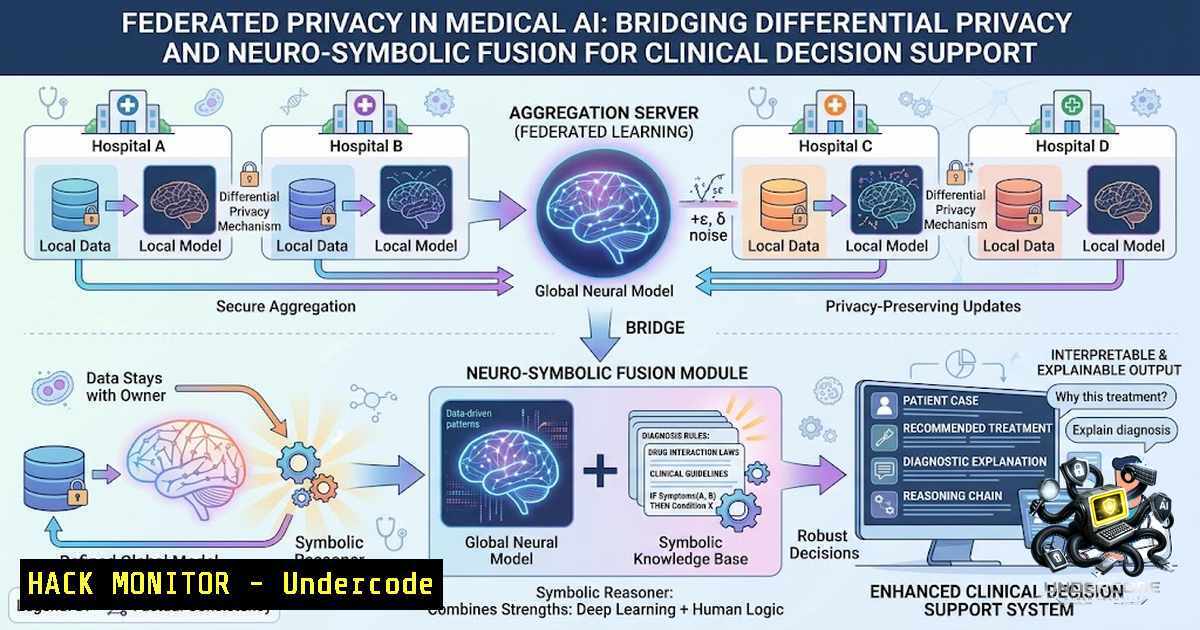
The integration of artificial intelligence into clinical decision-making is persistently challenged by the dual imperatives of data privacy and model accuracy. The presented research prototype from Fard Labs addresses this tension by implementing a privacy-preserving clinical decision-support system that combines federated tabular learning with a radiology-specific vision-language model and a rule-based fusion layer. This approach tackles the fundamental problem of training robust medical AI models across institutional silos without exposing sensitive patient data, while maintaining clinically meaningful performance compared to centralized baselines.
Learning Objectives & Secrets:
- Objective 1: Understand the architecture of a multi-modal federated learning system that integrates tabular patient data with chest X-ray imagery through a vision-language model.
- Objective 2 (Secret Tip): Implement differential privacy with a Rényi-DP moments accountant, as opposed to basic composition, to achieve a tighter and more meaningful privacy budget (ε=3.2) that is more acceptable for clinical deployment.
- Objective 3 (Secret Tip): Leverage a neuro-symbolic fusion layer to reconcile conflicting predictions from tabular and vision branches, ensuring auditable decision traces and improved performance over vision-only inference.
You Should Know:
- Setting Up a Federated Learning Environment with Flower
Federated learning (FL) allows models to be trained across multiple decentralized edge devices or servers holding local data samples, without exchanging them. The Flower framework is used here to orchestrate client/server separation across six institutional data sources. This is not a simulation; it’s a real distributed system.
Step‑by‑step guide explaining what this does and how to use it:
– Install Flower: `pip install flwr` (Linux/macOS) or `pip install flwr` in a Python virtual environment on Windows.
– Define the Strategy: Implement DP-FedAvg by customizing the `FedAvg` strategy in Flower. This involves adding differential privacy mechanisms to the aggregation step.
– Client Setup: Each institutional client (e.g., a hospital) runs a local training script that loads its private dataset and trains a model.
– Server Orchestration: The central server initializes the global model, distributes it to clients, collects model updates, and applies DP-FedAvg to create a new global model.
– Privacy Accounting: Use the `opacus` library for DP-SGD. Initialize a `PrivacyEngine` with `RényiDPAccountant` to track the privacy budget. Set parameters like `target_delta=1e-5` and target_epsilon=3.2.
– Configuration: In the server configuration, specify `num_rounds=10` and `fraction_fit=1.0` to involve all clients in each round.
2. Implementing Differential Privacy with Rényi-DP
The prototype uses a Rényi-DP moments accountant to provide a tighter privacy bound. Unlike basic composition, which can produce overly loose bounds (e.g., ε=60), Rényi-DP offers a more precise accounting of privacy loss across multiple training rounds.
Step‑by‑step guide explaining what this does and how to use it:
– Install Opacus: pip install opacus.
– Attach Privacy Engine: In your PyTorch training loop, attach the privacy engine to your optimizer: privacy_engine = PrivacyEngine() model, optimizer, train_loader = privacy_engine.make_private_with_epsilon( module=model, optimizer=optimizer, data_loader=train_loader, target_epsilon=3.2, target_delta=1e-5, epochs=10, max_grad_norm=1.0 ).
– Clipping and Noise: The `max_grad_norm` parameter clips each gradient vector to a maximum L2 norm. The privacy engine then adds Gaussian noise scaled to this clipping value and the desired privacy budget.
– Accounting: The `get_epsilon` method on the privacy engine uses the moments accountant to compute the current ε, ensuring you stay within your budget.
– Linux Command: To monitor resource usage during training, use `htop` or `nvidia-smi` (if using GPUs) to ensure system stability across clients.
3. Deploying BioViL-T for Radiology-Specific Visual Encoding
BioViL-T is a vision-language model pretrained on chest X-ray data. It’s used here to query five stochastic samples per case, producing a calibrated confidence score.
Step‑by‑step guide explaining what this does and how to use it:
– Access Model Weights: Obtain the pretrained BioViL-T model from a repository like HuggingFace (e.g., microsoft/BiomedVLP-CXR-BERT-specialized).
– Inference Setup: Load the model for inference using PyTorch. For each chest X-ray image, perform five forward passes with dropout enabled (model.train()) to generate stochastic predictions.
– Calibrating Confidence: Calculate the mean and variance of the predictions. Use the variance as a measure of confidence to calibrate the score.
– Vision-Only Baseline: Run a separate inference pipeline using only the vision branch to benchmark the full pipeline’s performance (78.3% vs 67.1%).
4. Building the Neuro-Symbolic Fusion Layer
This layer reconciles the tabular (structured patient data) and vision (X-ray) branches using explicit rules. It ensures decisions are auditable and interpretable.
Step‑by‑step guide explaining what this does and how to use it:
– Define Rules: Establish three core rules:
1. Agreement: If both branches output the same class, output that class.
2. Confidence-weighted Disagreement: If outputs disagree, weight them by their respective confidence scores, choosing the higher confidence prediction.
3. Low-confidence Fallback: If both branches have confidence below a threshold (e.g., 0.6), fallback to a predefined safe output (e.g., ‘inconclusive’) or a specialist review.
– Implementation: Use Python functions to implement these rules. For example:
def fusion_layer(tabular_pred, vision_pred, tabular_conf, vision_conf):
if tabular_pred == vision_pred:
return tabular_pred
if tabular_conf > vision_conf:
return tabular_pred
elif vision_conf > tabular_conf:
return vision_pred
else:
return "Inconclusive - Specialist Review Required"
– Auditing: Log every decision, the inputs, confidences, and the applied rule. This creates a complete trace for clinical audit.
5. Setting Up Secure Client/Server for Multi-Institutional Data
The system uses real Flower client/server separation, requiring secure communication channels.
Step‑by‑step guide explaining what this does and how to use it:
– Network Setup: Use SSH tunneling or a VPN to securely connect the six institutional data sources to the central Flower server.
– Secure Transmission: Configure Flower to use SSL/TLS for secure communication. Generate a server certificate and distribute it to clients.
– Client Registration: Each client registers with the server using a unique ID.
– Data Privacy: Ensure that no raw data leaves the client’s environment. Only model updates are transmitted.
– Windows Commands: On Windows, you can use `ssh -L` to forward ports, and the `Invoke-WebRequest` PowerShell command can be used to test server connectivity.
6. Evaluating and Benchmarking Federated Systems
The system achieves 81.4% macro accuracy on the federated benchmark vs. 83.1% for a centralized baseline. The 1.7pp cost for privacy guarantees is not statistically significant (p=0.21 by McNemar’s test).
Step‑by‑step guide explaining what this does and how to use it:
– Setup: Split your test set into paired samples (e.g., COVID-QU-Ex and CheXpert).
– Run Inference: Perform inference with the full pipeline and with the vision-only branch.
– Statistical Test: Apply McNemar’s test to compare the two pipelines. Use Python’s `statsmodels` library: from statsmodels.stats.contingency_tables import mcnemar.
– Interpretation: A p-value > 0.05 indicates no significant difference in performance between the two.
What Undercode Say:
- Key Takeaway 1: The 1.7pp accuracy drop for formal differential privacy (ε=3.2) is a game-changer, demonstrating that robust privacy can be achieved without sacrificing clinical utility.
- Key Takeaway 2: The performance leap from vision-only (67.1%) to the full pipeline (78.3%) underscores the critical value of integrating structured clinical data with imaging, especially when privacy-preserving techniques are applied.
The analysis reveals that this prototype addresses a core dilemma in medical AI: how to leverage large-scale, multi-institutional data while maintaining patient confidentiality. The use of a neuro-symbolic layer adds a layer of interpretability that is crucial for clinical trust. However, the results are based on a small test set, and the model has not been prospectively validated or assessed for fairness across subgroups. The heterogeneous nature of the data sources (COVID-19 and cardiac conditions) introduces variability that could affect generalization. Despite these limitations, the approach represents a significant step forward in making federated learning a practical reality in healthcare, where data sensitivity is paramount. The auditable decision trace is particularly valuable for regulatory compliance and building clinician confidence.
Prediction:
- +1 This architecture sets a new benchmark for privacy-preserving medical AI, likely becoming a blueprint for future clinical decision-support tools that will prioritize both accuracy and data security.
- +1 As federated learning frameworks mature, we can expect to see a reduction in the performance gap between federated and centralized models, potentially making privacy-preserving AI the default standard in healthcare.
- -1 Without prospective validation across diverse patient populations and clinical settings, these promising results may not translate to real-world efficacy, potentially leading to over-reliance on untested models.
- -1 The complexity of deploying such a system across six institutions could be a barrier to adoption, requiring significant IT infrastructure and cybersecurity investments to ensure the integrity of the federated network and the privacy guarantees.
▶️ Related Video (78% Match):
🎯Let’s Practice For Free:
🎓 Live Courses & Certifications:
Join Undercode Academy for Verified Certifications
🚀 Request a Custom Project:
Secure, high-velocity infrastructure and disruptive technological engineering. Contact our engineering team for high-tier development and proprietary systems:
[email protected]
💎 Smart Architecture | 🛡️ Secure by Design | ⭐ Trusted by Thousands
IT/Security Reporter URL:
Reported By: https://lnkd.in/p/eiqwJ5bm – Hackers Feeds
Extra Hub: Undercode MoN
Basic Verification: Pass ✅


