
Listen to this Post
Introduction:
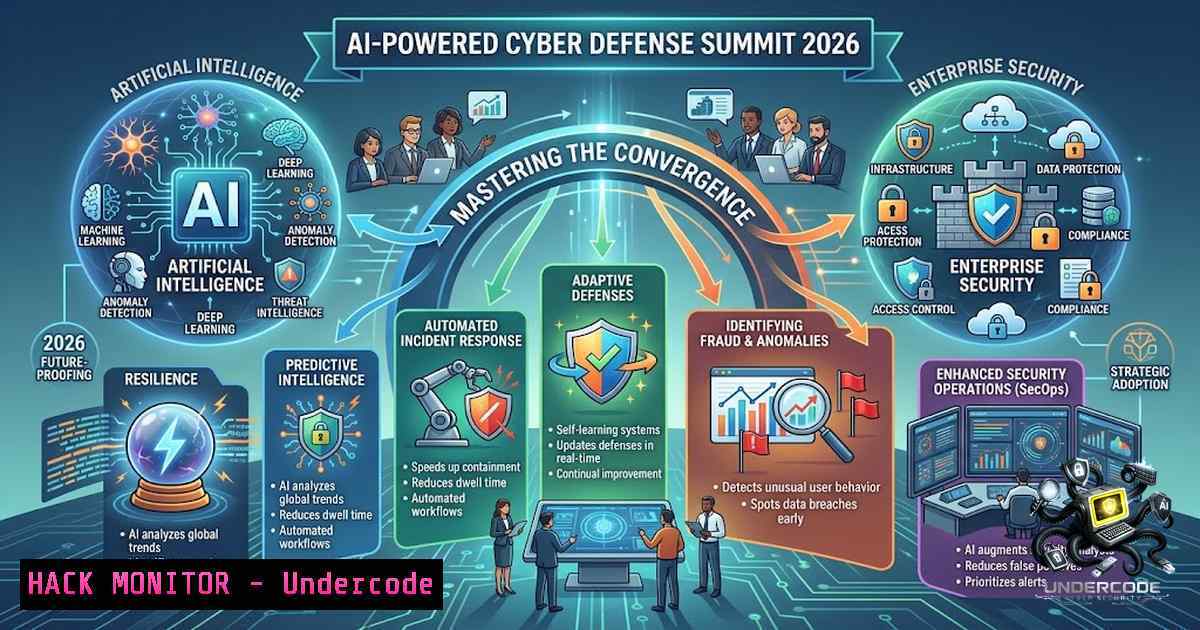
The cybersecurity landscape of 2026 is defined by a paradoxical duality—artificial intelligence simultaneously powers next-generation defense mechanisms while enabling sophisticated attack vectors that outpace traditional security controls. As organizations rush to adopt AI-driven security operations, the emergence of specialized certifications like CompTIA SecAI+ (launched February 2026) and the CERT Leadership in AI for Cybersecurity program signal a fundamental shift in how security professionals must approach threat detection, incident response, and system hardening. This article synthesizes the latest developments in AI security training, critical vulnerabilities patched in August 2026, and actionable hardening techniques across Linux and Windows environments to equip defenders with a comprehensive operational playbook.
Learning Objectives & Secrets:
- Objective 1: Master AI-Augmented Threat Detection—Learn to integrate machine learning models into SIEM workflows to reduce mean time to detection (MTTD) by correlating anomalous behavioral patterns across hybrid cloud environments.
- Objective 2 Secret Tips: Exploit AI Model Weaknesses Before Attackers Do—Implement adversarial robustness testing using frameworks like MITRE ATLAS to identify prompt injection vulnerabilities and data poisoning vectors in production LLM-powered applications.
- Objective 3 Secret Tips: Automate System Hardening with Intelligence—Deploy self-healing scripts that leverage AI to dynamically adjust firewall rules, patch priorities, and access controls based on real-time threat intelligence feeds rather than static baselines.
1. Critical Vulnerability Landscape: August 2026 Patch Priorities
The August 2026 Patch Tuesday cycle was historically significant, with Microsoft addressing approximately 398 CVEs, including an actively exploited zero-day (CVE-2026-68820) granting SYSTEM-level privilege escalation. Simultaneously, CISA added three critical flaws to its Known Exploited Vulnerabilities catalog: a Linux kernel vulnerability, a JFrog Artifactory SQL injection (CVE-2026-74820), and an ownCloud improper access control issue (CVE-2026-18886).
Step-by-Step Guide: Prioritizing and Applying Patches
- Inventory Assessment: Run vulnerability scanners (Nessus, OpenVAS) to identify CVE-2026-68820 and related RCE flaws across Windows Servers. For Linux systems, check kernel versions against CISA’s KEV catalog.
- Windows Patching: Deploy the August 2026 cumulative update via WSUS or directly from Microsoft Update Catalog. Use PowerShell to verify installation:
Get-HotFix | Where-Object {$_.InstalledOn -gt (Get-Date).AddDays(-30)} - Linux Kernel Update: For distributions affected by the kernel flaw, update using package managers:
Debian/Ubuntu
sudo apt update && sudo apt upgrade linux-image-$(uname -r)
RHEL/CentOS
sudo yum update kernel
sudo reboot
- Artifactory Mitigation: Apply the vendor patch for CVE-2026-74820 and restrict database user permissions to minimize SQL injection impact.
- Verification: Re-scan environments post-patching to confirm remediation and monitor for performance regressions.
2. AI Security Certifications: Building the 2026 Workforce
The certification ecosystem has rapidly evolved to address AI-specific threats. CompTIA SecAI+ (CY0-001) validates skills in securing AI systems, governing AI integration, and leveraging AI for enhanced threat detection. The EC-Council’s Certified Offensive AI Security Professional (COASP) focuses on red-teaming AI systems, exploiting LLM vulnerabilities, and mastering the OWASP LLM Top 10.
Step-by-Step Guide: Preparing for AI Security Certification
- Foundational Knowledge: Enroll in foundational courses like “Fundamentals of Statistics Applied to Cybersecurity” offered by CMU’s SEI to build the quantitative skills necessary for AI security.
- Hands-On Lab Environment: Set up a sandbox using open-source tools like Adversarial Robustness Toolbox (ART) to practice attacking and defending ML models.
- Framework Mastery: Study the MITRE ATLAS framework and OWASP LLM Top 10. Create cheat sheets for each attack type (e.g., prompt injection, model theft).
- Practice Exams: Utilize CompTIA’s official practice tests and EC-Council’s iLabs to simulate exam scenarios.
- Continuous Learning: Subscribe to threat intelligence feeds that focus on AI vulnerabilities, such as the CISA AI Security resources and the NIST AI Risk Management Framework.
-
Linux System Hardening: Commands and Configurations for 2026
System hardening remains the bedrock of defense. Recent guidelines emphasize kernel hardening, SSH configuration, and automated auditing.
Step-by-Step Guide: Hardening a Linux Server
- Kernel Hardening: Create a custom sysctl configuration file to enforce network security parameters:
sudo nano /etc/sysctl.d/99-hardening.conf
Add the following lines:
net.ipv4.ip_forward=0
net.ipv4.conf.all.rp_filter=1
net.ipv4.conf.default.rp_filter=1
net.ipv4.tcp_syncookies=1
Apply the settings:
sudo sysctl -p /etc/sysctl.d/99-hardening.conf
2. SSH Security: Disable root login and enforce key-based authentication:
sudo nano /etc/ssh/sshd_config
 Set: PermitRootLogin no
 Set: PasswordAuthentication no
sudo systemctl restart sshd
3. Firewall Configuration: Use UFW or nftables to restrict incoming traffic:
sudo ufw default deny incoming
sudo ufw default allow outgoing
sudo ufw allow ssh
sudo ufw enable
4. Audit and Monitoring: Install and configure auditd to track critical file changes:
sudo apt install auditd
sudo auditctl -w /etc/passwd -p wa -k identity_changes
5. Automated Hardening Script: Utilize community-tested scripts like `secure_ubuntu.sh` which integrate UFW, SSH, sysctl, PAM, and AppArmor configurations.
4. Windows Server Hardening: PowerShell Automation and Compliance
Windows environments require equivalent rigor, leveraging PowerShell for automation and Group Policy for centralized control.
Step-by-Step Guide: Hardening Windows Server 2022
- Firewall Configuration: Use PowerShell to enable Windows Defender Firewall and block all inbound traffic by default:
Set-1etFirewallProfile -Profile Domain,Public,Private -Enabled True
Set-1etFirewallProfile -Profile Domain,Public,Private -DefaultInboundAction Block
- User Account Control (UAC): Enforce UAC with appropriate consent prompt behaviors via Group Policy or registry.
- Account Policies: Enforce password complexity and lockout policies:
Set-ADDefaultDomainPasswordPolicy -ComplexityEnabled $true -LockoutThreshold 5
- Logging and Auditing: Enable advanced audit policies for login events, object access, and privilege use. Forward logs to a centralized SIEM using Windows Event Forwarding.
- BitLocker Encryption: Enable BitLocker for system drives using manage-bde:
Manage-bde -on C: -RecoveryPassword -RecoveryKey C:\Recovery
-
API Security and Cloud Hardening: Defending the Modern Perimeter
APIs are the primary attack surface in cloud-1ative architectures. NIST’s March 2026 guidelines emphasize pre-runtime and runtime controls, while industry best practices highlight Broken Object Level Authorization (BOLA) as the most critical risk in 2026.
Step-by-Step Guide: Securing APIs and Cloud Workloads
- Authentication and Authorization: Implement OAuth 2.0 with short-lived tokens. Use a dedicated secrets manager like HashiCorp Vault for credential storage.
- Rate Limiting and Throttling: Configure API gateways to enforce per-IP and per-token limits, typically 10-50 requests per second with sliding window enforcement to catch bursts.
- Input Validation: Implement strict schema validation for all API payloads to prevent injection attacks. Use JSON Schema or OpenAPI validators.
- BOLA Prevention: Replace sequential numeric IDs with UUIDs (Universally Unique Identifiers) to prevent resource enumeration. Validate user context (tokens and origin) before processing any backend request.
- Transport Layer Security: Enforce TLS 1.2 or newer for all API endpoints. In Azure, configure SQL Database to require TLS 1.2.
- Observability and Monitoring: Enable Microsoft Defender for APIs or equivalent cloud-1ative protection to discover and protect exposed endpoints.
-
Incident Response in the Age of AI-Driven Attacks
August 2026 saw active exploitation of a macOS Screen Sharing flaw deploying Monero miners and a Lazarus Group Windows kernel zero-day. These incidents underscore the need for AI-enhanced incident response playbooks.
Step-by-Step Guide: AI-Enhanced Incident Response
- Threat Intelligence Integration: Feed real-time IOCs (Indicators of Compromise) from CISA and vendor alerts into your SIEM. Use AI to correlate seemingly unrelated events.
- Automated Triage: Deploy machine learning models to prioritize alerts based on severity, asset criticality, and attack probability.
- Containment Automation: Develop playbooks that automatically isolate compromised endpoints using APIs from EDR solutions.
- Forensic Collection: Use AI to analyze memory dumps and logs for patterns indicative of advanced persistent threats (APTs).
- Post-Incident Analysis: Leverage AI to generate root cause analysis reports and recommend specific hardening measures to prevent recurrence.
What Undercode Say:
- Key Takeaway 1: The convergence of AI and cybersecurity is no longer optional—it is a survival imperative. Organizations that fail to invest in AI security training (via certifications like SecAI+ and COASP) and automated hardening will be disproportionately vulnerable to both known exploits and emerging AI-specific attack vectors.
- Key Takeaway 2: The August 2026 patch cycle is a stark reminder that foundational hygiene—prompt patching, system hardening, and API security—remains the most effective defense. Even as AI tools advance, they cannot compensate for unpatched systems or misconfigured APIs.
Analysis: The cybersecurity industry is at an inflection point. While AI offers unprecedented capabilities for threat detection and response, it simultaneously lowers the barrier to entry for attackers. The rapid adoption of AI in development pipelines (CI/CD) introduces new risks, such as exposed OAuth permissions and environment variables. Security teams must adopt a “defense-in-depth” strategy that spans edge, gateway, backend, and database layers, integrating AI not as a replacement for human expertise but as a force multiplier. The certifications and training programs emerging in 2026 are designed to bridge this skills gap, but they require hands-on practice and continuous adaptation to the evolving threat landscape.
Prediction:
- +1 The proliferation of AI security certifications (CompTIA SecAI+, EC-Council COASP, CMU SEI programs) will create a new generation of security professionals capable of defending against AI-1ative threats, driving down the average cost of data breaches by 15-20% by 2028.
- +1 Automated, AI-driven hardening tools will become standard in CI/CD pipelines, enabling “self-healing” infrastructures that dynamically adapt to new vulnerabilities without manual intervention.
- -1 The sophistication of AI-powered attacks—particularly prompt injection and model poisoning—will outpace defensive capabilities in the short term, leading to a surge in AI-specific data breaches and intellectual property theft over the next 12-18 months.
- -1 Organizations that delay adopting AI security training and hardening practices will face increased regulatory scrutiny and potential fines as frameworks like the EU AI Act and NIST AI RMF are enforced more rigorously.
- +1 The integration of AI with threat intelligence platforms will significantly enhance predictive capabilities, allowing organizations to anticipate and mitigate zero-day exploits before they are publicly disclosed.
▶️ Related Video (80% Match):
🎯Let’s Practice For Free:
🎓 Live Courses & Certifications:
Join Undercode Academy for Verified Certifications
🚀 Request a Custom Project:
Secure, high-velocity infrastructure and disruptive technological engineering. Contact our engineering team for high-tier development and proprietary systems:
[email protected]
💎 Smart Architecture | 🛡️ Secure by Design | ⭐ Trusted by Thousands
IT/Security Reporter URL:
Reported By: https://lnkd.in/p/eyk3gDwc – Hackers Feeds
Extra Hub: Undercode MoN
Basic Verification: Pass ✅


