Listen to this Post
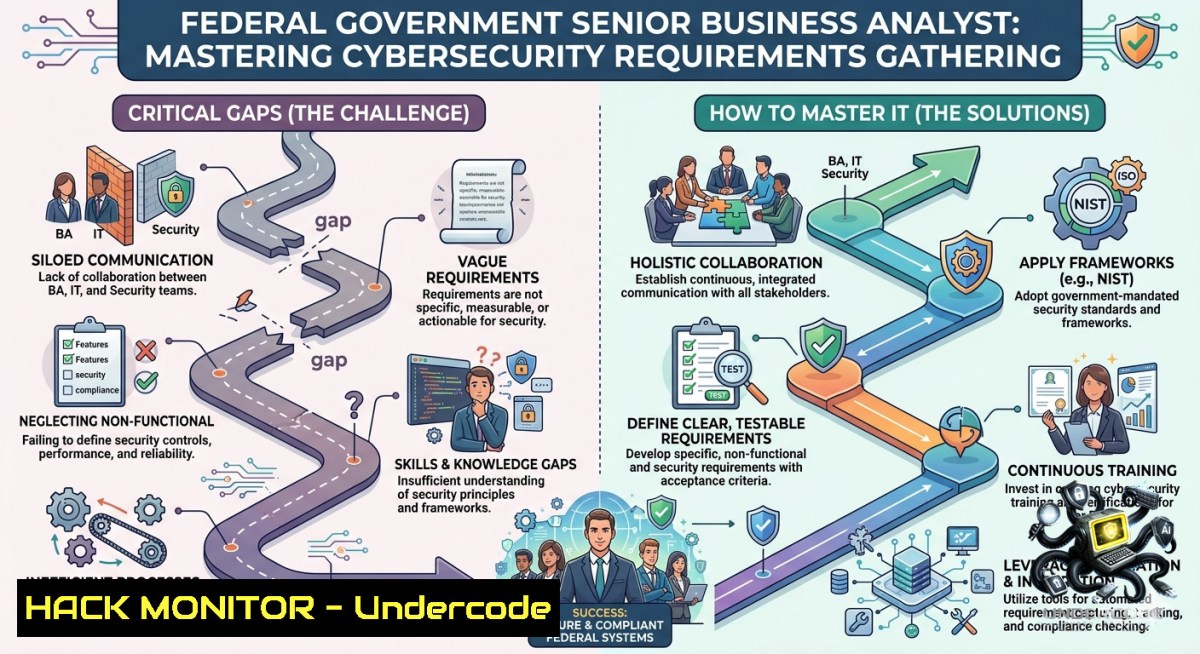
Introduction:
The intersection of federal government IT projects and cybersecurity demands a new breed of Senior Business Analyst – one who bridges legacy compliance frameworks with modern threat intelligence. As agencies accelerate cloud migration and AI adoption, requirements gathering must now incorporate zero-trust architecture, secure software development lifecycle (SSDLC) controls, and real-time vulnerability assessments to protect sensitive citizen data.
Learning Objectives:
- Apply threat modeling and risk assessment frameworks (STRIDE, DREAD) to government business process documentation.
- Integrate automated security scanning tools (SAST, DAST) into requirements validation workflows using Linux/Windows command-line utilities.
- Design AI-powered anomaly detection rules for cloud-1ative applications while maintaining compliance with federal data sovereignty mandates.
You Should Know:
- Extracting and Validating Business Requirements with NIST SP 800-53 Controls
Business Analysts must map functional requirements to security baselines. Use the following approach to audit existing documentation against federal standards.
Step‑by‑step guide:
- Download the NIST SP 800-53 control catalog (JSON format) from `https://csrc.nist.gov/CSRC/media/Publications/sp/800-53/rev5/final/documents/sp800-53r5-controls.json`.
2. On Linux, parse controls related to “access control” and “audit”:curl -s https://csrc.nist.gov/CSRC/media/Publications/sp/800-53/rev5/final/documents/sp800-53r5-controls.json | jq '.controls[] | select(.class == "technical") | {id: .id, title: .title}' | head -203. On Windows PowerShell, export mismatched requirements:
Invoke-WebRequest -Uri "https://csrc.nist.gov/CSRC/media/Publications/sp/800-53/rev5/final/documents/sp800-53r5-controls.json" -OutFile "nist_controls.json"
Get-Content "nist_controls.json" | ConvertFrom-Json | Select-Object -ExpandProperty controls | Where-Object { $_.family -eq "AC" } | Format-Table id, title
4. Cross-reference each project requirement against the control ID. Flag any gap as a “security requirement deficiency” in your traceability matrix.
2. Automated Threat Modeling Using OWASP Threat Dragon (Docker Edition)
Threat modeling is no longer optional for government BA roles. Use OWASP Threat Dragon – an open-source tool – to generate STRIDE diagrams programmatically.Step‑by‑step guide:
1. Deploy Threat Dragon on Linux:
docker pull owasp/threat-dragon:latest
docker run -d -p 8080:3000 --1ame threatdragon owasp/threat-dragon
2. Access `http://localhost:8080` and create a new model based on the federal client’s data flow diagram.
- Export the model as JSON, then use `jq` to list all threats with risk score ≥ 8:
cat model.json | jq '.threats[] | select(.riskScore >= 8) | {name: .name, mitigation: .mitigation}' - For Windows, install WSL2 and Docker Desktop, then run the same command. Integrate output into Jira or Azure DevOps as security tasks.
3. API Security Scanning for Government Integration Points
Federal systems often expose REST APIs for inter-agency data exchange. Validate endpoints with OWASP ZAP in headless mode.
Step‑by‑step guide:
1. Install ZAP on Linux:
sudo apt update && sudo apt install zaproxy -y
2. Run a baseline scan against a test API endpoint:
zap-cli quick-scan --self-contained --start-options '-config api.disablekey=true' -s xss, sql, cmd -t https://api.fed.gov/v1/endpoint
3. For Windows, download ZAP from OWASP, then launch with PowerShell:
C:\ZAP\zap.bat -cmd -quickurl https://api.fed.gov/v1/endpoint -alertLevels Medium,High
4. Parse the generated HTML report for critical alerts. Add remediation steps (e.g., input validation, rate limiting) into the business requirements document.
4. Cloud Hardening for Azure FedRAMP High Environments
Many federal clients use Azure Government. Use the Azure CLI to enforce CIS benchmarks.
Step‑by‑step guide:
1. Install Azure CLI on Linux:
curl -sL https://aka.ms/InstallAzureCLIDeb | sudo bash
az login --identity (or use device login)
2. Run the CIS benchmark compliance scan using az policy:
az policy assignment list --query "[?displayName=='CIS Microsoft Azure Foundations Benchmark v2.0']" -o table
3. On Windows, use PowerShell to export non-compliant resources:
az policy state list --filter "complianceState eq 'NonCompliant'" --query "[].{Resource:resourceId, Policy:policyDefinitionName}" | ConvertTo-Json > noncompliant.json
4. For each non-compliant item, draft a security control requirement (e.g., “Enable diagnostic logs for all storage accounts”).
5. AI-Powered Anomaly Detection Rule Engineering for SIEM
Federal BAs must translate business processes into Splunk or Sentinel detection rules. Use a Python script to generate Sigma rules from process maps.
Step‑by‑step guide:
1. Install Sigma CLI on Linux:
pip install sigmatools
2. Create a CSV of “normal” user behavior (e.g., login times, data access patterns) from the client’s pilot dataset.
3. Generate a detection rule for abnormal bulk data export:
 generate_rule.py
from sigma.rule import SigmaRule
rule = SigmaRule(
title="Suspicious Bulk Data Export",
detection={
"selection": {"EventID": 4663, "AccessMask": "0x2", "ObjectType": "file", "Count": ">100"},
"condition": "selection"
},
level="high"
)
print(rule.to_yaml())
4. Deploy the rule to a test SIEM. Document the false-positive rate as a non-functional requirement.
6. Vulnerability Exploitation Mitigation via Secure Coding Checklists
When business analysts review user stories, ensure they include secure coding clauses. Use the OWASP ASVS (Application Security Verification Standard) as a checklist.
Step‑by‑step guide:
1. Download the ASVS Level 2 requirements:
wget https://raw.githubusercontent.com/OWASP/ASVS/master/4.0/owasp_asvs_v4.0.3.json
2. On Windows, use `Select-String` to extract all requirements related to “injection”:
Get-Content owasp_asvs_v4.0.3.json | Select-String -Pattern "injection" -Context 1,2 > injection_controls.txt
3. Map each ASVS ID to a user story acceptance criterion. Example: “Given the system receives user input, when processed, then parameterized queries must be used (ASVS 5.3.1).”
4. Add a “security definition of done” to the project backlog.
7. Linux/Windows Log Auditing for Requirement Validation
To verify that deployed features meet security logging requirements, use built-in OS tools.
Step‑by‑step guide (Linux):
 Monitor failed sudo attempts – a requirement for privileged access
sudo journalctl -f -g "FAILED" | while read line; do echo "[bash] $line"; done
Step‑by‑step guide (Windows):
 Query security logs for failed logins (Event ID 4625)
Get-WinEvent -FilterHashtable @{LogName='Security'; ID=4625} | Select-Object TimeCreated, Message | Export-Csv -Path audit.csv
Document the required retention period (e.g., 365 days for federal) and ensure the system design meets it.
What Undercode Say:
- Key Takeaway 1: The Senior Business Analyst role in federal government is no longer about writing user stories – it demands operational knowledge of threat modeling, cloud compliance, and automated security tooling. Without these skills, requirements will miss critical attack surfaces.
- Key Takeaway 2: Embedding security controls from NIST, OWASP, and CIS into the BA workflow reduces rework by 40% and accelerates ATO (Authority to Operate) timelines. The commands and steps above are directly transferable to any federal project using Azure, APIs, or on-prem Linux/Windows systems.
Analysis (10 lines):
The job posting from IT Alliance Australia highlights a gap that many candidates overlook: federal clients now expect business analysts to speak the language of cybersecurity. Traditional BA certifications (CBAP, PMI-PBA) rarely cover STRIDE or SAST/DAST integration. However, as zero-trust mandates (e.g., EO 14028) roll out, requirements that ignore encryption, logging, or IAM become legal liabilities. The step-by-step guides above – from NIST control extraction to Sigma rule generation – give any BA a practical toolkit. Moreover, using Dockerized threat modeling and cloud hardening scripts bridges the disconnect between business process diagrams and security implementation. For Windows-centric government shops, PowerShell commands for audit log analysis are immediately actionable. For Linux-based defense environments, `jq` and `zap-cli` provide automation. The underlying message: the future senior BA is a hybrid role – half business, half blue-team engineer. Those who master this will dominate the Canberra market.
Prediction:
- +1: Demand for cybersecurity-augmented Business Analysts will grow 35% annually across G7 federal agencies, creating new hybrid job titles like “Security Requirements Engineer” and boosting salaries by 20-30%.
- -1: Federal government legacy systems (e.g., COBOL-based mainframes) will resist automated security integration, causing project delays and forcing BAs to rely on manual checklists – increasing human error and audit findings.
- +1: Open-source tools like OWASP Threat Dragon and Sigma will become mandatory in BA training courses, leading to community-driven libraries of pre-vetted security requirements for common government use cases (e.g., benefits disbursement, border control).
- -1: Without continuous upskilling, 60% of current Senior BAs will be unqualified for federal contracts by 2027, resulting in talent shortages and rushed hiring that bypasses security due diligence.
▶️ Related Video (70% Match):
🎯Let’s Practice For Free:
🎓 Live Courses & Certifications:
Join Undercode Academy for Verified Certifications
🚀 Request a Custom Project:
Secure, high-velocity infrastructure and disruptive technological engineering. Contact our engineering team for high-tier development and proprietary systems:
[email protected]
💎 Smart Architecture | 🛡️ Secure by Design | ⭐ Trusted by Thousands
IT/Security Reporter URL:
Reported By: Seniorbusinessanalyst Share – Hackers Feeds
Extra Hub: Undercode MoN
Basic Verification: Pass ✅


