
Listen to this Post
Introduction:
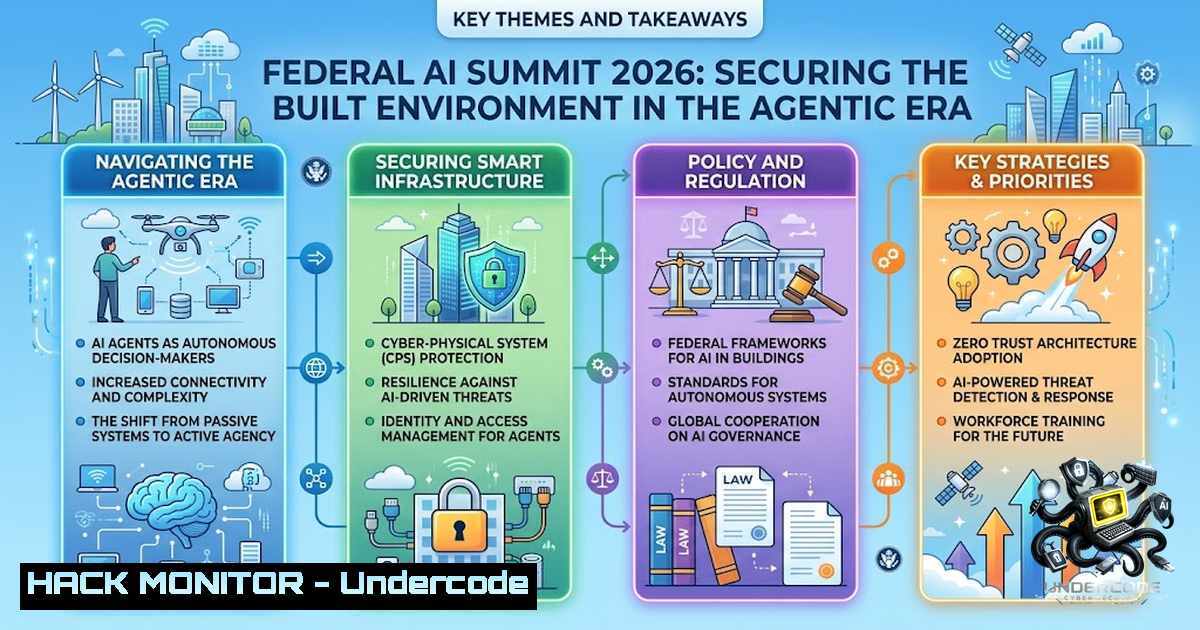
On September 10, 2026, Stanford University will host the Federal AI Summit, convening federal agency leaders, military engineers, A/E/C executives, technology innovators, and investors for a full day on what AI adoption actually requires in the built environment and the federal sector. Presented by the Society of American Military Engineers (SAME) San Francisco Post and Stanford CIFE, the summit features opening remarks from Stanford GSB’s Robert E. Siegel—author of The Systems Leader and venture partner at Piva Capital—and a closing address from Steve Blank, creator of the Customer Development process, co-creator of the Lean Startup methodology, and co-creator of the Department of Defense’s Hacking for Defense program. As federal agencies accelerate AI adoption under a rapidly evolving regulatory landscape—including Executive Order 14409, CISA BOD 26-04, and OMB M-26-14—the summit addresses five critical areas: empowering A/E/C adoption within a cybersecure federal framework, implementation pathways, policy and governance, Big Tech partnership, and future innovation.
Learning Objectives & Secrets:
- Objective 1: Understand the Federal AI Regulatory Surge — Between May 22 and June 10, 2026, the U.S. federal government issued five significant AI and cybersecurity policy instruments in rapid succession. Attendees will learn how OMB M-26-14 replaces the SolarWinds-era logging mandate with risk-based continuous event monitoring, how EO 14409 establishes an AI cybersecurity clearinghouse, and how CISA BOD 26-04 compresses critical vulnerability remediation to three calendar days.
-
Objective 2 Secret Tip: Inventory Agentic AI as Non-Human Identities — Agentic AI systems are already operating inside government organizations, often without the knowledge of security teams. Federal CISOs must treat agents as first-class actors in zero trust architectures, inventorying every agent’s data access, system permissions, and authorized decisions. Security teams must embed directly into how agents are built, tested, and deployed—not review them on monthly cycles.
-
Objective 3 Secret Tip: Build Agent-Driven Incident Playbooks — Traditional incident response frameworks assume human behavior—a person clicking a malicious link. When an agent takes the action, that model breaks. Agencies must define what evidence matters: the agent’s instruction chain, model outputs, context window, invoked permissions, and crossed decision boundaries.
You Should Know:
- Continuous Monitoring Under OMB M-26-14: From Logging to Risk-Based Event Monitoring
OMB Memorandum M-26-14 retired the five-year-old logging mandate from the SolarWinds era and replaced it with a risk-based continuous event monitoring requirement. This covers not just traditional IT systems but IoT and operational technology environments. For federal agencies and contractors, this means implementing centralized log aggregation with real-time threat detection.
Step-by-Step Guide: Implementing Continuous Event Monitoring
Linux (Rsyslog + Auditd):
 Install and configure auditd for system call monitoring
sudo apt-get install auditd audispd-plugins
sudo auditctl -e 1
 Add rules for critical file integrity monitoring
sudo auditctl -w /etc/passwd -p wa -k identity_changes
sudo auditctl -w /etc/sudoers -p wa -k privilege_escalation
 Forward logs to central SIEM
echo ". @@central-siem.example.com:514" >> /etc/rsyslog.conf
sudo systemctl restart rsyslog
Windows (PowerShell + Windows Event Forwarding):
 Enable advanced audit policy
auditpol /set /subcategory:"Credential Validation" /success:enable /failure:enable
auditpol /set /subcategory:"User Account Management" /success:enable /failure:enable
 Configure Windows Event Forwarding to collect security logs
wecutil qc /q
 Subscribe to forward events to collector
wecutil cs subscription.xml
This configuration ensures continuous visibility into system changes, aligning with M-26-14’s requirement for risk-based monitoring across IT and OT environments.
- CISA BOD 26-04: Three-Day Patching for AI-Accelerated Threats
CISA Binding Operational Directive 26-04 retired CVSS-based remediation timelines, replacing them with a four-variable risk matrix that mandates three-day remediation for the highest-priority vulnerabilities. The directive explicitly cites AI-accelerated exploitation as justification, as adversaries have compressed patching windows from months to hours.
Step-by-Step Guide: Implementing BOD 26-04 Compliant Patching
1. Inventory all assets with AI-enabled discovery tools:
 Nmap scan for asset discovery
nmap -sS -sV -O -p- -T4 10.0.0.0/24 -oA network_inventory
 Use OpenVAS for vulnerability scanning
openvas-1vt-sync
omp -u admin -w password -h 127.0.0.1 --xml="<create_task>..."
- Prioritize using the four-variable risk matrix (exploitability, impact, asset criticality, AI-specific threat amplification).
-
Automate patch deployment for critical vulnerabilities within 72 hours:
Linux - automated patching with Ansible
ansible-playbook -i inventory/hosts.ini playbooks/security_patching.yml \
--extra-vars "patch_level=critical reboot=yes"
Windows - using PSWindowsUpdate
Install-Module PSWindowsUpdate
Get-WUInstall -MicrosoftUpdate -AcceptAll -AutoReboot -Category "Security Updates"
-
Validate patch success with compliance scanning and report to CISA-mandated clearinghouse.
-
NIST AI RMF: Operationalizing the Four Functions for Federal AI Governance
NIST’s AI Risk Management Framework (AI RMF 1.0) defines four core functions: Govern, Map, Measure, and Manage. Federal agencies are increasingly required to adopt this framework, with OMB M-26-04 requiring continuous behavioral accountability for deployed AI models.
Step-by-Step Guide: NIST AI RMF Implementation
- Govern: Establish AI governance structures, document roles, and define risk tolerance.
- Map: Contextualize AI systems—document intended use, stakeholders, and deployment environment.
- Measure: Implement continuous monitoring for bias, accuracy degradation, and supply-chain modification.
- Manage: Treat AI risk as an ongoing operational discipline, not a certification checkpoint.
 Example: Continuous AI model monitoring script
import numpy as np
from sklearn.metrics import accuracy_score, fairness_metrics

def monitor_model_performance(predictions, ground_truth, sensitive_attributes):
accuracy = accuracy_score(ground_truth, predictions)
 Check for accuracy degradation (NIST Measure function)
if accuracy < baseline_accuracy  0.95:
alert("Model accuracy degradation detected")
 Check for fairness violations
for attr in sensitive_attributes:
if fairness_violation_detected(predictions, attr):
alert(f"Fairness violation detected for {attr}")
return {"accuracy": accuracy, "fairness_status": "pass"}
- Zero Trust for Agentic AI: Non-Human Identities as First-Class Actors
Federal agencies are increasingly integrating AI into zero trust architectures. The Five-Eyes Alliance identifies Zero Trust as the best defense against agentic AI threats, prioritizing least privilege, deny-by-default security, application containment, segmentation, and continuous verification.
Step-by-Step Guide: Zero Trust Implementation for AI Agents
- Discover and inventory all AI agents in the environment.
- Apply least privilege—agents should have minimum permissions necessary.
- Implement continuous verification of agent behavior and identity.
4. Segment agent workloads to contain potential breaches.
 Linux - implement least privilege for AI service accounts
sudo useradd -r -s /bin/false ai_agent_service
sudo setfacl -m u:ai_agent_service:rx /opt/ai/models
 Restrict network access with iptables
sudo iptables -A OUTPUT -m owner --uid-owner ai_agent_service -j ACCEPT
sudo iptables -A OUTPUT -m owner --uid-owner ai_agent_service -d 10.0.0.0/8 -j ACCEPT
- Hacking for Defense: Lean Startup Methodology Applied to National Security
Steve Blank’s Hacking for Defense program, now in 70 universities across the US, UK, Poland, and Germany, applies Lean Startup methodology to national security problems. The program has trained over 3,000 students addressing complex problems in energy networks, cybersecurity, and AI. The Lean Startup approach—build-measure-learn cycles, customer development, and MVP validation—offers a framework for federal AI adoption that emphasizes rapid experimentation and iterative security improvement.
Key Lean Security Principles:
- Design-First Security: Start with security in the discovery and design phase.
- Continuous Validation: Treat security as an ongoing process, not a compliance checkpoint.
- Automated Governance: Security reviews must keep pace with developer-speed AI deployment.
What Undercode Say:
- Key Takeaway 1: The Federal AI Summit represents a critical convergence of defense, engineering, and technology sectors around AI adoption in the built environment. The presence of Stanford GSB faculty Robert Siegel and Lean Startup pioneer Steve Blank signals that federal AI strategy is embracing both systems leadership and entrepreneurial methodologies.
-
Key Takeaway 2: Federal AI governance has entered a new era of continuous, real-time accountability. The five mandates issued in three weeks—EO 14409, BOD 26-04, M-26-14, NSPM-11, and NIST’s guardrail proof—collectively require federal agencies and contractors to build AI-aware monitoring capabilities that did not exist as regulatory requirements twelve months ago. The three-day patching deadline under BOD 26-04 is the shortest standing remediation deadline in any prior CISA directive.
-
Analysis: The convergence of federal AI policy with cybersecurity mandates signals a fundamental shift from periodic compliance to continuous operational security. Organizations that fail to implement automated agent inventories, real-time monitoring, and three-day patching capabilities will face both regulatory exposure and operational risk from AI-accelerated adversaries. The summit’s focus on “cybersecure federal framework” for A/E/C adoption reflects this reality. As NIST’s mathematical proof establishes that no finite set of AI guardrails is universally robust, the emphasis must shift to continuous red teaming, behavioral monitoring, and resilience planning.
Prediction:
-
+1 The Federal AI Summit will accelerate public-private partnerships in AI security, particularly through SAME’s AI Working Group and IGE Project Team, driving adoption of FedRAMP-authorized AI platforms in the built environment.
-
+1 The Hacking for Defense model will expand beyond universities into federal agency innovation labs, applying Lean Startup methodology to accelerate secure AI deployment in defense and civilian agencies.
-
-1 Organizations that fail to implement BOD 26-04’s three-day patching capability within the compliance window will face significant regulatory penalties and increased vulnerability to AI-accelerated exploits.
-
-1 The rapid pace of federal AI mandates—five major instruments in three weeks—will create compliance fragmentation, particularly for smaller contractors lacking the resources to implement continuous monitoring and agentic security programs.
-
+1 NIST’s AI RMF will become the de facto federal AI governance baseline, with increasing requirements for federal agencies, state and local government, and CMMC-aligned defense contractors, driving standardization in AI security practices across the public sector.
-
-1 The mathematical proof that no finite set of AI guardrails is universally robust will force agencies to shift from prevention-focused security to resilience-focused strategies, requiring significant investment in red teaming and incident response capabilities that are currently underfunded.
-
+1 The summit’s focus on “Implementation Pathways” and “Future Innovation” will catalyze investment in AI-1ative security tools that can achieve 97-99% protection rates, reducing the manual alert remediation burden by up to 25-fold.
▶️ Related Video (84% Match):
https://www.youtube.com/watch?v=-DnyeFpZcbc
🎯Let’s Practice For Free:
🎓 Live Courses & Certifications:
Join Undercode Academy for Verified Certifications
🚀 Request a Custom Project:
Secure, high-velocity infrastructure and disruptive technological engineering. Contact our engineering team for high-tier development and proprietary systems:
[email protected]
💎 Smart Architecture | 🛡️ Secure by Design | ⭐ Trusted by Thousands
IT/Security Reporter URL:
Reported By: https://lnkd.in/p/ens9YtNB – Hackers Feeds
Extra Hub: Undercode MoN
Basic Verification: Pass ✅


