Listen to this Post
Introduction:
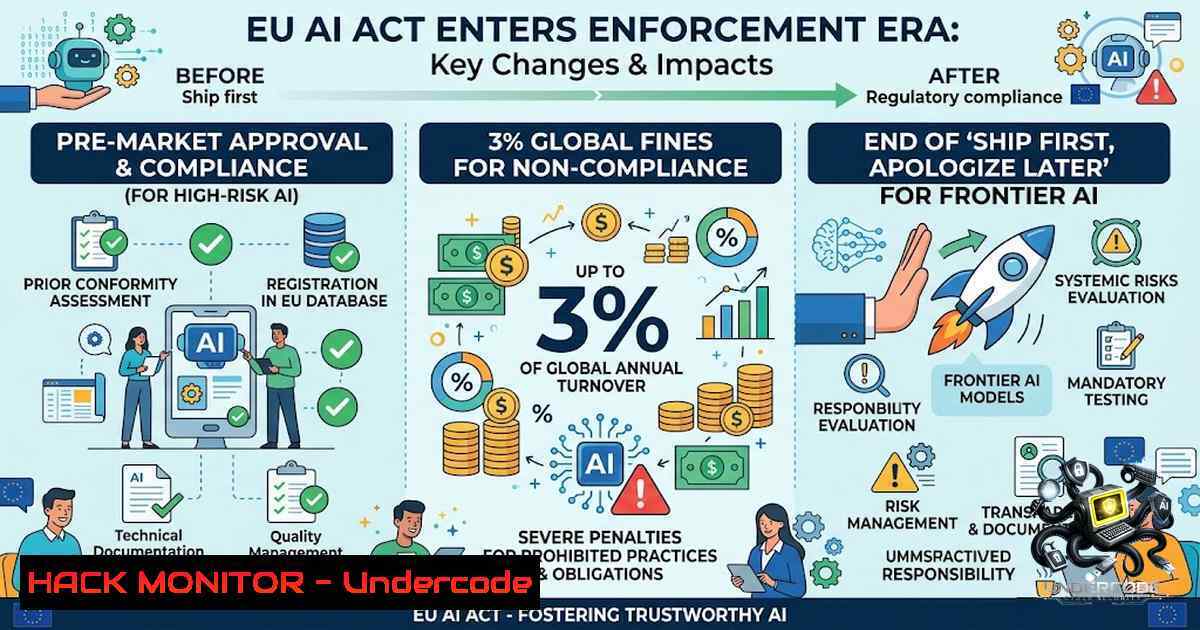
On August 2, 2026, the European Union’s Artificial Intelligence Act (EU AI Act) entered its enforcement phase, granting the European Commission—through its European AI Office—sweeping powers to investigate, audit, and penalize providers of general-purpose AI (GPAI) models. For the first time, frontier AI models from OpenAI, Anthropic, Google, and any other provider serving the EU market face pre-market scrutiny, mandatory transparency obligations, and fines of up to 3% of global annual revenue—or €15 million, whichever is higher. The era of “ship first, apologize later” that defined software development for decades has officially ended for frontier AI, with both Brussels and Washington now asserting pre-market control over who can deploy advanced AI models.
Learning Objectives:
- Understand the EU AI Act’s enforcement framework and its implications for GPAI providers, including pre-market authorization, model evaluations, and transparency obligations under 50
- Master the technical compliance requirements for GPAI providers, including Annex XI technical documentation, copyright policies, and training-content summaries
- Learn practical implementation strategies for AI-generated content watermarking, deepfake labeling, and system transparency disclosures
- Navigate the intersection of the EU AI Act with GDPR, open-source exemptions, and the systemic-risk threshold for models exceeding 10²⁵ FLOPs
You Should Know:
- The EU AI Office’s Enforcement Arsenal: Powers, Procedures, and Penalties
The EU AI Office, a dedicated structure within the European Commission, now holds exclusive authority under 88 to supervise and enforce GPAI obligations across the entire bloc. This centralized enforcement model differs from the rest of the AI Act, where national market surveillance authorities police most obligations. The AI Office’s powers include:
- Information and documentation requests: The Office can demand technical documentation, training records, and any information related to a GPAI model’s development and deployment
- Model access for evaluation: Under 92, the AI Office can obtain access to models for independent evaluation, either directly or through appointed external experts
- Corrective and mitigation measures: The Office can require providers to implement risk-mitigation measures or, in serious cases, restrict, withdraw, or recall a model from the EU market
- Fines and penalties: For GPAI non-compliance, fines can reach up to €15 million or 3% of the provider’s worldwide annual turnover, whichever is higher. Stonewalling an information request is finable on its own
The AI Office has signaled that “technical compliance dialogues” will remain its preferred initial tool for assessing compliance, but these dialogues may intensify and escalate to formal enforcement actions if concerns are not adequately resolved.
- 50 Transparency Obligations: Watermarking, Deepfake Labeling, and AI Disclosure
Starting August 2, 2026, businesses providing or deploying certain AI systems must comply with four main categories of transparency requirements under 50:
2.1 Human-AI Interaction Disclosure
Providers of AI systems that interact directly with individuals—such as chatbots, virtual assistants, and customer-service automation—must ensure that users are clearly notified they are interacting with an AI system, unless this is obvious from the circumstances.
2.2 Machine-Readable Content Marking
AI systems that generate synthetic audio, image, video, or text content must mark outputs in a machine-readable format so they can be reliably detected as artificially generated or manipulated. The European Commission’s final Code of Practice on Transparency of AI-Generated Content recommends a two-tier system: (1) hidden watermarks embedded directly into the content, and (2) cryptographically signed digital metadata. For free-form text, watermarking must be applied to content longer than 200 tokens, while very short text (under 200 tokens) need not be watermarked. The Code requires providers to make their watermark detection mechanisms interoperable by February 2, 2027.
2.3 Deepfake Labeling
Deployers of AI systems that generate or manipulate deepfakes must disclose that the content has been artificially generated or manipulated. Determining whether content constitutes a “deepfake” can be complex, particularly where AI is used to edit otherwise authentic content or create realistic but fictional material.
2.4 Transitional Grace Period
AI systems already on the market as of August 2, 2026, have until December 2, 2026, to comply with the content-marking obligation under 50(2). The watermarking obligations for AI-generated content will apply from December 2, 2026, rather than the originally proposed February 2027 date.
- GPAI Provider Obligations: Technical Documentation, Copyright Compliance, and Training Summaries
Since August 2, 2025, GPAI providers have been legally bound by substantive obligations under Articles 51 through 56. However, until August 2, 2026, these obligations existed without an enforcement mechanism. Now, providers must ensure full compliance with:
3.1 Technical Documentation ( 53(1)(a) – Annex XI)
Providers must draw up and maintain up-to-date technical documentation describing the GPAI model, including at minimum:
– General description of the model and its intended tasks
– Model architecture, design specifications, and license
– Release date, distribution methods, and acceptable use policies
– Training and testing processes, including data sources and evaluation results
– Details on the training process and the results of its evaluation
This documentation must be provided to the AI Office upon request and kept current throughout the model’s lifecycle.
3.2 Copyright Policy ( 53(1)(c))
Providers must implement and publish a policy for complying with EU copyright law, ensuring that training data does not infringe on copyright protections.
3.3 Training Content Summary ( 53(1)(d))
Providers must publish a summary of the model’s training content using the AI Office’s mandatory template.
3.4 Authorized Representative ( 54)
Providers established outside the EU must designate an authorized representative within the bloc. This representative serves as the point of contact for EU authorities, verifies compliance documentation, and maintains records.
3.5 Open-Source Exemptions
Providers of open-source GPAI models may be exempted from certain obligations under Articles 53 and 54, provided the model does not pose a systemic risk. To qualify, the model must be released under a genuinely free and open-source license, not be monetized, and publicly disclose model weights, architecture, and usage information.
- Systemic-Risk GPAI Models: Additional Obligations and the 10²⁵ FLOP Threshold
GPAI models trained with a cumulative compute exceeding 10²⁵ floating-point operations (FLOPs) are presumed to possess high-impact capabilities and are classified as systemic-risk GPAI models. This threshold captures only the most capable models in production. Providers of systemic-risk GPAI models face additional obligations:
- Notification to the Commission: Providers must notify the AI Office of the systemic-risk model
- Model evaluation and adversarial testing: Systematic testing for capabilities and risks
- Documented risk assessment and mitigation: Formal risk-assessment frameworks with documented mitigation measures
- Cybersecurity protections: Security measures for the model and its infrastructure
- Serious-incident reporting: Mandatory reporting to the AI Office of serious incidents
The Commission can adjust the 10²⁵ FLOP threshold to account for technological advancements. The threshold is currently under review.
5. Practical Implementation: Watermarking AI-Generated Content
To comply with 50’s content-marking requirements, providers must implement technical measures for marking AI-generated outputs. Below are practical approaches:
Linux/Command-Line Approach (Using ExifTool for Metadata Watermarking):
 Install ExifTool for metadata manipulation
sudo apt-get install exif  Debian/Ubuntu
brew install exiftool  macOS

Add cryptographic metadata watermark to an AI-generated image
exiftool -XMP-dc:Description="AI-Generated: [Model Name] [bash] [Unique ID]" \
-XMP-dc:Rights="Generated by [Provider Name] - EU AI Act Compliant" \
-overwrite_original image_output.png

Verify metadata watermark
exiftool image_output.png | grep -i "description|rights|generated"
Python Implementation for Invisible Watermarking:
import hashlib
import json
from PIL import Image
import piexif

def embed_watermark_metadata(image_path, model_name, provider_id):
"""
Embeds EU AI Act-compliant metadata watermark into an image file.
"""
 Generate unique watermark identifier
watermark_id = hashlib.sha256(
f"{model_name}{provider_id}{datetime.utcnow().isoformat()}".encode()
).hexdigest()[:16]

watermark_data = {
"ai_generated": True,
"model": model_name,
"provider": provider_id,
"watermark_id": watermark_id,
"timestamp": datetime.utcnow().isoformat(),
"compliance": "EU AI Act 50(2)"
}

Load image and prepare EXIF data
img = Image.open(image_path)
exif_dict = piexif.load(img.info.get("exif", b""))

Add watermark to EXIF UserComment field
exif_dict["Exif"][piexif.ExifIFD.UserComment] = (
json.dumps(watermark_data).encode("utf-8")
)

Save with embedded watermark
exif_bytes = piexif.dump(exif_dict)
img.save(image_path, exif=exif_bytes)
return watermark_id

def verify_watermark(image_path):
"""Verifies that an image contains the required EU AI Act watermark."""
img = Image.open(image_path)
exif_dict = piexif.load(img.info.get("exif", b""))

if piexif.ExifIFD.UserComment in exif_dict["Exif"]:
watermark = json.loads(
exif_dict["Exif"][piexif.ExifIFD.UserComment].decode("utf-8")
)
if watermark.get("ai_generated", False):
return True, watermark
return False, None
API Security Consideration: For API-based AI services, providers should include watermark metadata in API response headers and payloads:
POST /v1/generate HTTP/1.1
Host: api.provider.com
Content-Type: application/json

{
"prompt": "Generate a landscape image",
"watermark": {
"required": true,
"standard": "EU-AI-Act--50",
"detection_method": "metadata"
}
}

Response:
HTTP/1.1 200 OK
X-AI-Generated: true
X-AI-Model: gpt-4-vision
X-AI-Provider: provider-1ame
X-Watermark-ID: a1b2c3d4e5f6
Content-Type: application/json

{
"image": "base64_encoded_image_data",
"watermark_metadata": {
"ai_generated": true,
"model": "gpt-4-vision",
"watermark_id": "a1b2c3d4e5f6",
"detection_url": "https://api.provider.com/verify/a1b2c3d4e5f6"
}
}
6. Compliance Checklist for GPAI Providers
Organizations subject to the EU AI Act should operationalize the following checklist:
- [ ] Inventory and classification: Maintain an up-to-date inventory of all AI and automated decision-making tools, and classify each system against the AI Act’s risk categories (unacceptable, high-risk, limited-risk, GPAI)
- [ ] Technical documentation: Prepare and maintain Annex XI-compliant technical documentation for all GPAI models, including design specifications, training processes, and evaluation results
- [ ] Copyright policy: Implement and publish a documented policy for complying with EU copyright law in training data
- [ ] Training-content summary: Publish a summary of training content using the AI Office’s template
- [ ] Authorized representative: Non-EU providers must appoint an EU-based authorized representative
- [ ] Transparency disclosures: Implement 50 transparency measures, including human-AI interaction disclosure, content watermarking, and deepfake labeling
- [ ] Systemic-risk compliance: For models exceeding 10²⁵ FLOPs, implement model evaluation, risk assessment, cybersecurity protections, and incident reporting
- [ ] GDPR alignment: Conduct Data Protection Impact Assessments (DPIAs) where AI systems process personal data, and align AI Act compliance with GDPR requirements
- [ ] Code of Practice participation: Consider signing the voluntary GPAI Code of Practice to demonstrate compliance, as signatories may receive favorable treatment from regulators
What Undercode Say:
- Key Takeaway 1: The EU AI Act’s enforcement phase marks a fundamental shift from reactive to proactive AI governance—frontier AI models now face the same pre-market approval regime as pharmaceuticals and nuclear reactors. The “ship first, apologize later” culture that defined the software industry is legally dead for GPAI providers serving the EU market.
-
Key Takeaway 2: The convergence of EU pre-market approval and US export controls on frontier AI models signals a new era of geopolitical AI regulation. Two governments—not developers—now decide when and how advanced AI models can be deployed globally. Non-compliance carries existential financial risk: 3% of global revenue is not a compliance cost—it is a business-ending threat for many AI startups and even established players.
-
Analysis: The August 2, 2026 deadline represents the culmination of a two-year phased implementation, but it is not the finish line. The Digital Omnibus on AI deferred high-risk AI system requirements to December 2027 and August 2028, meaning the AI Act remains a rolling implementation program with further obligations, guidance, codes of practice, and technical standards still to come. The AI Office’s enforcement capacity remains a question mark—with only 34 of 145 staff working directly on regulation and compliance, early enforcement choices will signal whether GPAI enforcement becomes a genuine compliance driver or remains largely symbolic. Organizations that treated the twelve-month gap between binding obligation and enforceable obligation as slack now face active regulatory exposure. The technical complexity of implementing 50 watermarking, maintaining Annex XI documentation, and managing systemic-risk obligations demands immediate operational action—not future planning.
Prediction:
-
+1 The EU AI Act will accelerate the development of standardized AI watermarking and detection technologies, creating a new market for compliance-as-a-service providers and third-party evaluators. By 2027, machine-readable content marking will become an industry standard, not just a regulatory requirement.
-
-1 The 10²⁵ FLOP systemic-risk threshold will force AI labs to deliberately limit model training compute to avoid regulatory burdens, potentially slowing frontier AI innovation in Europe and creating a two-tier AI market where the most advanced models are deployed outside EU jurisdiction.
-
-1 The enforcement capacity gap in the AI Office—with fewer than 35 staff dedicated to regulation—will lead to inconsistent enforcement, creating a compliance arbitrage where well-resourced providers navigate the rules while smaller players face disproportionate scrutiny.
-
+1 The convergence of EU and US pre-market control will drive the development of international AI safety standards, similar to how GDPR influenced global privacy norms. By 2028, pre-market AI authorization will become a global baseline, not a regional exception.
-
-1 Small and medium-sized AI providers and open-source projects will struggle with the administrative burden of technical documentation and authorized-representative requirements, potentially consolidating AI development around a few large, well-resourced players and reducing overall innovation diversity.
▶️ Related Video (64% Match):
https://www.youtube.com/watch?v=4Zc6ABewqtU
🎯Let’s Practice For Free:
🎓 Live Courses & Certifications:
Join Undercode Academy for Verified Certifications
🚀 Request a Custom Project:
Secure, high-velocity infrastructure and disruptive technological engineering. Contact our engineering team for high-tier development and proprietary systems:
[email protected]
💎 Smart Architecture | 🛡️ Secure by Design | ⭐ Trusted by Thousands
IT/Security Reporter URL:
Reported By: https://lnkd.in/p/ev_UeRSi – Hackers Feeds
Extra Hub: Undercode MoN
Basic Verification: Pass ✅


