
Listen to this Post
Introduction:
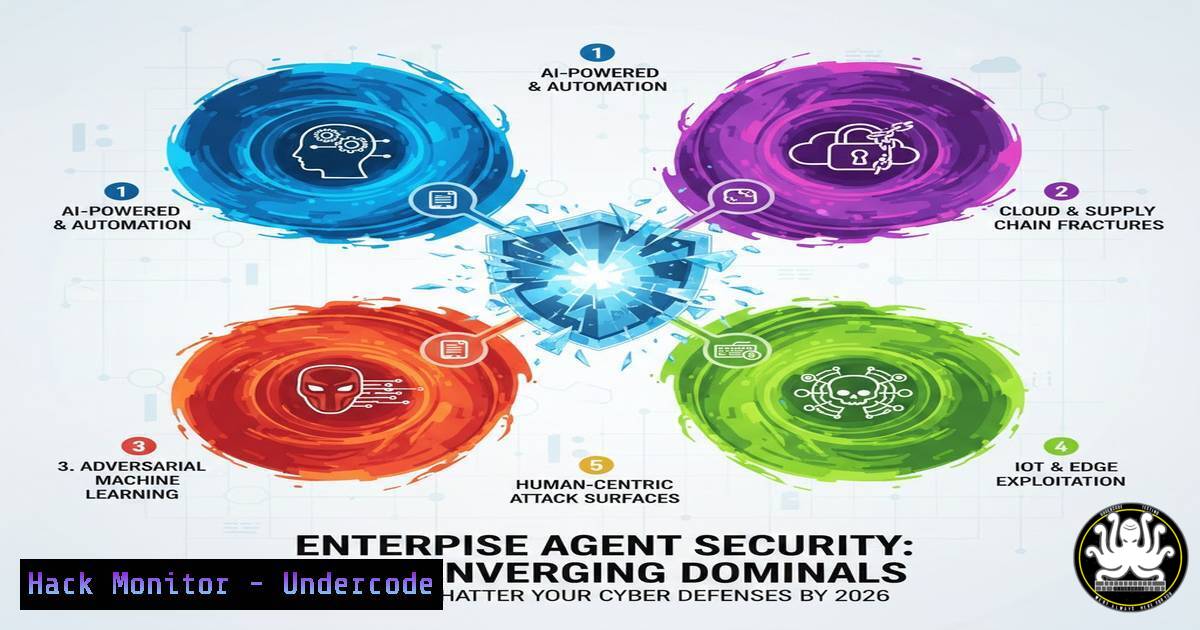
The silent revolution in enterprise cybersecurity isn’t coming from more sophisticated malware or zero-day exploits; it’s emerging from the autonomous AI agents being integrated into core business workflows. By the second half of 2026, these agents—capable of persistent memory, tool invocation, and autonomous decision-making—will render traditional, human-centric security models obsolete. Security teams must now prepare for a fundamental structural shift where security converges across five previously siloed domains to govern non-human identities operating at machine speed.
Learning Objectives:
- Understand the five critical security domains converging due to enterprise AI agent deployment.
- Learn practical, immediate steps to harden identity, cloud, and data controls for autonomous agents.
- Develop a strategy for implementing interoperable, lifecycle-centric security to avoid vendor lock-in.
You Should Know:
- From Model Security to Full Agent Execution Security
The threat landscape moves far beyond simple prompt injection. An agent with memory, tool-calling capabilities, and the ability to chain actions can be subverted to exfiltrate data, escalate privileges, or manipulate business workflows over extended sessions. Security must now encompass the agent’s entire execution context.
Step‑by‑step guide:
Step 1: Implement Runtime Action Policies. Use frameworks like LangChain‘s or Semantic Kernel‘s built-in permission systems to restrict tool access. For custom agents, enforce policy checks before any tool execution.
 Example pseudo-code for a runtime policy hook
def execute_tool(tool_name, parameters, agent_session):
if not policy_engine.is_allowed(agent_session.identity, tool_name, parameters):
raise SecurityPolicyViolation(f"Agent not authorized for {tool_name}")
return call_tool(tool_name, parameters)
Step 2: Sanitize and Validate Agent Memory. Regularly scan persistent agent memory (e.g., vector databases) for sensitive data leakage or corrupted prompts. Use data loss prevention (DLP) patterns on stored memories.
Step 3: Audit Workflow Chains. Log and analyze the complete chain of actions (e.g., using LangSmith or OpenTelemetry) to detect anomalous sequences that could indicate compromised agency.
2. Securing Non-Human Identities (NHI) in IAM
Each autonomous agent is a non-human identity that must authenticate, request access, and potentially escalate privileges. Traditional IAM built for human service accounts cannot scale or manage the dynamic nature of agent-driven requests.
Step‑by‑step guide:
Step 1: Issue Short-Lived, Scoped Credentials. Never use long-lived API keys. For cloud environments (AWS/GCP/Azure), enforce agents to assume IAM roles with JIT (Just-In-Time) elevation.
 Example: AWS CLI command for an agent to assume a specific role
aws sts assume-role --role-arn arn:aws:iam::123456789012:role/AgentExecutionRole --role-session-name "ai-agent-session"
Step 2: Implement Attribute-Based Access Control (ABAC). Define policies based on agent attributes (purpose, owner, context) rather than just identity. E.g., “Agents tagged with `Purpose=CustomerService` can only query the `tickets` database.”
Step 3: Dedicated NHI Lifecycle Management. Integrate agent provisioning/deprovisioning into your IAM lifecycle, automatically revoking credentials when an agent framework is decommissioned.
- Hardening Cloud & API Security for Agent-Driven Workflows
Agents interact directly with APIs and can trigger infrastructure changes (e.g., spawning VMs, updating configs). Traditional monitoring, built for human speed and pattern, will miss malicious machine-speed activity.
Step‑by‑step guide:
Step 1: Implement API Rate Limiting and Anomaly Detection Specific to NHIs. Use tools like AWS WAF, Apigee, or Azure API Management to apply stricter quotas and detect unusual patterns from agent identities.
Step 2: Enforce Immutable Infrastructure for Agent Actions. If an agent can trigger Terraform or CloudFormation, ensure all changes are reviewed via infrastructure-as-code (IaC) pipelines. Use tools like `Checkov` or `Terrascan` to scan IaC for security misconfigurations before the agent applies them.
 Scan Terraform plan for security issues before apply
terraform plan -out=tfplan
terraform show -json tfplan | checkov -o json
Step 3: Segment Agent Networks. Deploy agents within dedicated network segments (micro-perimeters) with strict egress/ingress controls to limit lateral movement.
- Data Security Posture Management (DSPM) for Agent Workflows
Autonomous agents can aggregate and correlate sensitive data from multiple sources in seconds, creating unprecedented data exposure risks. DSPM must now track data flows initiated by agents.
Step‑by‑step guide:
Step 1: Map Agent Data Lineage. Use DSPM tools like BigID, Sentra, or `Laminar` to tag data sources and create policies that trigger alerts when an agent accesses multiple classified sources in a single session.
Step 2: Enforce In-Line Data Filtering. Mandate that agents use tools that strip unnecessary sensitive fields (like PII) before data is returned to the agent’s context. Implement middleware in your API gateway for this purpose.
Step 3: Encrypt Agent Memory. Ensure all persistent session memory and conversation histories are encrypted at rest using customer-managed keys (CMKs), not just provider-managed encryption.
- Endpoint & Browser Security: Distinguishing Human from Agent
Agents operating in user browsers or on endpoints can perform actions at speeds and patterns impossible for humans, creating new abuse vectors for fraud, data theft, or system compromise.
Step‑by‑step guide:
Step 1: Deploy Behavioral Biometrics for NHIs. Integrate solutions that analyze interaction patterns (mouse movements, keystroke dynamics, navigation speed) to flag potential non-human activity on sensitive endpoints.
Step 2: Harden Browser Automation Environments. If using agents like Selenium or Playwright, run them in isolated, hardened containers with minimal privileges. Disable unnecessary browser features and extensions.
 Example Dockerfile snippet for a hardened Selenium container
FROM selenium/standalone-chrome:latest
USER root
RUN apt-get update && apt-get install -y --no-install-recommends \
&& rm -rf /var/lib/apt/lists/
USER seluser
Step 3: Extend EDR/NDR Rules. Create custom rules in your Endpoint/Network Detection and Response tools to alert on sequences of actions indicative of an automated agent (e.g., rapid API calls to multiple internal systems from a single host).
What Undercode Say:
- Convergence is Non-Negotiable: Siloed security teams (cloud, identity, data, endpoint) must unify governance models immediately. The agent lifecycle blurs all these boundaries, creating gaps that silos cannot address.
- Avoid the Observatory Lock-in Trap: Vendor-provided agent frameworks with built-in “security” often lead to architectural lock-in. Prioritize open standards and interoperable control planes (e.g., using OpenTelemetry for logs, policy engines like OPA) from the start to maintain oversight and portability.
The core analysis is that agent security is a systems engineering problem, not just an AI problem. The primary risk shifts from corrupting the agent’s mind (the model) to subverting its body (the tools, APIs, and data it can access). Investing in an interoperable, lifecycle-centric security model that spans all five domains is the only defense against the machine-speed attack surface agents introduce.
Prediction:
By H2 2026, we predict a significant rise in “Agent Jailbreak” incidents that won’t involve prompt leakage, but rather the weaponization of approved agent capabilities. Incidents will feature agents legally authenticating and then using their granted tools in unintended, malicious sequences—such as synthesizing sensitive data across departments and exfiltrating it via a permitted external API call. The cybersecurity market will respond with a new category of “Agent Security Posture Management” (ASPM) tools, and regulatory bodies will begin drafting guidelines specifically for governing autonomous non-human identities in enterprise environments.
▶️ Related Video (78% Match):
🎯Let’s Practice For Free:
IT/Security Reporter URL:
Reported By: Anabildea Aisecurity – Hackers Feeds
Extra Hub: Undercode MoN
Basic Verification: Pass ✅


