
Listen to this Post
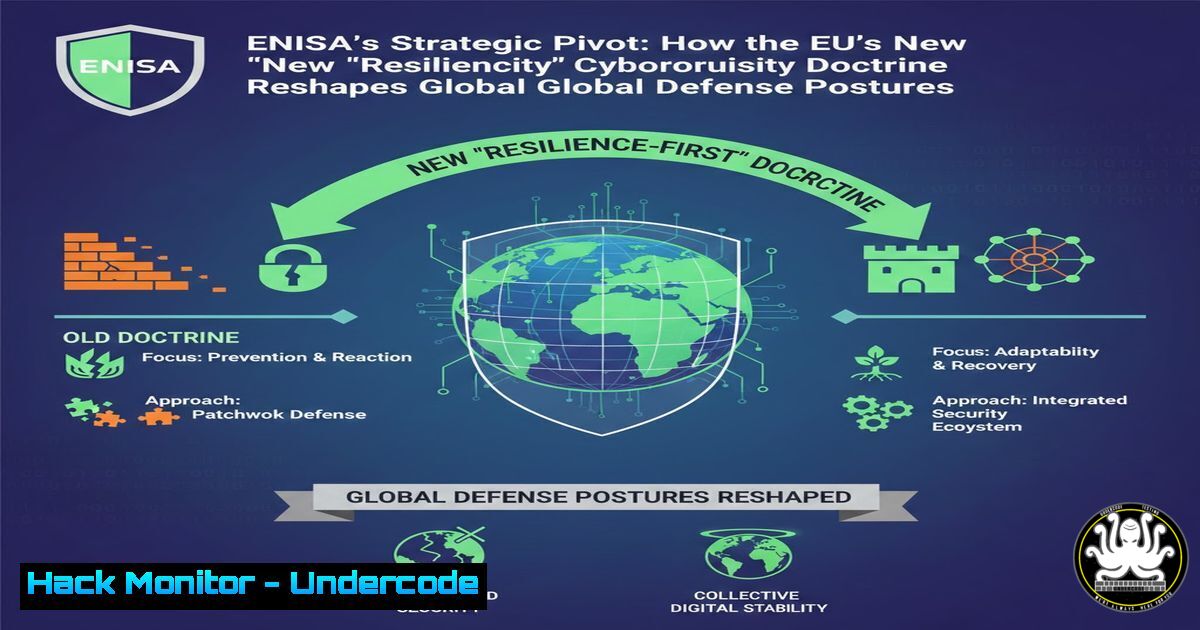
Introduction:
The European Union Agency for Cybersecurity (ENISA) has fundamentally redefined its approach to global collaboration with its updated International Strategy. Moving beyond traditional diplomatic cooperation, the strategy explicitly anchors international engagement as a core operational component for strengthening the EU’s internal cybersecurity resilience. This shift means that partnerships are now rigorously evaluated based on their direct contribution to the Union’s defensive capabilities, transforming geopolitical alliances into tangible, technical dependencies critical for threat intelligence sharing, coordinated incident response, and collective capacity building.
Learning Objectives:
- Understand the strategic shift from “cooperation around cybersecurity” to “cooperation inside cybersecurity” and its practical implications for security operations.
- Learn how to map and assess your organization’s external cybersecurity dependencies in the context of international partnerships and threat landscapes.
- Gain actionable steps for integrating international threat intelligence feeds and aligning internal policies with cross-border resilience frameworks like the EU Cybersecurity Reserve.
You Should Know:
- Decoding the Strategy: From Policy to Technical Dependency Mapping
The core of ENISA’s pivot is treating international partners as integral nodes in the EU’s cyber defense network. For security leaders, this necessitates a technical audit of how external entities—be they cloud providers, threat intel sharing groups, or international CERTs—directly affect internal security postures.
Step‑by‑step guide:
Step 1: Asset & Data Flow Inventory. Identify all critical assets (data, services, applications) and map their logical and physical flow across borders. Use tools like `traceroute` (Linux/Windows) or network mapping software to visualize paths.
Linux: `traceroute -I -m 20 your-critical-domain.com`
Windows: `tracert -d your-critical-domain.com`
Step 2: Dependency Cataloging. Create a register listing each critical external partner, the service or intelligence they provide, and the potential impact of its disruption. Classify dependencies (e.g., “Threat Intel Feed from Partner X,” “Cloud Region in Country Y”).
Step 3: Resilience Gap Analysis. For each high-impact dependency, assess the current failover or mitigation strategy. Is threat intelligence from one source correlated with another? If a geopolitical event disrupts a key partner, what is your contingency plan?
2. Operationalizing Partnerships: Integrating Cross-Border Threat Intelligence
Mere membership in an information-sharing group is no longer sufficient. The strategy demands the active technical integration of shared intelligence into Security Operations Center (SOC) workflows to directly bolster detection and response.
Step‑by‑step guide:
Step 1: Feed Evaluation and Normalization. Assess the compatibility of threat intelligence feeds (e.g., from EU-CERT, US CISA, or partners like Ukraine) with your SIEM or TIP. They may use different formats (STIX/TAXII, CSV, custom JSON).
Step 2: Automated Ingestion Pipeline. Configure your TIP or SIEM to automatically fetch, normalize, and deduplicate indicators of compromise (IoCs). Example using a cron job and a Python script for a STIX/TAXII feed:
 Linux cron entry to run daily
0 2    /usr/bin/python3 /opt/scripts/fetch_enisa_taxii_feeds.py
(A basic script would use libraries like `taxii2-client` to connect to a TAXII server, collect IoCs, and output them to a format your SIEM can ingest.)
Step 3: Create Detection Rules. Use the ingested IoCs to create concrete detection rules. For example, in a Splunk-like environment, you could search for IP addresses from the feed:
index=firewall_logs dest_ip IN ({{ENISA_PARTNER_FEED_IP_LIST}}) | stats count by src_ip, dest_ip, action
- Hardening the Cloud: Aligning with the EU Cybersecurity Reserve Concept
The extension of the EU Cybersecurity Reserve to associated states formalizes a shared “cyber civil protection” mechanism. Organizations must ensure their cloud and critical infrastructure deployments align with the security baselines expected by such collective defense initiatives.
Step‑by‑step guide:
Step 1: Benchmark Against EU Frameworks. Audit your cloud environment (AWS, Azure, GCP) against the EU’s cloud security scheme (based on ENISA’s guidelines) and other relevant frameworks like NIS2 Directive essentials.
Step 2: Implement Infrastructure-as-Code (IaC) Security. Harden your deployments by embedding security checks. Use tools like `checkov` or `tfsec` to scan IaC templates (Terraform, CloudFormation) for misconfigurations before deployment.
 Scan a Terraform directory for compliance
checkov -d /path/to/terraform/code --framework cis_aws
Step 3: Configure Cross-Region Resilience. Design workloads to failover not just across zones, but potentially across sovereign cloud regions that are part of cooperative agreements, ensuring operational continuity aligned with geopolitical resilience goals.
4. Securing the API Layer: Managing Digital Interdependencies
The interconnected digital landscape runs on APIs. An unsecured API connecting to an international partner’s system becomes a direct vector for compromising internal resilience, turning a trusted dependency into a vulnerability.
Step‑by‑step guide:
Step 1: Inventory and Classify External APIs. Document all APIs that consume data from or expose data to international partners. Classify them by data sensitivity and criticality.
Step 2: Enforce Strict Authentication and Rate Limiting. Ensure all external-facing APIs use robust authentication (OAuth 2.0, mTLS). Implement rate limiting to prevent abuse. Example Nginx configuration snippet for rate limiting:
http {
limit_req_zone $binary_remote_addr zone=partnerapi:10m rate=10r/s;
server {
location /partner/v1/ {
limit_req zone=partnerapi burst=20 nodelay;
proxy_pass http://backend_service;
}
}
}
Step 3: Implement Continuous API Security Testing. Integrate dynamic API security testing (DAST) and static analysis (SAST) into your CI/CD pipeline for any service with external dependencies, using tools like OWASP ZAP or specific API security scanners.
- Simulating Geopolitical Incidents: Tabletop Exercises with External Disruption Scenarios
Resilience must be tested. Modern incident response (IR) planning must include scenarios where disruption originates from or is compounded by the compromise of an international partner or the degradation of a cross-border digital corridor.
Step‑by‑step guide:
Step 1: Scenario Development. Craft a tabletop exercise scenario based on real geopolitical tensions. Example: “Threat actor group Z, suspected of affiliation with Country A, compromises a key software vendor in Partner Country B, whose update mechanism is used by your EU-based operations.”
Step 2: Conduct the Exercise. Gather IR, legal, comms, and executive teams. Walk through the stages: detection, analysis (is this part of a broader campaign?), containment (can we isolate the vendor’s system?), communication (what are the obligations to partners/authorities?).
Step 3: Update Plans and Playbooks. Based on exercise outcomes, formally update IR playbooks to include steps for engaging with international CERTs (e.g., via the EU’s CyCLONe network), switching to alternative intelligence sources, and executing technical contingencies for degraded external dependencies.
What Undercode Say:
- Key Takeaway 1: Cybersecurity is being re-politicized. ENISA’s strategy marks a clear move where technical infrastructure and alliances are inseparable from geopolitical strategy. For organizations, this means your vendor risk assessment must now explicitly include a “geopolitical resilience” dimension alongside traditional security metrics.
- Key Takeaway 2: The burden of ownership is internalized. The strategy’s subtext is a warning: if your organization depends on an international entity for its cyber resilience, you own that risk. Boards must demand clear accountability for managing these external technical dependencies, moving beyond vague partnership announcements to concrete architecture reviews and contingency testing.
Analysis: This is not a subtle evolution but a doctrinal shift. ENISA is architecting a form of “cyber sovereignty through managed interdependence.” It rejects naive digital globalization where cooperation was an unchecked good, and replaces it with a realist, outcome-based model. The technical consequence is profound: security architectures must now be designed with “sovereign-aware” failovers, and threat intelligence must be fused from multiple, politically vetted sources. This will accelerate the fragmentation of the global internet into aligned techno-blocs, complicating life for multinationals but creating clearer resilience mandates for those within a bloc. The organizations that will thrive are those that can translate this high-level strategy into granular, automated security policies and resilient system designs.
Prediction:
Within the next 2-3 years, we will see this “resilience-first” cooperation model harden into regulatory and procurement requirements. Tenders for critical infrastructure and government-adjacent services in the EU will mandate evidence of how a vendor’s architecture manages international dependencies and integrates with specific threat intelligence sharing frameworks. This will give rise to a new niche of “cyber diplomacy tech” – tools and consultants specializing in translating international cybersecurity agreements into technical configurations, compliance mappings, and validated tabletop scenarios. Concurrently, we may witness the emergence of mirror strategies from other geopolitical blocs, further solidifying the technical borders of cyberspace and making the role of the security professional increasingly intertwined with geopolitical risk analysis.
▶️ Related Video (80% Match):
🎯Let’s Practice For Free:
IT/Security Reporter URL:
Reported By: Senad D%C5%BEananovi%C4%87 – Hackers Feeds
Extra Hub: Undercode MoN
Basic Verification: Pass ✅


