Listen to this Post
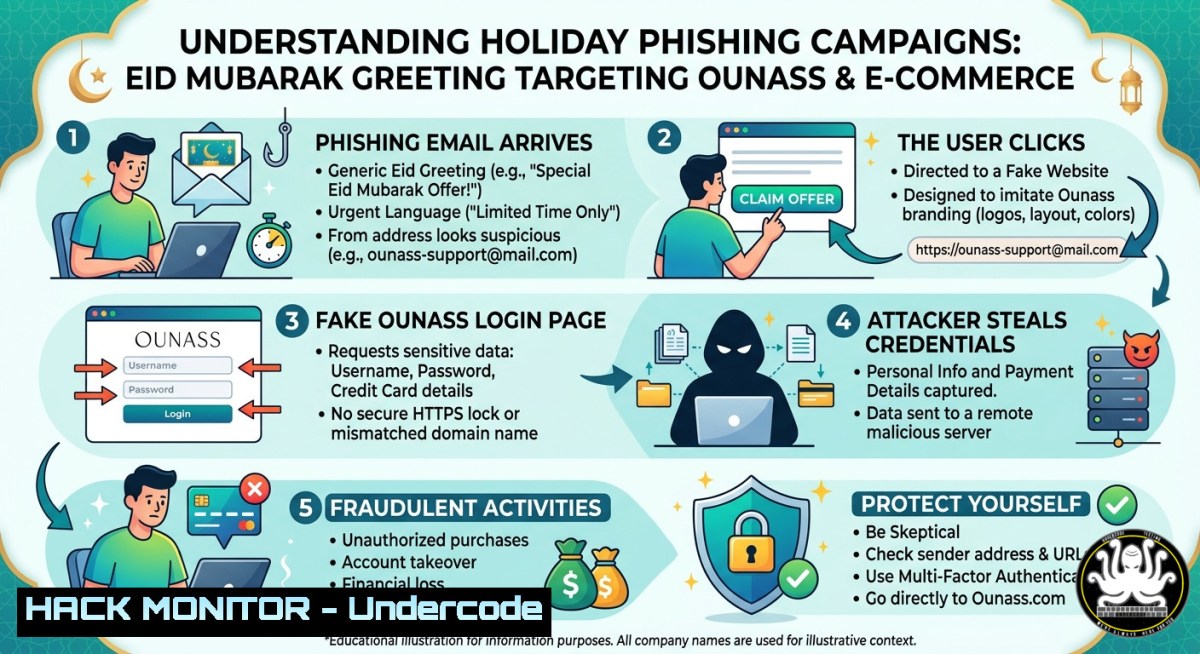
Introduction:
Holiday greetings such as “Eid Mubarak” are frequently weaponized by threat actors to deliver malicious payloads or harvest credentials via spoofed emails and social media posts. While Ounass’s legitimate message carries no technical threat, the absence of embedded URLs or security headers in such posts highlights a common blind spot: organizations often overlook the need to train users on distinguishing benign holiday wishes from lookalike phishing attacks that exploit festive themes.
Learning Objectives:
- Identify how threat actors repurpose legitimate brand greetings (e.g., Ounass’s Eid post) to craft convincing phishing lures.
- Implement email and web filtering rules to detect and block holiday-themed malicious URLs.
- Apply Linux/Windows commands to analyze suspicious messages and harden endpoint configurations against social engineering attacks.
You Should Know:
- Analyzing Holiday Greeting Emails for Indicators of Compromise (IoCs)
Even a simple “Eid Mubarak” email can hide malicious intent. Attackers often replace legitimate URLs with lookalike domains (e.g., ounass-eid[.]com). Use the following commands to inspect email headers and extract hidden links.
Step‑by‑step guide – Linux:
 Extract all URLs from an email file (.eml or plain text)
cat eid_message.eml | grep -iEo '(https?://|http?://)[a-zA-Z0-9./?=_-]' | sort -u

Check DNS records of suspicious domains
dig +short ounass-eid[.]com
nslookup malicious-link[.]xyz

Analyze email headers for spoofing (look for Received, Return-Path)
grep -E "^(Received|Return-Path|From|Reply-To):" eid_message.eml
Step‑by‑step guide – Windows (PowerShell):
 Extract URLs from an email file
Select-String -Path "C:\emails\eid_message.eml" -Pattern 'https?://[a-zA-Z0-9./?=<em>-]+' | ForEach-Object { $</em>.Matches.Value } | Sort-Object -Unique

Resolve suspicious domains
Resolve-DnsName -Name "ounass-eid[.]com" -Type A
Test-NetConnection -ComputerName "malicious-link[.]xyz" -Port 443
Tutorial: Save the greeting email as a `.eml` file. Run the above commands to reveal any hidden URLs. If a domain resolves to an IP not owned by the legitimate company (e.g., Ounass’s real IP range), block it at the firewall or proxy level.
2. Hardening Email Gateways Against Holiday‑Themed Phishing
Most Secure Email Gateways (SEGs) allow custom rule creation. Use regex patterns to flag messages containing “Eid Mubarak” combined with suspicious attachments or shortened URLs.
Step‑by‑step configuration (Proofpoint / Microsoft 365 example):
- In Microsoft 365 Defender, navigate to Email & Collaboration > Policies & Rules > Threat Policies > Anti‑phishing.
2. Create a new policy named “HolidayGreeting_Phishing”.
- Add condition: Subject or body matches these patterns → regex: `(Eid Mubarak|عيدكم مبارك|Eid|Mubarak).(https?://bit\.ly|https?://tinyurl\.com)`
4. Set action: Quarantine the message.
- Enable Spoof intelligence and add `ounass.com` (or relevant brand domain) to trusted senders.
- Test with an internal simulation (use open-source tool like Gophish) to send a fake Eid greeting to a test group and verify blocking.
-
Using OSINT to Detect Malicious “Ounass” Impersonator Domains
Attackers register domains like `ounass-eid.com` or `ounasshelp[.]xyz` hours before a holiday. Leverage OSINT tools to proactively identify and sinkhole them.
Linux commands for bulk domain investigation:
 Use crt.sh to find certificates issued for 'ounass' (reveals subdomains)
curl -s "https://crt.sh/?q=%25ounass%25&output=json" | jq -r '.[].name_value' | sort -u

Check newly registered domains (requires API key from SecurityTrails or WhoisXML)
whois ounass-eid[.]com | grep -E "Creation Date|Registrar"

Use dnstwist to generate typo‑squatting candidates
dnstwist --registered ounass.com
Windows alternative (PowerShell with Invoke‑RestMethod):
 Query crt.sh for certificates
$url = "https://crt.sh/?q=%25ounass%25&output=json"
$certs = Invoke-RestMethod -Uri $url
$certs | Select-Object -ExpandProperty name_value -Unique

Check domain registration date using WHOIS (install sysinternals whois or use online API)
whois.exe ounass-eid.com | Select-String "Creation Date"
- Simulating a Holiday Phishing Campaign (Red Team Exercise)
Use GoPhish on a Linux server to send a realistic “Eid Mubarak from Ounass” email with a tracking pixel and a fake login page.
Step‑by‑step setup:
 Install GoPhish on Ubuntu
wget https://github.com/gophish/gophish/releases/download/v0.12.1/gophish-v0.12.1-linux-64bit.zip
unzip gophish-v0.12.1-linux-64bit.zip
cd gophish-v0.12.1-linux-64bit
sudo ./gophish

Access admin panel at https://localhost:3333 (default creds: admin/gophish)
– Landing page: Clone `https://www.ounass.com` (use HTTrack or wget). Modify to display “Eid Mubarak – Log in to claim your 20% discount”.
– Sending profile: Configure SMTP using a disposable email service (e.g., SendGrid trial).
– Campaign: Send to internal test group, track clicks and credential entries.
Mitigation: After simulation, add detected phishing URLs to your proxy blacklist using:
echo "0.0.0.0 fake-ounass-page.com" >> /etc/hosts  Linux
 Windows: Add to C:\Windows\System32\drivers\etc\hosts
- API Security: How Threat Actors Abuse Legitimate Greeting Endpoints
Attackers may scan for API endpoints that accept “Eid Mubarak” parameters (e.g., /api/sendGreeting?message=...) to inject XSS or SQLi. Use the following to test your own APIs.
Linux command – fuzzing API parameters:
 Using ffuf to fuzz for hidden greeting endpoints
ffuf -u https://api.ounass.com/FUZZ -w /usr/share/wordlists/dirb/common.txt -e .php,.json

Check for XSS in message parameter
curl -X POST https://api.ounass.com/sendGreeting -d "message=<script>alert('Eid')</script>" -H "Content-Type: application/json"
Windows – using Burp Suite Community:
1. Intercept a legitimate request to `/sendGreeting`.
- Send to Intruder, set payload position at the `message` value.
3. Load XSS payload list (e.g., from SecLists).
- Analyze responses for reflected scripts or error messages (e.g., SQL syntax errors).
Mitigation: Sanitize all input fields, implement a WAF rule to block patterns like `(\<\ss\sc\sr\si\sp\st\s)` and use parameterized queries.
- Cloud Hardening for E‑Commerce During Holiday Traffic Spikes
Holiday surges (like Eid) attract DDoS and credential stuffing attacks. Implement rate limiting on cloud load balancers.
AWS CLI commands (for an e‑commerce front end):
 Create a WAF WebACL that blocks requests with 'Eid Mubarak' in User-Agent (common bot trick)
aws wafv2 create-web-acl --name HolidayGreetingBlock --scope REGIONAL --default-action Block={} --visibility-config SampledRequestsEnabled=true,CloudWatchMetricsEnabled=true,MetricName=HolidayBlock

Add rate‑based rule – allow only 100 requests per 5 min per IP
aws wafv2 create-rule-group --name RateLimitEid --capacity 500 --scope REGIONAL
Azure equivalent (PowerShell):
 Create Application Gateway with WAF policy
New-AzApplicationGatewayFirewallPolicy -Name "EidRateLimit" -ResourceGroupName "OunassRG" -Location "UAE North"
Add-AzApplicationGatewayFirewallPolicyCustomRule -Name "LimitEidRequests" -Priority 1 -RuleType RateLimitRule -RateLimitThreshold 100 -MatchCondition (New-AzApplicationGatewayFirewallCondition -MatchVariable RemoteAddr -Operator IPMatch)
- User Training: Spotting the Fake “Ounass Family” Greeting
Conduct a live workshop using the actual Ounass post as a benign example, then present a malicious variant.
Commands to generate a training environment (Linux):
 Clone the real Ounass homepage for comparison
wget --mirror --convert-links --page-requisites --no-parent https://www.ounass.com/ae-en/

Modify index.html to include a fake login popup
sed -i 's/<\/body>/

<

div id="eidPopup">Log in for Eid gift<\/div><\/body>/' www.ounass.com/ae-en/index.html

Host locally for training
python3 -m http.server 8080
Then ask employees to identify differences: URL bar (localhost vs real domain), missing SSL certificate padlock, awkward English phrasing in the popup.
What Undercode Say:
- Key Takeaway 1: Even a harmless “Eid Mubarak” post from a trusted brand like Ounass can be cloned by attackers – the absence of technical URLs in the original post does not reduce risk; it increases reliance on user vigilance.
- Key Takeaway 2: Proactive defense requires layered OSINT (domain monitoring, certificate transparency logs), email gateway regex rules, and simulated phishing campaigns tailored to cultural holidays.
Analysis: Many security teams focus only on technical vulnerabilities (CVEs, patching) while ignoring the human factor during festive seasons. The Ounass greeting, while legitimate, serves as a perfect template for red team exercises. Organizations in the Middle East, where Eid is widely celebrated, must adapt their security awareness training to include holiday‑specific lures. Implementing the commands above (from DNS inspection to WAF rate limiting) reduces the blast radius of a successful phishing attack. Additionally, the lack of any trackable URLs in the original post highlights a missed opportunity – legitimate brands should embed benign tracking pixels or email authentication headers (DKIM, DMARC) in every commercial communication to help users validate authenticity via automated filters.
Prediction:
By 2026, AI‑generated holiday messages will become indistinguishable from real brand communications, forcing a shift from content‑based detection to behavioral analysis (e.g., unusual sending times, mismatched TLS certificates). E‑commerce platforms like Ounass will adopt zero‑trust email architectures where every holiday greeting, even from a “family” brand, is sandboxed and rendered without remote content. Attackers will then pivot to voice phishing (vishing) using synthetic Eid greetings over WhatsApp, requiring real‑time audio deepfake detection integrated into cloud phone systems.
▶️ Related Video (84% Match):
🎯Let’s Practice For Free:
IT/Security Reporter URL:
Reported By: Eid Mubarak – Hackers Feeds
Extra Hub: Undercode MoN
Basic Verification: Pass ✅
🎓 Live Courses & Certifications:
Join Undercode Academy for Verified Certifications
🚀 Request a Custom Project:
Secure, high-velocity infrastructure and disruptive technological engineering. Contact our engineering team for high-tier development and proprietary systems:
[email protected]


