Listen to this Post
Introduction:
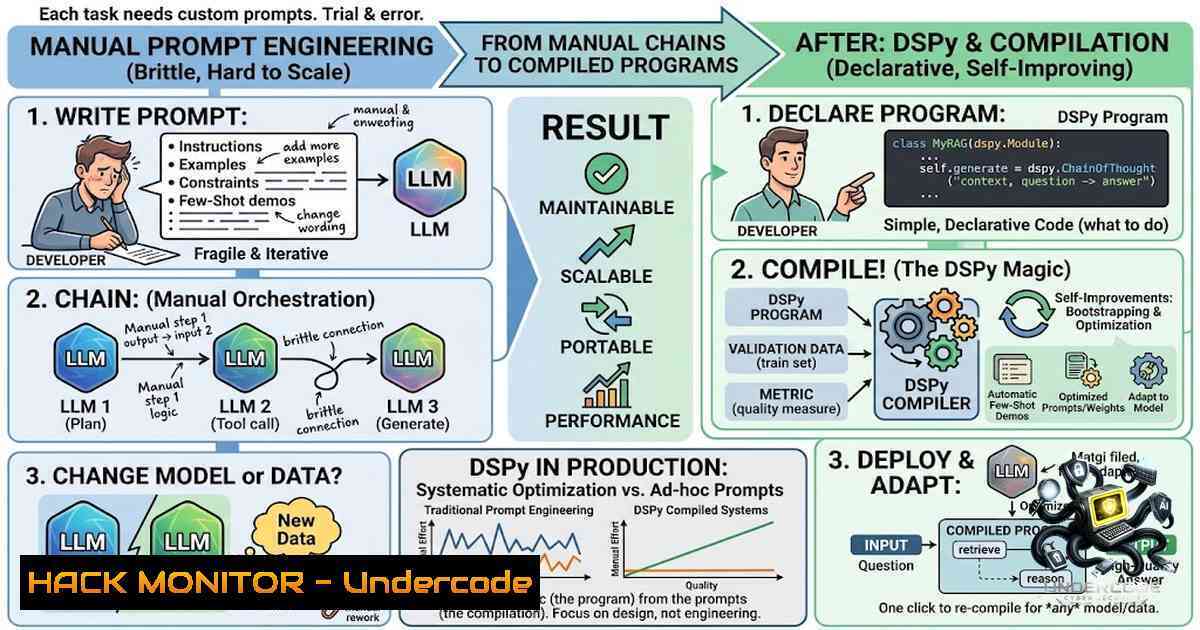
The fragility of hardcoded prompts has long been the Achilles’ heel of production LLM applications. A model swap from GPT-4 to Claude, or even a minor version update, can instantly break meticulously crafted system prompts, forcing engineering teams back to the drawing board. DSPy (Declarative Self-improving Python), a framework from Stanford NLP, fundamentally shifts this paradigm by treating LLMs not as black-box creative writers but as optimizable code. Instead of manual prompt hacking, DSPy allows developers to define declarative signatures (inputs/outputs) and algorithmically compile, bootstrap, and optimize prompts against specific validation datasets, transforming generative AI workflows into robust software engineering.
Learning Objectives & Secrets:
- Objective 1: Master Declarative Programming for LLMs – Learn to replace brittle, hardcoded prompts with compositional Python code that defines the flow of your program separately from the prompts themselves, using DSPy’s `dspy.Signature` and
dspy.Module. - Objective 2 Secret: Algorithmic Optimization with `BootstrapFewShot` – Discover how to use DSPy’s most popular optimizer to automatically generate few-shot demonstrations from your training data, eliminating manual example selection. The secret is starting with 10-50 diverse training examples and setting `max_bootstrapped_demos=3-5` for optimal performance.
- Objective 3 Secret: Metric-Driven Compilation – Treat prompt engineering as an optimization problem over a defined metric—much like training a neural network. By compiling your program against a validation dataset, DSPy systematically improves performance, with reported retrieval accuracy boosts of 14% or more.
You Should Know:
1. Installing DSPy and Setting Up Your Environment
DSPy is available via PyPI and can be installed in any Python 3.8+ environment. The framework integrates seamlessly with popular LLM providers and local models.
Step‑by‑step guide:
 Basic installation
pip install dspy

Install the latest development version from GitHub
pip install git+https://github.com/stanfordnlp/dspy.git
Configuration: Set up your language model (LM) and retrieval model (RM) configurations. For OpenAI:
import dspy

Configure OpenAI
turbo = dspy.OpenAI(model='gpt-3.5-turbo')
dspy.settings.configure(lm=turbo)

For a local model or other providers, simply swap the LM instance
 colbertv2 = dspy.ColBERTv2(url='http://20.102.90.50:2017/wiki17_abstracts')
 dspy.settings.configure(lm=turbo, rm=colbertv2)
- Defining Signatures and Modules – The Core of DSPy Programming
Instead of writing prompts, you define declarative signatures that specify inputs and outputs. DSPy then compiles these into optimized prompts.
Step‑by‑step guide:
import dspy

Define a signature for question answering
class GenerateAnswer(dspy.Signature):
"""Answer questions based on provided context."""
context = dspy.InputField(desc="Relevant context for the question")
question = dspy.InputField()
answer = dspy.OutputField(desc="Concise answer, usually 1-2 sentences")

Define a module (the "program")
class RAG(dspy.Module):
def <strong>init</strong>(self, num_passages=3):
super().<strong>init</strong>()
self.retrieve = dspy.Retrieve(k=num_passages)
self.generate_answer = dspy.ChainOfThought(GenerateAnswer)

def forward(self, question):
context = self.retrieve(question).passages
prediction = self.generate_answer(context=context, question=question)
return dspy.Prediction(context=context, answer=prediction.answer)
This modular approach separates the what from the how—the logic of your pipeline is independent of the specific prompts used to drive the LM.
3. Compiling and Optimizing with `BootstrapFewShot`
The real power of DSPy lies in its optimizers (formerly “teleprompters”). `BootstrapFewShot` is the most popular, automatically generating few-shot demonstrations from your training data.
Step‑by‑step guide:
from dspy.teleprompt import BootstrapFewShot

Assuming you have training data: trainset with examples having question and answer fields
 Define a metric (e.g., exact match or LLM-as-judge)
def validate_answer(example, pred, trace=None):
return example.answer.lower() == pred.answer.lower()

Set up the optimizer
optimizer = BootstrapFewShot(
metric=validate_answer,
max_bootstrapped_demos=4,
max_labeled_demos=8,
max_rounds=2  Increase to 2-3 for better quality
)

Compile the program
compiled_rag = optimizer.compile(RAG(), trainset=trainset)

Now use the compiled program
pred = compiled_rag(question="What is the capital of France?")
print(pred.answer)
Best Practices:
- Start with 10-50 training examples covering edge cases
- Use `max_bootstrapped_demos=3-5` for most tasks
- Increase `max_rounds=2-3` for better quality on complex tasks
4. Building a Production-Grade Multi-Hop RAG Pipeline
For complex retrieval-augmented generation, DSPy enables sophisticated multi-hop reasoning pipelines that are automatically optimized.
Step‑by‑step guide:
import dspy
from dspy.teleprompt import BootstrapFewShot

class MultiHopRAG(dspy.Module):
def <strong>init</strong>(self, passages_per_hop=3):
super().<strong>init</strong>()
self.retrieve = dspy.Retrieve(k=passages_per_hop)
self.generate_query = dspy.ChainOfThought("context, question -> search_query")
self.generate_answer = dspy.ChainOfThought("context, question -> answer")

def forward(self, question):
 First hop: initial retrieval
context = self.retrieve(question).passages

Generate a refined search query based on initial context
query_pred = self.generate_query(context=context, question=question)

Second hop: retrieve with refined query
additional_context = self.retrieve(query_pred.search_query).passages

Combine contexts and generate final answer
combined_context = "\n".join(context + additional_context)
answer_pred = self.generate_answer(context=combined_context, question=question)

return dspy.Prediction(answer=answer_pred.answer)

Compile with BootstrapFewShot
optimizer = BootstrapFewShot(metric=validate_answer)
compiled_multihop = optimizer.compile(MultiHopRAG(), trainset=trainset)
This approach completely eliminated manual instruction tweaking in one implementation, delivering a 14% boost in retrieval accuracy.
5. Evaluating and Validating DSPy Programs
DSPy provides built-in evaluation tools to measure performance against your validation datasets.
Step‑by‑step guide:
from dspy.evaluate import Evaluate

Set up the evaluator
evaluator = Evaluate(
devset=devset,  Your validation set
metric=validate_answer,
num_threads=4,
display_progress=True
)

Evaluate the compiled program
results = evaluator(compiled_rag)
print(f"Accuracy: {results:.2%}")
The evaluation framework allows you to iteratively improve your program by adjusting the signature, module architecture, or optimizer parameters, all while maintaining a clear, reproducible metric.
6. Advanced Optimization: MIPROv2 and Beyond
For more complex optimization needs, DSPy offers advanced optimizers like MIPROv2, which can generate multi-stage prompts and optimize across multiple dimensions.
from dspy.teleprompt import MIPROv2

optimizer = MIPROv2(
metric=validate_answer,
num_candidates=10,
init_temperature=1.0
)
compiled_program = optimizer.compile(RAG(), trainset=trainset)
MIPROv2 is particularly effective when hand-prompting tops out and you need to push past that performance ceiling.
What Undercode Say:
- Key Takeaway 1: DSPy represents a fundamental paradigm shift from “prompt engineering” to “programmatic LLM optimization.” By treating prompts as optimizable parameters within a compiler-like framework, it brings generative AI development into the realm of robust, reproducible software engineering.
-
Key Takeaway 2: The `BootstrapFewShot` optimizer is the entry point for most teams—it automatically generates few-shot demonstrations from your training data, eliminating the guesswork and fragility of manual example selection. With proper configuration (10-50 diverse examples, 3-5 bootstrapped demos, 2-3 optimization rounds), teams can achieve consistent, measurable improvements without the “prompt hacking” grind.
Analysis: The DSPy framework addresses a critical pain point in production LLM systems: the brittleness of hand-crafted prompts. As organizations scale their AI pipelines, the cost of maintaining prompts across model versions, API updates, and changing business requirements becomes unsustainable. DSPy’s compiler-like approach—where programs are optimized against metrics rather than manually tuned—offers a path to systematic, repeatable improvement. The reported 14% accuracy boost from a multi-hop RAG pipeline is significant, but perhaps more important is the elimination of manual intervention. This shifts the role of the AI engineer from “prompt whisperer” to “systems architect,” focusing on pipeline design and metric definition rather than endless prompt tweaking. However, adoption requires a mindset shift: teams must invest in building validation datasets and defining clear metrics upfront, which may be a barrier for organizations accustomed to ad-hoc prompt engineering.
Prediction:
- +1 DSPy and similar frameworks will become the standard for production LLM applications within 18-24 months, as organizations recognize that manual prompt engineering doesn’t scale. The “compilation” model will be as transformative for LLM development as compilers were for traditional software engineering.
-
+1 The ecosystem around DSPy will expand rapidly, with more optimizers, better integration with observability tools, and pre-built modules for common patterns (RAG, agents, classification). This will lower the barrier to entry and accelerate adoption across the industry.
-
-1 Organizations that fail to adopt programmatic optimization will face increasing technical debt as their prompt libraries grow unmanageable. The cost of maintaining brittle prompts across multiple models and versions will become a significant competitive disadvantage.
-
+1 The metric-driven approach will enable more rigorous A/B testing and continuous improvement of AI systems, similar to how modern ML pipelines operate. This will lead to higher-quality, more reliable LLM applications across the board.
-
-1 The shift may create a skills gap: engineers proficient in prompt engineering will need to upskill in programmatic optimization, metric design, and compiler-like workflows. Teams that don’t invest in this transition may struggle to maintain their AI systems.
▶️ Related Video (76% Match):
https://www.youtube.com/watch?v=5_BFqmQv1po
🎯Let’s Practice For Free:
🎓 Live Courses & Certifications:
Join Undercode Academy for Verified Certifications
🚀 Request a Custom Project:
Secure, high-velocity infrastructure and disruptive technological engineering. Contact our engineering team for high-tier development and proprietary systems:
[email protected]
💎 Smart Architecture | 🛡️ Secure by Design | ⭐ Trusted by Thousands
IT/Security Reporter URL:
Reported By: https://lnkd.in/p/eyR2rB6y – Hackers Feeds
Extra Hub: Undercode MoN
Basic Verification: Pass ✅


