Listen to this Post
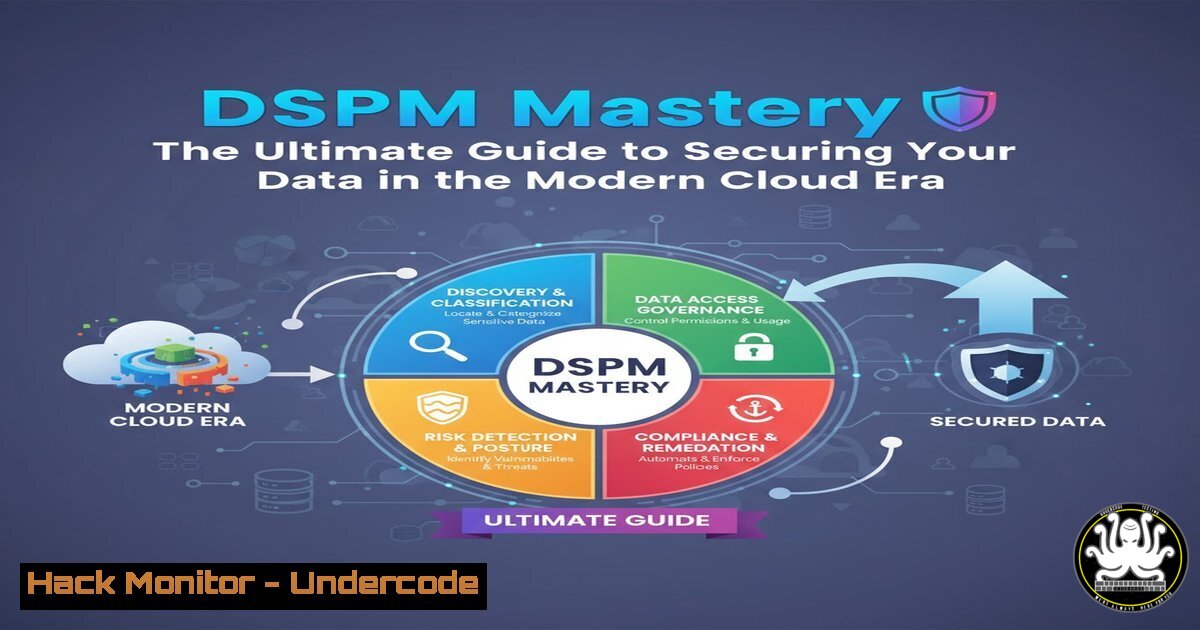
Introduction:
Data Security Posture Management (DSPM) is rapidly emerging as a critical cybersecurity discipline, enabling organizations to proactively discover, classify, and protect sensitive data across sprawling multi-cloud environments. As celebrated in recent industry achievements, DSPM represents a paradigm shift from perimeter-based security to a data-centric model, ensuring compliance and mitigating risks of catastrophic data breaches.
Learning Objectives:
- Understand the core principles and critical functions of a robust DSPM strategy.
- Learn practical steps to discover and classify sensitive data across cloud data stores.
- Implement automated security controls and remediation workflows to enforce data protection policies.
You Should Know:
1. The Foundational Pillars of DSPM
DSPM is not a single tool but a framework built on four key pillars. First, Data Discovery involves automatically and continuously scanning your entire cloud ecosystem—including AWS S3, Azure Blob Storage, and Google Cloud SQL—to identify all data repositories, even shadow IT ones. Second, Data Classification goes beyond discovery by using machine learning and pattern matching to tag data based on sensitivity (e.g., PII, PCI, PHI). Third, Risk Assessment analyzes the security posture of each data store, evaluating configurations like public access permissions, missing encryption, and inadequate access logs. Finally, Remediation and Monitoring provides actionable steps to fix misconfigurations and continuously monitors for drift from your security baseline.
2. Automating Sensitive Data Discovery with CLI Scanners
Before a DSPM platform is fully integrated, security teams can use native cloud provider command-line tools to perform initial discovery sweeps. This process helps inventory data assets that need to be brought under the DSPM umbrella.
Step-by-step guide:
Step 1: Authenticate your CLI session. Use aws configure, az login, or `gcloud auth login` to establish secure access to your cloud environment.
Step 2: Execute discovery commands. Run broad scans to list all data storage resources.
AWS CLI Example (for S3 Buckets):
 List all S3 buckets
aws s3 ls

Get detailed configuration for a specific bucket
aws s3api get-bucket-acl --bucket YOUR_BUCKET_NAME
aws s3api get-bucket-encryption --bucket YOUR_BUCKET_NAME
Azure CLI Example (for Storage Accounts):
 List all storage accounts
az storage account list --query "[].{Name:name, ResourceGroup:resourceGroup}" --output table

List containers within a storage account
az storage container list --account-name YOUR_STORAGE_ACCOUNT --auth-mode login
Step 3: Analyze Output. The output from these commands provides a raw inventory. A true DSPM solution automates this continuously and correlates the findings with other pillars like classification.
3. Implementing Data Classification and Tagging
Once data stores are discovered, the next critical step is classification. DSPM tools use pre-built and custom classifiers to scan the actual data contents.
Step-by-step guide:
Step 1: Define Your Classification Schema. Establish categories like “Public,” “Internal,” “Confidential,” and “Restricted.”
Step 2: Leverage DSPM or Cloud-Native Classification. In a platform like AWS Macie or Azure Purview, you enable sensitive data discovery. The process is typically UI-driven:
1. Navigate to the data catalog or classification service.
2. Select the data sources you discovered in the previous step.
3. Run a scan. The service will use regex patterns (for credit card numbers, social security numbers) and ML models to identify sensitive data.
Step 3: Apply Tags. Based on the classification results, apply metadata tags to the data stores. This enables future policy enforcement.
AWS CLI Example (Tagging an S3 Bucket):
aws s3api put-bucket-tagging --bucket YOUR_BUCKET_NAME --tagging 'TagSet=[{Key=DataClassification,Value=Confidential}]'
4. Hardening Cloud Storage: A Practical Remediation Guide
A common DSPM finding is cloud storage buckets with overly permissive access. Remediating this is a top priority.
Step-by-step guide for securing an AWS S3 bucket:
Step 1: Block ALL Public Access. This is the most crucial control.
aws s3api put-public-access-block --bucket YOUR_BUCKET_NAME --public-access-block-configuration BlockPublicAcls=true,IgnorePublicAcls=true,BlockPublicPolicy=true,RestrictPublicBuckets=true
Step 2: Review and Tighten Bucket Policies. Use the CLI to get the existing policy and analyze it for overly broad `”Principal”: “”` statements.
aws s3api get-bucket-policy --bucket YOUR_BUCKET_NAME
Step 3: Enforce Server-Side Encryption. Enable default encryption.
aws s3api put-bucket-encryption --bucket YOUR_BUCKET_NAME --server-side-encryption-configuration '{"Rules": [{"ApplyServerSideEncryptionByDefault": {"SSEAlgorithm": "AES256"}}]}'
- Integrating DSPM with SIEM and SOAR for Automated Response
For maximum efficacy, DSPM alerts should be integrated into your central security operations workflow.
Step-by-step guide:
Step 1: Identify Critical DSPM Alerts. Focus on high-severity alerts, such as “S3 bucket containing PII changed to public” or “New unencrypted database discovered.”
Step 2: Configure Webhook Output from DSPM. Most modern DSPM platforms can send alert payloads via webhooks.
Step 3: Create a SOAR Playbook. In a platform like Splunk Phantom, Siemplify, or XSOAR, create a playbook triggered by the DSPM webhook. A simple automated playbook could:
1. Parse the incoming alert for the resource ID (e.g., the S3 bucket ARN).
2. Execute a pre-approved remediation script (like the S3 blocking command from Section 4).
3. Open a ticket in ServiceNow or Jira for the security team.
4. Send a confirmation email to the data owner.
- The Human Element: Building a Data Security Culture
Technology is only one component. A successful DSPM program requires training and cultural change. Security teams must partner with development and DevOps teams to embed data security into the CI/CD pipeline. This involves “shift-left” security, where data policies are checked against infrastructure-as-code (IaC) templates like Terraform before deployment, preventing misconfigured resources from ever reaching production.
What Undercode Say:
- Data is the New Battlefield, and DSPM is Your Command Center. The proliferation of cloud data stores has made traditional perimeter defenses insufficient. DSPM provides the essential visibility and control needed to protect the crown jewels—your data—wherever it resides.
- Automation is Non-Negotiable. The scale and dynamism of modern IT infrastructure mean that manual processes for data security are a guaranteed failure. The integration of DSPM with automated remediation through SOAR and IaC scanning is critical for maintaining a strong posture against evolving threats.
Analysis: The professional achievement highlighted in the source post is a microcosm of a larger, critical trend in cybersecurity. As organizations accelerate their digital transformation, data sprawls across IaaS, PaaS, and SaaS platforms, creating a massive attack surface. DSPM directly addresses this chaos by applying principles of Cloud Security Posture Management (CSPM) specifically to the data layer. The ultimate value of DSPM lies in its ability to translate technical findings (a misconfigured bucket) into business context (this bucket contains 10,000 customer credit card numbers). This prioritization allows security teams to focus on what truly matters, moving from a reactive to a proactive and intelligent defense strategy.
Prediction:
DSPM will evolve from a standalone solution to the core intelligence layer of all cloud security platforms. Within the next 3-5 years, we will see DSPM capabilities fully baked into CSPM, CIEM (Cloud Infrastructure Entitlement Management), and even application development tools. Furthermore, as AI-generated code and autonomous data management become mainstream, DSPM will incorporate advanced AI agents not just for discovery, but for autonomous remediation—automatically applying the principle of least privilege to data access and preemptively sealing configuration gaps before they can be exploited. The role of the cybersecurity professional will shift from manual configuration reviewer to strategic overseer of these automated data governance systems.
🎯Let’s Practice For Free:
IT/Security Reporter URL:
Reported By: Nassif Khoury – Hackers Feeds
Extra Hub: Undercode MoN
Basic Verification: Pass ✅


