
Listen to this Post
Introduction:
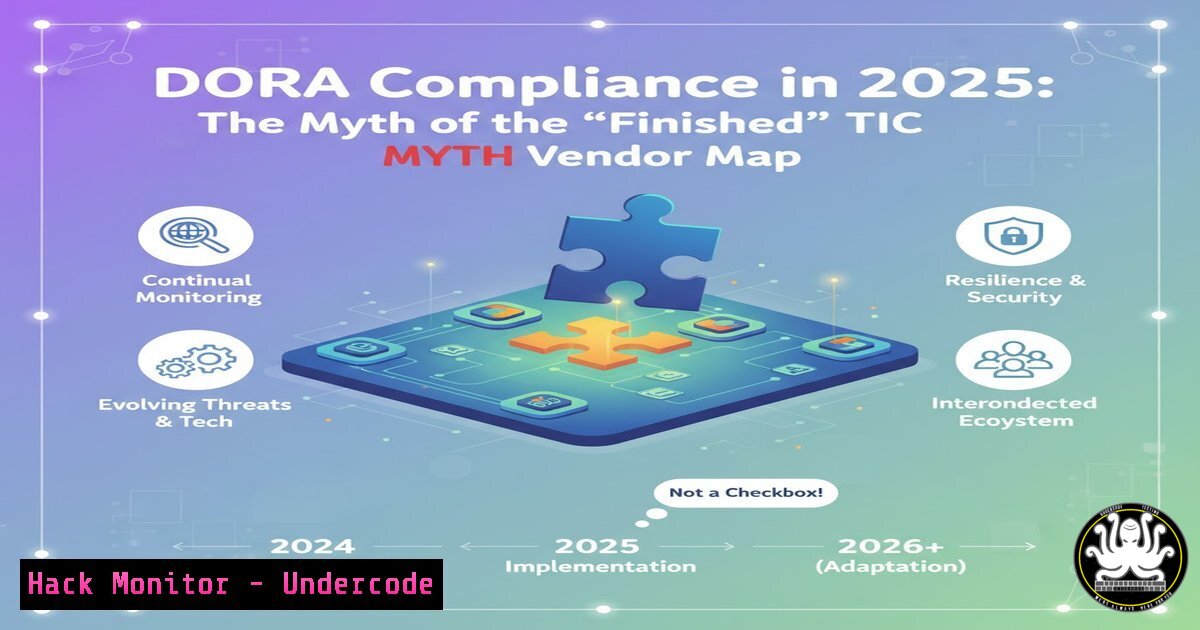
The Digital Operational Resilience Act (DORA) has shifted from a looming deadline to a present-day operational reality for financial entities across the EU. As initial compliance efforts settle, a new, more persistent challenge emerges: maintaining a dynamic and accurate mapping of Information and Communication Technology (ICT) third-party providers in a constantly evolving technological landscape. This article delves into the post-implementation hurdles and provides a technical toolkit for sustaining DORA compliance.
Learning Objectives:
- Understand the technical processes for continuously identifying and classifying ICT third-party service providers.
- Learn to implement automated checks and governance workflows to monitor critical vendor dependencies.
- Develop skills to conduct technical due diligence and hardening of cloud services identified as critical.
You Should Know:
- Automating Critical Provider Discovery with Cloud CLI Tools
The initial classification of a provider is not a one-time event. As noted in the case study, a cloud provider can evolve from non-critical to critical if it begins hosting production backups. Automation is key to discovering these changes.
Command (AWS CLI):
aws ec2 describe-snapshots --owner-ids self --query 'Snapshots[?StartTime>=<code>2024-01-01</code>].VolumeId' --output text | wc -w
Command (Azure CLI):
az backup vault list --query '[].properties.storageType' --output tsv
Step-by-step guide:
- What it does: The AWS command lists all EBS snapshots created since January 1, 2024, and counts them. A sudden increase in snapshot count or size could indicate a new critical backup process. The Azure command lists all backup vaults and their storage types.
- How to use it: Integrate these commands into a daily or weekly script. The output should be logged and compared against a baseline. Any significant deviation should trigger a review of the involved provider’s status in your DORA cartography. This provides data-driven evidence for re-classification, moving beyond guesswork.
2. Network Dependency Mapping for Criticality Assessment
A provider’s criticality is often determined by the network exposure and data flow it has to your core systems. Continuous network mapping is essential.
Command (Nmap) & Script:
 Discover hosts in a subnet
nmap -sn 192.168.1.0/24

Perform a TCP SYN scan on a target range
nmap -sS -T4 -A -oA network_scan_$(date +%Y%m%d) 10.0.1.0/24

Check for specific database ports (e.g., SQL, Oracle)
nmap -p 1433,1521,3306,5432 --open <VENDOR_IP_RANGE>
Step-by-step guide:
- What it does: The `-sn` flag performs a ping sweep to discover live hosts. The `-sS` (SYN scan) is a stealthy method to determine open ports and services. The `-A` flag enables OS and version detection. Scanning for specific database ports helps identify systems handling sensitive data.
- How to use it: Schedule regular, authorized scans of your internal and DMZ networks where vendor systems reside. Correlate the results with your asset inventory. Newly discovered services or open ports on a vendor’s system could indicate an expanded role, necessitating a re-evaluation of their DORA classification.
-
Contractual and API Security Scrutiny for Critical Vendors
For providers classified as critical, deep technical due diligence is mandated by DORA. This includes analyzing their API security posture.
Command (OWASP ZAP Baseline Scan):
docker run -v $(pwd):/zap/wrk/:rw -t owasp/zap2docker-stable zap-baseline.py -t https://api.vendor-critical.com/v1/ -J baseline_report.json
Command (curl for API Endpoint Discovery):
curl -H "Authorization: Bearer $TOKEN" https://api.vendor-critical.com/v1/ | jq '.paths[]'
Step-by-step guide:
- What it does: The OWASP ZAP command performs an automated baseline security scan against a vendor’s API, checking for common vulnerabilities like insecure headers, missing security controls, and more. The `curl` command, combined with
jq, helps discover and list all available API endpoints, which is the first step in understanding the attack surface. - How to use it: As part of the due diligence process for critical providers, request a specific endpoint for scanning or conduct a joint assessment. The generated report (
baseline_report.json) provides tangible evidence of the vendor’s security maturity and should be reviewed before contract signing and periodically thereafter.
4. Hardening Cloud Services Post-Reclassification
When a cloud service is reclassified as critical, immediate hardening actions are required to meet DORA’s resilience standards.
Command (AWS S3 Bucket Hardening):
 Check for public S3 buckets
aws s3api get-bucket-policy-status --bucket YOUR-BUCKET-NAME

Enable default encryption on a bucket
aws s3api put-bucket-encryption --bucket YOUR-BUCKET-NAME --server-side-encryption-configuration '{"Rules": [{"ApplyServerSideEncryptionByDefault": {"SSEAlgorithm": "AES256"}}]}'

Enable S3 access logging
aws s3api put-bucket-logging --bucket YOUR-BUCKET-NAME --bucket-logging-status '{"LoggingEnabled": {"TargetBucket": "YOUR-LOGGING-BUCKET", "TargetPrefix": "log/"}}'
Step-by-step guide:
- What it does: These commands check if an S3 bucket is publicly accessible, enforce default server-side encryption for all new objects, and enable access logging to a separate bucket for audit trails.
- How to use it: Run these commands against any S3 bucket used by a critical vendor for data storage or backups. Integrate these checks into your Infrastructure as Code (IaC) templates (e.g., Terraform, CloudFormation) to ensure all future buckets are created with these hardened settings by default.
-
Implementing Logging and Monitoring for Critical Vendor Access
DORA requires comprehensive logging to ensure operational resilience. You must monitor all access to critical vendor-managed systems.Command (Linux – Auditd Rule for SSH Logins):
Add a rule to monitor SSH logins
echo "-w /etc/ssh/sshd_config -p wa -k sshd_config" >> /etc/audit/rules.d/sshd.rules

Monitor successful and failed login attempts
echo "-a always,exit -F arch=b64 -S execve -F path=/usr/sbin/sshd -k sshd_logins" >> /etc/audit/rules.d/sshd.rules

Restart the auditd service
systemctl restart auditd
Step-by-step guide:
- What it does: These `auditd` rules monitor for changes to the SSH configuration file (
sshd_config) and log all processes executed by the SSH daemon, which captures login attempts and sessions. - How to use it: Apply these rules to any Linux server, especially jump hosts or bastion servers that provide vendor access. The logs generated by `auditd` should be forwarded to a central, secured SIEM (Security Information and Event Management) system that is not managed by the vendor in question, ensuring you maintain control over critical security telemetry.
6. Vulnerability Scanning for Subcontracted Services
As highlighted in the comments, the security of a vendor’s subcontractors is a critical concern. You can scan for known vulnerabilities in the services you depend on.
Command (Nmap NSE Scripts for Vuln Scanning):
 Scan for common vulnerabilities
nmap -sV --script vuln <TARGET_IP_OR_HOSTNAME>

Check specifically for EternalBlue or Heartbleed
nmap -sV --script smb-vuln-ms17-010,ssl-heartbleed <TARGET>
Step-by-step guide:
- What it does: The `vuln` category of Nmap Scripting Engine (NSE) scripts checks the target for a wide range of known vulnerabilities. Specific scripts like `smb-vuln-ms17-010` check for the EternalBlue exploit.
- How to use it: Use these scans during the due diligence phase and as part of periodic penetration testing exercises against the external IPs or URLs provided by your critical vendors. The results can be used as leverage in contract negotiations to mandate timely patching and prove compliance with DORA’s resilience testing requirements.
7. Scripting the Quarterly Cartography Review Workflow
The article suggests quarterly reviews as a best practice. This process can be semi-automated.
Script (Python Pseudocode for Change Detection):
 Pseudocode for a review trigger script
import boto3, json, smtplib
from datetime import datetime

cloudwatch = boto3.client('cloudwatch')
s3 = boto3.client('s3')

Get metrics for data egress to a vendor IP
response = cloudwatch.get_metric_statistics(
Namespace='AWS/EC2',
MetricName='NetworkOut',
Dimensions=[{'Name':'InstanceId', 'Value':'i-12345'}],
StartTime=datetime(2024, 1, 1),
EndTime=datetime.now(),
Period=86400,
Statistics=['Sum']
)

If data transfer exceeds a threshold, trigger a review
if response['Datapoints'][bash]['Sum'] > THRESHOLD:
 Send an alert email
message = "Vendor X data egress exceeded threshold. Trigger DORA review."
smtplib.SMTP('smtp.company.com').sendmail('[email protected]', '[email protected]', message)
 Log event to S3 for audit trail
s3.put_object(Bucket='dora-audit-logs', Key=f"review_trigger_{datetime.now().isoformat()}.json", Body=json.dumps(response))
Step-by-step guide:
- What it does: This script checks AWS CloudWatch for network egress metrics from a specific instance. If the data transfer to a vendor’s system exceeds a predefined threshold, it automatically sends an alert and logs the event.
- How to use it: Develop and deploy such scripts to monitor key metrics that indicate a change in a vendor’s role: data transfer volume, API call rates to a vendor service, or new connections from vendor IP ranges. This transforms the quarterly review from a manual, memory-based exercise into a data-driven, automated governance process.
What Undercode Say:
- Compliance is a Dynamic Process, Not a Static State: The core challenge is cultural and procedural, not just technical. Organizations must abandon the “project-based” compliance mindset and embrace continuous monitoring and adaptation as a core IT governance function.
- Automation is the Key to Sustainable Compliance: The sheer volume of data and the pace of change make manual processes untenable. The integration of security scripts, CLI tools, and automated alerts into daily operations is no longer a luxury but a necessity for meeting regulatory demands like DORA without crippling administrative overhead.
The analysis from the field confirms that the most resilient organizations are those using technical telemetry to inform their governance decisions. The gap is not in the will to comply, but in the operational mechanisms to keep pace with a dynamic environment. The future of regulatory compliance lies in DevOps-style feedback loops applied to governance, risk, and compliance (GRC) activities.
Prediction:
By the end of 2025, financial regulators’ examinations under DORA will heavily focus on the mechanisms for continuous compliance, not just the state of compliance at a single point in time. Entities that fail to demonstrate automated discovery, continuous monitoring, and data-driven re-classification of ICT providers will face significant regulatory scrutiny and penalties. The “set-and-forget” approach to vendor risk management will be officially obsolete, replaced by a dynamic, evidence-based model enforced by regulatory standards.
🎯Let’s Practice For Free:
IT/Security Reporter URL:
Reported By: Elodie Le – Hackers Feeds
Extra Hub: Undercode MoN
Basic Verification: Pass ✅


