Listen to this Post
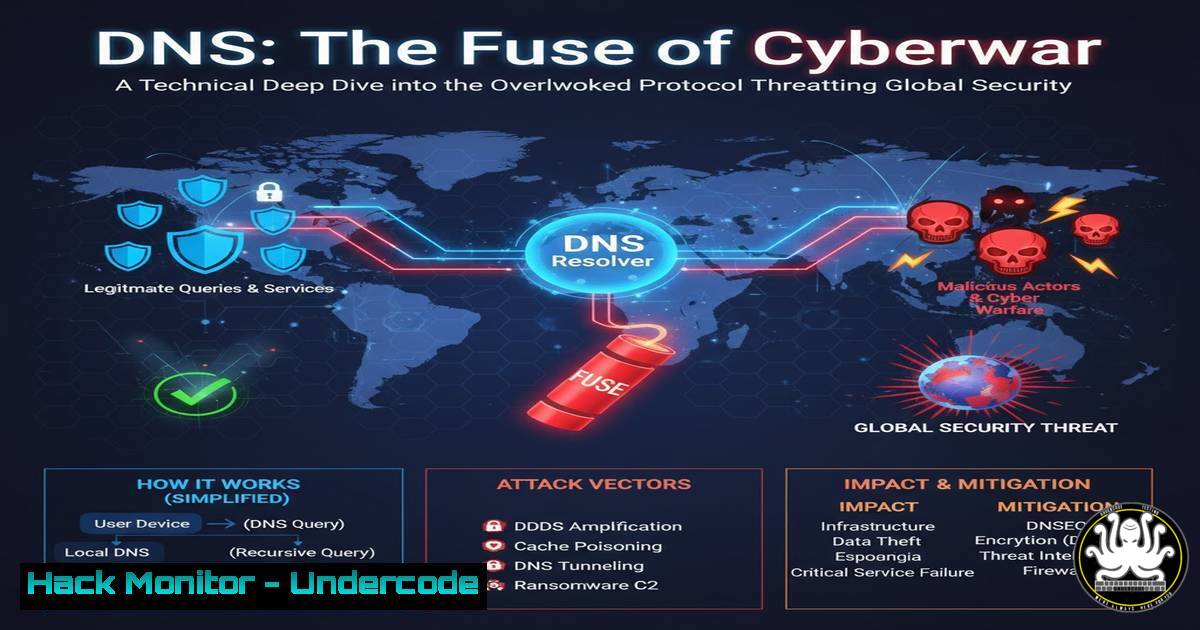
Introduction:
The recent AWS outage served as a stark reminder that the Domain Name System (DNS), the foundational phonebook of the internet, is a critical vulnerability. Adversaries are actively mapping and exploiting systemic weaknesses in DNS to potentially disrupt critical infrastructure, from power grids to financial markets. This article provides a technical roadmap for security professionals to audit, secure, and harden their DNS infrastructure against these escalating threats.
Learning Objectives:
- Understand the core attack vectors against DNS, including cache poisoning, DDoS, and hijacking.
- Implement practical commands and configurations to audit and secure DNS resolvers and zones.
- Develop a strategy for deploying advanced DNS security protocols like DNSSEC and DNS over HTTPS/TLS.
You Should Know:
- Auditing Your DNS Resolver for Cache Poisoning Vulnerabilities
Cache poisoning attacks corrupt DNS resolvers with false data, redirecting users to malicious sites. Auditing your resolver’s configuration is the first line of defense.
Verified Linux Command:
 Check the version of BIND to identify known vulnerabilities
named -v

Review key BIND configuration for security settings
grep -E '(allow-query|allow-recursion|version|dnssec)' /etc/bind/named.conf.options
Step-by-step guide:
The `named -v` command reveals the version of your BIND DNS server, allowing you to cross-reference with CVE databases for unpatched exploits. The `grep` command then audits the configuration file. You should restrict `allow-query` and `allow-recursion` to specific, trusted client IP ranges only, not any. Suppressing the version string prevents attackers from easily fingerprinting your server.
2. Implementing DNSSEC Validation on Your Resolver
DNSSEC adds a layer of cryptographic signing to DNS data, allowing resolvers to verify that the responses they receive are authentic and have not been tampered with.
Verified Linux Command (BIND):
 Key lines to add to /etc/bind/named.conf.options
dnssec-validation auto;
dnssec-lookaside auto;

Check if DNSSEC validation is operational
dig sigfail.verteiltesysteme.net +dnssec
dig sigok.verteiltesysteme.net +dnssec
Step-by-step guide:
Enabling `dnssec-validation` in your BIND configuration forces your resolver to check for and require digital signatures on DNS records. The `dig` commands test this setup. The query to `sigfail.verteiltesysteme.net` should return a `SERVFAIL` status, indicating the resolver correctly rejected an invalid signature. The query to `sigok.verteiltesysteme.net` should return an `AD` (Authentic Data) flag and a valid IP address.
- Hardening Against DDoS with Response Rate Limiting (RRL)
DNS Amplification attacks are a common DDoS technique. Response Rate Limiting (RRL) in BIND mitigates this by limiting the number of identical responses sent to a network block.
Verified Linux Command (BIND):
 Add to the 'options' section in /etc/bind/named.conf.options
rate-limit {
responses-per-second 10;
window 5;
};
Step-by-step guide:
This configuration snippet tells your BIND server to start rate-limiting responses if it sends more than 10 identical responses per second to a single client network, within a sliding 5-second window. This cripples amplification attacks, where an attacker spoofs a source IP to receive a flood of large DNS responses, without significantly impacting legitimate users.
4. Preventing Zone Transfer Abuse
Unauthorized zone transfers can leak your entire internal network map to attackers. It is critical to restrict them strictly.
Verified Windows Command (PowerShell – DNSCmd):
 List DNS zones on a server (Run as Administrator)
DNSCmd /EnumZones

View properties of a specific zone to check security
DNSCmd /ZoneInfo example.com
Step-by-step guide:
Use `DNSCmd /EnumZones` to inventory all zones on your Windows DNS server. Then, for each zone, especially those that are not public, use `DNSCmd /ZoneInfo` and examine the output for the `SecureSecondaries` setting. This should be configured to only allow transfers to specific, authorized secondary DNS server IPs, not to all servers.
5. Enumerating DNS Records for Reconnaissance
Attackers use DNS enumeration to map your attack surface. Understanding their tools allows you to identify and protect exposed information.
Verified Linux Command:
 Perform a zone transfer attempt (to test your own security)
dig axfr @ns1.example.com example.com

Enumerate common subdomains using a wordlist
for sub in $(cat wordlist.txt); do host $sub.example.com; done
Step-by-step guide:
The `dig axfr` command attempts a zone transfer. If this returns all the records for the domain, your server is critically misconfigured (see point 4). The `for` loop script automates subdomain discovery, a common reconnaissance technique. Defenders should run this against their own domains to discover and assess any unintended or forgotten subdomains that could be targeted.
- Securing Client Queries with DNS over HTTPS (DoH)
DoH encrypts DNS queries between the client and the resolver, preventing eavesdropping and manipulation on local networks.
Verified Browser/OS Configuration:
Firefox: Navigate to about:config, search for network.trr, and set `network.trr.mode` to `2` (DNS-over-HTTPS by default) and `network.trr.uri` to a provider like `https://cloudflare-dns.com/dns-query`.
Windows 11: Go to Settings > Network & Internet > Advanced Network Settings > More network adapter options. Right-click your adapter, select Properties, double-click “Internet Protocol Version 4 (TCP/IPv4)”, click Advanced, and go to the DNS tab. Check “Encrypt DNS traffic over HTTPS”.
Step-by-step guide:
Configuring DoH at the OS or browser level ensures that even on untrusted Wi-Fi networks, your DNS queries cannot be monitored, blocked, or tampered with by a malicious actor on the same network. This is a critical control for remote workers.
7. Leveraging Threat Intelligence with DNS Filtering
Blocking known malicious domains at the DNS layer is an effective first defense against malware, phishing, and botnet communication.
Verified Command-Line Filter Test:
 Use a public blocklist to check a domain (example using 'hosts' file format)
curl -s https://raw.githubusercontent.com/StevenBlack/hosts/master/hosts | grep -i "example-malware-domain.com"
Step-by-step guide:
This command fetches a consolidated blocklist and searches for a specific domain. In a production environment, you would integrate commercial or open-source threat intelligence feeds directly into your DNS filtering solution (e.g., Cisco Umbrella, Pi-hole, a pfSense firewall). This prevents internal hosts from even resolving the IP addresses of known malicious domains, stopping attacks before they start.
What Undercode Say:
- The Plumbing is the Target: The most unglamorous, foundational layer of IT infrastructure is now the primary battlefield. Neglecting DNS in favor of more “advanced” security tools is a catastrophic strategic error.
- Validation is Non-Negotiable: Relying on unverified DNS responses is akin to trusting a stranger who claims to be your bank manager. DNSSEC or encrypted transport (DoH/DoT) must become standard practice, not an advanced feature.
The AWS incident was not an anomaly but a symptom of a systemic disease. The analysis from security leaders like Jenkinson highlights that state-level actors are not just looking for zero-days in software; they are actively probing the brittle, trust-based core of global internet routing. The technical debt accrued over decades of treating DNS as mere plumbing has created a low-risk, high-reward attack surface. The commands and configurations outlined here are not just IT tasks; they are urgent countermeasures against an active, ongoing reconnaissance campaign. The time for passive monitoring is over; active DNS defense is now a core requirement of national and corporate security.
Prediction:
The next major state-sponsored cyber-attack will not solely rely on a novel software exploit. It will strategically combine a known-but-unpatched DNS vulnerability—such as a hijacked or poisoned major ISP’s resolver—with a simultaneous DDoS on key infrastructure. This one-two punch will cause a cascading failure, disrupting not just web services but the operational technology (OT) controlling physical infrastructure. The financial market freeze or regional power outage that results will be the definitive wake-up call, forcing a globally coordinated, regulatory-driven overhaul of DNS management akin to the birth of modern cybersecurity in the early 2000s.
🎯Let’s Practice For Free:
IT/Security Reporter URL:
Reported By: Andy Jenkinson – Hackers Feeds
Extra Hub: Undercode MoN
Basic Verification: Pass ✅


