
Listen to this Post
Introduction:
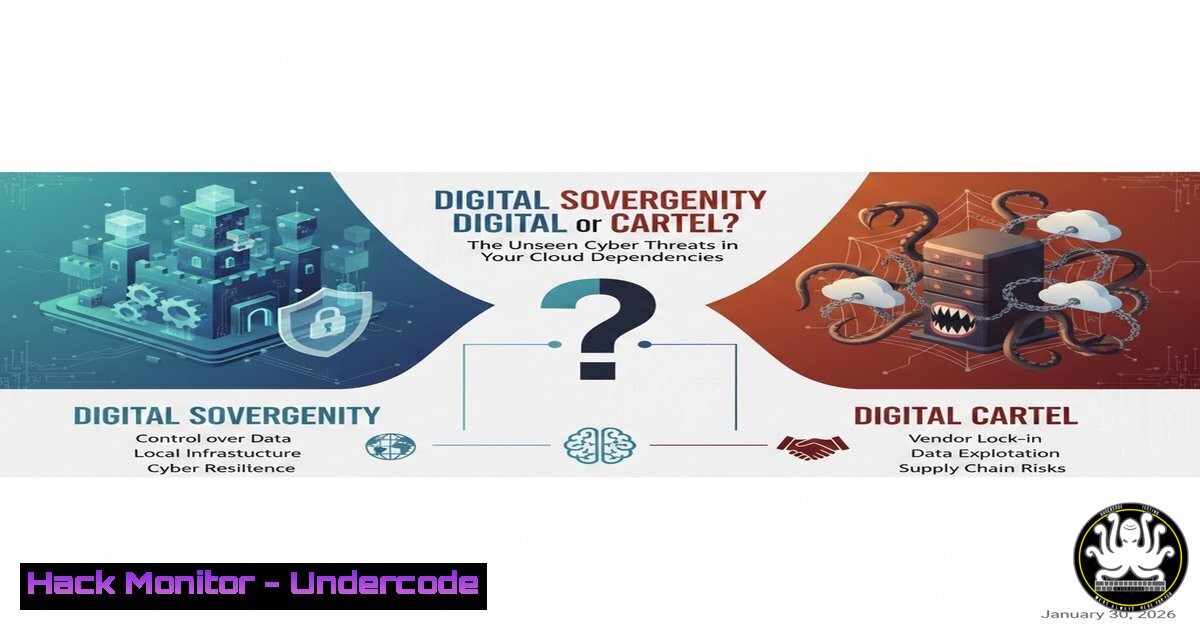
The global push for digital and data sovereignty (DDS) is often overshadowed by a stark reality: structural dependency on foreign hyperscalers and opaque third-party supply chains. This reliance creates a “Digital Cartel” where convenience undermines control, turning cybersecurity into mere theater and exposing organizations to unlawful access, surveillance, and systemic fraud. True security begins not with policy statements, but with ruthless visibility into every digital asset and dependency.
Learning Objectives:
- Understand the concrete cyber risks embedded in uncontrolled digital supply chains and foreign cloud dependencies.
- Learn how to conduct a full technical audit of your organization’s external footprint, including DNS, IP ranges, and CDN dependencies.
- Implement actionable steps to map, analyze, and harden your infrastructure against sovereignty-related threats.
You Should Know:
- The Architecture of Dependence: Mapping Your Digital Supply Chain
The first step toward sovereignty is acknowledging dependence. Every service—from cloud hosting and SaaS applications to DNS providers and CDNs—represents a potential vector for data harvesting, surveillance, or disruption. An attacker only needs to compromise one link in this chain.
Step‑by‑step guide:
- Asset Inventory: Create a comprehensive list of all external-facing digital assets. Use tools like `amass` or `subfinder` to begin passive enumeration.
Example using amass for passive domain enumeration
amass enum -passive -d yourcompany.com -o domains.txt
- Provider Identification: For each asset (domain, IP), identify the hosting provider, DNS registrar, and nameservers. Use `whois` and
dig.whois yourcompany.com | grep -i "registrar|name server" dig NS yourcompany.com +short
- Dependency Mapping: Use security tools like `OWASP Dependency-Track` (for software libraries) and manual review of cloud configuration files to map third-party code and platform dependencies.
-
DNS and Domain Sovereignty: The Foundation of Your Online Presence
DNS is a critical, yet often overlooked, control plane. Foreign-controlled DNS infrastructure can lead to domain hijacking, traffic interception, or complete takedown.
Step‑by‑step guide:
- Audit DNS Configuration: Check for outdated or vulnerable records. Use `dig` to audit all record types.
dig ANY yourcompany.com +noall +answer
Check for SPF, DMARC, DKIM to prevent email spoofing
dig TXT yourcompany.com
dig TXT _dmarc.yourcompany.com
- Assess Registrar Security: Ensure your domain registrar account uses strong multi-factor authentication (MFA), is not tied to a single individual’s email, and has locking enabled.
- Consider Sovereign DNS Providers: Evaluate DNS providers based on their jurisdictional location, data policies, and security history. Implement secondary DNS from a provider in a different legal jurisdiction for resilience.
3. Cloud Hosting Audit: Beyond the Hyperscaler Dashboard
Merely using a cloud provider does not equate to security. Misconfigurations and inherited vulnerabilities in platform-as-a-service (PaaS) offerings are rampant.
Step‑by‑step guide:
- Configuration Scanning: Use infrastructure-as-code (IaC) scanners like `tfsec` or `checkov` on your Terraform or CloudFormation templates before deployment.
Scan Terraform plans for misconfigurations
tfsec .
- Runtime Inventory: Use the cloud provider’s native tools (AWS Config, Azure Security Center, GCP Security Command Center) to discover all running resources, their configurations, and network exposure.
- Egress Traffic Analysis: Identify where your data is going. Restrict and log all outbound traffic to detect unauthorized data exfiltration to foreign jurisdictions.
Example: List outbound network connections on a Linux host
sudo netstat -tunap | grep ESTABLISHED
Or use more advanced tools like Zeek (Bro) for full traffic analysis
-
Securing the Software Supply Chain: From Repository to Runtime
Third-party libraries and containers are the backbone of modern development but are a prime target for supply chain attacks.
Step‑by‑step guide:
- SBOM Generation: Mandate the creation of a Software Bill of Materials (SBOM) for all applications. Use `syft` to generate an SBOM for container images.
syft your-application:latest -o cyclonedx-json > sbom.json
- Vulnerability Scanning: Integrate static application security testing (SAST) and software composition analysis (SCA) tools like `Trivy` or `Snyk` directly into your CI/CD pipeline.
trivy image --severity HIGH,CRITICAL your-application:latest
- Artifact Signing & Verification: Implement sigstore/cosign to sign container images and verify their integrity before deployment.
Sign an image
cosign sign --key cosign.key your-application:latest
Verify an image
cosign verify --key cosign.pub your-application:latest
5. Building a Sovereign Security Posture: Actionable Hardening
Visibility without action is futile. Use audit findings to enforce a hardened, sovereign-aligned baseline.
Step‑by‑step guide:
- Network Segmentation & Encryption: Segment critical data and systems into separate VPCs/VNETs. Enforce TLS 1.3 for all data in transit, using internal certificate authorities where possible.
- Zero-Trust Architecture: Implement strict identity-aware proxy access and micro-segmentation. Never rely solely on network perimeter security.
- Sovereign Procurement Policy: Develop and enforce a technical procurement checklist. New vendors must disclose their infrastructure jurisdiction, supply chain controls, and provide third-party audit reports (SOC 2, ISO 27001).
What Undercode Say:
- Key Takeaway 1: Digital sovereignty is an operational cybersecurity requirement, not a political abstraction. The lack of a sovereign foundation makes advanced security tools irrelevant, as the underlying control plane is compromised.
- Key Takeaway 2: The path to sovereignty is a continuous technical audit cycle—enumerate assets, identify dependencies, assess risks, and enforce hardening controls. Leadership’s failure to mandate this process is willful blindness that invites state-level and criminal threat actors into the heart of the enterprise.
Prediction:
Within the next 3-5 years, organizations that fail to operationalize digital sovereignty will face catastrophic multi-vector incidents. We will see a rise in “legalized hacking” where foreign entities use lawful access provisions within their jurisdiction to siphon data from dependent clouds, followed by sophisticated ransomware attacks exploiting the identified supply chain weaknesses. Conversely, a new market will emerge for verifiably sovereign, audited, and interoperable cloud and DNS services, forcing current hyperscalers to offer fully isolated, jurisdiction-specific infrastructure or lose control of critical government and defense sectors. The cyber landscape will bifurcate into sovereign-secure and vulnerable-dependent classes.
▶️ Related Video (82% Match):
🎯Let’s Practice For Free:
IT/Security Reporter URL:
Reported By: Andy Jenkinson – Hackers Feeds
Extra Hub: Undercode MoN
Basic Verification: Pass ✅


