Listen to this Post
Introduction
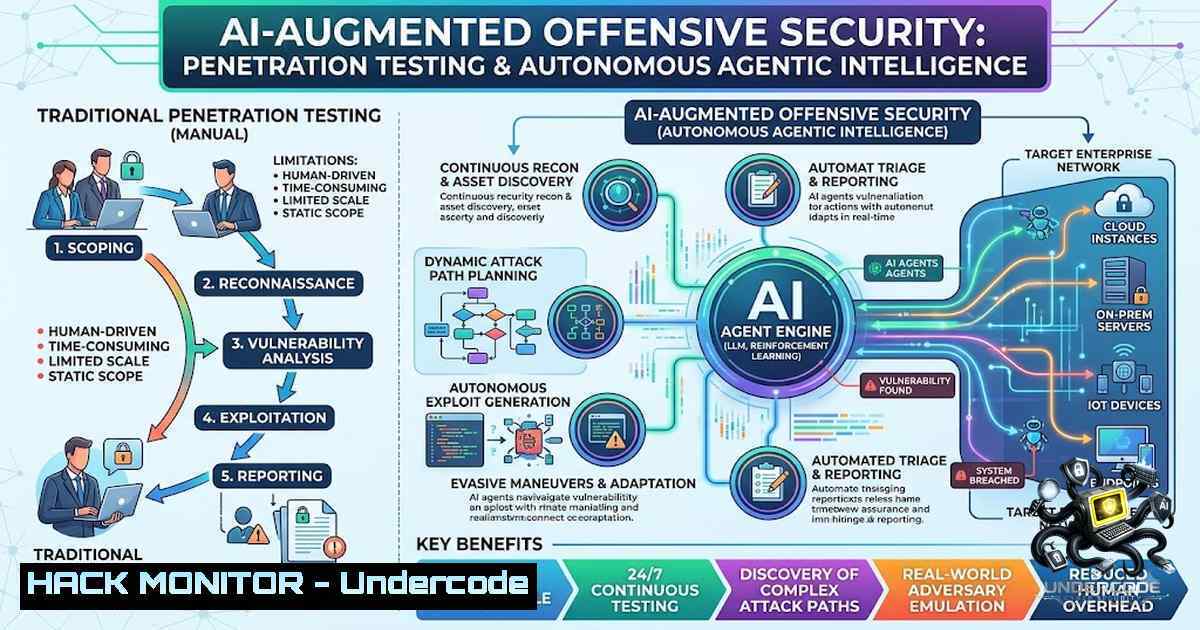
The cybersecurity industry is witnessing a paradigm shift as Large Language Models (LLMs) and agentic AI frameworks transform traditional penetration testing from a manual, labour-intensive process into an autonomous, continuously operating security validation capability. While many perceive AI as merely a conversational assistant like ChatGPT, security professionals are now deploying AI agents that handle everything from reconnaissance and vulnerability analysis to exploitation and reporting — at machine speed and scale. This article explores the practical intersection of AI and offensive security, providing hands-on guidance for security professionals looking to integrate AI into their penetration testing workflows.
Learning Objectives
- Understand the core architecture and capabilities of AI-powered penetration testing frameworks and agentic security tools
- Learn to deploy and configure AI-assisted testing environments using open-source tools like Pentest Swarm AI, Strix, and Auto-Pentest-LLM
- Master the four-phase AI-driven penetration testing workflow: mission scoping, autonomous exploration, vulnerability hypothesis verification, and payload generation
1. Understanding the AI Penetration Testing Ecosystem
The landscape of AI-powered offensive security tools has expanded dramatically, with over 70 open-source AI penetration testing tools catalogued as of early 2026. These tools range from semi-automated assistants to fully autonomous multi-agent systems capable of end-to-end penetration testing.
Key AI Pentesting Platforms:
- Pentest Swarm AI: The first open-source autonomous penetration testing platform built on swarm intelligence architecture, providing live coordinated access to tools including Nmap, SQLMap, Burp Suite, ZAP, and Metasploit. It features stigmergic coordination where agents communicate through a shared PostgreSQL-backed blackboard with pheromone weighting.
-
Strix: Autonomous AI penetration testing agents that act like real hackers — running code dynamically, finding vulnerabilities, and validating them through actual proofs-of-concept.
-
AutoSecAgent: An AI-powered platform built on the adaptive Agent Zero orchestration framework, powered by the cybersecurity-focused DeepSeek LLM, supporting semi-automated end-to-end penetration testing under human oversight.
-
Auto-Pentest-LLM: An autonomous security agent using a Manager-Specialist multi-agent architecture with dedicated agents for reconnaissance, web analysis, and exploitation.
Step-by-Step: Setting Up a Basic AI Pentesting Environment
- Install Docker and Ollama (for local LLM deployment):
Install Docker
sudo apt update && sudo apt install docker.io docker-compose
Install Ollama for local LLM
curl -fsSL https://ollama.ai/install.sh | sh
ollama pull qwen2.5:1.5b
2. Clone and configure Auto-Pentest-LLM:
git clone https://github.com/knooob/Auto-Pentest-LLM
cd Auto-Pentest-LLM
cp .env.example .env
 Edit .env with your TARGET_IP, KALI_HOST, and LLM configuration
3. Launch the agent:
./run.sh
 Or manually via Docker Compose
docker compose up --build
The agent will begin autonomous reconnaissance using Nmap and Masscan, followed by web application analysis and vulnerability research.
2. The Four-Phase AI Penetration Testing Workflow
According to recent academic research, LLM-based penetration testing follows a structured four-phase workflow that enables systematic security assessment.
Phase I: Mission Scoping and Prompt Engineering
Define test parameters, constraints, and objectives through carefully crafted prompts. This phase establishes the rules of engagement and ensures the AI operates within authorized boundaries.
Phase II: Autonomous Exploration and Tool Selection
The AI agent autonomously explores the target, selecting appropriate tools based on discovered services. For example, when Nmap detects a web server, the agent automatically invokes Gobuster or Nikto for directory enumeration.
Phase III: Vulnerability Hypothesis Formation and Verification
The AI formulates hypotheses about potential vulnerabilities and designs experiments to verify them, learning from feedback loops.
Phase IV: Payload Generation and Refinement
Validated findings are transformed into concrete exploits, with the AI generating and refining payloads for maximum effectiveness.
Example: AI-Driven Reconnaissance Pipeline
Using Talon (Penetration Testing MCP for Claude Code), security professionals can execute AI-directed reconnaissance:
 Install and configure Talon
cp mcp-config.example.json ~/.claude/mcp.json
 Edit with your SSH host and username

AI-directed commands
 "Run a full recon on 10.10.10.100 using Kali"
 "Enumerate SMB shares on the target"
 "Check for web vulnerabilities on http://10.10.10.100"
 "Run linpeas and analyze the output"
The AI executes commands on your Kali VM, interprets output, suggests next steps, and maintains a complete attack narrative.
3. AI-Assisted Vulnerability Discovery and Exploitation
AI agents excel at identifying and validating vulnerabilities through automated scanning, intelligent analysis, and proof-of-concept generation.
Comprehensive Vulnerability Scanning
Modern AI pentesting tools can identify and validate a wide range of vulnerabilities across the OWASP Top 10 and beyond, including:
– Broken Access Control (IDOR, privilege escalation, auth bypass)
– Injection Attacks (SQL, NoSQL, OS command injection, SSTI)
– Server-Side Vulnerabilities (SSRF, XXE, insecure deserialization, RCE)
Practical Demonstration: AI-Powered Exploitation Pipeline
The following example demonstrates an AI-driven exploitation pipeline using a lab environment:
 Clone the AI Pentest Lab
git clone https://github.com/mauriciobnet/ai-pentest-lab
cd ai-pentest-lab

Configure API key
cp .env.example .env
 Edit .env with ANTHROPIC_API_KEY

Start the environment
./up.sh

Execute the attack
./attack.sh 172.31.31.10
The pipeline operates as follows:
1. Reconnaissance: `nmap -sV` detects exact service versions
- AI Analysis: Services are sent to Claude, which returns a list of CVEs with CVSS scores and Metasploit modules in JSON format
- Exploitation: For vsftpd 2.3.4 (CVE-2011-2523), a pure Python exploit triggers the backdoor and opens a root shell on port 6200
4. Cloud and API Security Testing with AI
AI-powered tools are particularly effective for testing cloud infrastructure and APIs, addressing the complexity and scale of modern deployments.
Key Cloud Security Testing Capabilities:
- Continuous Offensive Security: Platforms like Snyk Evo provide autonomous AI-powered penetration testing that runs continuously rather than on a once- or twice-a-year schedule.
-
API Security Fuzzing: AI-powered API security fuzzers with cross-tool orchestration can identify vulnerabilities in REST, GraphQL, and gRPC APIs.
-
AI/LLM Security Testing: Tools like `offsec-ai` combine classic network reconnaissance with modern AI/LLM security testing, including OWASP Top 10 for LLMs and MCP endpoint security scanning.
Step-by-Step: Cloud Penetration Testing with AI
1. Install offsec-ai:
pip install offsec-ai
2. Run a comprehensive scan:
offsec-ai scan example.com --include-ai-tests
3. Test for AI-specific vulnerabilities:
offsec-ai llm-test https://api.example.com/chat --prompt-injection
4. Generate compliance-ready report:
offsec-ai report --format sarif --output scan_results.sarif
- Best Practices and Safety Guardrails for AI Pentesting
The Cloud Security Alliance (CSA) has established critical best practices for using agentic AI in penetration testing.
Essential Guardrails:
- Technical Containment: Implement non-bypassable blocklists for destructive commands (e.g.,
rm -rf,DROP TABLE), strict rate-limiting, and egress filters to prevent out-of-scope actions. -
Human-in-the-Loop: Systems must not be fully autonomous. Include real-time “emergency stop” buttons and require mandatory human approval for ambiguous, high-risk, or post-exploitation actions.
-
Data Security: Enforce a zero-trust approach to data. All sensitive information (PII) must be masked in prompts, logs, and reports.
-
Model Integrity: Vet the agent’s training data, testing methodologies (e.g., OWASP), and all third-party LLMs used. Platforms must have robust defences against “model jailbreaking” and prompt injection attacks.
Implementation Commands:
 Configure scope enforcement
pentestswarm scan example.com --scope example.com --swarm --follow

The --scope flag is enforced at both the tool layer and executor layer
 for defence-in-depth, making it safe for CI/CD pipelines
6. CI/CD Integration and Continuous Security Testing
AI penetration testing tools can be integrated directly into CI/CD pipelines, enabling continuous security validation with every deployment.
GitHub Actions Integration:
Pentest Swarm AI ships with a ready-made GitHub Action with SARIF output, enabling automated pentesting directly within any CI/CD workflow.
 .github/workflows/pentest.yml
name: AI Security Scan
on:
pull_request:
branches: [ main ]
jobs:
pentest:
runs-on: ubuntu-latest
steps:
- uses: actions/checkout@v3
- name: Run AI Pentest
env:
PENTESTSWARM_ORCHESTRATOR_API_KEY: ${{ secrets.PENTESTSWARM_KEY }}
run: |
pentestswarm scan ${{ github.event.pull_request.head.repo.clone_url }} \
--scope ${{ github.event.pull_request.head.repo.clone_url }} \
--swarm --follow
- name: Upload SARIF Report
uses: github/codeql-action/upload-sarif@v2
with:
sarif_file: pentest_results.sarif
MCP Server Integration:
The `pentestswarm mcp serve` command exposes the entire swarm as an MCP server, integrating natively with Claude Desktop and Cursor for IDE-level offensive security testing.
 Start MCP server
pentestswarm mcp serve --port 8080

Connect from Claude Desktop
 Configure mcp.json with the server endpoint
What Undercode Say:
- AI is not replacing pentesters — it’s augmenting them: The most effective approach combines AI’s speed and scalability with human oversight and strategic decision-making. AI handles the repetitive, time-consuming tasks while human experts focus on complex attack paths and business logic flaws.
-
The attack surface is expanding faster than manual testing can cover: With AI agents capable of continuous, parallel vulnerability discovery across thousands of assets, organizations can finally achieve the scale and speed needed to match modern threat landscapes. The cost of not adopting AI-assisted security testing is becoming untenable.
-
Safety and ethics must be built in, not bolted on: As AI agents gain more autonomy, technical guardrails, human-in-the-loop controls, and strict scope enforcement become non-1egotiable. The cybersecurity community must proactively address these challenges to prevent misuse and ensure responsible AI deployment.
The integration of AI into penetration testing represents not just an evolution but a revolution in offensive security. As demonstrated by the upcoming HackToLive Academy webinar (14 August 2026, 9:00 PM BST), security professionals who embrace AI-augmented testing methodologies will be better positioned to defend against increasingly sophisticated threats. The tools are available, the frameworks are mature, and the time to adopt AI-powered security testing is now.
Prediction:
- +1 AI-powered penetration testing will become the industry standard within 18-24 months, with autonomous agents handling 70-80% of routine security testing tasks while human experts focus on strategic threat hunting and complex vulnerability chains.
-
+1 The democratization of AI pentesting tools will enable smaller organizations and developing nations to access enterprise-grade security testing capabilities, significantly improving global cybersecurity posture.
-
-1 The same AI capabilities that empower defenders will be weaponized by threat actors, leading to an AI-driven arms race where attack automation outpaces defensive adaptation.
-
-1 Regulatory frameworks will struggle to keep pace with autonomous AI agents, creating legal ambiguities around liability, scope violations, and unintended damage caused by AI-driven testing.
-
+1 Continuous, AI-driven security validation integrated into CI/CD pipelines will become the new normal, shifting security left and reducing the average time to detect and remediate vulnerabilities from weeks to hours.
-
+1 The emergence of standardized agentic security benchmarks and frameworks will enable organizations to compare and validate AI pentesting capabilities, driving rapid innovation and quality improvement in the sector.
-
-1 Over-reliance on AI without proper human oversight will lead to critical vulnerabilities being missed, particularly in business logic, authentication flows, and complex multi-step attack chains that require contextual understanding.
▶️ Related Video (88% Match):
https://www.youtube.com/watch?v=142dkJC8V7s
🎯Let’s Practice For Free:
🎓 Live Courses & Certifications:
Join Undercode Academy for Verified Certifications
🚀 Request a Custom Project:
Secure, high-velocity infrastructure and disruptive technological engineering. Contact our engineering team for high-tier development and proprietary systems:
[email protected]
💎 Smart Architecture | 🛡️ Secure by Design | ⭐ Trusted by Thousands
IT/Security Reporter URL:
Reported By: https://lnkd.in/p/ess-7Adz – Hackers Feeds
Extra Hub: Undercode MoN
Basic Verification: Pass ✅


