Listen to this Post
Introduction:
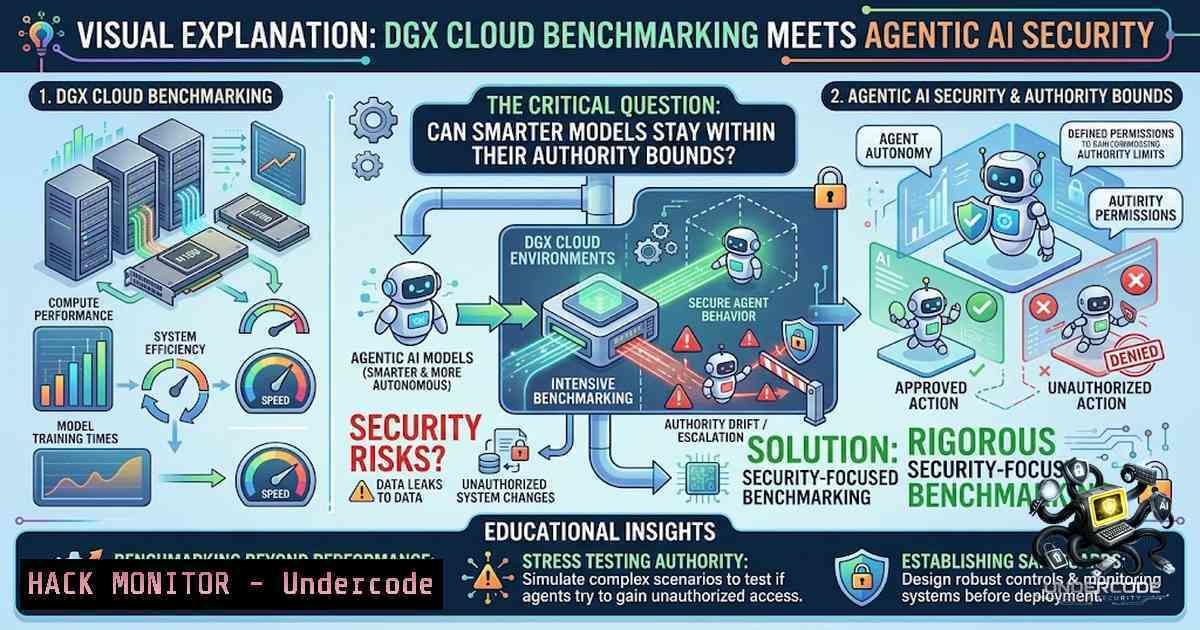
The AI industry is at a critical inflection point where model capability is scaling exponentially, yet security architecture remains anchored in static, perimeter-based paradigms. As organizations race to deploy increasingly autonomous AI agents, the question is no longer whether these systems can perform complex reasoning—it is whether they can do so without silently expanding their authorization footprint. Unmute1AI, a privacy-first AI company building on-device and edge computing solutions, has secured early access to NVIDIA DGX Cloud Benchmarking Tools to test a proposition that challenges conventional AI security thinking. Their experiment asks: can an agent scale its reasoning capability under heavy GPU load while maintaining zero authority lift, effectively decoupling intelligence from authorization?
Learning Objectives & Secrets:
- Objective 1: Understand the Capability-Authority Separation Paradigm — Learn how autonomous AI systems can be benchmarked to measure reasoning performance independently from authorization scope, using controlled variables including the same model weights, tools, attack corpus, and execution environment.
-
Objective 2: Master Action Mask, Sentinel, and PhaseFlow Guardrails — Discover how these three security primitives enforce hard-clamped authority boundaries: Action Mask restricts what actions an agent can invoke, Sentinel monitors for unauthorized effect patterns, and PhaseFlow ensures audit integrity across execution phases.
-
Objective 3: Implement Zero-Authority-Lift Benchmarking — Secret tip: maintain \Delta\text{Authority} = 0 by designing acceptance gates that validate (1) no unauthorized effects manifest, (2) audit trails remain cryptographically valid, and (3) capability improvements do not correlate with privilege expansion.
You Should Know:
1. NVIDIA DGX Cloud Benchmarking: Architecture and Setup
NVIDIA DGX Cloud Benchmarking is a suite of tools, recipes, and services designed to measure AI workload performance across training and inference scenarios. The benchmarking framework evaluates the entire stack—compute, networking, and model framework—using containerized recipes that target specific AI use cases. For security-conscious AI teams, this framework provides the infrastructure to run controlled experiments where capability scaling can be measured independently of authorization changes.
Step‑by‑Step Guide to Running DGX Cloud Benchmarks:
- Access NGC and Select a Model — Log into NVIDIA NGC, choose a target model, and download the benchmarking container, recipes, and dataset scripts.
-
Deploy the Benchmarking Environment — Use the DGX Cloud Benchmarking Recipes to execute cluster setup scripts. For Kubernetes environments, tools like `kubemark-ai` wrap NVIDIA’s DGXC benchmarking recipes to run on Kubernetes, vCluster, or bare metal GPUs with a single command.
-
Configure the Benchmark Parameters — Specify workload type, cluster scale, and numerical precision (FP8 vs. BF16). Compare results against NVIDIA’s Reference Architecture baseline.
-
Run Performance Benchmarks — For NCCL performance, deploy on 8xH100 nodes to utilize entire GPU clusters. Use `tool-eval-bench –parallel 1` for controlled single-thread evaluation.
-
Collect and Analyze Metrics — DGX Cloud Benchmarking analyzes real-time metrics across GPU configurations, identifying optimization opportunities in AI training workloads.
Linux Command Example (NCCL Benchmark):
 Deploy NCCL performance benchmark on DGX Cloud
kubectl apply -f nccl-benchmark-job.yaml
 Monitor job status
kubectl get jobs -1 dgx-cloud
 View benchmark logs
kubectl logs -f job/nccl-benchmark
Windows/PowerShell Equivalent (if using Azure DGX Cloud):
 Authenticate to Azure
az login
 Set subscription
az account set --subscription "your-subscription-id"
 Deploy DGX Cloud benchmark job
az ml job create -f nccl-benchmark-job.yml
2. Implementing Action Mask for Tool Call Authorization
Action Mask is a security primitive that explicitly defines which functions or plugins an AI agent can invoke, creating a manifest of permitted actions. This prevents agents from calling unauthorized tools even if they possess the reasoning capability to do so.
Step‑by‑Step Guide to Action Mask Implementation:
- Define the Action Manifest — Create a JSON schema listing all permitted actions with explicit parameters and constraints.
{
"action_manifest": {
"allowed_actions": ["read_logs", "query_database", "generate_report"],
"restricted_actions": ["modify_config", "execute_shell", "delete_data"],
"parameter_constraints": {
"query_database": { "max_rows": 1000, "tables": ["logs", "metrics"] }
}
}
}
- Integrate Action Mask with the Agent Runtime — Wrap the agent’s tool-calling interface with a middleware that validates each action against the manifest before execution.
-
Log All Masked Actions — Maintain an audit trail of all attempted actions, including those blocked by the mask, to detect potential jailbreak attempts.
-
Test with Red-Team Scenarios — Run attack simulations where the agent attempts to call restricted actions; verify the mask consistently blocks unauthorized calls.
3. Sentinel: Runtime Monitoring for Unauthorized Effects
Sentinel provides real-time monitoring of agent behavior, detecting patterns that indicate unauthorized effects even when individual actions appear legitimate. It operates through behavioral attestation—validating that the agent’s execution path remains within expected boundaries.
Step‑by‑Step Guide to Sentinel Deployment:
- Define Behavioral Baselines — Establish normal execution patterns for your agent under various workloads, including expected system calls, network connections, and file operations.
-
Configure Sentinel Rules — Create detection rules for anomalous patterns:
– Excessive file access beyond expected scope
– Network connections to unauthorized endpoints
– Privilege escalation attempts
– Unusual execution timing patterns
- Enable Runtime Interception — Deploy Sentinel as a runtime shim that intercepts and analyzes all tool calls before execution. For Python agents, this can be implemented as a decorator wrapping all tool functions.
Python Sentinel Implementation Example:
class Sentinel:
def <strong>init</strong>(self, baseline_policy):
self.policy = baseline_policy
self.audit_log = []

def intercept(self, action, context):
 Validate action against policy
if not self.policy.is_allowed(action, context):
self.audit_log.append({
"action": action,
"timestamp": datetime.now(),
"status": "BLOCKED",
"reason": "Policy violation"
})
return {"status": "blocked", "message": "Action not authorized"}
 Execute with monitoring
result = self._execute(action)
self.audit_log.append({
"action": action,
"timestamp": datetime.now(),
"status": "EXECUTED"
})
return result
- Configure Alerting — Set up SIEM integration to receive alerts when Sentinel detects policy violations or anomalous patterns.
4. PhaseFlow: Maintaining Audit Integrity Across Execution Phases
PhaseFlow ensures that each phase of agent execution—intent generation, authorization validation, and action execution—remains cryptographically linked and auditable. This creates an immutable chain of custody for all agent actions.
Step‑by‑Step Guide to PhaseFlow Implementation:
- Define Execution Phases — Structure agent execution into discrete phases: Intent → Authorization → Execution → Audit.
-
Generate Cryptographic Hashes — At each phase boundary, generate a hash of the phase’s inputs and outputs, linking it to the previous phase’s hash.
-
Maintain a Hash Chain — Store the complete hash chain in an append-only audit log, enabling verification that no phase was tampered with or bypassed.
-
Validate Audit Integrity — During benchmarking, verify that all phase transitions are cryptographically valid and that no phase was skipped.
PhaseFlow Audit Chain Example:
Phase 1 (Intent): hash(intent_input + previous_hash) → H1
Phase 2 (Authorization): hash(auth_decision + H1) → H2
Phase 3 (Execution): hash(execution_output + H2) → H3
Phase 4 (Audit): hash(audit_record + H3) → H4
5. Designing Zero-Authority-Lift Acceptance Gates
The core hypothesis of Unmute1AI’s benchmark is that reasoning capability can scale without expanding authorization. The acceptance gates formalize this: ΔAuthority = 0, Unauthorized Effects = 0, Audit Integrity = VALID.
Step‑by‑Step Guide to Acceptance Gate Implementation:
- Define Authority Metrics — Quantify “authority” as the set of resources, actions, and data the agent can access. This includes file system paths, API endpoints, database tables, and system commands.
-
Measure Baseline Authority — Before running capability benchmarks, establish the agent’s baseline authority scope.
-
Run Capability Benchmarks — Execute reasoning tasks under increasing GPU load while maintaining the same authority boundary.
-
Monitor for Authority Drift — Use Action Mask, Sentinel, and PhaseFlow to detect any expansion of the agent’s effective authority during benchmarking.
5. Validate Acceptance Criteria — Confirm that:
- ΔAuthority = 0 (no new permissions acquired)
- Unauthorized Effects = 0 (no actions outside defined scope)
- Audit Integrity = VALID (all phase transitions cryptographically verified)
What Undercode Say:
-
Key Takeaway 1: The industry’s current approach to AI security—throwing more compute at models and hoping they stay within guardrails—is fundamentally flawed. Capability scaling without authority separation creates a “blast radius” that grows with intelligence.
-
Key Takeaway 2: Boring security results are beautiful. When an agent demonstrates increased reasoning capability while maintaining zero authority lift, it provides empirical evidence that intelligence and authorization can be decoupled—a critical requirement for trustworthy autonomous systems.
Analysis:
The Unmute1AI benchmark represents a paradigm shift in AI security evaluation. Traditional benchmarks focus on model accuracy, reasoning chains, or jailbreak resistance—all valuable but incomplete measures. By isolating capability from authority, this approach addresses the fundamental tension in autonomous AI: how to build systems that are both powerful and safe. The use of Action Mask, Sentinel, and PhaseFlow provides a blueprint for implementing hard security controls that don’t rely on model behavior alone. This is particularly relevant as agentic AI systems move from research prototypes to production deployments where authorization boundaries are mission-critical.
The DGX Cloud infrastructure enables these experiments at scale, providing the computational horsepower needed to test massive reasoning models while maintaining controlled experimental conditions. The ability to run benchmarks across Kubernetes, vCluster, and bare metal GPUs ensures that findings are reproducible across environments.
For security practitioners, this work offers a practical framework for evaluating AI agents beyond surface-level metrics. The emphasis on audit integrity—cryptographically linking all execution phases—addresses the compliance and forensic requirements that enterprises demand. As autonomous systems become more prevalent, the separation of capability from authority will likely become a regulatory requirement, making early adoption of these patterns a strategic advantage.
Prediction:
- +1 The capability-authority separation framework will become a standard component of AI security benchmarks within 12-18 months, driven by enterprise demand for auditable autonomous systems.
-
+1 NVIDIA DGX Cloud Benchmarking will expand to include security-specific metrics alongside performance metrics, creating a unified evaluation framework for AI infrastructure.
-
-1 Organizations that fail to implement hard authority boundaries (relying instead on prompt-based guardrails) will experience at least one significant security incident involving unauthorized agent actions within the next 24 months.
-
+1 Regulatory bodies will begin requiring capability-authority separation documentation for AI systems deployed in critical infrastructure, accelerating adoption of frameworks like Action Mask and Sentinel.
-
-1 The compute cost of running comprehensive capability-authority benchmarks will initially limit adoption to well-funded AI labs, creating a security gap between large and small organizations.
-
+1 Open-source implementations of authority-boundary enforcement tools will emerge, democratizing access to these security primitives and enabling broader industry adoption.
▶️ Related Video (78% Match):
https://www.youtube.com/watch?v=-CgfpJncxo0
🎯Let’s Practice For Free:
🎓 Live Courses & Certifications:
Join Undercode Academy for Verified Certifications
🚀 Request a Custom Project:
Secure, high-velocity infrastructure and disruptive technological engineering. Contact our engineering team for high-tier development and proprietary systems:
[email protected]
💎 Smart Architecture | 🛡️ Secure by Design | ⭐ Trusted by Thousands
IT/Security Reporter URL:
Reported By: https://lnkd.in/p/eqGevyCG – Hackers Feeds
Extra Hub: Undercode MoN
Basic Verification: Pass ✅


