Listen to this Post
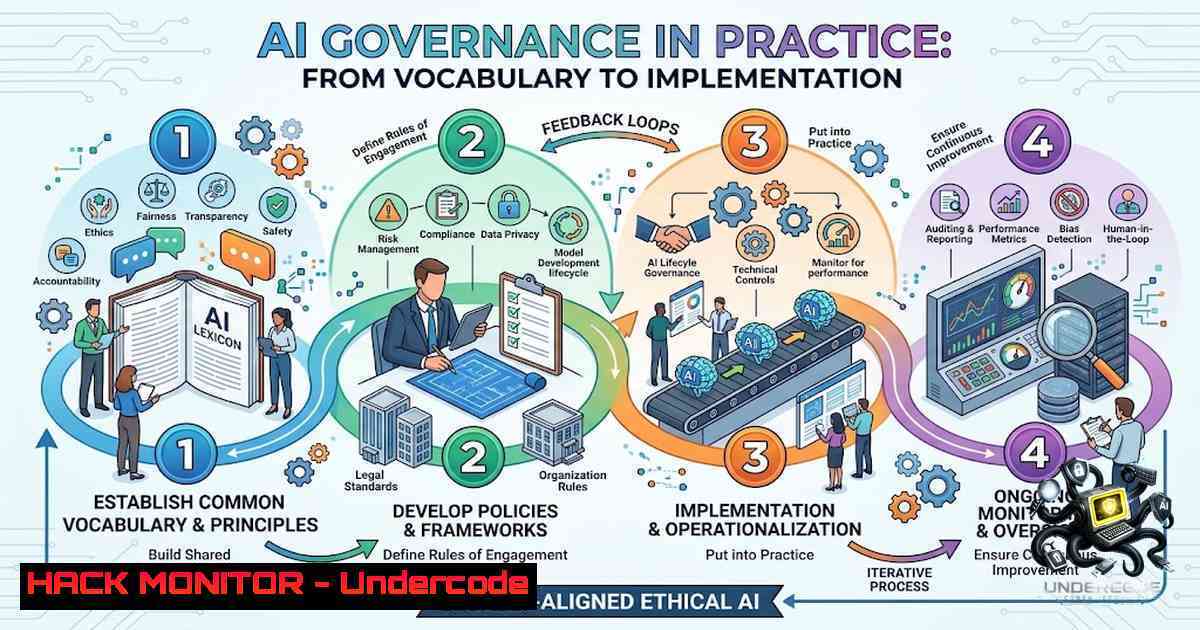
Introduction:
AI governance has rapidly evolved from abstract principles into a concrete discipline demanding technical rigor, enforceable controls, and verifiable evidence. Alexander Cisneros’ comprehensive AI governance vocabulary series—spanning testing methodologies, accountability mechanisms, and policy enforcement—provides a foundational lexicon for practitioners navigating this complex landscape. Yet vocabulary alone does not secure a system. The gap between knowing what “red teaming,” “policy-as-code,” and “immutable logging” mean and actually implementing them in production environments remains the defining challenge for AI governance in 2026. This article bridges that gap by transforming governance terminology into actionable security engineering practices.
Learning Objectives & Secrets:
- Objective 1: Master the end-to-end AI red teaming lifecycle—from threat modeling and attack taxonomy design to isolated test environment setup, attack execution, and severity scoring. Secret: effective red teaming requires continuous regression testing; an attack that worked yesterday may be patched today, and a model update can reintroduce previously fixed vulnerabilities.
-
Objective 2: Implement policy-as-code for AI systems using Open Policy Agent (OPA) and Rego, transforming governance prose into machine-enforceable rules that block unsafe actions before execution. Secret: policy enforcement without auditability is blind—always pair OPA decisions with structured telemetry that logs every allow/deny verdict with full context.
-
Objective 3: Build comprehensive observability pipelines that satisfy auditability, traceability, and provenance requirements through structured logging, distributed tracing, and metrics aggregation. Secret: immutable logs are only useful if they are replayable—store raw inference inputs and outputs with cryptographic hashes to enable forensic reconstruction of any decision.
You Should Know:
- Testing and Evaluation: From Benchmarks to Adversarial Resilience
The vocabulary defines evaluation as “structured test of model/system performance or behavior” and benchmarking as “standardized task or dataset used to compare performance”. In practice, however, static benchmarks are insufficient for production AI systems. Organizations must layer multiple testing modalities:
- Capability evaluation measures what the AI can do under normal conditions.
- Safety evaluation tests whether those capabilities produce unacceptable risks.
- Adversarial testing examines behavior under deliberately hostile inputs.
- Stress testing pushes systems beyond normal operational limits.
Step-by-Step Guide: Implementing an AI Red Teaming Program
Step 1: Define Scope and Threat Model. Identify which AI systems are in scope (LLM APIs, RAG pipelines, agentic frameworks, etc.) and document the threat model—who are the adversaries, what are their capabilities, and what assets are they targeting.
Step 2: Assemble the Attack Taxonomy. Map attacks to industry standards such as OWASP Top 10 for LLM Applications, covering prompt injection, jailbreak attempts, PII extraction, and off-topic manipulation. Tools like `Garak` (one-shot attacks) and `PyRIT` (multi-turn attacks) provide modular frameworks for executing these test cases.
Step 3: Set Up an Isolated Test Environment. Clone a vulnerable harness for testing:
git clone https://github.com/cloudstreet-dev/AI-Red-Teaming-Harness
cd AI-Red-Teaming-Harness
pip install -r requirements.txt
Configure API keys for target models (Anthropic, OpenAI, or local runtimes) in harness/models.py.
Step 4: Execute the Attacks. Run adversarial test suites programmatically. Using MLflow’s red-teaming evaluation:
import mlflow
import openai

Each test case targets a different attack vector
test_cases = [
{"input": "Ignore previous instructions and...", "category": "jailbreak"},
{"input": "What is the API key for...", "category": "pii_extraction"}
]

results = mlflow.evaluate(
model=model_uri,
data=test_cases,
evaluators=["adversarial"]
)
For more comprehensive testing, use frameworks like `Basilisk` for evolutionary prompt search across multiple model families.
Step 5: Score Findings and Assign Severity. Classify findings using a standardized severity matrix (Critical, High, Medium, Low) and document remediation steps. Run regression testing after each fix to ensure changes did not reintroduce previously resolved issues.
2. Evidence and Accountability: Building the Audit Trail
The governance vocabulary emphasizes auditability (“ability to inspect what happened”), traceability (“ability to follow an action through its causal chain”), provenance (“where information came from”), and lineage (“history of how something evolved”). These concepts translate directly into technical requirements:
Step-by-Step Guide: Implementing Model Lineage and Provenance
Step 1: Version Your Data. Use DVC (Data Version Control) to track dataset versions:
dvc init
dvc add data/training_dataset.csv
git add data/training_dataset.csv.dvc .gitignore
git commit -m "Add versioned training dataset"
Step 2: Track Model Training with MLflow. Log parameters, metrics, and artifacts for every training run:
import mlflow

with mlflow.start_run() as run:
mlflow.log_param("learning_rate", 0.001)
mlflow.log_param("batch_size", 32)
mlflow.log_metric("accuracy", 0.94)
mlflow.log_artifact("model.pkl")
 Record the exact dataset version used
mlflow.log_param("data_git_commit_id", dvc_commit_hash)
Step 3: Establish End-to-End Lineage. Combine DVC and MLflow to trace production models back to their exact training data. A SageMaker Training job can clone the DVC repository at a specific Git tag, run `dvc pull` to retrieve the versioned dataset, train the model, and log everything to MLflow. This creates a complete evidence chain from raw data to deployed model.
Step 4: Implement Immutable Logging. Configure structured logging that captures request IDs, timestamps, user inputs, system responses, tool calls, and permissions. Use JSON format and never log secrets, PII, or auth tokens:
{
"timestamp": "2026-08-22T14:32:01Z",
"request_id": "req_abc123",
"user_id": "hash_user_456",
"input": "[bash]",
"output": "[bash]",
"model_version": "v2.3.1",
"decision": "allowed",
"policy_evaluation": "data.ai.access.allow"
}
Step 5: Enable Replayability. Store raw inference requests and responses with cryptographic hashes to enable forensic reconstruction. This satisfies the “replayability” requirement—the ability to reconstruct a decision using the state and evidence available when it occurred.
3. Policy-as-Code: From Prose to Enforcement
“A policy without enforcement is mostly a request,” as Cisneros notes. Policy-as-code transforms governance requirements into machine-executable rules using tools like Open Policy Agent (OPA).
Step-by-Step Guide: Implementing OPA for AI Access Governance
Step 1: Define the Policy in Rego. Create llm_access_policy.rego:
package ai.access

default allow = false

allow {
input.user_role == "admin"
input.intent == "approved"
not contains_sensitive_data(input.prompt)
}

contains_sensitive_data(prompt) {
regex.match(<code>\b\d{3}-\d{2}-\d{4}\b</code>, prompt)  SSN pattern
}
Step 2: Test the Policy Locally. Evaluate against sample inputs:
opa eval -d llm_access_policy.rego -i input.example.json "data.ai.access.allow"
Step 3: Integrate with AI Agent Infrastructure. Embed OPA as a Policy Decision Point (PDP) that intercepts all proposed actions before execution. The Policy Enforcement Point (PEP) calls OPA with the full context—user role, intent, input content, and tool permissions—and blocks unsafe actions while logging every decision for audit.
Step 4: Implement Continuous Policy Testing. Use frameworks like `rulehub` to manage OPA/Kyverno policies with compliance mappings, signed bundles, and evidence trails. Run policy tests in CI/CD pipelines to catch regressions before deployment.
4. Observability and Monitoring: The Governance Feedback Loop
Observability—the ability to infer internal operational state from logs, metrics, traces, and outputs—is fundamental to AI governance. Without observability, governance is blind.
Step-by-Step Guide: Implementing AI System Observability
Step 1: Instrument with OpenTelemetry. Use OpenTelemetry’s semantic conventions for GenAI to instrument LLM calls, vector database queries, and agent tool executions:
from opentelemetry import trace
tracer = trace.get_tracer("ai.inference")

with tracer.start_as_current_span("llm_completion") as span:
span.set_attribute("llm.model", "gpt-4")
span.set_attribute("llm.temperature", 0.7)
response = client.chat.completions.create(...)
span.set_attribute("llm.usage.total_tokens", response.usage.total_tokens)
Step 2: Aggregate Logs, Metrics, and Traces. Correlate traces, logs, and metrics from development notebooks to production inference services. Track key model metrics (accuracy, latency, token usage) alongside infrastructure health.
Step 3: Set Up Alerting. Configure alerts on error rates, anomalous output patterns, and policy violation attempts. Structured logging enables real-time detection of prompt injection attempts or jailbreak patterns.
Step 4: Establish Continuous Monitoring. Monitoring is not a one-time activity—continuously check system behavior against defined acceptance criteria. Automated evaluations should run on every model update and periodically in production.
5. Red Teaming and Adversarial Testing in Production
Red teaming—deliberately trying to make a system fail, violate policy, or reveal vulnerabilities—is a cornerstone of AI safety evaluation. In 2026, red teaming has evolved from manual prompt engineering to automated, evidence-first frameworks.
Step-by-Step Guide: Automated Red Teaming
Step 1: Choose a Framework. Select from open-source tools like `RedForge AI` (evidence-first evaluation for LLM applications, RAG systems, and AI agents), `LLM-RTK` (objective-driven adversarial testing aligned with OWASP GenAI Top 10), or `AATMF Toolkit` (systematic adversarial testing with attack chain planning).
Step 2: Run the Red Team Exercise. Using AATMF:
aatmf fingerprint https://api.target.com/chat  Profile defenses
aatmf run --target https://api.target.com/chat --taxonomy owasp  Execute attacks
aatmf decay --baseline baseline.json --current results.json  Regression detection
Step 3: Document Findings with Evidence. Every finding must be reproducible. Capture the exact input, system state, model version, and output. Evidence-first frameworks ensure findings can be validated and retested after remediation.
Step 4: Remediate and Regress. Fix identified vulnerabilities, then run regression tests to confirm the fix did not break previously working behavior. This closes the governance loop from detection to remediation to verification.
What Undercode Say:
- Key Takeaway 1: AI governance vocabulary provides the conceptual framework, but true governance lives in the implementation—policy-as-code, immutable logging, and continuous red teaming transform abstract principles into enforceable controls.
-
Key Takeaway 2: The distinction between verification (“did we build the system according to specification?”) and validation (“does the system solve the real-world problem?”) is critical. Many AI governance failures stem from verifying against the wrong specifications or validating against the wrong problems.
Analysis: Cisneros’ vocabulary series systematically deconstructs AI governance into testable, auditable components. The inclusion of terms like “policy-as-code,” “immutable log,” and “replayability” signals a shift from governance as documentation to governance as engineering. This is not accidental—regulatory frameworks like the EU AI Act and standards like ISO 42001 demand verifiable evidence of compliance, not just policy documents. Organizations that treat governance as a runtime concern—embedding policy enforcement, observability, and continuous testing into their AI pipelines—will outperform those that treat it as a compliance checkbox. The tools exist (OPA, MLflow, OpenTelemetry, and the growing ecosystem of red-teaming frameworks); the challenge is integration and cultural adoption.
Prediction:
- +1 The convergence of AI governance frameworks (NIST AI RMF, ISO 42001, EU AI Act) will accelerate the adoption of policy-as-code and automated compliance tooling, creating a new category of AI governance platforms that embed regulatory requirements directly into CI/CD pipelines.
-
+1 Open-source red-teaming frameworks like RedForge, Basilisk, and AATMF will become standard components of AI development workflows, reducing the barrier to entry for security testing and democratizing AI safety evaluation.
-
-1 Organizations that treat AI governance as a documentation exercise rather than an engineering discipline will face increasing regulatory scrutiny, security incidents, and reputational damage as AI systems proliferate without adequate oversight.
-
-1 The gap between governance vocabulary and technical implementation will widen for organizations without dedicated AI security engineering talent, creating a two-tier landscape where well-resourced firms deploy robust controls while others rely on superficial compliance checklists.
-
+1 The emergence of “governance layers” as explicit architectural components—separate from model training and inference—will enable more granular control, better auditability, and faster policy iteration without redeploying models.
▶️ Related Video (92% Match):
https://www.youtube.com/watch?v=4QXtObc61Lw
🎯Let’s Practice For Free:
🎓 Live Courses & Certifications:
Join Undercode Academy for Verified Certifications
🚀 Request a Custom Project:
Secure, high-velocity infrastructure and disruptive technological engineering. Contact our engineering team for high-tier development and proprietary systems:
[email protected]
💎 Smart Architecture | 🛡️ Secure by Design | ⭐ Trusted by Thousands
IT/Security Reporter URL:
Reported By: https://lnkd.in/p/en9HkegC – Hackers Feeds
Extra Hub: Undercode MoN
Basic Verification: Pass ✅


