Listen to this Post
Introduction:
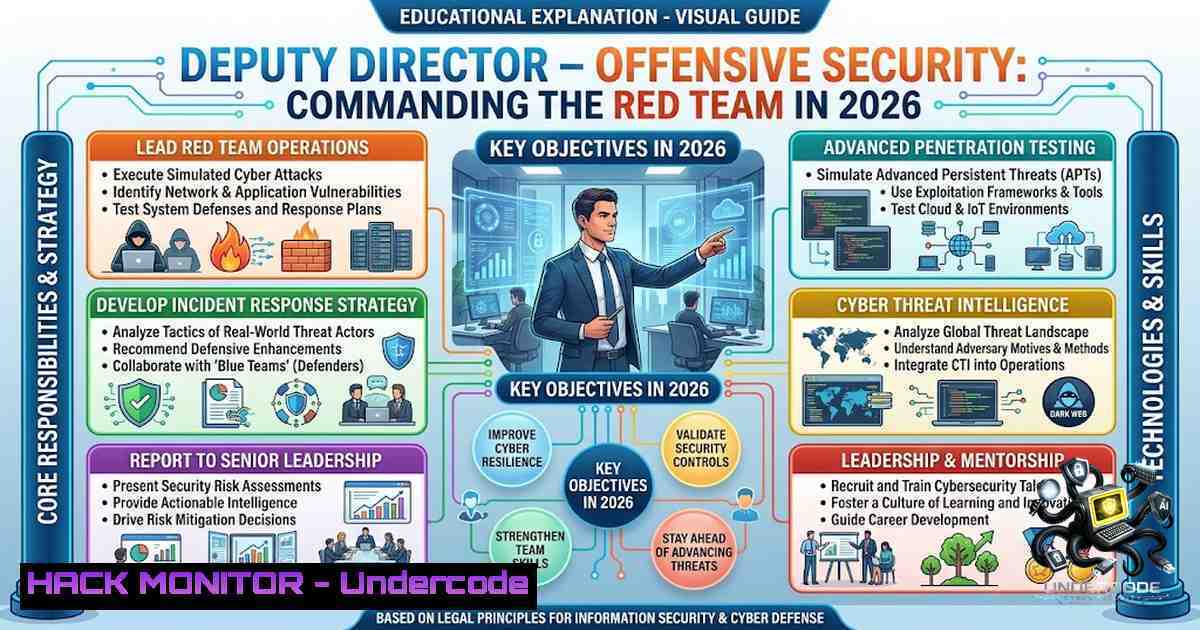
The modern offensive security landscape has evolved far beyond point-in-time penetration tests. Organizations now demand continuous adversarial validation — a shift that places the Deputy Director of Offensive Security at the helm of high-concurrency red team operations, advanced malware development, and resilient Command and Control (C2) architecture. This leadership role requires not only mastery of exploitation tooling but also the strategic vision to orchestrate simultaneous attack campaigns across disparate target networks while translating technical findings into clear business risk narratives. As highlighted in a recent professional network opportunity shared by Umair Siddiqui, Modern Data Center Solutions Architect, organizations are actively seeking experienced professionals with a minimum of five years in vulnerability management, red teaming, and penetration testing — preferably holding globally recognized certifications such as OSCP, LPT, CPENT, or C|EH.
Learning Objectives & Secrets:
- Objective 1 – Master High-Concurrency Offensive Operations: Learn to manage multiple red team engagements executing simultaneously across separate target networks or business entities. The secret lies in developing standardized playbooks and automation pipelines that enable consistent, repeatable attack execution without sacrificing operational security.
-
Objective 2 – Build Resilient C2 and Malware Infrastructure: Design and maintain Command and Control architectures that evade modern detection mechanisms. The secret tip: implement domain fronting, certificate pinning, and traffic shaping to mimic legitimate application behavior while rotating infrastructure regularly to avoid signature-based detection.
-
Objective 3 – Bridge Technical Exploitation with Strategic Communication: Translate complex attack findings into actionable intelligence for executive stakeholders. The secret tip: adopt the “red team storytelling” approach — frame every vulnerability in terms of business impact (data exfiltration potential, regulatory exposure, operational downtime) rather than technical CVSS scores alone.
You Should Know:
- Building Your Offensive Security Arsenal: Essential Tooling & Configuration
The modern offensive security professional must be proficient across an extensive toolkit. The job posting explicitly calls for expertise in Kali Linux, Metasploit, Nessus, InsightVM, Cobalt Strike, BloodHound, and Mimikatz — tools that span the entire attack lifecycle from reconnaissance to post-exploitation. Here’s how to set up and configure a professional-grade offensive security workstation:
Kali Linux Setup & Customization:
 Update Kali repositories and install core tooling
sudo apt update && sudo apt full-upgrade -y
sudo apt install metasploit-framework bloodhound neo4j cobalt-strike --fix-missing

Configure BloodHound with Neo4j database
sudo systemctl enable neo4j
sudo systemctl start neo4j
 Default credentials: neo4j/neo4j — change immediately
sudo bloodhound-setup  Interactive setup wizard

Install additional red team utilities
sudo apt install responder impacket-scripts crackmapexec evil-winrm
Metasploit Framework Optimization:
 Update Metasploit modules and exploit database
msfupdate
msfconsole -q
 Within msfconsole:
db_status  Check database connectivity
workspace -a TARGET_NAME  Create project workspace
setg RHOSTS 192.168.1.0/24  Set global target range
Cobalt Strike Team Server Setup (Linux):
 Extract and run Cobalt Strike team server
./teamserver <your-ip> <password> <c2-profile>
 Example: ./teamserver 10.0.0.5 MySecurePass123 ./Malleable-C2-Profile.profile
- Active Directory Enumeration & Attack Path Mapping with BloodHound
Active Directory remains the crown jewel of most enterprise environments. BloodHound has become the industry standard for mapping attack paths to Domain Admin. The following step-by-step guide demonstrates a complete AD enumeration workflow:
Step 1 – Install BloodHound CE and Neo4j on Kali Linux:
sudo apt install bloodhound neo4j -y
sudo systemctl start neo4j
sudo systemctl enable neo4j
 Access Neo4j browser at http://localhost:7474
 Default credentials: neo4j/neo4j — change immediately
Step 2 – Data Collection Using SharpHound (Windows) or bloodhound-python (Linux):
On a Windows domain-joined machine:
 Download and execute SharpHound
 Run as a domain user with standard privileges
SharpHound.exe -c All --zipfilename bloodhound_data
From a Linux attack machine (no domain join required):
 Using bloodhound-python with domain credentials
bloodhound-python -u 'username' -p 'password' -d domain.local -1s 192.168.1.10 -c All -zip
Step 3 – Ingest Data and Analyze Attack Paths:
 Import the ZIP file into BloodHound UI
 Navigate to http://localhost:7474 (Neo4j) then BloodHound GUI
 In BloodHound GUI: Upload Data -> Select ZIP file
Step 4 – Query for High-Value Attack Paths:
Within the BloodHound UI, use the following Cypher queries to identify critical paths:
 Find the shortest path to Domain Admin
MATCH p=shortestPath((u:User)-[1..]->(g:Group {name: "DOMAIN [email protected]"}))
RETURN p

Find all users with Kerberoastable accounts
MATCH (u:User {hasspn:true}) RETURN u

Identify computers with unconstrained delegation
MATCH (c:Computer {unconstraineddelegation:true}) RETURN c
3. Vulnerability Management & Scanning Infrastructure
The role demands proficiency with enterprise-grade vulnerability scanners including Nessus and InsightVM. Effective vulnerability management extends beyond simply running scans — it requires prioritization, validation, and remediation tracking aligned with frameworks like OWASP, ISO, NIST, and CIS.
Nessus Professional Scan Configuration (Command Line):
 Install Nessus on Kali Linux
dpkg -i Nessus-<version>-debian6_amd64.deb
sudo systemctl start nessusd
 Access https://localhost:8834

Launch a scan via Nessus CLI (nessuscli)
/opt/nessus/sbin/nessuscli scan --1ame "Internal_Network_Scan" \
--targets "192.168.1.0/24" \
--template "Internal Network Scan"
InsightVM (Rapid7) Console Management:
 PowerShell cmdlets for InsightVM automation
Connect-R7InsightVM -ConsoleUrl "https://console.insightvm.rapid7.com" -ApiKey "YOUR_API_KEY"
Start-R7Scan -SiteId 1 -ScanTemplate "Full Discovery"
Get-R7Asset -SearchCriteria "os=Windows" | Export-R7Asset -Path C:\Reports\windows_assets.csv
4. Windows and Linux Security Hardening for Defenders
Understanding how to break systems is only half the equation — offensive security leaders must also comprehend defensive postures. Here are verified hardening commands for both platforms:
Linux Hardening (Ubuntu/Debian):
 Harden SSH configuration
sudo sed -i 's/PermitRootLogin prohibit-password/PermitRootLogin no/' /etc/ssh/sshd_config
sudo sed -i 's/PasswordAuthentication yes/PasswordAuthentication no/' /etc/ssh/sshd_config
sudo systemctl restart sshd

Configure UFW firewall
sudo ufw default deny incoming
sudo ufw default allow outgoing
sudo ufw allow ssh
sudo ufw enable

Kernel hardening via sysctl
cat << EOF | sudo tee /etc/sysctl.d/99-hardening.conf
net.ipv4.ip_forward=0
net.ipv4.conf.all.rp_filter=1
net.ipv4.conf.default.rp_filter=1
net.ipv4.tcp_syncookies=1
kernel.randomize_va_space=2
EOF
sudo sysctl -p /etc/sysctl.d/99-hardening.conf

Disable unnecessary services
sudo systemctl disable --1ow bluetooth.service
sudo systemctl disable --1ow cups.service
Windows Hardening (PowerShell as Administrator):
 Disable default Administrator account
net user administrator /active:no

Configure Windows Defender Firewall
New-1etFirewallRule -DisplayName "Block RDP from Untrusted" -Direction Inbound -Protocol TCP -LocalPort 3389 -Action Block -RemoteAddress "0.0.0.0/0"

Enable Windows Defender Application Control
 Requires Windows 10/11 Enterprise or Education
Set-MpPreference -EnableControlledFolderAccess Enabled
Set-MpPreference -AttackSurfaceReductionRules_Ids 75668C1F-73B5-4CF0-BB93-3ECF5CB7CC84 -AttackSurfaceReductionRules_Actions Enabled

Audit and remove insecure protocols
Disable-WindowsOptionalFeature -Online -FeatureName SMB1Protocol
Set-ItemProperty -Path "HKLM:\SYSTEM\CurrentControlSet\Control\SecurityProviders\SCHANNEL\Protocols\TLS 1.0\Server" -1ame "Enabled" -Value 0
- Web Application Security Testing: OWASP Top 10 & Beyond
The job posting explicitly requires knowledge of web application vulnerabilities including SQL Injection, XSS, and other attack vectors. OWASP provides the definitive framework for application security testing.
SQL Injection Testing with SQLMap:
 Basic SQLMap enumeration
sqlmap -u "http://target.com/page?id=1" --dbs --batch

Advanced with cookie authentication and level/risk escalation
sqlmap -u "http://target.com/api/search" --data "query=test" --cookie "SESSION=abc123" --level 3 --risk 2 --os-shell
Cross-Site Scripting (XSS) Discovery with Custom Payloads:
 Using Burp Suite Intruder or manual payload crafting
 Basic reflective XSS test:
http://target.com/search?q=<script>alert('XSS')</script>

DOM-based XSS detection with browser console:
document.querySelector('input').value = '<img src=x onerror=alert(1)>'
OWASP ZAP Automated Scanning (Headless):
 Run ZAP in headless mode for CI/CD integration
zap-cli quick-scan --self-contained --start-options '-config api.disablekey=true' \
-t "https://target.com" -s "xss,sqli,csrf"
6. Framework Alignment: OWASP, ISO, NIST, and CIS
A Deputy Director must navigate multiple security frameworks simultaneously. Here’s how they map to offensive security operations:
- OWASP (Open Web Application Security Project): Focuses on application-layer risks. Use OWASP ASVS (Application Security Verification Standard) as a testing checklist for web and mobile applications.
- NIST Cybersecurity Framework (CSF 2.0): Organizes security work around five functions: Identify, Protect, Detect, Respond, Recover. Red team findings should map directly to gaps in these functions.
- CIS Controls (v8): Provides prioritized security measures from basic (asset inventory) to advanced (penetration testing). CIS Control 20 specifically addresses penetration testing and red team exercises.
- ISO/IEC 27001: The international standard for information security management. Offensive security reports should map findings to specific Annex A controls for compliance reporting.
7. Mobile Security Testing: Android & iOS
The role requires proficiency in Android and iOS security testing. Mobile application testing introduces unique challenges including certificate pinning, runtime application self-protection (RASP), and platform-specific sandboxing.
Android Testing Setup:
 Install Android SDK tools
sudo apt install android-sdk

Enable USB debugging on device and connect
adb devices
adb install app-debug.apk

Use Drozer for Android security assessment
drozer console connect
 Within Drozer:
run app.package.list -f target_app
run app.package.info -a com.target.app
run app.activity.info -a com.target.app
iOS Testing (Requires macOS or jailbroken device):
 Use objection for runtime exploration
objection -g "com.target.app" explore

Within objection:
ios ui dump  View all UI elements
ios hooking watch class_methods "ViewController" --dump-args
What Undercode Say:
- Key Takeaway 1 – Certifications Remain the Gatekeeper: The OSCP (now OSCP+ with mandatory three-year renewal) remains the most respected practical penetration testing certification in the industry. Candidates with OSCP or LPT Master receive preference — a clear signal that hands-on, exam-based validation trumps theoretical knowledge alone.
-
Key Takeaway 2 – The Automation-First Mandate: Modern offensive security is shifting toward an automation-first and AI-enabled operating model that scales penetration testing, adversary emulation, and continuous security validation. The Deputy Director must not only execute attacks but also build systems that enable continuous, repeatable testing at scale.
-
Analysis: The job market for offensive security leadership is consolidating around a specific skill set: deep technical proficiency across the full attack chain (recon → exploitation → persistence → exfiltration), combined with the strategic capability to manage multiple concurrent operations and communicate effectively with non-technical stakeholders. The emphasis on frameworks (OWASP, ISO, NIST, CIS) signals that organizations expect offensive security leaders to bridge the gap between technical hacking and regulatory compliance. The growing importance of mobile security testing and cloud-1ative environments suggests that tomorrow’s red team leaders must expand their expertise beyond traditional Windows/Linux and web application testing. Finally, the shift toward continuous validation models — moving away from annual point-in-time penetration tests — represents a fundamental change in how organizations approach security assurance.
Prediction:
-
+1 The offensive security leadership role will increasingly require AI literacy as automated penetration testing tools and AI-assisted red teaming become mainstream. Professionals who embrace AI-enabled operating models will command premium compensation and accelerated career progression.
-
+1 The OSCP+ certification’s new Active Directory set and three-year renewal requirement will drive demand for continuous upskilling, creating a thriving ecosystem of training providers, lab platforms, and certification preparation services.
-
-1 Organizations that fail to adopt continuous adversarial validation models will face increasing breach risks as attackers automate their reconnaissance and exploitation at scale. The gap between annual penetration tests and real-world attack timelines will widen dangerously.
-
-1 The convergence of offensive security with compliance frameworks (NIST CSF, ISO 27001, CIS Controls) may create tension between “check-the-box” compliance activities and genuine security improvement. Leaders must resist the temptation to prioritize framework alignment over actual risk reduction.
-
+1 Mobile security testing expertise will become a differentiator as enterprise mobile device adoption continues to grow. Android and iOS security specialists will find themselves in high demand across financial services, healthcare, and government sectors.
▶️ Related Video (86% Match):
https://www.youtube.com/watch?v=0Lx9mkPsAt0
🎯Let’s Practice For Free:
🎓 Live Courses & Certifications:
Join Undercode Academy for Verified Certifications
🚀 Request a Custom Project:
Secure, high-velocity infrastructure and disruptive technological engineering. Contact our engineering team for high-tier development and proprietary systems:
[email protected]
💎 Smart Architecture | 🛡️ Secure by Design | ⭐ Trusted by Thousands
IT/Security Reporter URL:
Reported By: https://lnkd.in/p/e4NiTAsR – Hackers Feeds
Extra Hub: Undercode MoN
Basic Verification: Pass ✅


