Listen to this Post
Introduction
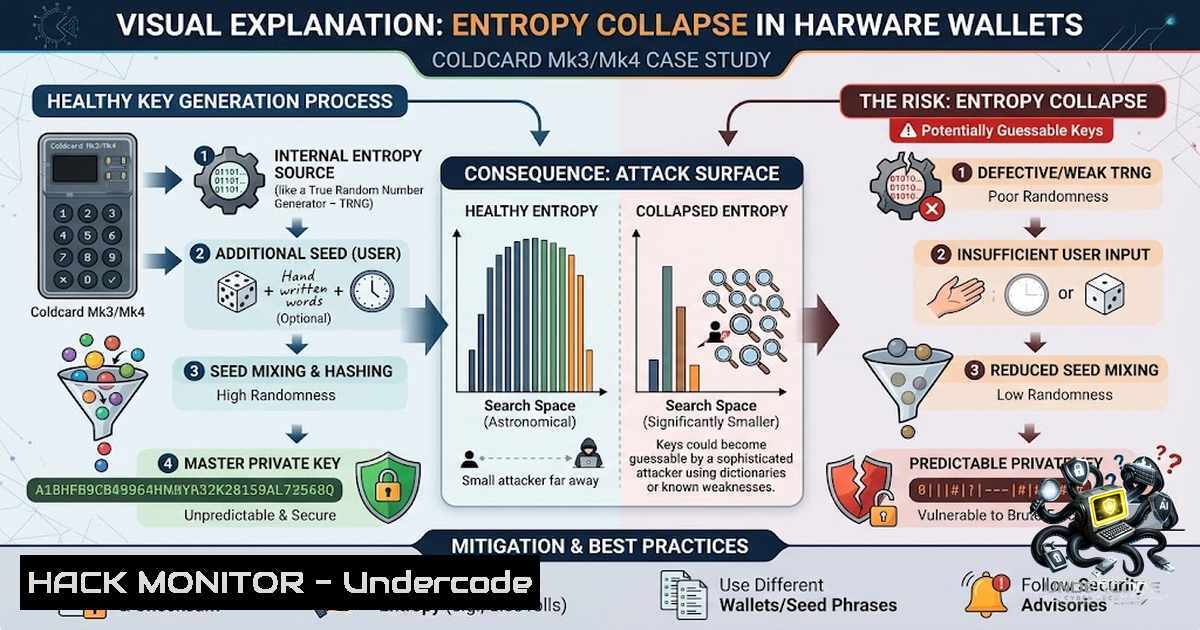
On July 30, 2026, the Bitcoin world was shaken when Coldcard hardware wallets—widely regarded as the gold standard for Bitcoin self-custody—began leaking funds en masse. The culprit was not a physical compromise, a supply chain attack, or a stolen seed phrase. It was a firmware bug that had quietly undermined the cryptographic foundation of wallet generation since March 2021, reducing effective entropy from 128 bits to as little as 40 bits. Over 1,596 BTC (approximately $130 million) was drained from more than 7,300 addresses across four attack waves. The attackers reconstructed private keys from predictable seeds using AI-assisted cryptanalysis tools—without ever touching a single hardware device.
Learning Objectives & Secrets
- Objective 1: Understand the Root Cause of the Coldcard Entropy Bug — Learn how a build configuration error (
MICROPY_HW_ENABLE_RNG = 0) combined with a linker-level symbol resolution flaw caused the device to fall back to a deterministic software PRNG (Yasmarang) instead of the STM32 hardware TRNG. This effectively made every seed generated on affected firmware the output of a predictable function of the device’s serial number, SysTick phase, and RTC registers—not 256 bits of hardware entropy. -
Objective 2 Secret Tip: Validate Entropy with Physical Dice Rolls — The safest mitigation against RNG flaws is to inject independent physical entropy. Coldcard officially recommends at least 50 independent dice rolls during seed generation, which provides approximately 2.5 bits of entropy per roll (125 bits total when combined with the device’s output). Use the dice-to-seed conversion tool available in Coldcard’s advanced menu to verify the device correctly converts die faces into a BIP-39 seed phrase.
-
Objective 3 Secret Tip: Never Trust “Update Only” — Always Migrate — Firmware updates (v5.6.0 for Mk4/Mk5, v4.2.0 for Mk3, v1.5.0Q for Q models) patch the vulnerability for future seed generation. However, updating firmware does not fix seeds already generated on vulnerable firmware. Those seeds remain compromised regardless of what firmware you’re running. The only safe action is a complete wallet migration: generate a new seed on patched firmware with added dice entropy, and move all funds to wallets derived from that new seed.
You Should Know
- How the Coldcard Entropy Vulnerability Works (Step‑by‑Step Technical Deep Dive)
The Coldcard Mk3/Mk4 vulnerability is a textbook case of how a single build configuration error can cascade into a catastrophic security failure. Here’s what happened under the hood:
Step 1: The Intended Flow — When a user selects “New Wallet,” the Coldcard firmware runs shared/seed.py:
seed = random.bytes(32)  32 bytes of randomness
assert len(set(seed)) > 4  sanity check: >4 distinct byte values
seed = ngu.hash.sha256s(seed)  compress to final 32-byte seed
This seed becomes a 24-word BIP-39 phrase from which all wallet keys are derived. The `random.bytes` function was an alias for `ngu.random.bytes` (libngu), which repeatedly calls a global C function: rng_get().
Step 2: The Linker-Level Mistake — The Mk3 hardware (STM32L475) has a true hardware RNG. The board code in `stm32/COLDCARD/rng.c` reads it—but as a `static` function (rng_get_or_fault()), invisible to the linker outside that file. Meanwhile, the Mk3 build deliberately set MICROPY_HW_ENABLE_RNG = 0, telling MicroPython “this board has no hardware RNG”. MicroPython’s `ports/stm32/rng.c` then compiled in a global `rng_get()` fallback—a deterministic software PRNG (Yasmarang).
Step 3: The Result — At link time, libngu’s call to `rng_get()` resolved to MicroPython’s software PRNG fallback, not the hardware TRNG. The PRNG was seeded once from the device’s unique-ID word, the SysTick phase, and raw RTC registers. Every Mk3 wallet seed generated on affected firmware became the output of a deterministic function of a small, partially-knowable state—not 256 bits of hardware entropy.
Step 4: Entropy Collapse by Model — Coinkite’s post-incident analysis estimated effective entropy as follows:
– Mk2/Mk3 (firmware 4.0.1–4.1.9): ~40 bits of effective entropy
– Mk4/Mk5/Q (pre-patch): ~72 bits of effective entropy
– Expected/Standard: 128 bits
Step 5: Attack Execution — With entropy reduced to 40 bits (approximately 1 trillion possible combinations), attackers could brute-force private keys using modern GPU clusters or AI-assisted cryptanalysis tools. TRM Labs reported that attackers did not need physical access to devices; by reconstructing affected seeds, they derived corresponding private keys and signed transactions on other systems.
Step 6: Fix Implementation — The patched firmware versions (v4.2.0 for Mk3, v5.6.0 for Mk4/Mk5, v1.5.0Q for Q) restore the hardware TRNG path. The fix ensures `MICROPY_HW_ENABLE_RNG` is properly enabled and the linker resolves `rng_get()` to the hardware RNG function.
- How to Verify Your Coldcard’s Seed Generation Integrity
Given that simply trusting the device is no longer sufficient, here’s a step‑by‑step guide to independently verify that your Coldcard is generating truly random seeds:
Step 1: Check Your Firmware Version — Navigate to Settings > Advanced > Version Info on your Coldcard. If your firmware version falls within the affected ranges, treat any existing seed as compromised:
– Mk3: 4.0.1 through 4.1.9
– Mk4/Mk5: pre-5.6.0
– Q: pre-1.5.0Q
Step 2: Generate a New Seed with Dice Entropy — Update to the latest patched firmware first. Then, when generating a new wallet, use the Dice Roll feature (available in Coldcard’s advanced menu):
– Roll a physical die at least 50 times (more is better)
– Enter each roll result into the Coldcard
– The device combines your dice entropy with its internal RNG output
– Each dice roll provides approximately 2.5 bits of true physical entropy
Step 3: Verify the Seed with an Independent Tool — Use an offline, air-gapped computer to verify that the seed phrase generated by your Coldcard maps to the expected master public key (xpub). Tools like `seedtool` (available on GitHub) can perform this verification without exposing your private keys to the internet.
Step 4: Add a BIP-39 Passphrase — Even with dice entropy, add a strong, unique BIP-39 passphrase (25th word). This acts as an additional layer of entropy independent of the device’s RNG.
Step 5: Migrate All Funds — Once you’ve generated and verified your new seed with dice entropy, transfer all Bitcoin from old addresses to new addresses derived from the new seed. Do not simply update firmware and continue using the same seed.
- How Attackers Used AI to Exploit Low-Entropy Seeds
The Coldcard hack represents a paradigm shift in crypto-crime: attackers leveraged AI tools to scale what would otherwise be computationally infeasible brute-force attacks. Here’s the technical breakdown:
The Math — A 40-bit entropy space contains approximately 1.099 trillion possible combinations. While this is far too large for a single CPU to brute-force, modern GPU clusters can test billions of combinations per second. AI-assisted cryptanalysis tools further optimize the search by:
– Training models on known weak RNG patterns
– Predicting likely seed generation states based on device metadata (serial numbers, timestamps)
– Parallelizing key derivation across thousands of GPU cores
AI Tooling in the Wild — Security researchers have documented AI-powered crypto-theft campaigns using tools like GitHub Copilot and Claude Code to speed up malicious app development and automate attack infrastructure. In one case, an attacker used a jailbroken instance of Google Gemini to crack WordPress credentials and drain cryptocurrency wallets.
The Lesson for Defenders — AI did not create new attack vectors; it automated and scaled existing ones. The Coldcard hack succeeded because the underlying entropy was weak—not because AI broke cryptography. As one security researcher noted: “Brute-force against properly generated keys is computationally infeasible at any realistic scale”. The vulnerability was always there; AI just made exploitation practical.
- How to Harden Your Bitcoin Self-Custody Setup Against RNG Failures
The Coldcard incident demonstrates that “Not your keys, not your coins” is only half the story. The other half is: “Not your entropy, not your security.” Here’s a comprehensive hardening guide:
Linux Command: Check System Entropy Available — On Linux systems, verify the available entropy before generating any cryptographic keys:
 Check available entropy in bits
cat /proc/sys/kernel/random/entropy_avail

Generate 256 bits of random data using /dev/urandom (acceptable for most uses)
dd if=/dev/urandom of=random.bin bs=1 count=32 2>/dev/null | xxd -p

For high-security seed generation, use hardware RNG if available
cat /dev/hwrng | head -c 32 | xxd -p
Windows Command: Verify Randomness Quality — On Windows, use PowerShell to generate cryptographically secure random bytes:
 Generate 32 random bytes using Windows Cryptography API
$rng = New-Object System.Security.Cryptography.RNGCryptoServiceProvider
$bytes = New-Object byte[] 32
$rng.GetBytes($bytes)
[System.BitConverter]::ToString($bytes) -replace '-',''
Multi-Device Entropy Generation — For maximum security, consider splitting entropy generation across multiple independent devices:
1. Generate 16 bytes of entropy on Device A (Coldcard)
2. Generate 16 bytes of entropy on Device B (Trezor or another hardware wallet)
3. Combine both outputs using XOR or SHA-256 to create a 32-byte seed
4. This eliminates single-device RNG failure as a point of compromise
Physical Entropy Methods — The Bitcoin community has embraced physical entropy methods post-Coldcard:
– Dice rolling: Roll 50+ times and use the Coldcard’s dice-to-seed conversion
– Paper shuffling: Print the BIP-39 word list, cut into individual words, shuffle thoroughly, and randomly select 24 words
– Coin flips: 256 coin flips provide 256 bits of pure physical entropy
Verification — Always verify your seed phrase using an offline tool before depositing significant funds. The goal is to make seed generation as independently verifiable as every other part of your self-custody workflow.
- How to Perform a Coldcard Firmware Update and Wallet Migration (Complete Guide)
This is the critical action required for all Coldcard users:
Step 1: Download the Patched Firmware — Download the appropriate firmware from Coldcard’s official GitHub repository (github.com/Coldcard/firmware):
– Mk3: v4.2.0
– Mk4/Mk5: v5.6.0
– Q: v1.5.0Q
Step 2: Verify the Firmware Signature — Before installing, verify the PGP signature of the firmware binary to ensure it hasn’t been tampered with:
 Download the firmware and signature
wget https://coldcard.com/downloads/coldcard-v5.6.0.dfu
wget https://coldcard.com/downloads/signatures.txt

Import Coldcard's public key and verify
gpg --verify signatures.txt coldcard-v5.6.0.dfu
Step 3: Install the Firmware — Copy the `.dfu` file to a microSD card, insert it into the Coldcard, and follow the on-screen update instructions.
Step 4: Generate a New Seed with Dice Entropy — After updating, generate a completely new seed using the dice-roll method (50+ rolls minimum).
Step 5: Record and Secure the New Seed — Write down the new 24-word seed phrase and BIP-39 passphrase (if used) on metal backup plates. Store them in separate secure locations.
Step 6: Migrate Funds — Use a wallet interface (e.g., Electrum, Sparrow Wallet) connected to your Coldcard to:
1. Get receive addresses from your new wallet
- Send all funds from old addresses to new addresses
- Important: Transfer in multiple transactions if dealing with large amounts to reduce risk
Step 7: Verify the Migration — After all funds are moved, use a blockchain explorer to confirm the old addresses are empty and the new addresses hold the correct balance.
Step 8: Destroy Old Seeds — Once migration is confirmed, securely destroy any backups of the old seed phrase.
- How to Audit Your Own Hardware Wallet’s RNG Implementation
The Coldcard incident exposed a fundamental gap in hardware wallet security audits: auditors verified the presence of a TRNG but never confirmed that production firmware actually used it. Here’s how you can independently audit your wallet’s RNG:
Step 1: Review the Source Code — For open-source wallets like Coldcard, review the build configuration:
– Look for macros like `MICROPY_HW_ENABLE_RNG`
– Trace the `random.bytes()` function call chain through the codebase
– Verify the linker resolves symbols to hardware RNG functions, not software fallbacks
Step 2: Reproducible Builds — Coldcard supports reproducible builds, allowing you to compile the firmware from source and verify the binary matches the official release:
git clone https://github.com/Coldcard/firmware.git
cd firmware
git checkout <specific-version-tag>
cd stm32
make -f MK4-Makefile repro
If the build produces the same bytes as the official binary, you have cryptographic proof that the source code matches the running firmware.
Step 3: Statistical RNG Testing — Generate 10,000+ seeds from your device and run statistical tests (NIST SP 800-22, Dieharder) to detect patterns or biases. This is a practical check for entropy quality.
Step 4: Independent Third-Party Audits — Kraken CSO Nick Percoco noted that “the industry needs an audit of the full path—from the randomness source to the production firmware that creates the seed phrase”. Demand this level of audit from your wallet manufacturer.
7. Key Commands for Bitcoin Wallet Security Verification
Linux – Verify BIP-39 Seed Phrase Checksum:
 Install seedtool or use bip39 utility
pip install mnemonic
python3 -c "from mnemonic import Mnemonic; m = Mnemonic('english'); print(m.check('your 24 word seed phrase'))"
Linux – Generate a Seed Using Physical Dice Input:
 Convert dice rolls (1-6) to entropy using a simple script
echo "4 2 6 1 3 5 ..." | tr -d ' ' | \
python3 -c "import sys, hashlib, binascii; \
rolls = sys.stdin.read().strip(); \
entropy = int(rolls, 6).to_bytes(32, 'big'); \
print(binascii.hexlify(hashlib.sha256(entropy).digest()).decode())"
Windows – Verify Wallet Integrity with PowerShell:
 Compute SHA-256 hash of your seed file
Get-FileHash -Path C:\seed_backup.txt -Algorithm SHA256

Generate cryptographically secure random bytes for comparison
$rng = New-Object System.Security.Cryptography.RNGCryptoServiceProvider
$bytes = New-Object byte[] 32
$rng.GetBytes($bytes)
[System.BitConverter]::ToString($bytes) -replace '-',''
Coldcard-Specific – Verify Dice Roll Conversion:
On the Coldcard device itself, use the Dice Roll feature in the advanced menu. The device will display the SHA-256 hash of the combined entropy, allowing you to verify the conversion manually using an offline tool.
What Undercode Say
- Key Takeaway 1: “Not your keys, not your coins” is incomplete. The Coldcard hack proves that owning your private keys is meaningless if those keys were generated from predictable entropy. The full maxim should be: “Not your keys, not your entropy, not your security.” Self-custody requires control over both the generation and storage of keys.
-
Key Takeaway 2: Air-gapping alone does not guarantee security. Many Coldcard victims, including Jonathan Goodman who lost 18.25 BTC, stored their devices in safe deposit boxes and never connected them to the internet. Yet their funds were stolen because the seed generation was compromised before the device was ever used. Air-gapping protects against transmission attacks but does nothing to protect against generation flaws.
-
Key Takeaway 3: AI is a force multiplier for existing vulnerabilities. The Coldcard attackers used AI-assisted cryptanalysis to brute-force 40-bit entropy spaces at scale. AI did not create new attack vectors; it automated and accelerated the exploitation of known weaknesses. Security practitioners must assume that any vulnerability with <80 bits of entropy is practically exploitable with modern AI/GPU resources.
-
Key Takeaway 4: Physical entropy is the ultimate backstop. Users who generated seeds with independent dice rolls were unaffected by the Coldcard hack. Physical entropy methods (dice, coins, shuffled word lists) provide verifiable, independent randomness that cannot be compromised by a firmware bug. Every hardware wallet user should adopt these methods as standard practice.
-
Key Takeaway 5: Updates are not fixes—migration is the fix. Coldcard was explicit that firmware updates only prevent future vulnerable seeds. Existing seeds remain compromised regardless of firmware version. The only safe action is a complete wallet migration: generate a new seed with independent entropy and move all funds. This is a critical lesson for all hardware wallet users—never assume a patch retroactively secures your existing keys.
Prediction
- +1 The Coldcard incident will accelerate the adoption of physical entropy standards in hardware wallet manufacturing. Expect future devices to include built-in dice-roll interfaces, hardware-based entropy verification displays, and mandatory user-injected randomness during initial setup.
-
+1 Regulatory bodies and insurance providers will begin mandating independent RNG audits for custody solutions. The Kraken CSO’s call for “full-path auditing”—from randomness source to production firmware—will become industry standard.
-
-1 AI-powered cryptanalysis will continue to erode the security margin of any system with weak entropy. The Coldcard hack is likely the first of many such incidents as attackers deploy AI tools against other hardware wallets, password managers, and cryptographic systems with implementation flaws.
-
-1 User trust in hardware wallets will suffer a long-term decline. The Coldcard hack affected the most trusted name in Bitcoin hardware wallets. If Coldcard—with its open-source code, air-gapped design, and Bitcoin-only focus—can have a five-year undetected entropy bug, no hardware wallet is immune.
-
+1 The incident will drive innovation in verifiable randomness generation. Expect new open-source tools and hardware devices focused exclusively on generating and verifying cryptographic entropy, decoupling randomness generation from wallet firmware entirely.
-
-1 The estimated $130 million loss may be just the beginning. As victims continue to discover their funds missing and as more addresses are brute-forced, the total damage could exceed $200 million. Over 5,200 addresses were drained across four waves, and multiple attackers may still be exploiting the vulnerability.
-
+1 The Bitcoin community’s response—rallying to help victims and sharing technical solutions—demonstrates the resilience of decentralized ecosystems. The international effort to migrate funds to safe wallets【post content】 proves that community-driven security can mitigate even the most severe technical failures.
▶️ Related Video (88% Match):
https://www.youtube.com/watch?v=-3tgUmkO2s8
🎯Let’s Practice For Free:
🎓 Live Courses & Certifications:
Join Undercode Academy for Verified Certifications
🚀 Request a Custom Project:
Secure, high-velocity infrastructure and disruptive technological engineering. Contact our engineering team for high-tier development and proprietary systems:
[email protected]
💎 Smart Architecture | 🛡️ Secure by Design | ⭐ Trusted by Thousands
IT/Security Reporter URL:
Reported By: https://lnkd.in/p/eTA3W9pq – Hackers Feeds
Extra Hub: Undercode MoN
Basic Verification: Pass ✅


