Listen to this Post
Introduction:
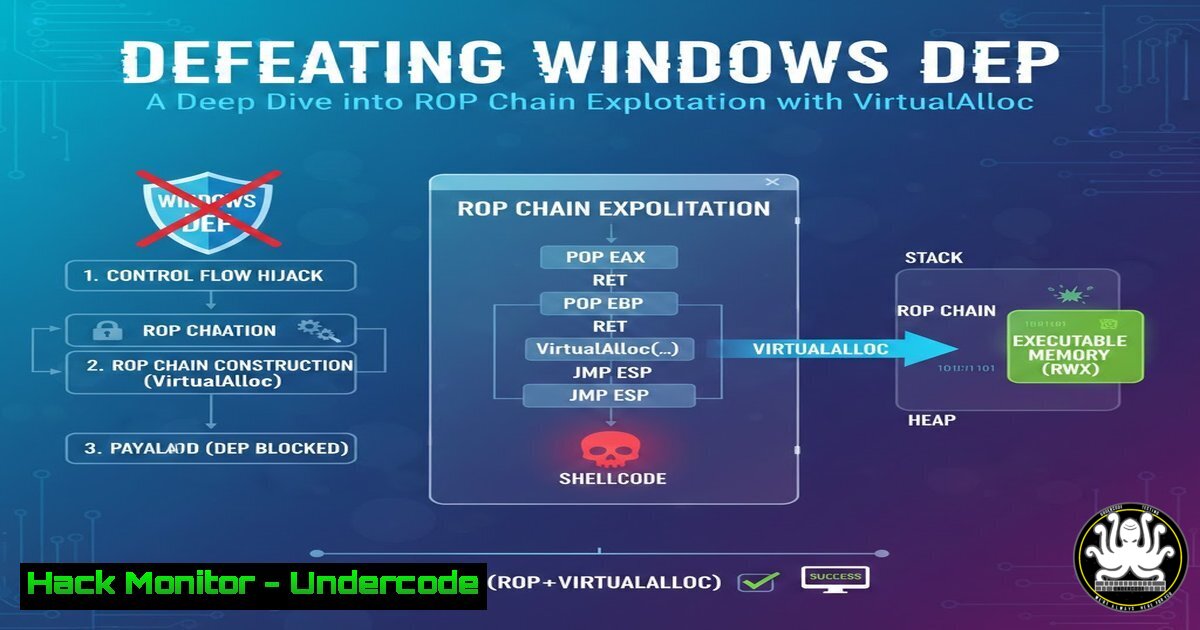
Data Execution Prevention (DEP) is a critical Windows security mechanism that marks memory pages as non-executable, preventing attackers from running shellcode directly on the stack or heap. To bypass this, exploit developers must employ Return-Oriented Programming (ROP), a technique that chains together small sequences of existing code (gadgets) ending in a `ret` instruction to manipulate program execution. This article dissects a proven method for defeating DEP by leveraging ROP chains to call VirtualAlloc, creating a new executable memory region where shellcode can be safely placed and executed. Based on hands-on experience from the OffSec OSED (EXP-301) certification, this guide provides a technical roadmap for understanding and implementing this advanced exploitation technique.
Learning Objectives:
- Understand the fundamental principles of Data Execution Prevention (DEP) and its role in memory protection.
- Learn how to construct and debug Return-Oriented Programming (ROP) chains to bypass DEP.
- Master the technique of leveraging the `VirtualAlloc` API to create executable memory and redirect execution flow.
You Should Know:
- Understanding the Target Vulnerability and DEP Bypass Strategy
Before building a ROP chain, you must analyze the vulnerable application. For this demonstration, assume we have a classic stack-based buffer overflow in a Windows application that is compiled with DEP enabled (but not Address Space Layout Randomization, or ASLR). Our goal is to overwrite the instruction pointer (EIP/RIP) and redirect execution to our ROP chain. Instead of jumping directly to shellcode on the stack (which is non-executable), we will use a ROP chain to call VirtualAlloc.
`VirtualAlloc` is a Windows API function that allows a process to allocate or reserve a region of memory. Crucially, we can specify `PAGE_EXECUTE_READWRITE` (0x40) as the protection flag, creating a memory region that is both writable and executable. We will then copy our shellcode into this new region and redirect execution to it.
Step‑by‑step guide:
- Crash the Application and Control EIP: Fuzz the application to find the exact offset that overwrites the return address. Tools like a custom Python script with `pattern_create` and `pattern_offset` (from Metasploit) are essential.
Example command (Linux):
/usr/share/metasploit-framework/tools/exploit/pattern_create.rb -l 5000
Example command (Windows with Mona):
!mona pattern_offset 0x316a4230
- Verify DEP Status: Use a debugger like WinDbg or x64dbg to check the DEP status of the process.
Command in WinDbg:
!process 0 0 vulnerable_process.exe
Look for flags indicating DEP is enabled. Alternatively, use a tool like `Process Explorer` to view the DEP policy of the running process.
- Locate a Pointer to
VirtualAlloc: In a non-ASLR module (e.g., the vulnerable executable or a specific system DLL loaded at a static address), find the address ofVirtualAlloc. This address will be used in our ROP chain to call the function. Mona can help list all modules without ASLR and find their imported functions.
Mona command:
!mona modules
!mona find -s "VirtualAlloc" -m non_aslr_module.dll
2. Constructing the ROP Chain to Invoke VirtualAlloc
The core of the exploit is the ROP chain. We need to place the arguments for `VirtualAlloc` onto the stack and then call it. The function prototype is:
LPVOID VirtualAlloc(
LPVOID lpAddress, // Address to allocate (let's use 0x00400000, a common neutral address)
SIZE_T dwSize, // Size of memory region (enough for shellcode, e.g., 0x1000)
DWORD flAllocationType, // Type of allocation (0x3000 = MEM_COMMIT | MEM_RESERVE)
DWORD flProtect // Protection (0x40 = PAGE_EXECUTE_READWRITE)
);
In a 32-bit system (standard for OSED), arguments are pushed onto the stack before the function call. With ROP, we use gadgets to pop these values into registers or directly onto the stack.
Step‑by‑step guide to building the chain:
- Find ROP Gadgets: Use a tool like `rp++` (Linux) or Mona (Windows with Immunity Debugger) to find gadgets within the non-ASLR module.
Example `rp++` command to find `pop` gadgets:
rp-lin-x86 -f /path/to/non_aslr_module.dll --unique -r 5 > gadgets.txt
Search for sequences like POP EAX; RET, POP EBX; RET, etc.
- Structure the Chain: A typical ROP chain to call `VirtualAlloc` looks like this in memory:
– Gadget 1: `POP EAX; RET` (Address: 0x1001122c)
– Value to pop: Address of `VirtualAlloc` (e.g., 0x7c809ae1)
– Gadget 2: `MOV
, EAX; RET` (Find a gadget that moves EAX into a register that will be used for the call, or directly into a memory location if needed. A simpler approach is to push EAX onto the stack and then `RET` to it, but we'll build the stack frame correctly.)
- Alternative common method (using <code>PUSHAD</code>): A more efficient way is to use a `PUSHAD` gadget, which pushes all general-purpose registers onto the stack, and then adjust the stack pointer to point to our arguments. However, for clarity, we'll simulate a standard call.
- Stack Setup: We need to place the 4 arguments and the return address for `VirtualAlloc` on the stack.
- Return Address for VirtualAlloc: This should be the address of another gadget that will redirect execution to our shellcode (e.g., `MOV ESP, EBP; POP EBP; RET` or just <code>JMP ESP</code>).
- Argument 1 (lpAddress): 0x00400000 (or a suitable address)
- Argument 2 (dwSize): 0x1000
- Argument 3 (flAllocationType): 0x3000
- Argument 4 (flProtect): 0x40

<ol>
<li>Crafting the Final Exploit Buffer: The buffer will be: <code>[JUNK A's to EIP] + [ADDRESS OF GADGET 1] + [ADDRESS OF VirtualAlloc] + [ADDRESS OF GADGET THAT SETS UP STACK/CALL] + [RETURN ADDR FOR VirtualAlloc] + [bash] + [bash] + [bash] + [bash] + [NOPSled + Shellcode]</code>.</li>
</ol>

<h2 style="color: yellow;">3. Testing and Debugging the ROP Chain</h2>

Debugging ROP chains is meticulous. You must ensure the stack pointer (ESP) is correctly aligned after each gadget and that the arguments are in the right place when `VirtualAlloc` is invoked. A single misaligned value will cause a crash.

<h2 style="color: yellow;">Step‑by‑step guide to debugging with x64dbg:</h2>

<ol>
<li>Set a Hardware Breakpoint on Access: After the overflow occurs and execution lands at the start of your ROP chain, set a hardware breakpoint on the `RET` instruction of your first gadget. This allows you to step through the chain one gadget at a time.</li>
<li>Monitor ESP and Registers: Use the `d esp` command to watch the stack. As you step through each <code>RET</code>, observe how values are popped off the stack and how the stack pointer moves.</li>
<li>Verify `VirtualAlloc` Call: When you reach the point where `VirtualAlloc` is about to be called, pause and verify the arguments in the debugger. They should be at the top of the stack or in the correct registers.</li>
</ol>

<h2 style="color: yellow;">Example check in WinDbg:</h2>

[bash]
 Assuming arguments are on the stack
dd esp L5
This displays the top 5 DWORDs on the stack, which should be the return address and the four arguments.
- Test with a Breakpoint Shellcode: Initially, replace your real shellcode with a simple breakpoint instruction (
\xCC). When execution jumps to the newly allocated executable memory, the program should hit the breakpoint and pause. This confirms that `VirtualAlloc` succeeded and execution was redirected correctly.
4. Mitigation and Modern Defense Considerations
While this article focuses on exploitation, understanding the defense is equally crucial for a comprehensive security posture. Modern Windows versions include several mitigations that make this exact technique more difficult.
Step‑by‑step guide to hardening applications:
- Enable ASLR: Ensure all modules in your application are compiled with `/DYNAMICBASE` (for MSVC). This randomizes the base addresses of DLLs and executables, making it impossible for an attacker to reliably find gadgets without an information leak first.
Compiler flag (Visual Studio):
/DYNAMICBASE
- Enable Control Flow Guard (CFG): CFG adds checks at indirect call sites to verify the target address is a valid function, preventing calls to gadgets.
Compiler flag (Visual Studio):
/guard:cf
- Enable Arbitrary Code Guard (ACG) and other mitigations: ACG prevents the creation of executable memory pages after a process starts, directly defeating the `VirtualAlloc` technique. This is a key component of Windows Defender Exploit Guard (WDEG).
What Undercode Say:
- Key Takeaway 1: DEP is not a silver bullet. The `VirtualAlloc` ROP technique demonstrates that memory protections can be systematically bypassed by chaining existing code, highlighting the importance of understanding low-level system internals for both offense and defense.
- Key Takeaway 2: The OSED (EXP-301) certification and its practical, hands-on approach are invaluable for developing a deep, intuitive understanding of exploit development. The ability to craft and debug a ROP chain is a fundamental skill that separates script kiddies from professional penetration testers and security researchers.
The analysis of Edo Maland’s post reveals a growing, global appetite for advanced Windows exploitation knowledge that transcends language barriers. His effort to provide both Indonesian and English resources underscores a crucial point: the cybersecurity community thrives on shared, technical deep-dives. The focus on bypassing core OS protections like DEP via ROP chains is not just an academic exercise; it is a direct simulation of how sophisticated adversaries operate. For defenders, understanding this process is the first step toward implementing layered defenses like CFG and ACG. For attackers, it is a reminder that modern exploitation requires a mastery of system internals, not just reliance on automated tools.
Prediction:
As endpoint detection and response (EDR) solutions become more adept at detecting simple ROP chains, we will see a shift toward more sophisticated evasion techniques. Future exploitation research will focus on “ROP without ROP” (using call-oriented programming) and leveraging edge-case CPU instructions to blend in with normal program behavior. Additionally, the integration of machine learning for gadget discovery and chain generation will lower the barrier to entry for complex bypasses, forcing a new arms race in exploit mitigation technologies.
▶️ Related Video (84% Match):
🎯Let’s Practice For Free:
IT/Security Reporter URL:
Reported By: Edomaland Maland – Hackers Feeds
Extra Hub: Undercode MoN
Basic Verification: Pass ✅


