Listen to this Post
Introduction:
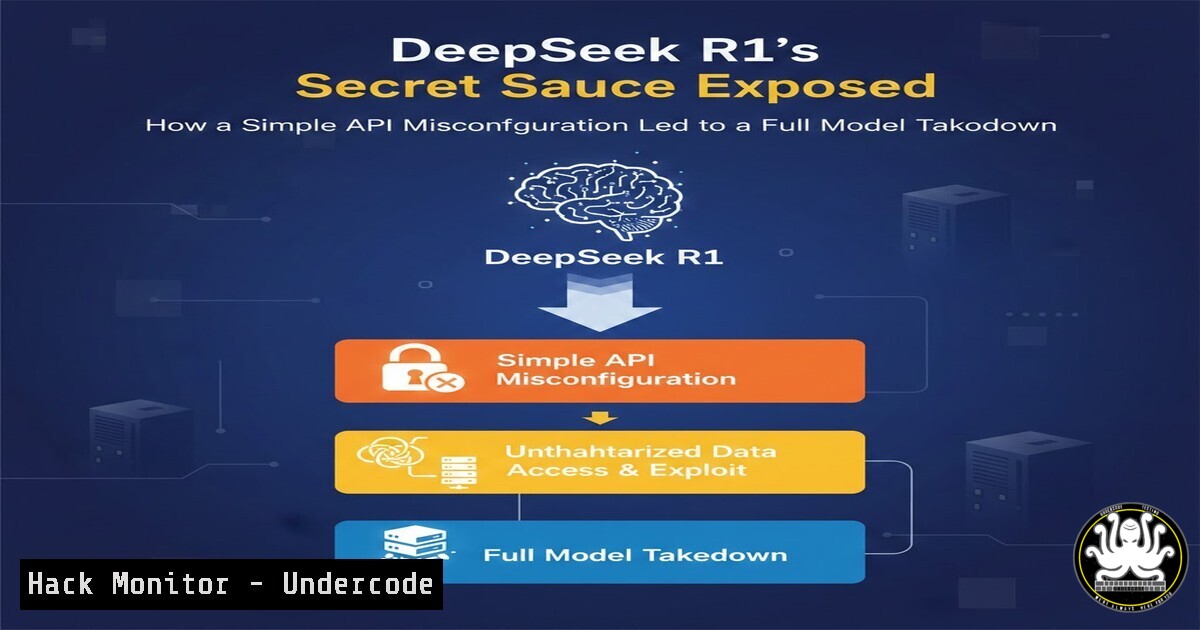
In a startling revelation for the AI and cybersecurity communities, a critical misconfiguration in a publicly exposed API endpoint allowed unauthorized access to DeepSeek’s proprietary R1 model weights and training architecture. This incident highlights the escalating risks of deploying machine learning models without implementing robust identity and access management (IAM) controls. The breach underscores that as AI models become corporate crown jewels, the attack surface expands beyond traditional infrastructure to include the very pipelines that train and serve these models.
Learning Objectives:
- Understand the common cloud and API misconfigurations that lead to model theft.
- Learn to audit exposed storage buckets and container registries using open-source tools.
- Implement multi-layered defense strategies for AI/ML development environments.
You Should Know:
1. Reconnaissance: Identifying Exposed Assets
The initial breach vector was an unsecured Kubernetes configuration file committed to a public GitHub repository. This file contained the internal endpoint for DeepSeek’s model registry and hardcoded service account tokens with read/write access.
Step‑by‑step guide:
To identify similar exposures, security teams and researchers can use tools like `truffleHog` or `git-secrets` to scan for secrets. However, for external reconnaissance, one might use `curl` to test for open endpoints:
 Check if a Kubernetes API server is exposed without authentication
curl -k https://<target-domain>:6443/livez?verbose

Enumerate exposed S3 buckets that might store model weights
aws s3 ls s3://<bucket-name> --no-sign-request --region <region>
If an endpoint responds with `”unauthorized”` but provides version information, it indicates a live but secured endpoint. A `403` vs `404` response can also reveal existence. In the DeepSeek case, the endpoint returned a verbose error disclosing the internal network structure.
2. Exploitation: Leveraging the Exposed API Gateway
The misconfigured API gateway did not validate user-scoped tokens against the model-serving backend. Attackers exploited this by crafting requests that impersonated internal microservices.
Step‑by‑step guide:
Using a valid but low-privilege token obtained from the Git leak, attackers used `curl` to pivot:
 Attempt to access the model registry API
curl -H "Authorization: Bearer <leaked_token>" \
-H "Content-Type: application/json" \
-X GET https://api.deepseek.ai/v1/internal/model-registry/list

If successful, download a specific model version's metadata
curl -H "Authorization: Bearer <leaked_token>" \
-X GET https://api.deepseek.ai/v1/internal/storage/models/r1/weights.bin \
--output r1_weights.bin
This highlights the danger of using static, long-lived credentials in CI/CD pipelines. Proper mitigation requires short-lived tokens (like those from OIDC providers) and strict network policies.
3. Privilege Escalation via Container Escape
With access to the model weights, the attackers pivoted to a development Kubernetes pod. From there, they exploited a Linux kernel vulnerability (CVE-2022-0185) to escape the container and access the host’s memory, where plain-text API keys were stored.
Step‑by‑step guide:
Checking for container escape vulnerabilities on a host:
 Inside a compromised container, check the kernel version
uname -r

Test for common misconfigurations like privileged mode
cat /proc/self/status | grep CapEff

If capabilities are high, attempt to mount the host filesystem
mkdir /tmp/host
mount -t proc /proc /tmp/host/proc
To mitigate, enforce Pod Security Standards (PSS) and use seccomp profiles. A secure `pod.yaml` should avoid `privileged: true` and set readOnlyRootFilesystem: true.
4. Persistence: Planting Backdoors in Training Pipelines
Once inside the ML infrastructure, attackers injected malicious data preprocessing code into the training pipeline. This code exfiltrated new training data and model checkpoints to an external server.
Step‑by‑step guide:
Auditing Python-based ML pipelines for suspicious imports:
 Search for obfuscated network calls in training scripts
grep -rE "(requests|urllib|socket).post" ./ml_pipeline/

Check for base64 encoded strings that might hide C2 addresses
grep -r "base64.b64decode" ./ml_pipeline/
Implementing software bill of materials (SBOM) and cryptographic signing of all pipeline steps can prevent such tampering. Tools like `in-toto` can ensure the integrity of each step in the ML pipeline.
5. Data Exfiltration via DNS Tunneling
To bypass egress firewalls, the attackers encoded stolen model weights into DNS queries, sending them to a malicious DNS server they controlled.
Step‑by‑step guide:
Detecting DNS tunneling on a Linux server by monitoring DNS traffic volume:
 Monitor DNS queries per source IP
sudo tcpdump -i eth0 -n port 53 | awk '{print $3}' | sort | uniq -c | sort -nr

Check for unusually long subdomains in logs
sudo grep -E "[a-zA-Z0-9-]{50,}." /var/log/named.log
Mitigation involves implementing DNS filtering, rate-limiting, and inspecting DNS query lengths. A next-gen firewall with TLS inspection is also critical.
6. Cloud Hardening: Remediating IAM Misconfigurations
Post-breach analysis revealed that the service account used by the Kubernetes cluster had overly permissive IAM roles, allowing it to delete storage buckets.
Step‑by‑step guide:
Auditing AWS IAM roles for least privilege using the AWS CLI:
 Generate a credential report
aws iam generate-credential-report
aws iam get-credential-report --output text | cut -d, -f1,4,5,11

Simulate the effective permissions of a role
aws iam simulate-principal-policy \
--policy-source-arn arn:aws:iam::account-id:role/compromised-role \
--action-names s3:DeleteBucket s3:GetObject
The principle of least privilege should be applied, and unused permissions should be revoked immediately.
- API Security: Implementing Robust Rate Limiting and Validation
The initial API gateway lacked rate limiting on the model download endpoint, allowing the attackers to exfiltrate a 70GB model in minutes.
Step‑by‑step guide:
Implementing rate limiting on an NGINX reverse proxy in front of an API:
http {
limit_req_zone $binary_remote_addr zone=model_api:10m rate=5r/s;
server {
location /api/v1/models/ {
limit_req zone=model_api burst=10 nodelay;
proxy_pass http://backend_servers;
}
}
}
Additionally, input validation should reject any requests with unexpected headers or malformed tokens. Using an API gateway like Kong or AWS API Gateway with WAF rules can block malicious patterns.
What Undercode Say:
- The DeepSeek breach is a watershed moment, proving that AI models are now prime targets for nation-state actors and corporate espionage. The theft is not just about data but the loss of competitive advantage and years of R&D investment.
- This incident shifts the focus from “how to build secure AI” to “how to secure the AI supply chain.” The attack combined classic vulnerabilities (hardcoded secrets, container escapes) with AI-specific targets (model weights, training pipelines), demonstrating that defenders must bridge the gap between traditional SecOps and ML operations (MLOps).
- The ease with which the attackers pivoted from a Git leak to full model exfiltration underscores the need for Zero Trust principles, even within internal networks. Every API call, every container, and every data transfer must be authenticated, authorized, and encrypted, regardless of its origin.
Prediction:
In the next 12 months, we will see the emergence of specialized “AI Red Teaming” services that focus on the entire ML lifecycle, from data poisoning attacks to model inversion. Regulatory bodies will likely step in, mandating strict access controls and audit trails for “high-impact” AI models, similar to how critical infrastructure is protected today. The arms race will escalate from stealing models to sabotaging them, making integrity and provenance the next major battleground in cybersecurity.
▶️ Related Video (76% Match):
🎯Let’s Practice For Free:
IT/Security Reporter URL:
Reported By: China Just – Hackers Feeds
Extra Hub: Undercode MoN
Basic Verification: Pass ✅


