Listen to this Post
Introduction:
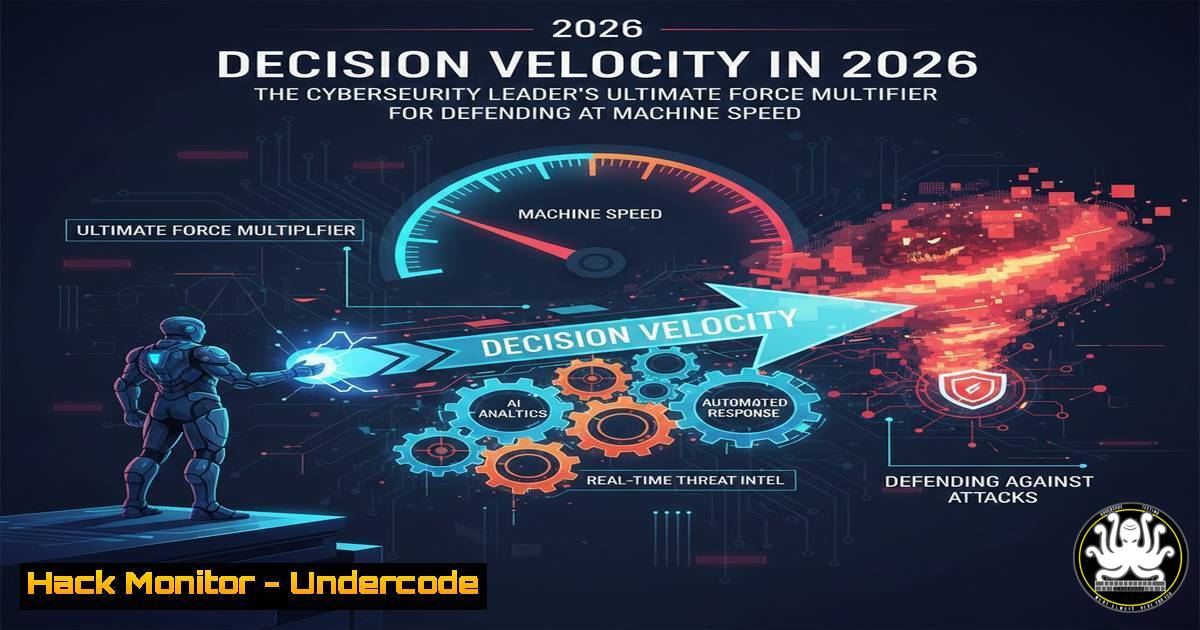
In the modern threat landscape, organizational slowness is not just an operational inefficiency—it’s a critical vulnerability. The concept of “Decision Velocity,” championed by business leaders, is exponentially more critical in cybersecurity, where the window between detection, decision, and response is measured in minutes. This article translates the leadership principle of decisive action into a technical blueprint for security operations, empowering teams to move at the speed of the adversary by eliminating bureaucratic and technical bottlenecks.
Learning Objectives:
- Understand how to architect security processes and tooling to minimize Mean Time to Acknowledge (MTTA) and Mean Time to Respond (MTTR).
- Implement technical delegation and automated playbooks to enable frontline analyst action without top-tier approval paralysis.
- Measure and track the “Idea → Action” cycle for security initiatives to throttle growth-inhibiting hesitation.
You Should Know:
- Architecting for Speed: Automating the Security Approval Bottleneck
The greatest bottleneck in security is often the human gatekeeper required for a containment action. High-velocity security organizations pre-approve actions through automated playbooks.
Step-by-step guide:
Concept: Security Orchestration, Automation, and Response (SOAR) platforms allow you to codify decision trees. For example, a medium-confidence phishing alert can automatically quarantine an email, block the sender URL, and create a ticket—all without waiting for a lead analyst.
Implementation (SOAR Playbook Logic):
- Trigger: Alert from Email Security Gateway with ‘Phishing Confidence Score >= 70’.
- Automated Action 1: Isolate the email from all user inboxes via API call to O365/Google Workspace.
- Automated Action 2: Extract URLs/IOCs and submit to firewall/endpoint security for blocking.
- Automated Action 3: Create an incident ticket in ITSM (e.g., ServiceNow) and assign to the phishing review queue.
Technical Command (Example – Log Search for Approval Delays): In your SIEM, run a query to identify slow decisions: `source=incident_logs status=”awaiting_approval” | bucket _time span=1h | stats count as pending_approvals by _time | eval avg_delay_hrs = (now() – _time)/3600`
2. Over-Delegating Securely: Implementing Just-Enough-Access (JEA)
The leadership advice to “over-delegate” translates technically to implementing granular, role-based access controls and empowering Tier 1 analysts with safe, pre-configured response tools.
Step-by-step guide:
Concept: Instead of requiring senior analyst credentials for every action, create constrained administrative roles for specific tasks.
Implementation (Windows – Just Enough Administration):
- Create a JEA endpoint configuration session file (
Tier1Responder.pssc) that grants a security group the ability to run only specific PowerShell commands as a privileged virtual account.
2. Example Commands Allowed: `Restart-Service`, `Get-NetTCPConnection`, `Stop-Process`, `Block-NetFirewallRule`.
- Analysts connect via `Enter-PSSession -ConfigurationName ‘Tier1Responder’ -ComputerName TARGETBOX` and have elevated, but narrowly scoped, powers.
Implementation (Linux – Sudoers with Command Restrictions): In/etc/sudoers.d/security_analyst, define: `%soc_analysts ALL=(ALL:ALL) NOPASSWD: /usr/bin/systemctl stop malware_service, /usr/sbin/iptables -A INPUT -s , /usr/bin/kill ` - Tracking Your Security Rhythm: Measuring Decision Cycle Time
You cannot improve what you do not measure. The “Idea → Action” timeline must be tracked for both tactical responses and strategic security projects.
Step-by-step guide:
Concept: Instrument your SecOps pipeline to collect metrics on every stage of the incident lifecycle and project rollout.
Tactical Metrics (Incident Response): Use your SIEM/SOAR to dashboard:
MTTA (Mean Time to Acknowledge): Time from alert generation to first analyst review.
MTTR (Mean Time to Respond): Time from acknowledgment to containment.
Data Source: index=incidents | stats avg(time_to_ack) as avg_MTTA, avg(time_to_contain) as avg_MTTR by alert_category.
Strategic Metrics (Project Velocity): For security initiatives (e.g., “Deploy EDR to all servers”), track the timeline from project approval (Phase 1: Pilot - 10%) to full deployment (Phase 5: Complete). Tools like Jira or Azure DevOps can visualize these cycles.
4. Cloud Security Hardening: Pre-Approved, Automated Remediation
In cloud environments (AWS, Azure, GCP), misconfigurations are exploited in real-time. Decision velocity means automating the remediation of known insecure states.
Step-by-step guide:
Concept: Use cloud-native tools like AWS Config, Azure Policy, or GCP Security Command Center with automated remediation actions.
Implementation (AWS Example):
1. Create an AWS Config rule `s3-bucket-public-read-prohibited`.
- Set up an automated remediation action using AWS Systems Manager Automation Documents.
- Automation Logic: When a public S3 bucket is detected, trigger an SSM document that runs the AWS CLI command: `aws s3api put-public-access-block –bucket
–public-access-block-configuration BlockPublicAcls=true, IgnorePublicAcls=true, BlockPublicPolicy=true, RestrictPublicBuckets=true`
This eliminates the delay of a ticket and manual intervention for a well-understood risk.
5. API Security: Velocity in Threat Mitigation
APIs are high-speed attack vectors. Slowness in blocking a malicious IP or revoking a compromised API key can be devastating.
Step-by-step guide:
Concept: Integrate your API gateway (e.g., Apigee, AWS API Gateway) with your threat intelligence and SIEM to enable dynamic, automated block lists.
Implementation Flow:
- Deploy an API security tool (e.g., Wallarm, Traceable) or WAF that monitors for abuse patterns (e.g., excessive 401 errors, credential stuffing).
- Upon high-confidence detection of an attacking IP, the tool automatically pushes a block rule to the gateway or edge firewall.
- Example Mitigation Command (Linux WAF – ModSecurity): The tool can dynamically update the CRS ruleset: `sudo nginx -s reload` after updating a denylist file.
This creates a decision-and-response loop that operates at the speed of the attack.
What Undercode Say:
- Speed as an Architectural Feature, Not an Adrenaline Rush: True decision velocity in cybersecurity is not about frantic, manual heroics. It is the deliberate engineering of systems—through SOAR, JEA, and automated cloud guardrails—that transforms human intent into defensive action at machine speed. The “over-delegation” Lisa Goldenthal advocates for is technically embodied in secure, least-privilege automation that empowers the frontline.
- Measurement is the Antidote to Hesitation: The leadership audit questions (“What launches stalled?”) have direct technical analogs in MTTR and project cycle metrics. By instrumenting and exposing these delays, security leaders shift the culture from “being careful” to being “effectively fast,” making data-driven decisions to clear bottlenecks. The “circular meeting” is often a symptom of un-instrumented processes.
Prediction:
By the end of 2026, the divide between resilient organizations and vulnerable ones will be defined by their implemented Decision Velocity in security operations. Organizations that treat automated, pre-approved response playbooks as standard operating procedure will successfully contain the vast majority of incidents before they escalate. Conversely, those clinging to multi-layered, manual approval chains will become the primary victims of ransomware and data exfiltration attacks, as human-speed decision-making proves utterly incapable of countering automated, AI-enhanced adversarial campaigns. The future belongs to the architecturally decisive.
▶️ Related Video (78% Match):
🎯Let’s Practice For Free:
IT/Security Reporter URL:
Reported By: Lisa Goldenthal – Hackers Feeds
Extra Hub: Undercode MoN
Basic Verification: Pass ✅


