
Listen to this Post
Introduction:
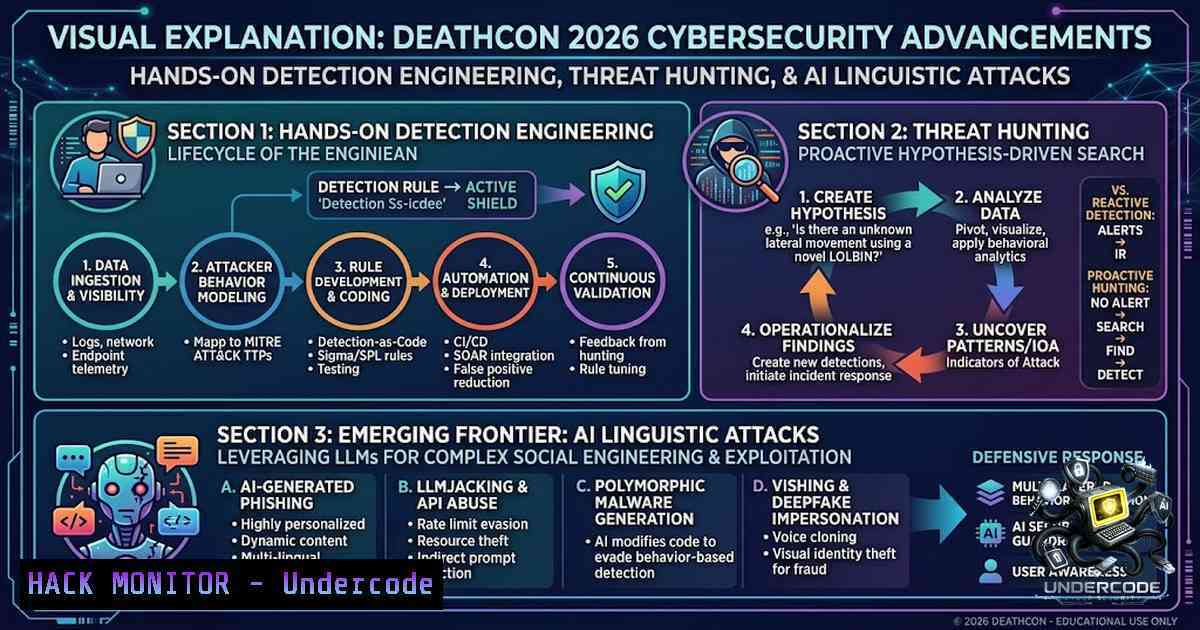
The cybersecurity industry is saturated with theoretical talks and slide‑deck presentations, yet the skills that truly matter—detection engineering, threat hunting, and incident response—are best learned through direct, hands‑on experience. DEATHCon (Detection Engineering and Threat Hunting Conference), hosted by BSides San Diego, addresses this gap with a 100% hands‑on format that includes workshops, a hacking lab, and a capture‑the‑flag (CTF) competition. Taking place November 13–14, 2026 at the University of San Diego, the conference brings together security practitioners to build tangible detection capabilities. A standout session this year features Sahara Al‑Madi, a computational linguist and AI security researcher, who will present Polyglot Poisoning: Hands‑On Hunting for Linguistic Attacks in AI—a workshop focused on detecting language‑based AI attacks using the open‑source Linguistic Firewall probe.
Learning Objectives & Secrets:
- Objective 1 – Build Production‑Ready Detection Rules: Walk away with detection rules you can deploy immediately in your own environment. The workshops emphasize practical output over passive listening, ensuring every attendee leaves having built something functional.
-
Objective 2 (Secret Tip) – Hunt for Polyglot Poisoning in AI Pipelines: Learn to identify and neutralize polyglot poisoning attacks—malicious inputs that exploit multiple language encodings or file formats to bypass AI safety filters. Pro tip: focus on canonicalization failures; attackers often use emoji homoglyphs, multi‑stage encoding, and mixed‑script payloads to evade detection.
-
Objective 3 (Secret Tip) – Deploy Linguistic Firewall Probes Proactively: The Linguistic Firewall probe allows you to test real polyglot poisoning examples and spot “Clever Hans” patterns—where models appear correct but rely on spurious correlations. Pro tip: integrate these probes into your CI/CD pipeline to catch linguistic attacks before they reach production.
You Should Know:
- Understanding Polyglot Poisoning and Linguistic Attacks in AI
Polyglot poisoning refers to the crafting of inputs that are valid and meaningful in multiple languages, character encodings, or file formats simultaneously, allowing attackers to smuggle malicious content past AI safety filters. These attacks are particularly dangerous because they exploit the very flexibility that makes large language models (LLMs) powerful. For example, an attacker might embed a harmful instruction in a string that appears benign when parsed as UTF‑8 but reveals a malicious prompt when interpreted as UTF‑16 or another encoding. The MITRE ATLAS framework categorizes such techniques under data poisoning and adversarial inputs, highlighting the need for dedicated detection strategies.
To defend against polyglot poisoning, security teams must implement multi‑layer input validation. This includes:
- Unicode normalization to collapse homoglyphs and variant characters into canonical forms.
- Language detection to flag off‑topic or unexpected language switches.
- Perplexity filtering to identify gibberish or adversarially crafted text.
- Prompt injection classifiers that use both rule‑based and ML‑based approaches.
Step‑by‑step guide to setting up a basic linguistic firewall probe:
- Install the Linguistic Firewall probe (if open‑sourced) or a comparable tool like `guardrailprobe` from PyPI.
- Define your baseline—collect a corpus of benign inputs for your use case.
- Configure detection rules for homoglyph detection, encoding anomalies, and language switching.
- Deploy the probe as a sidecar container or API gateway middleware.
- Monitor alerts and tune thresholds based on false positive rates.
- Integrate with your SIEM to correlate linguistic alerts with other security events.
2. Detection Engineering for AI‑Powered Systems
Traditional detection engineering focuses on network, endpoint, and identity threats. However, as organizations integrate LLMs and AI agents into their workflows, detection engineers must expand their purview to include model‑specific threats. The OWASP LLM Top 10 provides a starting point, covering risks such as prompt injection, insecure output handling, and training data poisoning. DEATHCon’s hands‑on workshops emphasize translating these abstract risks into concrete detection rules.
Key detection strategies for AI systems include:
- Input‑side monitoring: Log and analyze all prompts and queries for suspicious patterns.
- Output‑side validation: Check model outputs for policy violations, PII leakage, or unsafe content.
- Behavioral anomaly detection: Establish baselines for normal model behavior and flag deviations (e.g., sudden changes in response length, tone, or topic).
- Telemetry poisoning detection: Monitor for attacks that manipulate observability data to hide malicious activity.
Step‑by‑step guide to building a detection rule for prompt injection:
- Identify the attack surface—which APIs, chatbots, or agents accept user input?
- Collect benign and malicious prompt samples (use public datasets or generate your own).
- Extract features such as presence of special characters, length, language entropy, and known injection patterns.
- Choose a detection method—regex‑based rules for known patterns, ML classifiers for novel attacks, or a hybrid approach.
- Implement the rule in your SIEM or custom detection platform (e.g., using Sigma rules or Splunk ES).
- Test and tune using a hold‑out dataset to minimize false positives.
- Deploy and monitor—continuously update rules as attackers evolve their techniques.
3. Threat Hunting for AI‑Specific Threats
Threat hunting for AI systems requires a shift in mindset from reactive alert triage to proactive hypothesis‑driven investigation. DEATHCon’s threat hunting workshops guide participants through structured hunting methodologies, including hypothesis generation, data collection, and pattern analysis. For AI threats, common hypotheses include:
- “An attacker is using polyglot inputs to bypass our content filters.”
- “Our model is being poisoned via the training data pipeline.”
- “Adversaries are exploiting our vector database with poisoned documents.”
Step‑by‑step guide to hunting for polyglot poisoning in vector databases:
- Inventory your vector databases (Pinecone, Weaviate, Chroma, Qdrant, pgvector, etc.).
- Deploy a scanner like `rag‑poison‑detector` to scan for poisoned documents, trigger tokens, and invisible Unicode characters.
- Analyze scan results—look for documents that contain multiple language scripts, unusual encoding sequences, or known injection patterns.
- Correlate with model behavior—check if the model’s outputs have changed for queries related to the suspected poisoned documents.
- Quarantine and investigate—remove suspicious documents and perform a root‑cause analysis.
- Document findings and update your detection rules to prevent recurrence.
-
Cloud Hardening and API Security for AI Workloads
AI workloads often run in cloud environments with complex API dependencies. Securing these environments requires a combination of cloud hardening and API security best practices. Key areas of focus include:
- Identity and access management (IAM): Apply the principle of least privilege to all AI service accounts and API keys.
- Network segmentation: Isolate AI training and inference environments from production networks.
- API gateway security: Implement rate limiting, input validation, and authentication at the API layer.
- Secrets management: Use dedicated secrets managers (e.g., HashiCorp Vault, AWS Secrets Manager) to store API keys and credentials.
Step‑by‑step guide to hardening an AI API endpoint:
1. Audit existing IAM policies—remove overly permissive roles.
- Enable API gateway logging and forward logs to your SIEM.
- Implement input validation at the gateway level (e.g., JSON schema validation, size limits).
- Deploy a Web Application Firewall (WAF) with rules for common LLM attacks (e.g., prompt injection, excessive recursion).
- Set up anomaly detection for API traffic patterns (e.g., sudden spikes in request volume).
- Regularly rotate API keys and audit access logs.
5. Vulnerability Exploitation and Mitigation in AI Pipelines
AI pipelines introduce unique vulnerabilities, from insecure model serialization (e.g., pickle files) to dependency confusion attacks. Understanding how these vulnerabilities are exploited is the first step toward effective mitigation. For example, polyglot model files can be valid in multiple formats, allowing attackers to disguise malicious models as benign ones.
Step‑by‑step guide to mitigating AI pipeline vulnerabilities:
- Inventory all AI dependencies—libraries, frameworks, and pre‑trained models.
- Scan for known vulnerabilities using tools like `safety` or
pip‑audit. - Implement model signing and verification—only load models from trusted sources with cryptographic signatures.
- Use sandboxed execution environments for model inference (e.g., containers with restricted privileges).
- Monitor for anomalous model behavior—sudden changes in accuracy, output distribution, or resource usage.
- Establish an incident response plan specific to AI security incidents.
What Undercode Say:
- Key Takeaway 1: DEATHCon is not a passive conference—it is a build‑fest. Attendees are expected to bring a laptop and leave having created something tangible, whether it is a detection rule, a hunting query, or a deployed probe. This hands‑on ethos is what sets DEATHCon apart from traditional security conferences.
-
Key Takeaway 2: The frontier of AI security is linguistic. As Sahara Al‑Madi’s session demonstrates, language is both the power and the vulnerability of modern AI systems. Polyglot poisoning and other linguistic attacks exploit the inherent complexity of human language, and defending against them requires a new class of tools and skills that blend computational linguistics with traditional security engineering.
Analysis: The convergence of detection engineering and AI security is inevitable. As organizations rush to adopt LLMs, they are creating massive new attack surfaces that traditional security tools are ill‑equipped to handle. DEATHCon addresses this gap by providing practical, hands‑on training in detecting and hunting for AI‑specific threats. The emphasis on open‑source tools, such as the Linguistic Firewall probe, democratizes access to advanced AI security capabilities. However, the field is still nascent—many organizations lack the in‑house expertise to implement these defenses effectively. Conferences like DEATHCon play a critical role in upskilling the workforce and fostering a community of practice around AI security. The global, distributed nature of DEATHCon—with sites in Seattle, Chicago, Atlanta, Tampa, Montreal, Edinburgh, Amsterdam, Melbourne, and more—ensures that this knowledge reaches a wide audience.
Prediction:
- +1 DEATHCon will catalyze the development of a new generation of detection engineers who are proficient in both traditional security and AI‑specific threats, creating a talent pool that can address the growing demand for AI security expertise.
-
+1 The open‑source Linguistic Firewall probe and similar tools will become standard components of AI security stacks, similar to how WAFs became standard for web applications.
-
-1 Organizations that fail to invest in AI‑specific detection and hunting capabilities will suffer significant breaches as attackers increasingly target LLM pipelines with polyglot poisoning and other linguistic attacks.
-
+1 The hands‑on, community‑driven model of DEATHCon will inspire similar conferences and workshops, accelerating the adoption of practical AI security practices across the industry.
-
-1 The rapid pace of AI innovation means that even the best detection rules and hunting methodologies will quickly become outdated, requiring continuous learning and adaptation from security practitioners.
▶️ Related Video (78% Match):
https://www.youtube.com/watch?v=-N89tCovqHU
🎯Let’s Practice For Free:
🎓 Live Courses & Certifications:
Join Undercode Academy for Verified Certifications
🚀 Request a Custom Project:
Secure, high-velocity infrastructure and disruptive technological engineering. Contact our engineering team for high-tier development and proprietary systems:
[email protected]
💎 Smart Architecture | 🛡️ Secure by Design | ⭐ Trusted by Thousands
IT/Security Reporter URL:
Reported By: https://lnkd.in/p/eqQSwCkw – Hackers Feeds
Extra Hub: Undercode MoN
Basic Verification: Pass ✅


