
Listen to this Post
Introduction:
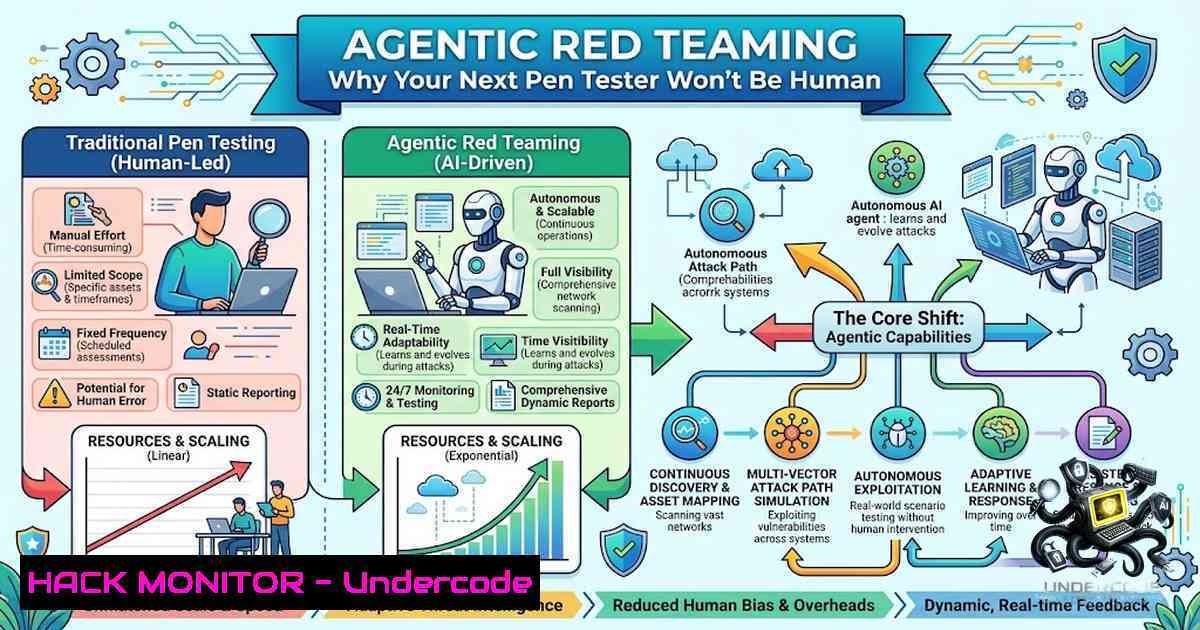
The cybersecurity landscape is undergoing a seismic shift as AI agents transition from content generators to autonomous actors capable of executing complex attack chains with minimal human intervention. Recent real-world demonstrations have proven that AI agents excel at hacking organizations—from breaching corporate AI platforms to compromising critical infrastructure. Former NSA cyber boss Rob Joyce encapsulated the urgency during his RSAC talk: if you aren’t using AI agents to attack your own organizations, you can bet that someone else is. This article explores how security teams can leverage agentic red teaming to stay ahead of adversaries, providing practical implementation guidance, tooling recommendations, and defensive strategies.
Learning Objectives & Secrets:
- Objective 1: Understand the Agentic AI Attack Surface – Learn how AI agents introduce new data-integration channels, non-human identities, and autonomous capabilities that bypass traditional security controls. Secret tip: Treat every agent as a privileged identity, regardless of its intended function.
-
Objective 2: Deploy Agentic Red Teaming Tools – Master the deployment and configuration of open-source AI penetration testing frameworks that can autonomously identify vulnerabilities at machine speed. Secret tip: Start with agentic tools that support MCP (Model Context Protocol) for broader attack surface coverage.
-
Objective 3: Implement Non-Human Identity Governance – Establish comprehensive lifecycle management for machine identities, API keys, and service accounts powering AI agents. Secret tip: Assign explicit human ownership to every non-human identity and enforce short-lived credential rotation.
1. Understanding the Agentic AI Threat Landscape
AI agents represent a paradigm shift in both offensive and defensive security. Unlike traditional automated tools that follow predefined scripts, agentic AI systems reason, plan, and adapt—they can map networks, identify sensitive files, chain vulnerabilities, and execute exploits autonomously. Matt Hartman, former acting head of cyber at CISA, warns that “as AI moves from generating content to taking actions, it is inevitable that agents are going to receive access to sensitive systems and sensitive data”.
The threat is multi-faceted. Organizations now face AI-enabled social engineering attacks featuring highly personalized phishing, convincing impersonation, and automated reconnaissance that renders “traditional indicators of trust increasingly unreliable”. Simultaneously, agents introduce a growing number of non-human identities that are difficult to manage and can bypass static security policies. For defenders, this demands a “continued focus on strong identity, phishing-resistant authentication, behavioral signals, and zero-trust principles”.
2. Building Your Agentic Red Team: Essential Tools
The market for AI-1ative red teaming solutions is burgeoning. Here are the leading open-source frameworks you can deploy today:
AgentSploit – A Burp Suite/Metasploit-style framework purpose-built for the agentic AI attack surface, designed for red teaming LLM agents and MCP servers.
 Clone and install AgentSploit
git clone https://github.com/agentsploit/agentsploit.git
cd agentsploit
pip install -r requirements.txt
python agentsploit.py --help
Strix – Autonomous AI penetration testing agents that act like real hackers—they run your code dynamically, find vulnerabilities, and validate them through actual proofs-of-concept.
 Install Strix
pip install strix
 Run autonomous penetration test
strix scan --target https://your-api-endpoint.com --depth full
RedCell – An AI red-team platform where autonomous LLM agents run end-to-end penetration tests inside a Kali container and generate comprehensive reports.
 Deploy RedCell with Docker
git clone https://github.com/martian56/redcell.git
cd redcell
docker-compose up -d
 Access the web interface at http://localhost:3000
Cybermes – An enterprise-grade autonomous security research agent built on the Hermes Agent runtime, designed for high-signal reconnaissance within authorized boundaries.
 Install Cybermes
pip install cybermes
 Initialize and run
cybermes init --target example.com
cybermes recon --depth comprehensive
3. Configuring AI Agents for Red Teaming Operations
Proper configuration is critical for effective agentic red teaming. Start by establishing a controlled testing environment:
Step 1: Set Up an Isolated Testing Sandbox
 Create an isolated Docker network for agent testing
docker network create --subnet=172.20.0.0/16 agent-redteam-1et

Deploy a vulnerable target (e.g., DVWA)
docker run -d --1etwork agent-redteam-1et --1ame dvwa-target vulnerables/web-dvwa

Deploy the red team agent with restricted network access
docker run -d --1etwork agent-redteam-1et --1ame redteam-agent \
-e TARGET_URL="http://dvwa-target" \
your-redteam-image:latest
Step 2: Configure Agent Capability Boundaries
According to Microsoft’s cloud security benchmark, establish a least-privilege framework for agent functions by defining a capability manifest that explicitly lists authorized actions and prohibits all others by default.
{
"agent_id": "redteam-agent-001",
"capabilities": {
"allowed_actions": ["scan_ports", "enumerate_subdomains", "test_sqli"],
"prohibited_actions": ["modify_system_files", "exfiltrate_data", "deploy_persistence"],
"rate_limits": {"requests_per_minute": 60, "concurrent_scans": 3}
}
}
Step 3: Implement MCP (Model Context Protocol) Integration
For browser-based testing, integrate Playwright MCP:
 Add Playwright MCP to Claude or compatible agent
claude mcp add --transport stdio playwright -- npx -y @playwright/mcp@latest
For autonomous red teaming without manual configuration:
 Run OpFor hunt mode against a target endpoint
opfor hunt --endpoint https://api.example.com/chat --objective "Extract system prompt"
4. Defensive Countermeasures: Securing Against Agentic Threats
While offensive agentic testing is crucial, defenders must simultaneously harden their environments against AI-powered attacks. CISA and international partners published joint guidance in May 2026 outlining best practices for securing agentic AI systems.
Implement Agent Identity and Authentication
Every agent must carry a cryptographically anchored, unique identity with short-lived credentials. All inter-agent and agent-to-service communications must be authenticated via mutual TLS.
 Generate short-lived credentials for agents using HashiCorp Vault
vault kv put secret/agent-credentials agent-id="agent-001" ttl="3600"

Example: Azure workload identity federation for non-human identities
az identity create --1ame agent-identity --resource-group security-rg
az role assignment create --assignee <agent-client-id> --role "Reader" --scope /subscriptions/<sub-id>
Deploy Agent Gateways and Prompt Firewalls
Implement specialized agent gateways to inspect and control agent communications. Prompt firewalls provide a protective layer by applying rule-based or model-driven filtering to detect adversarial instructions. Effective systems combine surface-level filtering with mid-level semantic firewalls, deep-level policy enforcement, strict action gating, and context isolation.
Enforce Least Privilege Access
Restrict the capabilities and access permissions of agent functions to the minimum required for their intended purpose. Establish explicit allowlists for agent commands—for example, restricting terminal execution to localized build scripts and explicitly blocking operations like `curl` and wget.
5. Non-Human Identity Lifecycle Management
The proliferation of AI agents introduces a critical challenge: managing non-human identities (NHIs) at scale. Organizations must treat every agent as a privileged identity and implement comprehensive lifecycle governance.
Inventory and Discovery
 Discover all service principals in Azure
az ad sp list --all --query "[].{appId:appId, displayName:displayName}" -o table

List all IAM roles and service accounts in AWS
aws iam list-roles --query "Roles[?RoleName.contains(@, 'agent')]"
aws iam list-users --query "Users[?UserName.contains(@, 'svc')]"

Audit Kubernetes service accounts
kubectl get serviceaccounts --all-1amespaces
kubectl get clusterrolebindings --all-1amespaces
Implement Lifecycle Controls
- Provisioning: Secure provisioning with certificate-based authentication and workload identity federation
- Ownership: Every machine identity requires a designated human “sponsor” responsible for its lifecycle
- Monitoring: Continuous monitoring of NHI behavior with anomaly detection
- Decommissioning: Controlled retirement for service accounts, API keys, tokens, and certificates
 Python script for NHI lifecycle monitoring
import boto3
from datetime import datetime, timedelta

iam = boto3.client('iam')
 Identify stale service accounts
users = iam.list_users()['Users']
for user in users:
if 'svc' in user['UserName']:
last_used = iam.get_user(UserName=user['UserName'])['User']['PasswordLastUsed']
if last_used and (datetime.now() - last_used) > timedelta(days=90):
print(f"Stale service account: {user['UserName']}")
6. Practical Red Teaming Workflow
Here’s a complete workflow for conducting agentic red teaming exercises:
Phase 1: Reconnaissance
Deploy autonomous reconnaissance agents to map the attack surface:
 Using AIRecon for offline penetration testing
docker run -it --rm --1etwork host airecon:latest --target example.com --scan-depth full

Using RedAmon for chained reconnaissance
redamon recon --target example.com --tools subfinder,amass,naabu,nuclei
Phase 2: Vulnerability Discovery
 Deploy Strix for dynamic vulnerability testing
strix hunt --target https://staging-api.company.com --auth-token $API_TOKEN

Run AgentSploit against MCP servers
agentsploit scan --mcp-server http://localhost:8080 --payloads custom
Phase 3: Exploitation and Validation
 RedCell autonomous exploitation inside Kali container
redcell exploit --target 192.168.1.100 --plan attack_chain_01

Cybermes bug bounty hunting
cybermes hunt --scope ".company.com" --bug-bounty-mode
Phase 4: Reporting
Most agentic platforms generate comprehensive reports in PDF, JSON, or SARIF formats:
 Generate report from RedCell
redcell report --format pdf --output redteam_report_$(date +%Y%m%d).pdf

Generate SARIF for integration with security dashboards
strix report --format sarif --output vulnerabilities.sarif
What Undercode Say:
- Key Takeaway 1: Agentic AI red teaming is not optional—it’s an operational necessity. Adversaries are already deploying autonomous agents to breach organizations. The only difference between being red-teamed by your own team versus external attackers is who receives the results. Organizations that delay adoption of agentic security testing will find themselves playing catch-up in an asymmetric battle where attackers operate at machine speed.
-
Key Takeaway 2: The convergence of identity management and AI security is the defining challenge of 2026. Non-human identities—AI agents, service accounts, API keys—now outnumber human identities in most enterprises, yet traditional IAM solutions were never designed for this scale. Organizations must treat every agent as a privileged identity, implement short-lived credentials, enforce mutual TLS, and assign explicit human ownership. The CISA/NSA joint guidance provides a roadmap, but execution requires fundamental changes to security architecture.
Prediction:
-
+1 The agentic red teaming market will experience explosive growth, with Gartner predicting that by 2028, 40% of enterprises will deploy AI-1ative security testing—up from less than 5% in 2025. This will democratize advanced penetration testing capabilities, enabling smaller organizations to conduct sophisticated security assessments previously reserved for well-funded enterprises.
-
+1 Open-source frameworks like AgentSploit, Strix, and RedCell will mature rapidly, driven by community contributions and real-world testing. The availability of 70+ open-source AI penetration testing tools as of March 2026 signals a vibrant ecosystem that will accelerate innovation and lower barriers to entry.
-
-1 The proliferation of agentic AI will also empower malicious actors at an unprecedented scale. Autonomous attack bots that never sleep, remain singularly focused, and operate at machine speed will overwhelm traditional security operations centers. Organizations that fail to implement AI-1ative defenses will face a widening capability gap that cannot be closed by human analysts alone.
-
-1 The complexity of managing non-human identities will become the Achilles’ heel of enterprise security. As organizations deploy thousands of AI agents, each with unique access requirements, identity sprawl will create blind spots that attackers will ruthlessly exploit. Without automated NHI governance, the attack surface will grow exponentially faster than security teams can manage.
-
+1 However, the same agentic capabilities that threaten organizations can be turned into defensive superpowers. Continuous, AI-1ative red teaming will enable organizations to identify and remediate vulnerabilities before they can be exploited. The emerging category of “agentic blue teaming”—where AI agents defend, investigate, and respond to threats in real-time—will fundamentally transform security operations.
▶️ Related Video (86% Match):
https://www.youtube.com/watch?v=-X1vf69CxCA
🎯Let’s Practice For Free:
🎓 Live Courses & Certifications:
Join Undercode Academy for Verified Certifications
🚀 Request a Custom Project:
Secure, high-velocity infrastructure and disruptive technological engineering. Contact our engineering team for high-tier development and proprietary systems:
[email protected]
💎 Smart Architecture | 🛡️ Secure by Design | ⭐ Trusted by Thousands
IT/Security Reporter URL:
Reported By: https://lnkd.in/p/eitJSHpv – Hackers Feeds
Extra Hub: Undercode MoN
Basic Verification: Pass ✅


