Listen to this Post
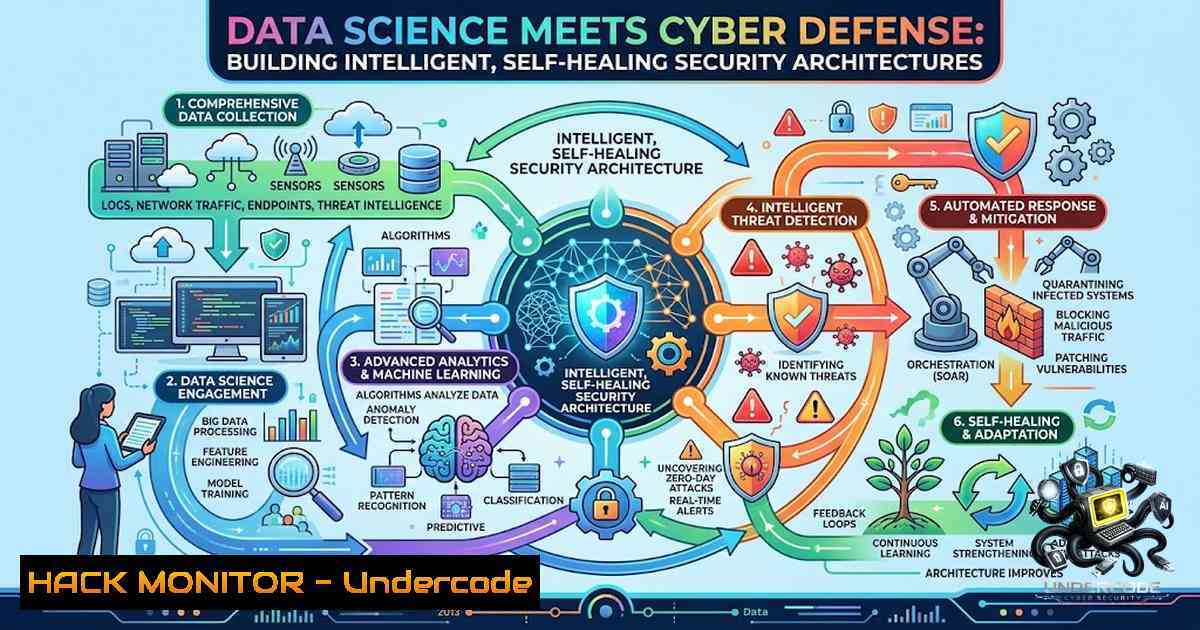
Introduction:
Every click generates data; every byte demands protection. In today’s hyper-connected digital ecosystem, organizations face an unprecedented volume of security telemetry—far more than human analysts can manually process. Data science transforms this raw signal noise into actionable intelligence, while cybersecurity ensures the insights derived remain trustworthy and resilient against adversarial manipulation. This synergy between statistical learning and security engineering is no longer optional—it is the foundation of next-generation defense.
Learning Objectives:
- Understand how machine learning models can be applied to threat detection, anomaly identification, and predictive security analytics
- Learn to implement secure data science pipelines that protect training data, models, and inference endpoints from poisoning, evasion, and extraction attacks
- Master practical techniques for integrating AI-driven threat intelligence into Security Operations Center (SOC) workflows and DevSecOps practices
You Should Know:
1. The Data-Driven Threat Detection Pipeline
Modern cybersecurity generates massive datasets—network flows, endpoint logs, authentication attempts, and API transactions. Data science provides the statistical and machine learning frameworks to extract meaningful patterns from this deluge. At its core, this involves data collection, feature engineering, statistical analysis, and ML model deployment to security problems.
What does this look like in practice? A typical threat detection pipeline follows these steps:
- Data Ingestion: Collect logs from firewalls, IDS/IPS, endpoints (e.g., Windows Event Logs, Sysmon), and cloud audit trails
- Feature Engineering: Transform raw logs into numerical features—packet sizes, connection durations, failed login ratios, entropy of domain names
- Model Training: Train supervised models (Random Forest, XGBoost) on labeled attack data or unsupervised models (Isolation Forest, Autoencoders) for anomaly detection
- Inference & Alerting: Deploy models to score live traffic and generate alerts when anomaly thresholds are exceeded
Linux Command Example – Real-Time Log Analysis with AI/ML:
 Stream system logs and extract features for anomaly detection
sudo journalctl -f -o json | jq 'select(.SYSLOG_IDENTIFIER=="sshd") | {time: .__REALTIME_TIMESTAMP, user: .SYSLOG_PID, msg: .MESSAGE}' | \
python3 -c "
import sys, json, re
from sklearn.ensemble import IsolationForest
import numpy as np
 Simulated feature extraction from SSH logs
failed_attempts = []
for line in sys.stdin:
try:
data = json.loads(line)
if 'Failed password' in data.get('msg', ''):
failed_attempts.append(1)
else:
failed_attempts.append(0)
 Roll over every 100 events for anomaly scoring
if len(failed_attempts) >= 100:
X = np.array(failed_attempts).reshape(-1, 1)
clf = IsolationForest(contamination=0.1)
pred = clf.fit_predict(X)
if -1 in pred:
print('[bash] Anomalous authentication pattern detected')
failed_attempts = []
except:
pass
"
Windows PowerShell Example – Feature Extraction from Security Logs:
 Extract failed login attempts from Windows Security Event Log
Get-WinEvent -LogName Security -FilterXPath "[System[EventID=4625]]" -MaxEvents 1000 | ForEach-Object {
$props = $<em>.Properties
[bash]@{
TimeCreated = $</em>.TimeCreated
Account = $props[bash].Value
SourceIP = $props[bash].Value
Workstation = $props[bash].Value
}
} | Export-Csv -Path "failed_logins.csv" -1oTypeInformation

Python script to run Isolation Forest on the exported data
python -c "
import pandas as pd
from sklearn.ensemble import IsolationForest
df = pd.read_csv('failed_logins.csv')
 Group by source IP and count attempts
features = df.groupby('SourceIP').size().values.reshape(-1,1)
clf = IsolationForest(contamination=0.05)
predictions = clf.fit_predict(features)
print('Suspicious IPs detected:', df.groupby('SourceIP').size().index[predictions == -1].tolist())
"
2. Securing the Machine Learning Pipeline – DevSecMLOps
Data science models are only as trustworthy as the pipelines that build and deploy them. Attackers can poison training data, steal model parameters through API queries, or craft adversarial inputs that cause misclassification. The emerging discipline of DevSecMLOps embeds security controls throughout the ML lifecycle.
Step-by-Step Guide to Secure Your ML Pipeline:
- Data Validation: Implement schema validation and statistical checks on incoming training data to detect poisoning attempts. Use tools like Great Expectations or TensorFlow Data Validation.
- Access Control: Treat training data and model artifacts as high-value assets. Apply data classification, role-based access controls, and encryption at rest and in transit.
- Model Integrity: Generate cryptographic hashes of trained models and training datasets. Verify these hashes before deployment to ensure provenance.
- Adversarial Robustness Testing: Before deployment, test models against adversarial examples using frameworks like Foolbox or CleverHans. Measure robustness against FGSM, PGD, and other attack methods.
- Continuous Monitoring: Deploy drift detection to identify when model performance degrades due to concept drift or active evasion attempts. Retrain or roll back as needed.
Example – Verifying Model Integrity with Cryptographic Hashing:
 Generate SHA-256 hash of trained model artifact
sha256sum model.pkl > model.hash

Before deployment, verify the hash matches
if sha256sum -c model.hash 2>/dev/null; then
echo "Model integrity verified - deploying"
 Deploy model to production endpoint
else
echo "ERROR: Model hash mismatch - possible tampering detected"
exit 1
fi
Example – Implementing Rate Limiting on ML Inference APIs (Python with Flask):
from flask import Flask, request, jsonify
from flask_limiter import Limiter
from flask_limiter.util import get_remote_address
import pickle

app = Flask(<strong>name</strong>)
limiter = Limiter(app=app, key_func=get_remote_address)

Load model with integrity check
with open('model.pkl', 'rb') as f:
model = pickle.load(f)

@app.route('/predict', methods=['POST'])
@limiter.limit("10 per minute")  Prevent API abuse and model extraction
def predict():
data = request.get_json()
 Input validation - reject malformed payloads
if not data or 'features' not in data:
return jsonify({'error': 'Invalid input'}), 400
try:
prediction = model.predict([data['features']])
return jsonify({'prediction': int(prediction[bash])})
except Exception as e:
return jsonify({'error': str(e)}), 500

if <strong>name</strong> == '<strong>main</strong>':
app.run(host='0.0.0.0', port=5000)
3. AI-Powered Threat Intelligence and SOC Automation
Security Operations Centers (SOCs) are overwhelmed by alert fatigue—thousands of daily notifications, most of which are false positives. Machine learning models can triage alerts, correlate disparate events, and prioritize genuine threats. Advanced systems leverage Natural Language Processing (NLP) to parse threat reports and automatically map indicators of compromise (IOCs) to MITRE ATT&CK frameworks.
Step-by-Step Guide – Building an Automated Threat Intelligence Feed:
- Ingest Feeds: Pull data from open-source threat intelligence feeds (AlienVault OTX, MISP, AbuseIPDB) using their REST APIs
- Extract IOCs: Use regular expressions and NLP to extract IP addresses, domains, hashes, and CVE identifiers from unstructured text
- Enrichment: Query enrichment services (VirusTotal, Shodan, NVD) to add context—geolocation, reputation scores, CVSS severity
- Correlation: Use clustering algorithms (DBSCAN, K-means) to group related IOCs and identify campaign-level patterns
- Alerting: Push enriched, correlated intelligence to SIEM platforms (Splunk, Elastic) or directly to ticketing systems
Example – Python Script for IOC Extraction and Enrichment:
import re
import requests
from collections import Counter

Sample threat report text
threat_report = """
Analysis identified malicious activity originating from IP 185.234.216.89.
The attacker used domain malicious-domain.xyz and dropped a file with SHA256
hash: 6c6b6f6c6b6f6c6b6f6c6b6f6c6b6f6c6b6f6c6b6f6c6b6f6c6b6f6c6b6f.
This activity is associated with CVE-2024-12345.
"""

Extract IP addresses
ip_pattern = r'\b(?:[0-9]{1,3}.){3}[0-9]{1,3}\b'
ips = re.findall(ip_pattern, threat_report)

Extract domains (simplified)
domain_pattern = r'\b[a-zA-Z0-9-]+.(?:com|org|net|xyz)\b'
domains = re.findall(domain_pattern, threat_report)

Extract SHA256 hashes
hash_pattern = r'\b[a-fA-F0-9]{64}\b'
hashes = re.findall(hash_pattern, threat_report)

Extract CVE IDs
cve_pattern = r'CVE-\d{4}-\d{4,}'
cves = re.findall(cve_pattern, threat_report)

print(f"Extracted IOCs:\nIPs: {ips}\nDomains: {domains}\nHashes: {hashes}\nCVEs: {cves}")

Enrich IPs with AbuseIPDB (requires API key)
API_KEY = "YOUR_ABUSEIPDB_API_KEY"
for ip in ips:
response = requests.get(
f"https://api.abuseipdb.com/api/v2/check?ipAddress={ip}",
headers={"Key": API_KEY, "Accept": "application/json"}
)
if response.status_code == 200:
data = response.json()
abuse_score = data['data']['abuseConfidenceScore']
print(f"IP {ip} abuse confidence score: {abuse_score}%")
4. API Security and Anomaly Detection with ML
APIs are the backbone of modern applications, but they also represent a massive attack surface. The OWASP API Security Top Ten highlights critical vulnerabilities including broken object-level authorization, excessive data exposure, and security misconfiguration. Machine learning offers a powerful defense: models can learn normal API access patterns and detect anomalous behavior indicative of API abuse or credential stuffing.
Step-by-Step Guide – Implementing ML-Based API Anomaly Detection:
- Log Collection: Aggregate API access logs from reverse proxies (NGINX, HAProxy) or API gateways (Kong, AWS API Gateway)
- Feature Extraction: For each API call, extract: endpoint path, HTTP method, status code, response size, user agent, source IP, and timestamp
- Baseline Modeling: Train an unsupervised model (e.g., Autoencoder or LSTM) on historical normal traffic to learn expected patterns
- Real-Time Scoring: Score incoming requests against the model—high reconstruction error indicates anomalous behavior
- Alert & Respond: Trigger alerts for anomalies that exceed threshold; optionally implement automated rate limiting or IP blocking
NGINX Log Format for API Analytics:
log_format api_log '$remote_addr - $remote_user [$time_local] "$request" '
'$status $body_bytes_sent "$http_referer" '
'"$http_user_agent" $request_time';
access_log /var/log/nginx/api_access.log api_log;
Python Script – Anomaly Detection with Isolation Forest on API Logs:
import pandas as pd
import numpy as np
from sklearn.ensemble import IsolationForest
from datetime import datetime

Load API logs (assuming CSV format with columns: ip, method, endpoint, status, size, user_agent, timestamp)
df = pd.read_csv('api_logs.csv')

Feature engineering
df['hour'] = pd.to_datetime(df['timestamp']).dt.hour
df['day_of_week'] = pd.to_datetime(df['timestamp']).dt.dayofweek

Create feature matrix: status code, response size, hour, endpoint frequency
endpoint_counts = df['endpoint'].map(df['endpoint'].value_counts())
ip_counts = df['ip'].map(df['ip'].value_counts())

X = pd.DataFrame({
'status': df['status'],
'size': df['size'],
'hour': df['hour'],
'endpoint_freq': endpoint_counts,
'ip_freq': ip_counts
}).fillna(0)

Train Isolation Forest
clf = IsolationForest(contamination=0.05, random_state=42)
predictions = clf.fit_predict(X)

Flag anomalies
df['anomaly'] = predictions
anomalies = df[df['anomaly'] == -1]
print(f"Detected {len(anomalies)} anomalous API requests")
print(anomalies[['ip', 'method', 'endpoint', 'status', 'timestamp']].head())
5. Cloud Security Hardening with AI-Driven Compliance Monitoring
Cloud environments introduce unique security challenges—dynamic assets, ephemeral workloads, and complex IAM configurations. AI can continuously monitor cloud configurations against compliance frameworks (CIS Benchmarks, NIST, SOC2) and automatically detect misconfigurations before they are exploited.
Step-by-Step Guide – Automated Cloud Compliance Scanning:
- Asset Discovery: Use cloud provider APIs (AWS Config, Azure Policy, GCP Asset Inventory) to enumerate all resources
- Rule Evaluation: Apply compliance rules—check for publicly accessible S3 buckets, unencrypted EBS volumes, overly permissive IAM policies
- Risk Scoring: Assign severity scores based on CVSS-equivalent cloud risk metrics
- Remediation Automation: Trigger Infrastructure-as-Code (IaC) updates or Lambda functions to automatically remediate non-compliant resources
AWS CLI Example – Identifying Publicly Accessible S3 Buckets:
 List all S3 buckets
aws s3api list-buckets --query 'Buckets[].Name' --output text | tr '\t' '\n' | while read bucket; do
 Check bucket ACL for public access
acl=$(aws s3api get-bucket-acl --bucket "$bucket" 2>/dev/null)
if echo "$acl" | grep -q '"URI":"http://acs.amazonaws.com/groups/global/AllUsers"'; then
echo "WARNING: Bucket $bucket is publicly accessible"
fi
done
Python Script – Automated IAM Policy Review with AI:
import boto3
import json
from sklearn.feature_extraction.text import TfidfVectorizer
from sklearn.metrics.pairwise import cosine_similarity

Fetch all IAM policies
iam = boto3.client('iam')
policies = iam.list_policies(Scope='Local')['Policies']

Extract policy documents and flag overly permissive patterns
dangerous_actions = ['', 's3:', 'iam:', 'ec2:', 'lambda:']
dangerous_resources = ['', 'arn:aws:s3:::']

for policy in policies:
version = iam.get_policy_version(PolicyArn=policy['Arn'], VersionId=policy['DefaultVersionId'])
document = version['PolicyVersion']['Document']

for statement in document.get('Statement', []):
action = statement.get('Action', '')
resource = statement.get('Resource', '')

Check for dangerous combinations
if any(act in str(action) for act in dangerous_actions) and any(res in str(resource) for res in dangerous_resources):
print(f"CRITICAL: Policy {policy['PolicyName']} has overly permissive statement")
print(f" Actions: {action}")
print(f" Resources: {resource}")
What Undercode Say:
- Key Takeaway 1: The convergence of data science and cybersecurity is not merely a trend—it is an operational necessity. Organizations that fail to adopt data-driven security will be unable to scale their defenses against automated, AI-powered adversaries.
- Key Takeaway 2: Security must be embedded into the ML lifecycle from data collection through deployment. DevSecMLOps is the new frontier, and practitioners who master both domains will define the next generation of cyber defense.
Analysis: The session hosted by CMP Hack Squad with Dr. Dinesh Pateria—a professional with over 20 years of IT experience—addresses a critical skills gap in the industry. As cyber threats become more sophisticated, the demand for professionals who can bridge data science and security continues to grow exponentially. The webinar’s focus on real-world applications and career opportunities reflects the urgent need for hands-on, practical training in this intersection. From anomaly detection in healthcare networks to adversarial robustness in ML pipelines, the technical depth required is substantial. Organizations like CMU SEI and CISA now offer professional certificates in applied data science for cybersecurity, validating this domain as a recognized career path. The tools and techniques discussed—Isolation Forest for anomaly detection, cryptographic model verification, API anomaly detection with Autoencoders—represent the current state of the art. However, the field is evolving rapidly, with generative AI and federated learning emerging as next-generation capabilities. For security practitioners, the message is clear: data science literacy is no longer optional—it is foundational.
Prediction:
- +1 The integration of Generative AI with cybersecurity will accelerate, enabling autonomous threat hunting and self-healing systems that can detect and remediate attacks in milliseconds without human intervention.
- +1 DevSecMLOps will become a standard practice in regulated industries, with compliance frameworks (NIST, ISO 27001) adding specific controls for AI/ML security by 2027.
- -1 The democratization of AI will also empower threat actors, leading to a surge in AI-generated malware, deepfake-based social engineering, and automated vulnerability discovery that outpaces traditional defenses.
- +1 Professional certification programs in cybersecurity data science will proliferate, creating a new talent pipeline and addressing the industry’s critical skills shortage.
- -1 Organizations that lag in adopting data-driven security will face increased breach costs and regulatory penalties as attack surfaces expand with AI adoption.
▶️ Related Video (88% Match):
🎯Let’s Practice For Free:
🎓 Live Courses & Certifications:
Join Undercode Academy for Verified Certifications
🚀 Request a Custom Project:
Secure, high-velocity infrastructure and disruptive technological engineering. Contact our engineering team for high-tier development and proprietary systems:
[email protected]
💎 Smart Architecture | 🛡️ Secure by Design | ⭐ Trusted by Thousands
IT/Security Reporter URL:
Reported By: Cmphacksquad Datascience – Hackers Feeds
Extra Hub: Undercode MoN
Basic Verification: Pass ✅


