Listen to this Post
Introduction:
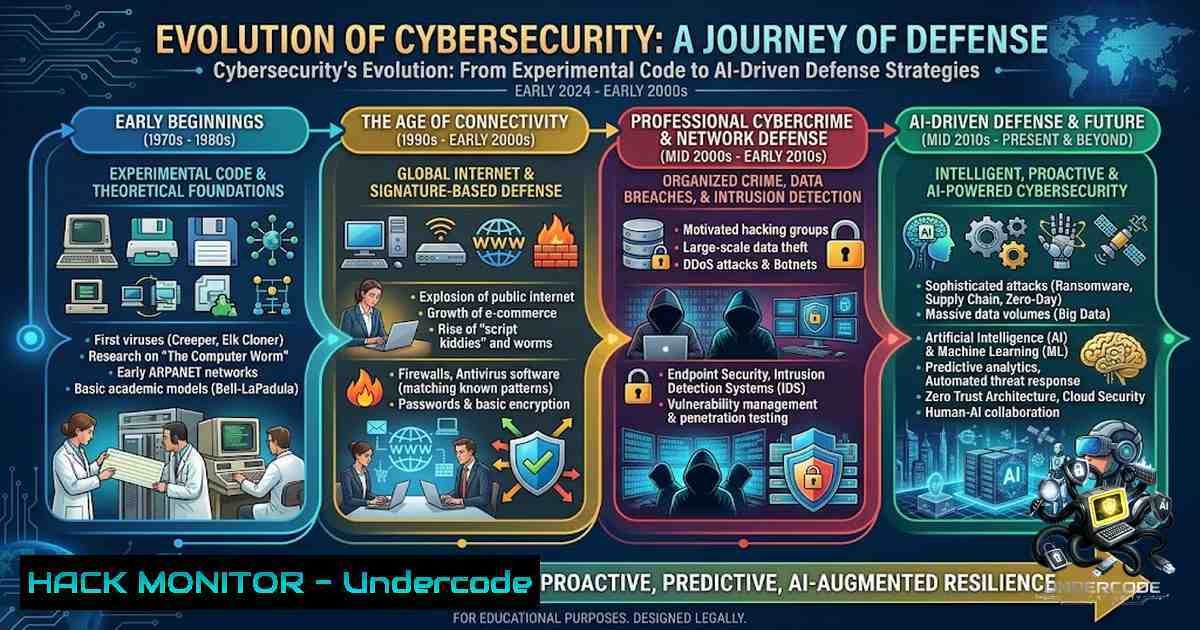
The digital frontier has transformed from a small network of research computers into a global infrastructure underpinning modern civilization. This evolution, however, has been paralleled by an equally sophisticated progression of threats, starting from benign experimental worms to today’s state-sponsored ransomware and AI-powered attacks. Understanding this historical trajectory is not merely an academic exercise; it is critical for any security professional aiming to build resilient defenses against the multi-vector threats of the modern era.
Learning Objectives:
- Understand the chronological evolution of cybersecurity threats and the corresponding defensive technologies.
- Identify the core technologies (firewalls, AV, EDR, AI) that define each major cybersecurity era and their modern implementations.
- Gain practical knowledge of commands and tools used for system hardening and threat analysis in contemporary Linux and Windows environments.
You Should Know:
- The Foundational Era: ARPANET, Creeper, and the Birth of Antivirus (1970s)
The journey began with the Creeper virus, an experimental self-replicating program designed to move across ARPANET nodes. Its successor, Reaper, was the first known antivirus software, tasked with hunting and deleting Creeper. This cat-and-mouse game established the fundamental cybersecurity dynamic: a new threat emerges, and a countermeasure is subsequently developed. While basic, this era set the precedent for vulnerability research and patch management, a discipline now formalized through CVEs and bug bounty programs.
To understand this foundational network movement, modern penetration testers often use tools like `traceroute` or `nmap` to map network topologies. On Linux, a simple network path discovery command is:
traceroute -1 example.com
On Windows, the equivalent is:
tracert -d example.com
These commands illustrate the packet-hopping principle that made Creeper’s initial propagation possible, providing a low-level view of how data navigates networks.
- The Commercialization Era: PC Threats and the Rise of the AV Industry (1980s)
The “Brain” virus of 1986 marked the shift from academic experiments to real-world threats against personal computers. This boot sector virus spread via floppy disks, prompting the creation of the commercial antivirus industry. This era highlighted signature-based detection—identifying malware by its unique code fingerprint. While still used today, this approach is increasingly ineffective against polymorphic malware. Today, this concept is scaled into enterprise-grade Endpoint Detection and Response (EDR) systems.
For an analyst investigating suspicious processes on a modern Windows system, PowerShell is invaluable. To list active network connections and associated process IDs (PID), mirroring the identification of malicious “Brain-like” activity, use:
netstat -ano | findstr LISTEN
On Linux, the corresponding command to view active listening ports and associated binaries is:
sudo ss -tulpn
These commands are the basic building blocks of incident response, enabling analysts to identify unauthorized services or backdoors on a system.
- The Internet Age: Firewalls, Encryption, and the Perimeter (1990s)
As the web went mainstream, the need for network-level security became paramount. Firewalls and Virtual Private Networks (VPNs) emerged as primary defenses, creating a hardened perimeter around corporate networks. This era also saw the rise of the “script kiddie” and the commoditization of hacking tools. The concept of defense-in-depth took root, where security was layered across the network perimeter, not just on the endpoint. Modern equivalents include Cloud Access Security Brokers (CASBs) and Secure Web Gateways (SWGs).
To inspect and manipulate network traffic at the operating system level, Linux administrators rely on `iptables` (or nftables). A command to block a specific IP address—a fundamental firewall task—is:
sudo iptables -A INPUT -s 192.168.1.100 -j DROP
For Windows, the native firewall is managed via `netsh` or the newer New-1etFirewallRule. To block an IP with PowerShell:
New-1etFirewallRule -DisplayName "Block IP" -Direction Inbound -Action Block -RemoteAddress 192.168.1.100
These commands demonstrate the foundational security configurations that protect servers from unauthorized access.
- The Modern Era: Cloud, Ransomware, and AI-Driven Security (2020s+)
Today’s landscape is dominated by sophisticated ransomware gangs, zero-day vulnerabilities, and the weaponization of AI. Attackers leverage AI for social engineering and vulnerability discovery, while defenders use it for threat intelligence and automated response. The cloud has eliminated the traditional network perimeter, making identity and access management (IAM) the new security frontier. Concepts like Zero Trust Architecture (ZTA) require constant verification of every user, device, and application.
Hardening a cloud instance often involves securing SSH access. A crucial step is disabling password-based authentication in favor of SSH keys. On a Linux server, edit the `/etc/ssh/sshd_config` file:
sudo nano /etc/ssh/sshd_config
Find the line `PasswordAuthentication yes` and change it to:
PasswordAuthentication no
Then restart the SSH service:
sudo systemctl restart sshd
For Azure or AWS, this coincides with configuring Network Security Groups (NSGs) to restrict inbound traffic, highlighting the convergence of OS-level and cloud-level security practices.
- API Security and Tool Configuration in the CI/CD Pipeline
Modern applications are built on APIs, making them a prime attack vector. Insecure Direct Object References (IDOR) and Broken Object Level Authorization (BOLA) are common API flaws. A step-by-step guide to testing an API endpoint for basic authentication bypass using `curl` on Linux, which simulates a malicious request:
– Step 1: Capture a legitimate request using Burp Suite or a browser DevTools.
– Step 2: Use `curl` to replay the request with an altered user ID.
curl -X GET "https://api.example.com/user/123" -H "Authorization: Bearer YOUR_TOKEN"
– Step 3: Change the `123` to `124` and observe if the response returns data for a different user. If it does, the API is vulnerable to BOLA.
This manual testing is crucial before automating security checks within a CI/CD pipeline using tools like OWASP ZAP.
- Vulnerability Exploitation and Mitigation: The Active Directory Reality
Active Directory (AD) remains the cornerstone of enterprise authentication, making it a prime target. The “Golden Ticket” attack, which exploits the Kerberos authentication protocol, is a prime example of how a single misconfiguration can lead to total domain compromise. To mitigate this, defense-in-depth strategies for AD include:
– Implementing a Tiered Administrative Model to segregate admin accounts.
– Deploying Microsoft Defender for Identity to detect anomalous behavior.
– Enforcing the principle of “least privilege” by auditing and removing unnecessary user rights.
A PowerShell command to list all users with administrative privileges (potentially unnecessary) is:
Get-ADGroupMember -Identity "Domain Admins" | ft Name
This visibility is the first step in reducing the attack surface.
What Undercode Say:
- Key Takeaway 1: The history of cybersecurity is a relentless cycle of threat innovation and defense countermeasure. The current focus on AI threats is a natural progression, and organizations must adapt by integrating AI into their defensive strategies.
- Key Takeaway 2: While the tools and complexities have changed, the core principles remain: understanding your network, verifying access, and maintaining meticulous configuration hygiene are more critical than ever.
Analysis: The text beautifully summarizes the technological leaps from a simple experiment to global infrastructure protection. However, the crucial takeaway is that this evolution is accelerating. The move to the cloud and AI is not just a technological shift but a paradigm change where the perimeter has vanished and threats are autonomous. The professional must now focus on identity, data protection, and automated response. The historical perspective should not be nostalgic but instructive: we are still fighting the same fundamental battle for integrity and confidentiality, but with exponentially higher stakes.
Prediction:
- -1: Legacy organizations that fail to adopt a Zero Trust architecture will likely face catastrophic breaches within the next 24 months as AI-driven attacks automate the exploitation of outdated perimeter defenses.
- +1: The integration of Generative AI into defensive security will lead to “self-healing” networks that can autonomously isolate threats and rollback encrypted data in seconds, significantly reducing the average breach lifecycle.
- +1: A new wave of “Cybersecurity Historians” will emerge as a niche role within GRC teams, providing context and precedent to analysts to help them identify novel attack patterns that bypass signature-based and behavior-based detection.
- +1: The creation of comprehensive, attack-specific training courses, akin to the “Cybersecurity History” lesson, will become mandatory onboarding material for all security staff to establish a fundamental understanding of threat evolution.
- -1: The weaponization of AI for social engineering will lead to a dramatic increase in Business Email Compromise (BEC) attacks, rendering traditional phishing training modules obsolete within the next year.
- +1: There will be a resurgence of interest in “simple” security measures like network segmentation and explicit firewalls, as organizations realize that cloud complexity often obscures the foundational security principles from the 1990s.
- +1: The technical commands used for system monitoring (
ss,netstat,iptables) will be re-engineered into AI-driven scripts that provide contextual alerts, increasing the efficiency of SOC analysts.
▶️ Related Video (90% Match):
🎯Let’s Practice For Free:
🎓 Live Courses & Certifications:
Join Undercode Academy for Verified Certifications
🚀 Request a Custom Project:
Secure, high-velocity infrastructure and disruptive technological engineering. Contact our engineering team for high-tier development and proprietary systems:
[email protected]
💎 Smart Architecture | 🛡️ Secure by Design | ⭐ Trusted by Thousands
IT/Security Reporter URL:
Reported By: https://lnkd.in/p/evmckhwp – Hackers Feeds
Extra Hub: Undercode MoN
Basic Verification: Pass ✅


