Listen to this Post
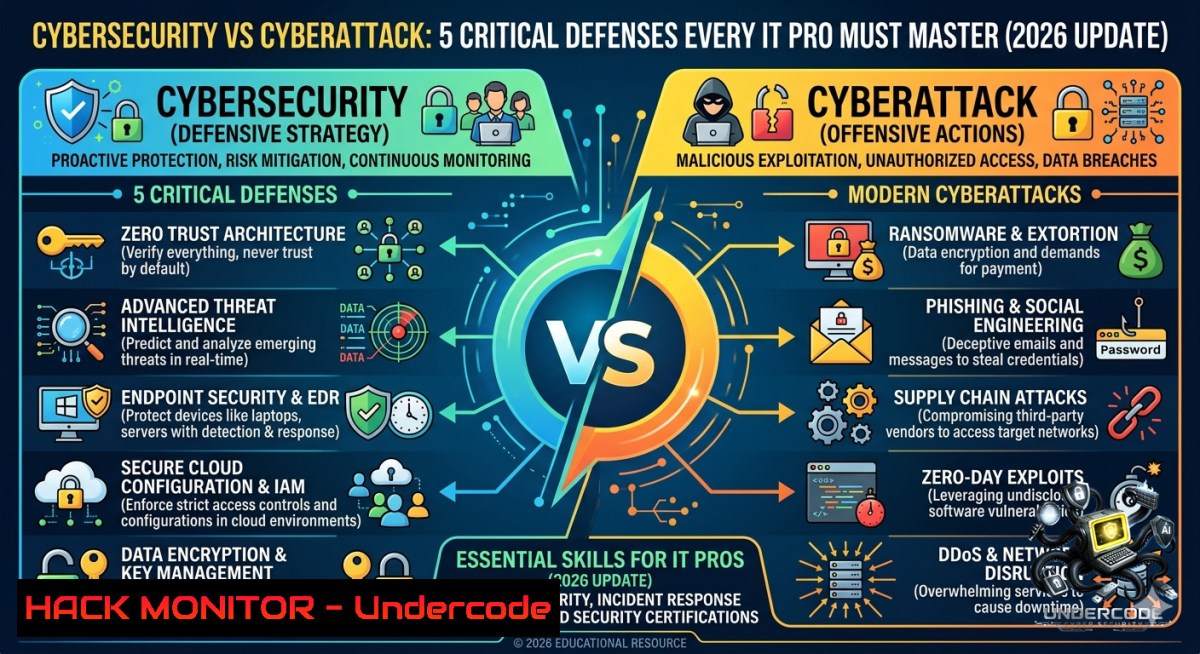
Introduction:
Cybersecurity is the proactive discipline of protecting systems, networks, and data from digital threats, whereas a cyberattack represents the adversarial execution of exploits, malware, or social engineering to breach those defenses. Understanding this fundamental tension is essential for IT professionals who must build resilient architectures while anticipating real-world attack vectors used in modern breaches.
Learning Objectives:
– Differentiate between defensive cybersecurity strategies and offensive cyberattack methodologies.
– Implement practical Linux and Windows commands to detect, block, and log common attack patterns.
– Apply cloud hardening and API security controls based on real-world threat intelligence.
You Should Know:
1. Defensive Logging & Attack Surface Reconnaissance
Start with an extended version of what the post is saying: The LinkedIn post highlights the constant arms race between cybersecurity teams (blue team) and adversaries (red team). To win, defenders must first understand how attackers gather information. Below are verified commands to audit your own attack surface before an attacker does.
Step‑by‑step guide explaining what this does and how to use it:
On Linux (network reconnaissance and service enumeration):
 Discover open ports and running services (requires root)
sudo nmap -sS -sV -p- 192.168.1.0/24 --open

 List listening TCP/UDP sockets
ss -tulpn

 Enumerate firewall rules (iptables)
sudo iptables -L -1 -v
On Windows (PowerShell as Administrator):
 Show active network connections
netstat -anob

 Detect open firewall ports
Get-1etFirewallRule | where {$_.Enabled -eq "True"} | Format-Table DisplayName, Direction, Action

 List scheduled tasks that could be abused
Get-ScheduledTask | where {$_.State -1e "Disabled"}
These commands help you see your system from an attacker’s perspective. Run them weekly to spot unexpected open ports or weak service configurations.
2. Malicious Process Detection & Mitigation
Step‑by‑step guide explaining what this does and how to use it:
Attackers often inject code into legitimate processes. Use these steps to hunt for anomalies.
Linux – Identify suspicious processes:
 List processes with network connections, including PID and binary path
lsof -i -P -1 | grep LISTEN

 Check for processes running from unusual directories (e.g., /tmp)
ps aux | awk '{print $11}' | grep -E '^(/tmp|/dev/shm|/var/tmp)'

 Monitor real-time process creation (auditd)
sudo auditctl -a always,exit -F arch=b64 -S execve -k process_monitor
Windows – Leverage built-in tools:
 Get processes with network connections and show command line
Get-Process | Where-Object {$_.Path -like "\Temp\" -or $_.Path -like "\AppData\"} | Select ProcessName, Id, Path

 Use Sysinternals Autoruns to detect persistence (download from Microsoft)
.\Autoruns64.exe -accepteula -a -c > autoruns.csv

 Check for unsigned drivers (common rootkit vector)
Get-WindowsDriver -Online | Where-Object {$_.DriverSignature -1e "Valid"}
If you find an unknown process in `/tmp` or `%TEMP%`, immediately isolate the host and collect memory dump for analysis.
3. API Security Hardening (REST & GraphQL)
Modern attacks target APIs directly. Below is a configuration checklist for cloud-1ative environments.
Step‑by‑step guide for API gateway hardening (using NGINX as example):
 Limit request rate to prevent brute force
limit_req_zone $binary_remote_addr zone=api:10m rate=10r/s;

 Block common API attack patterns
if ($request_uri ~ "(?i)(union.select|exec.xp_cmdshell|\.\.\/)") {
return 403;
}

 Enforce JWT validation (example using Lua script)
location /api/ {
access_by_lua_block {
local jwt = require("resty.jwt")
local token = ngx.var.http_authorization
if not token then
ngx.exit(401)
end
}
proxy_pass http://backend_api;
}
For AWS API Gateway (policy snippet):
{
"Version": "2012-10-17",
"Statement": [{
"Effect": "Deny",
"Action": "execute-api:Invoke",
"Resource": "arn:aws:execute-api:::",
"Condition": {
"NumericLessThan": {"aws:TokenIssueTime": "3600"}
}
}]
}
Implement rate limiting, input validation, and short-lived tokens to reduce API attack surface.
4. Cloud Hardening Against Credential Theft (Azure & AWS)
Attackers frequently abuse over-privileged identities. Use these commands to enforce least privilege.
Step‑by‑step guide for Azure CLI (install Azure CLI first):
 List all role assignments with high risk (Owner, Contributor)
az role assignment list --include-inherited --query "[?roleDefinitionName=='Owner' || roleDefinitionName=='Contributor']"

 Enable just-in-time (JIT) VM access
az vm update --resource-group myRG --1ame myVM --set securityProfile.jitEnabled=true

 Find unused service principals (attackers love dormant SPNs)
az ad sp list --filter "accountEnabled eq true" --query "[?appDisplayName!=null]"
AWS CLI hardening:
 Detect unused IAM keys older than 90 days
aws iam list-access-keys --user-1ame admin-user | jq '.AccessKeyMetadata[] | select(.CreateDate < `date -d "90 days ago" +%Y-%m-%d`)'

 Enforce MFA on all console users
aws iam get-account-summary --query 'SummaryMap.AccountMFAEnabled'
Rotate keys every 30 days and remove inactive identities immediately.
5. Vulnerability Exploitation (Simulated) & Patching Strategy
Understanding how exploits work helps defenders prioritize patches. Below is a simulated local privilege escalation (LPE) check on Linux, followed by mitigation.
Step‑by‑step guide – testing for CVE-2021-3156 (sudo buffer overflow):
 Check sudo version (vulnerable: 1.8.25p1 to 1.8.31)
sudo --version

 Test exploit without harming system (safe test)
sudoedit -s '\' `perl -e 'print "A" x 1000'`
 If it crashes, patch immediately.
Mitigation on Linux:
 Update sudo package
sudo apt update && sudo apt upgrade sudo -y  Debian/Ubuntu
sudo yum update sudo -y  RHEL/CentOS

 Alternatively, remove setuid bit from sudoedit as temporary workaround
sudo chmod 0755 /usr/bin/sudoedit
Windows LPE mitigation (mitigating PrintNightmare style):
 Check for missing patches
Get-HotFix | Where-Object {$_.HotFixID -like "KB500"}

 Disable vulnerable print spooler if not needed
Stop-Service Spooler -Force
Set-Service Spooler -StartupType Disabled
Apply patches within 48 hours for CVSS ≥ 7.0 and use automated vulnerability scanners (e.g., OpenVAS, Nessus).
What Undercode Say:
– Defenders must simulate attacks to truly understand their blind spots; passive protection is never enough.
– The most effective security teams blend real-time monitoring (SIEM) with proactive hardening (CIS benchmarks).
What Undercode Say:
– Key Takeaway 1: Cybersecurity is not a product but an iterative process – every new cyberattack method forces defenders to update logging, patching, and access controls.
– Key Takeaway 2: Training courses (like SANS SEC504 or OSCP) that combine Linux/Windows command-line proficiency with cloud API security yield the highest ROI for blue teams.
Expected Output:
Introduction:
Cybersecurity is the proactive discipline of protecting systems, networks, and data from digital threats, whereas a cyberattack represents the adversarial execution of exploits, malware, or social engineering to breach those defenses. Understanding this fundamental tension is essential for IT professionals who must build resilient architectures while anticipating real-world attack vectors used in modern breaches.
What Undercode Say:
– Key Takeaway 1: Defenders must simulate attacks to truly understand their blind spots; passive protection is never enough.
– Key Takeaway 2: The most effective security teams blend real-time monitoring (SIEM) with proactive hardening (CIS benchmarks).
Expected Output:
Prediction:
+1 Organizations will adopt “adversarial validation” pipelines – using AI to automatically test every code commit against known attack patterns, reducing mean time to patch from weeks to hours.
-1 Traditional perimeter-based training (firewall certifications without hands-on logging) will become obsolete by 2028 as cloud-1ative attacks bypass network controls entirely.
+1 The rise of generative AI will double the speed of both attack automation and defense scripting; expect LLM-powered SIEM queries to become standard within 18 months.
▶️ Related Video (82% Match):
🎯Let’s Practice For Free:
🎓 Live Courses & Certifications:
[Join Undercode Academy for Verified Certifications](https://undercode.co.uk/certifications/)
🚀 Request a Custom Project:
Secure, high-velocity infrastructure and disruptive technological engineering. Contact our engineering team for high-tier development and proprietary systems:
[[email protected]](mailto:[email protected])
💎 Smart Architecture | 🛡️ Secure by Design | ⭐ Trusted by Thousands
IT/Security Reporter URL:
Reported By: [Cybersecurity Vs](https://www.linkedin.com/posts/cybersecurity-vs-cyberattack-ugcPost-7469463537577316352-o2gh/) – Hackers Feeds
Extra Hub: Undercode MoN
Basic Verification: Pass ✅
🔐JOIN OUR CYBER WORLD [ CVE News • HackMonitor • UndercodeNews ]
[💬 Whatsapp](https://undercode.help/whatsapp) | [💬 Telegram](https://t.me/UndercodeCommunity)
📢 Follow UndercodeTesting & Stay Tuned:
[𝕏 formerly Twitter 🐦](https://x.com/undercodeupdate) | [@ Threads](https://www.threads.net/@undercodetesting) | [🔗 Linkedin](https://www.linkedin.com/company/undercodetesting/) | [🦋BlueSky](https://bsky.app/profile/undercode.bsky.social)


