Listen to this Post
Introduction
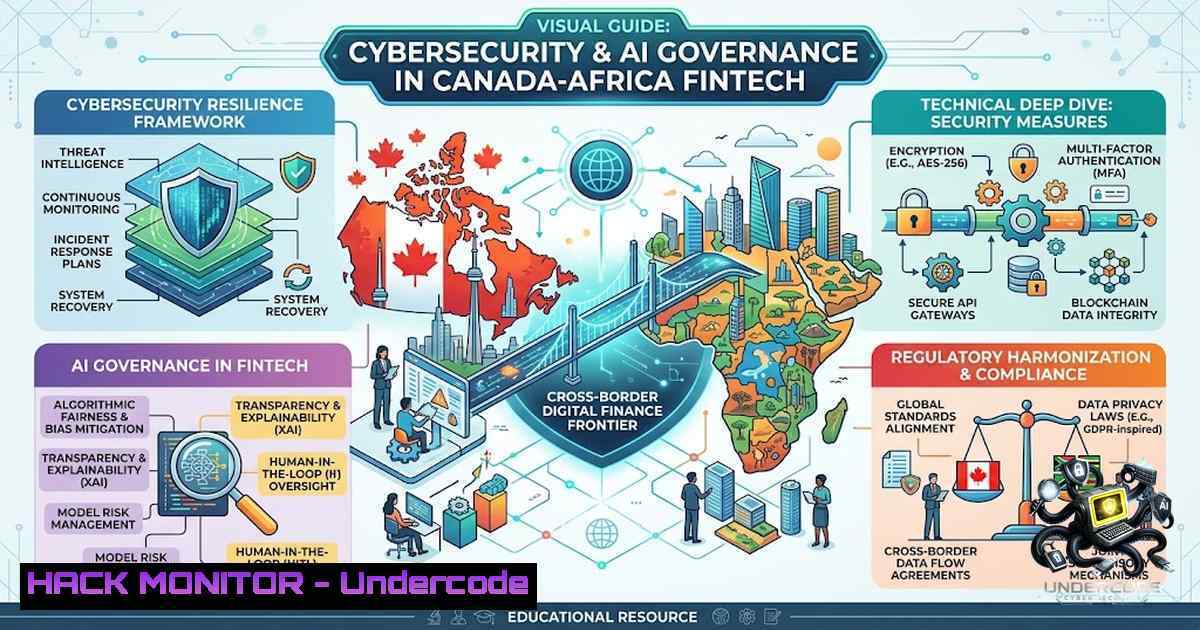
The convergence of artificial intelligence, cross-border digital finance, and escalating cyber threats has created a complex risk landscape that demands sophisticated governance frameworks and proactive security measures. As financial institutions expand their digital footprints across continents—exemplified by initiatives like the Canada–Africa Fintech Summit (CAFS)—the imperative to implement robust cybersecurity controls and ethical AI governance has never been more critical. This article examines the technical pillars of securing fintech ecosystems, drawing on insights from industry leaders and established risk management frameworks.
Learning Objectives
- Understand the core components of AI governance frameworks applicable to financial institutions, including NIST AI RMF and the Financial Services AI RMF (FS AI RMF)
- Master practical cybersecurity hardening techniques for fintech infrastructure across Linux and Windows environments
- Implement cross-border digital finance security controls aligned with global compliance standards
You Should Know
1. AI Governance Frameworks for Financial Institutions
The financial services sector has witnessed a paradigm shift in AI risk management, moving from ethical intent to demonstrable, auditable, and transparent risk control. The U.S. Treasury’s Financial Services AI Risk Management Framework (FS AI RMF), which adapts the 2023 NIST AI Risk Management Framework, provides the industry with a shared vocabulary and a common control architecture for governing AI—from fraud detection to customer engagement to internal productivity tools.
The FS AI RMF is structured around four integrated components: an AI Adoption Stage Questionnaire that determines institutional maturity, a Risk and Control Matrix (RCM) that maps applicable controls, a Guidebook providing implementation guidance, and a Control Objective Reference Guide offering detailed technical support. Institutions are categorized into four maturity levels—Initial, Minimal, Evolving, or Embedded—with control objectives scaling from 21 to 230 depending on the stage.
Practical Implementation: Building an AI Inventory
One of the fundamental challenges in AI governance is that you cannot govern what you cannot see. Organizations must build a comprehensive AI inventory spanning everything from production chatbots to enterprise-wide ChatGPT deployments. The following command can help system administrators identify AI-related processes and services running on Linux servers:
 Identify AI/ML related processes
ps aux | grep -E 'tensorflow|pytorch|keras|openai|anthropic|llama|transformers|langchain' | grep -v grep

List installed Python AI/ML packages
pip list | grep -E 'tensorflow|torch|keras|scikit-learn|transformers|langchain|openai'

Scan for containerized AI workloads
docker ps --format "table {{.Names}}\t{{.Image}}\t{{.Status}}" | grep -E 'ai|ml|llm|model'

Windows PowerShell equivalent for AI process detection
Get-Process | Where-Object { $<em>.ProcessName -match 'python|node|java' } | ForEach-Object { Get-WmiObject Win32_Process -Filter "ProcessId = $($</em>.Id)" | Select-Object CommandLine } | Select-String -Pattern 'tensorflow|torch|keras|openai|langchain'
The FINOS AI Governance Framework v1.0 offers another valuable resource, mutualizing 18 top-level risk categories and 17 implementable controls aligned to NIST RMF, OWASP, and EU AI Act mapping. This framework includes operational playbooks for red teaming, prompt-injection testing, and continuous monitoring contributed by member banks.
2. Cross-Border Digital Finance Security Controls
Cross-border digital finance introduces unique security challenges, including varying regulatory regimes, diverse technical standards, and increased exposure to cyber threats. Every player touching cross-border flows, including non-bank remittance providers, must deploy bank-grade controls encompassing customer due diligence, ongoing transaction monitoring, sanctions screening, and robust technology-risk management.
API Security Hardening for Fintech Integration
Securing APIs that facilitate cross-border financial transactions is paramount. Implement the following measures:
 Linux: Implement rate limiting using iptables to prevent API abuse
iptables -A INPUT -p tcp --dport 443 -m connlimit --connlimit-above 100 -j DROP

Linux: Monitor API endpoint access patterns
tail -f /var/log/nginx/access.log | awk '{print $1, $7, $9}' | sort | uniq -c | sort -1r

Linux: Scan for exposed API keys in repositories
grep -r --include=".{js,py,java,go,json,yaml,yml}" -E "(api[_-]?key|apikey|secret|token|auth)" . 2>/dev/null | grep -v ".git"

Windows: Monitor API traffic using PowerShell
Get-1etTCPConnection -State Established | Where-Object { $<em>.LocalPort -eq 443 -or $</em>.LocalPort -eq 8443 } | Format-Table LocalAddress, LocalPort, RemoteAddress, RemotePort, State
Real-time Fraud Surveillance
Financial institutions are increasingly required to implement real-time fraud surveillance directed at detecting unauthorized transactions. Scam prevention and anti-money laundering are no longer compliance checkboxes but operational imperatives.
3. Cyber Resilience and Incident Management
Dr. Adefemi Debo-Omidokun, a featured speaker at CAFS 2026, has emphasized the urgency of strong cybersecurity hygiene and practices, noting that even major technology companies remain vulnerable to attacks such as password spraying. The Microsoft breach by Russian hackers—where attackers had potential access for about two months before detection—underscores the need for continuous vigilance in the evolving landscape of cyber threats.
Implementing Continuous Monitoring
 Linux: Set up file integrity monitoring with AIDE
aide --init
mv /var/lib/aide/aide.db.new.gz /var/lib/aide/aide.db.gz
aide --check

Linux: Monitor for unauthorized sudo usage
grep "sudo" /var/log/auth.log | tail -20

Linux: Check for failed login attempts (potential password spraying)
grep "Failed password" /var/log/auth.log | awk '{print $9}' | sort | uniq -c | sort -1r

Windows: Audit failed logon events using PowerShell
Get-WinEvent -FilterHashtable @{LogName='Security'; ID=4625} -MaxEvents 50 | Format-Table TimeCreated, @{n='Account';e={$<em>.Properties[bash].Value}}, @{n='Source IP';e={$</em>.Properties[bash].Value}}
4. Cloud Hardening for Fintech Workloads
As fintech increasingly migrates to cloud environments, implementing cloud-specific security controls is essential. The CRI Profile remains a globally recognized, industry-developed framework that connects threats to mitigating controls and associated compliance requirements—providing a comprehensive view of cyber and technology risk from the server room to the boardroom.
Cloud Security Configuration
 AWS: Enable CloudTrail for comprehensive audit logging
aws cloudtrail create-trail --1ame fintech-audit-trail --s3-bucket-1ame fintech-logs --is-multi-region-trail

AWS: Configure GuardDuty for threat detection
aws guardduty create-detector --enable

Azure: Enable Azure Security Center monitoring
az security auto-provisioning-setting update --1ame default --auto-provision On

GCP: Enable Cloud Security Command Center
gcloud scc settings create --organization=YOUR_ORG_ID --enable-security-center
5. Vulnerability Exploitation and Mitigation
Understanding common attack vectors in fintech environments is crucial for effective defense. Password spraying attacks, as demonstrated in the Microsoft breach, remain a significant threat. Implementing multi-factor authentication (MFA) and enforcing strong password policies are foundational controls.
Implementing MFA and Strong Authentication
 Linux: Configure PAM for strong password policies
echo "password requisite pam_pwquality.so retry=3 minlen=12 difok=3 ucredit=-1 lcredit=-1 dcredit=-1 ocredit=-1" >> /etc/pam.d/common-password

Linux: Enforce account lockout after failed attempts
echo "auth required pam_tally2.so onerr=fail deny=5 unlock_time=900" >> /etc/pam.d/common-auth

Windows: Set account lockout policy via PowerShell
net accounts /lockoutthreshold:5 /lockoutduration:15 /lockoutwindow:15
6. Ethical AI Adoption in Financial Services
The ethical deployment of AI in financial services requires adherence to principles of transparency, accountability, privacy, and safety. The Financial Stability Board has outlined 12 sound practices spanning organization-wide governance and the full AI lifecycle, from inception through to retirement.
AI Model Validation and Monitoring
 Python: Implement model drift detection
import pandas as pd
from scipy.stats import ks_2samp

def detect_drift(reference_data, current_data, threshold=0.05):
statistic, p_value = ks_2samp(reference_data, current_data)
return p_value < threshold  Drift detected if p-value below threshold

Example usage
reference = pd.read_csv('reference_predictions.csv')
current = pd.read_csv('current_predictions.csv')
drift_detected = detect_drift(reference['score'], current['score'])
What Undercode Say
- Key Takeaway 1: AI governance in financial services is transitioning from voluntary ethical guidelines to mandatory, auditable risk management frameworks, with the FS AI RMF establishing a common control architecture that scales from 21 to 230 control objectives based on institutional maturity. Organizations must prioritize building comprehensive AI inventories as a foundational step.
-
Key Takeaway 2: Cross-border digital finance requires bank-grade security controls across the entire ecosystem, including real-time fraud surveillance, API security hardening, and continuous monitoring. The integration of AI into fraud detection and compliance processes—such as Know Your Transaction (KYT) and AML/CFT—represents both an opportunity and a risk that must be managed through robust governance frameworks.
Analysis: The Canada–Africa Fintech Summit represents a microcosm of the broader digital finance transformation occurring globally. As financial institutions expand across borders, the attack surface expands exponentially. The convergence of AI adoption, cross-border data flows, and evolving regulatory requirements creates a complex environment where traditional security controls are insufficient. Organizations must adopt a proactive, defense-in-depth approach that integrates AI governance, continuous monitoring, and robust incident response capabilities. The insights shared by industry leaders like Dr. Adefemi Debo-Omidokun—with his extensive experience at the Bank of Canada, Export Development Canada, and Emrads—highlight the critical importance of cyber resilience and AI risk governance in shaping the future of digital finance.
Prediction
- +1 The formalization of AI governance frameworks like the FS AI RMF will accelerate fintech innovation by providing clear regulatory guardrails, reducing compliance uncertainty, and enabling financial institutions to deploy AI solutions with greater confidence.
-
+1 Cross-border fintech partnerships, exemplified by CAFS 2026, will drive the adoption of standardized security controls and interoperable compliance mechanisms, reducing friction in international digital finance transactions.
-
-1 The sophistication of AI-enabled cyberattacks, including automated vulnerability discovery and adaptive threat vectors, will outpace traditional security controls, requiring continuous investment in AI-driven defense mechanisms.
-
-1 Financial institutions that fail to build comprehensive AI inventories and implement robust governance frameworks will face significant regulatory penalties, reputational damage, and increased exposure to cyber incidents.
-
+1 The open-source collaboration exemplified by FINOS AI Governance Framework v1.0 will democratize AI risk management, enabling smaller financial institutions to leverage shared controls and industry-standard practices without duplicating months of policy writing and audit effort.
▶️ Related Video (72% Match):
https://www.youtube.com/watch?v=0cstRKRxh6w
🎯Let’s Practice For Free:
🎓 Live Courses & Certifications:
Join Undercode Academy for Verified Certifications
🚀 Request a Custom Project:
Secure, high-velocity infrastructure and disruptive technological engineering. Contact our engineering team for high-tier development and proprietary systems:
[email protected]
💎 Smart Architecture | 🛡️ Secure by Design | ⭐ Trusted by Thousands
IT/Security Reporter URL:
Reported By: Cafs2026 Nidec2026 – Hackers Feeds
Extra Hub: Undercode MoN
Basic Verification: Pass ✅


