Listen to this Post
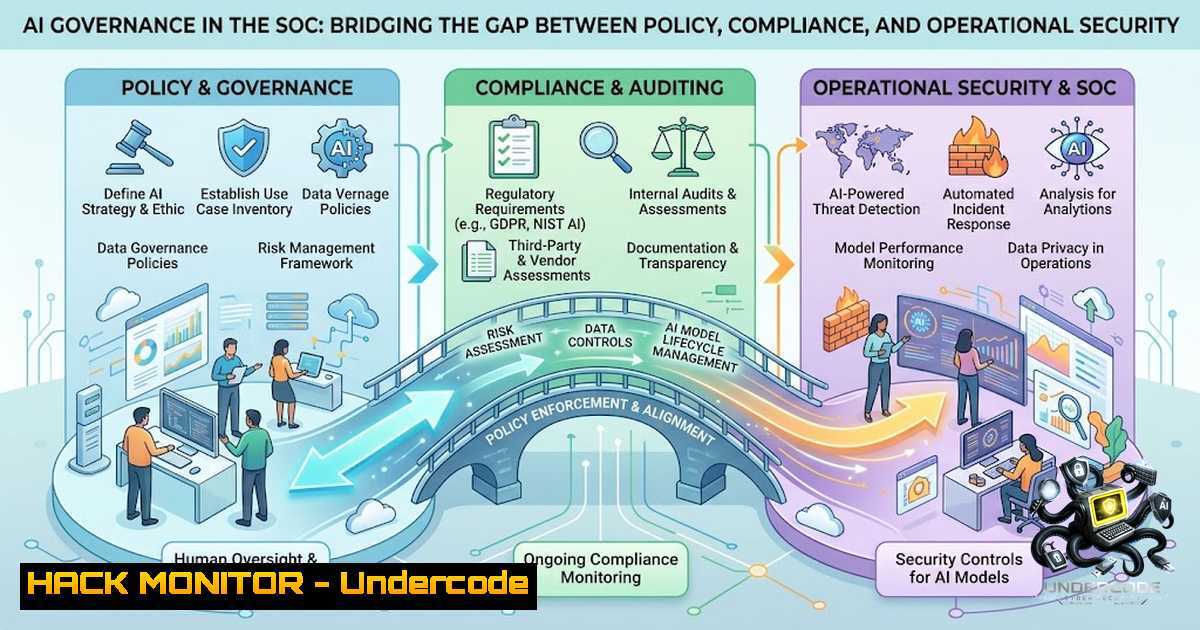
Introduction:
The integration of Artificial Intelligence into enterprise environments has fundamentally altered the cybersecurity landscape, introducing novel attack surfaces and complex governance challenges. As organizations race to adopt AI for operational efficiency, security operations centers (SOCs) and governance, risk, and compliance (GRC) teams must contend with adversarial AI attacks, data poisoning, supply chain vulnerabilities, and the critical need for demonstrable compliance. The recent evolution of frameworks such as the NIST CSF 2.0 with its new Govern function, alongside the draft Cyber AI Profile (NIST IR 8596), marks a pivotal shift: AI-specific controls are no longer optional but a structural requirement for modern cybersecurity programs. This article provides a technical deep-dive into operationalizing AI governance, securing AI components, and hardening SOC operations against AI-boosted threats.
Learning Objectives:
- Understand the three distinct angles of AI cybersecurity as defined by NIST IR 8596: securing AI systems, using AI for defense, and defending against AI-enabled threats.
- Learn to implement AI-specific controls across the NIST CSF 2.0 functions, including asset inventory, data security, and continuous monitoring.
- Acquire practical command-line and API security techniques to harden AI infrastructure, enforce compliance, and mitigate prompt injection and model evasion risks.
You Should Know:
- Operationalizing NIST CSF 2.0 and the Cyber AI Profile
The NIST Cybersecurity Framework 2.0, released in February 2024, introduced a sixth core function—Govern—which mandates that organizations establish, communicate, and monitor cybersecurity risk management strategy across the enterprise. The draft NIST Cyber AI Profile (NIST IR 8596), published in December 2025, applies CSF 2.0 to three distinct AI cybersecurity focus areas: securing AI components, conducting AI-enabled cyber defense, and defending against AI-enabled threats.
For GRC programs still mapped to CSF 1.1, this represents a structural gap. Control mappings, evidence libraries, and assessment questionnaires built for CSF 1.1 do not cover Govern requirements, leaving organizations with unmapped compliance exposure. To address this, GRC teams must extend their existing frameworks to include AI-specific asset types such as models, training datasets, system prompts, fine-tuning checkpoints, embedding models, and retrieval indexes. Under the Protect function, controls must address training data lineage, model weight protection, and prompt-injection-aware input validation.
Step‑by‑step guide: Auditing Your AI Governance Posture Against NIST CSF 2.0
- Inventory AI Assets: Use the following Linux command to scan for common AI model file types across your environment, which helps satisfy the Identify function’s asset management requirements:
find / -type f ( -1ame ".h5" -o -1ame ".pt" -o -1ame ".pth" -o -1ame ".onnx" -o -1ame ".tflite" ) -exec ls -lh {} \; 2>/dev/null | awk '{print $9, $5}' -
Audit Training Data Integrity: Verify the integrity of training datasets using cryptographic hashing to detect unauthorized modifications, aligning with PR.DS controls for data security:
sha256sum /path/to/training/dataset/ > training_data_hashes.txt
Regularly re-run and compare against the baseline
sha256sum -c training_data_hashes.txt
-
Enforce Model Weight Protection: Implement access controls on model weight files using Linux file permissions and ACLs. Store critical model weights in a KMS-protected vault and audit access via KMS audit logs:
Restrict access to model directory
sudo chown -R root:ml-team /opt/models/
sudo chmod -R 750 /opt/models/
Set an ACL for a specific user
sudo setfacl -m u:username:rx /opt/models/
-
Map Controls to Framework: Create a control mapping document that links each identified AI asset and control to the specific NIST CSF 2.0 subcategory (e.g., ID.AM, PR.DS, DE.CM) and the relevant angle from IR 8596.
2. Securing AI APIs and Mitigating Prompt Injection
As organizations expose AI models via APIs, they become prime targets for prompt injection, model evasion, and data extraction attacks. OWASP’s Top 10 for LLM Applications highlights these as critical risks. Traditional web application firewalls (WAFs) are often insufficient against these novel threats, as they cannot inspect the semantic content of prompts. A case study from a global law firm revealed that despite having a security stack including Zscaler and browser security tools, the security team could not determine what sensitive data was being entered into AI prompts, creating a significant governance gap.
To secure AI APIs, organizations must implement input validation, rate limiting, and content inspection at the API gateway level. The principle of least privilege must be extended to AI agents, requiring cryptographically anchored identities and short-lived credentials.
Step‑by‑step guide: Hardening AI API Endpoints
- Implement Input Validation and Sanitization: Use a web application firewall (WAF) or API gateway to filter and sanitize inputs. Below is an example of using `jq` to validate JSON payload structure before it reaches the AI model:
Validate that the input JSON has a "prompt" field and no suspicious keys
if echo "$INPUT_JSON" | jq -e '.prompt | strings' > /dev/null; then
echo "Valid input structure."
Proceed to forward to the AI model
else
echo "Invalid input structure." >&2
exit 1
fi
-
Deploy Rate Limiting with
iptables: Protect against denial-of-service and brute-force attacks on the AI API by limiting connection rates from a single IP:Limit to 10 new connections per minute from a single IP to port 8080 sudo iptables -A INPUT -p tcp --dport 8080 -m state --state NEW -m recent --set sudo iptables -A INPUT -p tcp --dport 8080 -m state --state NEW -m recent --update --seconds 60 --hitcount 10 -j DROP
-
Enforce API Authentication and Authorization: Use mutual TLS (mTLS) or API keys with short-lived validity. For Kubernetes deployments, enforce network policies to restrict which services can communicate with the AI model pod. Below is a sample Kubernetes NetworkPolicy:
apiVersion: networking.k8s.io/v1
kind: NetworkPolicy
metadata:
name: ai-model-ingress
spec:
podSelector:
matchLabels:
app: ai-model
policyTypes:</p></li>
</ol>

<p>- Ingress
ingress:
- from:
- podSelector:
matchLabels:
app: authorized-client
ports:
- protocol: TCP
port: 8080
- Monitor for Anomalous Agent Tool-Use Patterns: Implement continuous monitoring to detect abnormal AI agent behavior, such as unusual tool invocation sequences or embedding-similarity attack signals. Use SIEM solutions to ingest and correlate API logs, looking for spikes in error rates or atypical prompt lengths.
3. Hardening the SOC Against AI-Boosted Attacks
Adversaries are leveraging generative AI for spear-phishing, deepfake-enabled fraud, and accelerated vulnerability discovery. Simultaneously, many SOCs are adopting AI for triage, threat hunting, and response automation, introducing risks around AI agent autonomy, false-positive rates, and accountability. Modern SOCs must evolve from reactive response to resilient defense by adopting an integration-first strategy, using AI as a force multiplier to reduce alert noise by up to 66%, and freeing analysts for high-value threat hunting.
Agentic AI guidance from CISA and the Five Eyes emphasizes the need for agent-level least-privilege enforcement, human approval gates for high-impact actions, and explicit accountability for system designers. The traditional Tier 1 SOC analyst role is becoming obsolete as agentic AI autonomously handles routine monitoring and triage.
Step‑by‑step guide: Integrating AI into SOC Workflows
- Deploy Threat Intelligence Feeds: Integrate AI-enhanced threat intelligence platforms that correlate data from multiple sources. Use the following Linux command to automate the download and update of threat intelligence feeds (e.g., from CISA or AlienVault OTX):
Download the latest CISA known exploited vulnerabilities catalog
curl -s https://www.cisa.gov/sites/default/files/feeds/known_exploited_vulnerabilities.json | jq '.' > known_exploited_vulns.json
-
Automate Alert Triage with SOAR: Implement a SOAR platform that uses AI to enrich and prioritize alerts. Use Python scripts to query AI models for initial triage. Below is an example using the `requests` library to send alert data to an AI classification endpoint:
import requests import json</p></li> </ol> <p>alert_data = {"alert_id": "12345", "severity": "high", "description": "Suspicious outbound connection"} response = requests.post("https://ai-triage.internal/classify", json=alert_data) classification = response.json() print(f"Alert {alert_data['alert_id']} classified as: {classification['risk_level']}")- Implement Human Approval Gates: For high-impact actions (e.g., blocking an IP range or isolating a critical server), configure the SOAR platform to require manual approval. Use a ticketing system (e.g., Jira, ServiceNow) to create an approval task.
-
Conduct Regular Tabletop Exercises: Simulate AI-boosted attacks (e.g., deepfake social engineering, automated vulnerability scanning) to test the SOC’s detection and response capabilities. Use tools like MITRE CALDERA with AI-specific plugins to emulate adversary behavior.
What Undercode Say:
- Governance is a State Machine, Not a Spreadsheet: AI governance must move from passive documentation to active enforcement. The “Machine Law Engine” concept demonstrates that regulatory compliance can be transformed from a retrospective discipline into a pre-emptive, cryptographically enforced property, making non-compliant operations computationally impossible rather than merely detectable.
- Visibility is the Foundation of AI Security: Organizations cannot secure what they cannot see. The gap between policy and assurance is the most critical vulnerability in AI adoption. Deploying tools that inspect the content of AI prompts (not just the domains being accessed) is essential for protecting sensitive data and demonstrating compliance to regulators and clients.
Analysis: The internship experience at Ulta Beauty highlights a crucial trend: cybersecurity professionals are no longer siloed in technical roles but are increasingly engaged in cross-functional projects that bridge AI, law, and governance. The case study on AI in the legal field underscores the growing demand for GRC expertise that can navigate the complex regulatory landscape surrounding AI. This aligns with the broader industry shift where NIST CSF 2.0 and the Cyber AI Profile are becoming the de facto standards for AI governance. For aspiring cybersecurity professionals, this means that a deep understanding of AI-specific risks, framework implementation, and the ability to translate technical controls into business and legal contexts is no longer a differentiator but a baseline requirement. The future of cybersecurity lies at the intersection of technology, policy, and human judgment, where professionals must be equally comfortable with command-line tools, compliance frameworks, and ethical considerations.
Prediction:
- +1 By 2027, the majority of enterprise GRC programs will have fully integrated NIST CSF 2.0 and the Cyber AI Profile, leading to a standardized approach to AI risk management across industries.
- +1 The adoption of “Governance as Code” and cryptographic enforcement of compliance will significantly reduce the incidence of AI-related data breaches and regulatory fines.
- -1 The rapid deployment of agentic AI without adequate governance frameworks will lead to a surge in high-profile AI security incidents, prompting regulators to impose stricter accountability measures on system designers and deployers.
- +1 SOCs that successfully integrate AI as a force multiplier will achieve a substantial competitive advantage, reducing mean time to detect (MTTD) and respond (MTTR) while improving analyst retention by automating mundane tasks.
- -1 The gap between AI policy and enforcement will persist in organizations that fail to adopt content-inspection tools, leading to an increase in data leakage through AI prompts and a corresponding rise in legal claims, which Gartner expects to top 2,000 by the end of 2026.
▶️ Related Video (80% Match):
🎯Let’s Practice For Free:
🎓 Live Courses & Certifications:
Join Undercode Academy for Verified Certifications
🚀 Request a Custom Project:
Secure, high-velocity infrastructure and disruptive technological engineering. Contact our engineering team for high-tier development and proprietary systems:
[email protected]
💎 Smart Architecture | 🛡️ Secure by Design | ⭐ Trusted by ThousandsIT/Security Reporter URL:
Reported By: Nethrasha Ultabeauty – Hackers Feeds
Extra Hub: Undercode MoN
Basic Verification: Pass ✅🔐JOIN OUR CYBER WORLD [ CVE News • HackMonitor • UndercodeNews ]
📢 Follow UndercodeTesting & Stay Tuned:


