
Listen to this Post
Introduction:
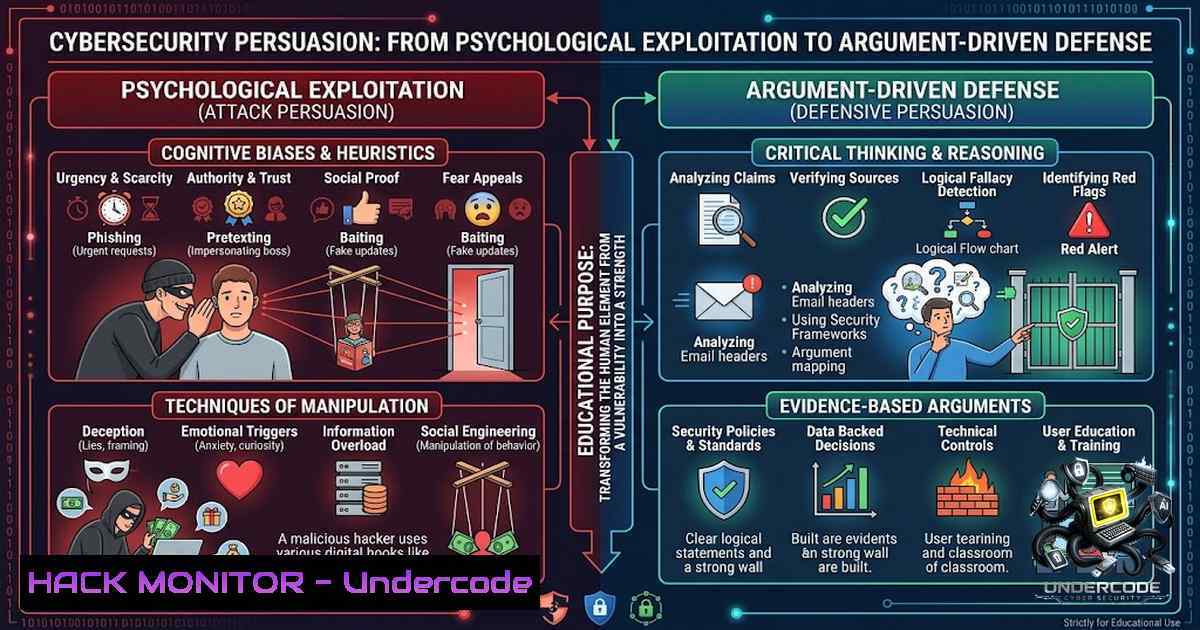
In the high-stakes arena of cybersecurity, traditional marketing and training often rely on psychological triggers—fear of breaches, scarcity of expert talent, or the allure of “silver bullet” AI solutions—to drive action. However, as threats evolve and decision-makers become more technically sophisticated, an “argument-driven” approach proves far more robust. This method, which prioritizes logical evidence, testable claims, and transparent reasoning over manipulative tactics, is transforming how we approach enterprise IT security, cloud hardening, and security training, ensuring that strategies survive the rigorous scrutiny of boards, auditors, and skeptical engineering teams.
Learning Objectives & Secrets:
- Objective 1: Master the art of constructing a verifiable security argument. Instead of marketing a product’s features, learn how to frame your security strategy as a logical claim supported by premises, evidence, and acknowledgment of counterarguments.
- Secret Tip 2: Implement “Falsifiability Testing” in your security audits. A key secret is to actively design tests that could disprove your security controls, rather than just confirming they work. This adversarial mindset is the cornerstone of argument-driven security.
- Secret Tip 3: Leverage evidence-based persuasion for C-level buy-in. The secret to gaining executive support is not exploiting fear, but presenting a clear, logical case with sufficient evidence that aligns with business risk tolerance and regulatory requirements.
You Should Know:
- Building a Verifiable Security Posture for Investors and Boards
Cybersecurity is no longer a purely technical issue; it is a material business risk. Investors and boards possess agency and are increasingly literate in cybersecurity frameworks. To persuade them, you must move beyond “best practices” and adopt a logical, evidence-based approach. This means treating your security posture as a formal argument: a claim (“Our infrastructure is secure against external threats”) must be supported by premises (e.g., “We have implemented multi-factor authentication,” “Our perimeter is defended by next-generation firewalls”) and sufficient evidence (penetration test results, compliance audit reports, and real-time threat intelligence feeds).
Step-by-step guide to constructing an argument-driven security report:
- Define the Claim: Start with a clear, defensible statement. (e.g., “Our AWS environment is hardened against unauthorized access.”)
- List Supporting Premises: Identify the technical controls and policies that validate the claim. (e.g., “All IAM roles follow the principle of least privilege,” “S3 buckets are private and not publicly accessible.”)
- Gather Evidence: Document concrete data. This includes logs, configuration files, and scan results. For example, use `aws s3api get-bucket-acl –bucket your-bucket` to demonstrate a private ACL.
- Address Counterarguments: Acknowledge potential weaknesses. (e.g., “While our perimeter is strong, an insider threat remains a challenge, which is mitigated by UEBA tools.”)
- Draw a Logical Conclusion: Synthesize the evidence to confirm or refute the original claim.
Linux/Windows Commands for Verification:
- Linux (Check for unauthorized open ports): `sudo netstat -tulpn | grep LISTEN` or `ss -tulwn` to audit which services are exposed.
- Windows (Audit local admin accounts): `net localgroup administrators` to verify who has privileged access, a core premise of a secure environment.
- Cloud (AWS IAM policy checker): `aws iam get-account-authorization-details –filter Group User Role` to output a comprehensive list of policies, helping you build the evidence for your security claim.
2. Hardening Cloud Infrastructure with Logic-Driven Configurations
The “argument-driven” approach compels us to configure cloud infrastructure based on logical reasoning rather than checking boxes. It demands a deep understanding of why a specific configuration is required and what assumptions it makes. For instance, assuming that a Virtual Private Cloud (VPC) is secure simply because it’s isolated is a weak premise. A strong argument would include evidence of proper subnetting, security group rules, and flow logs that disallow malicious traffic.
Step-by-step guide to hardening an AWS VPC using argument-driven logic:
1. Claim: “Our VPC is protected against network-based attacks.”
2. Premise 1: “We restrict inbound traffic to only necessary ports.” Action: Configure security groups with specific rules, e.g., allow TCP port 443 (HTTPS) but deny all other inbound traffic.
3. Premise 2: “We monitor and log all network activity.” Action: Enable VPC Flow Logs to capture IP traffic information.
4. Verification: Use the `aws ec2 describe-security-groups` command to retrieve and audit the security group rules as evidence.
5. Troubleshooting: If the claim is challenged (e.g., a breach occurs), the evidence in the logs provides the falsifiability test. If traffic is observed on an unexpected port, the argument is falsified and the configuration must be revised.
Useful Commands:
- Linux CLI: `curl -I https://your-server.com` to test if a web server is responding, a quick check of the service’s availability.
- Windows PowerShell: `Test-1etConnection -Port 443 google.com` to check TCP connectivity and test the network path, which supports a claim about network reliability.
- AWS CLI: `aws cloudtrail lookup-events –lookup-attributes AttributeKey=EventName,AttributeValue=CreateSecurityGroup` to audit the history of security group changes.
3. API Security: The Argument Against Bypass
API endpoints are a prime target for attackers. A marketing approach might promise “state-of-the-art AI protection,” but an argument-driven security engineer asks: “What premises support this API’s security?” The logical case for a secure API rests on strong authentication (JWT/OAuth), strict input validation, and rate limiting. The evidence includes OWASP ZAP or Burp Suite scan reports.
Step-by-step guide to implementing logic-driven API security:
- Claim: “Our RESTful API is resilient to injection attacks.”
- Premise: “We validate and sanitize all user inputs.”
- Implementation: In a Node.js environment, use a library like `express-validator` to systematically check inputs. For Python Flask, use `marshmallow` for data schema validation.
- Testing: Execute a command using `curl` to test for SQL injection weaknesses. For example,
curl -X GET "https://api.example.com/user?id=1%20AND%201=1". - Analysis: If the API returns an error or unexpected data, the premise is invalid. You must update the validation logic. This step-by-step process ensures that your API security is a demonstrable, logical fact, not just a marketing claim.
Mitigation Command (Linux/Unix):
- Setup Rate Limiting (Nginx): If using Nginx as a reverse proxy, add `limit_req_zone $binary_remote_addr zone=api:10m rate=1r/s;` to your config. This makes a strong case for DDoS resilience through evidence of configuration.
4. Vulnerability Exploitation and Mitigation (The Falsifiability Principle)
To truly adopt an argument-driven posture, you must embrace the concept of “falsifiability.” This means actively attempting to exploit your systems to see if your security claims hold up. This is the core of penetration testing. Instead of simply claiming “our firewall is secure,” prove it by trying to bypass it.
Step-by-step guide to conducting a controlled falsifiability test:
- Claim: “Our web application is not vulnerable to Cross-Site Scripting (XSS).”
- Action: Use a browser’s developer tools or a command-line tool like `curl` to inject a test script into a form field. Example:
<script>alert('XSS')</script>. - Observation: If the script executes, your claim is falsified.
- Mitigation: Implement proper encoding and filtering. If using Python, use
html.escape(); in JavaScript, useDOMPurify. - Re-test: Re-run the test to confirm the mitigation. This builds a powerful, evidence-based argument for the application’s security that is far more compelling than a marketing slogan.
-
Training and Awareness: Fostering a Culture of Critical Thinking
The most profound application of the “argument-driven” approach lies in cybersecurity training. Instead of designing courses that exploit fear (like “90% of attacks target people!”), a more effective model encourages critical thinking. The goal is to transform employees from passive recipients of security rules into active participants who can articulate the reasoning behind policies.
Course Outline for a Training Module:
- Module 1: The Argument Against Phishing. Claim: “This email is malicious.” Premises: The domain is misspelled, the request is urgent, and the link leads to an unknown URL. Evidence: Hover over the link to inspect it.
- Practical Exercise:
- Linux: Use `dig` or `nslookup` to investigate a suspicious domain to see its IP address and reputation.
- Windows: Use `Resolve-DnsName` in PowerShell for the same purpose.
- Action: Students must document the premises and evidence to support their conclusion (phishing or legitimate). This method teaches that security decisions must be data-driven and logical, not based on emotion or a gut feeling.
What Undercode Say:
- Key Takeaway 1: The era of manipulating stakeholders through fear and scarcity is over. In cybersecurity, rigorous evidence and clear logic are paramount for persuading technical and non-technical audiences alike.
- Key Takeaway 2: By adopting an “argument-driven” framework, security professionals can proactively identify and patch vulnerabilities before they are exploited, turning their security strategy into a defensible, testable, and falsifiable fact.
Prediction:
- +1: The next wave of cybersecurity certifications will increasingly emphasize argumentative logic and evidence-based reporting, moving beyond rote memorization of attack vectors to testing an analyst’s ability to defend their conclusions.
- +1: AI will serve as a powerful tool to generate “evidence” and “counterarguments” automatically, helping security teams quickly build robust cases for their security posture.
- +1: Companies that adopt this intellectual posture will build stronger trust with investors, customers, and regulators, leading to a competitive advantage and more resilient business models. This shift will demand a new breed of professional who is as skilled in logic and rhetoric as they are in coding and configuration.
▶️ Related Video (92% Match):
🎯Let’s Practice For Free:
🎓 Live Courses & Certifications:
Join Undercode Academy for Verified Certifications
🚀 Request a Custom Project:
Secure, high-velocity infrastructure and disruptive technological engineering. Contact our engineering team for high-tier development and proprietary systems:
[email protected]
💎 Smart Architecture | 🛡️ Secure by Design | ⭐ Trusted by Thousands
IT/Security Reporter URL:
Reported By: https://lnkd.in/p/ebRptJba – Hackers Feeds
Extra Hub: Undercode MoN
Basic Verification: Pass ✅


