Listen to this Post
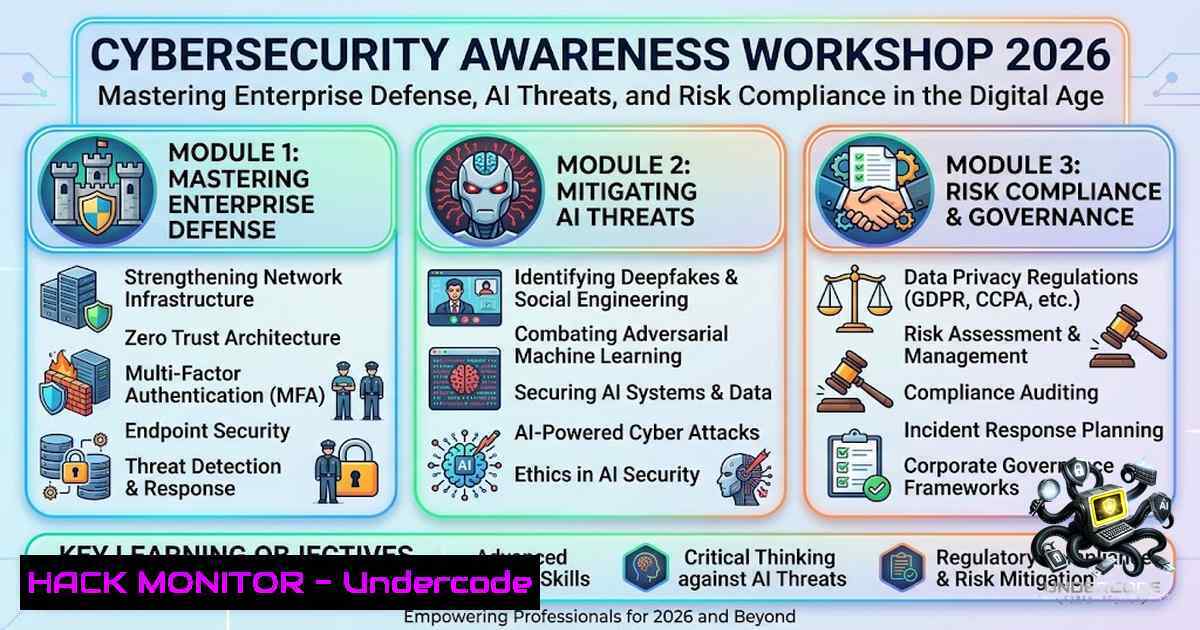
Introduction:
As digital transformation accelerates across industries, organizations face an unprecedented expansion of their attack surface—from cloud-1ative infrastructures to AI-powered applications. The one-day Cybersecurity Awareness Workshop hosted by IIM Bangalore’s Centre for Software & IT Management (CSITM) on 28th August 2026 addresses this critical gap by equipping working professionals with practical knowledge to identify, prevent, and respond to cyber threats in both personal and organizational contexts. Led by industry veterans Samir Khare (former Indian Army airborne forces officer with leadership roles at Capgemini and Mphasis) and Prathima Kasagar (Accenture India’s Cybersecurity Transformation lead with 24 years of experience), the program bridges the chasm between theoretical frameworks and actionable defense strategies.
Learning Objectives:
- Master the Current Threat Landscape – Understand global attack vectors, recent high-profile breaches, and the role of cybersecurity in business continuity.
- Implement Enterprise-Grade Defense – Deploy defense-in-depth architectures, IAM/MFA, EDR, network segmentation, zero trust, and SOC operations.
- Navigate Risk and Compliance Frameworks – Apply NIST, ISO 27001, GDPR, HIPAA, PCI-DSS, and third-party risk management practices.
- Harness AI in Cybersecurity – Leverage AI-powered threat detection, counter generative AI attacks, automate vulnerability management, and secure AI/ML systems.
You Should Know:
1. Defense-in-Depth Architecture: Building Layered Enterprise Security
Defense-in-depth is not merely a concept—it is an operational mandate. This strategy layers multiple independent security controls so that if one fails, others continue to protect the asset. The workshop’s Enterprise Cyber Defense session covers this extensively, emphasizing that no single control is sufficient.
Step-by-Step Guide to Implementing Defense-in-Depth:
- Layer 1 – Perimeter Security: Deploy next-generation firewalls (NGFW) with intrusion prevention systems (IPS). On Linux, use `iptables` or `nftables` for stateful inspection:
Block all incoming traffic except established connections
iptables -A INPUT -m state --state ESTABLISHED,RELATED -j ACCEPT
iptables -A INPUT -p tcp --dport 22 -j ACCEPT  Allow SSH
iptables -A INPUT -j DROP
On Windows, configure Windows Defender Firewall via PowerShell:
New-1etFirewallRule -DisplayName "Block All Inbound" -Direction Inbound -Action Block
- Layer 2 – Network Segmentation: Isolate critical assets using VLANs and micro-segmentation. Verify segmentation with
nmap:nmap -sn 192.168.1.0/24 Discover hosts in subnet
-
Layer 3 – Endpoint Protection: Deploy EDR solutions like CrowdStrike or Microsoft Defender. On Linux, use `auditd` to monitor file integrity:
auditctl -w /etc/passwd -p wa -k identity_changes
-
Layer 4 – Application Security: Implement Web Application Firewalls (WAF) and conduct regular SAST/DAST scans using tools like OWASP ZAP:
zap-cli quick-scan --self-contained --start-options '-host 127.0.0.1 -port 8080' https://target.com
-
Layer 5 – Data Security: Encrypt data at rest and in transit. Use LUKS for disk encryption on Linux:
cryptsetup luksFormat /dev/sdX
cryptsetup open /dev/sdX encrypted_volume
- Identity and Access Management (IAM) with Zero Trust
The workshop emphasizes IAM and MFA as cornerstones of enterprise cyber defense. Zero Trust assumes no implicit trust—verify explicitly, use least privilege, and assume breach.
Step-by-Step Guide to Hardening IAM:
- Enforce MFA Everywhere: On Azure AD, use Conditional Access policies:
New-AzureADMSConditionalAccessPolicy -DisplayName "Require MFA for All Users" -Conditions $conditions -GrantControls $grants
-
Implement Least Privilege: Review user roles regularly. On Linux, audit sudo permissions:
grep -r "NOPASSWD" /etc/sudoers /etc/sudoers.d/
-
Monitor Privileged Access: Use Windows Event Logs to track privileged account usage:
Get-WinEvent -FilterHashtable @{LogName='Security'; ID=4672} | Select-Object TimeCreated, Message -
Deploy PAM (Privileged Access Management): Use tools like `teleport` or `border0` for ephemeral access:
teleport start --roles=node --auth-server=proxy.example.com:3025 --token=xyz
- Risk Assessment Frameworks: NIST and ISO 27001 in Practice
The Risk and Compliance session covers NIST CSF and ISO 27001, which are essential for regulatory adherence and cyber resilience.
Step-by-Step Guide to Conducting a NIST-Based Risk Assessment:
- Identify: Catalog all assets (hardware, software, data). Use `nmap` and `masscan` for network discovery:
masscan -p1-65535 192.168.1.0/24 --rate=1000
-
Protect: Implement safeguards based on asset criticality. Harden SSH configuration:
/etc/ssh/sshd_config
PermitRootLogin no
PasswordAuthentication no
PubkeyAuthentication yes
-
Detect: Deploy continuous monitoring with SIEM. On Linux, use `syslog-1g` to forward logs:
/etc/syslog-1g/syslog-1g.conf destination d_remote { syslog("192.168.1.100" transport("tcp") port(514)); }; -
Respond: Develop an incident response playbook. Test with tabletop exercises using tools like `TheHive` and
Cortex. -
Recover: Maintain offline backups and test restoration:
rsync -avz /data/ /backup/
4. AI-Powered Threat Detection and Automated Vulnerability Management
The workshop’s AI session explores how machine learning enhances threat detection and automates vulnerability management.
Step-by-Step Guide to Deploying AI in Security Operations:
- Anomaly Detection with SIEM: Integrate ML models into SIEM (e.g., Splunk ES) to detect outliers in user behavior. Use Python to train a basic isolation forest model:
from sklearn.ensemble import IsolationForest
model = IsolationForest(contamination=0.01)
model.fit(network_traffic_data)
predictions = model.predict(new_data)
-
Automated Vulnerability Scanning: Integrate vulnerability scanners like `OpenVAS` into CI/CD pipelines:
gvm-cli socket --gmp-username admin --gmp-password pass socket --xml "<create_task>...</create_task>"
-
Generative AI as an Attack Tool: The workshop highlights deepfakes and AI-generated phishing. Defend by implementing content verification headers (DMARC, DKIM, SPF):
Add to DNS TXT record
v=DKIM1; k=rsa; p=MIGfMA0GCSqGSIb3DQEBAQUAA4GNADCBiQKBgQC...
-
Securing LLMs: Apply prompt injection defenses and rate limiting. Use `llm-guard` to sanitize inputs:
from llm_guard import Guard
guard = Guard.from_preset("prompt-injection")
sanitized = guard.scan(user_input)
5. Third-Party and Supply Chain Risk Management
With supply chain attacks on the rise, the workshop dedicates attention to third-party risk.
Step-by-Step Guide to Mitigating Supply Chain Risks:
- Vendor Risk Assessment: Use SIG (Standardized Information Gathering) questionnaires. Automate with tools like
OneTrust. -
Software Bill of Materials (SBOM): Generate SBOM for all dependencies using
syft:syft dir:./project -o json > sbom.json
-
Dependency Scanning: Use `trivy` to scan for vulnerabilities:
trivy fs --severity HIGH,CRITICAL ./project
-
Binary Authorization: Enforce signed images in Kubernetes:
kubectl create -f - <<EOF
apiVersion: policy/v1beta1
kind: PodSecurityPolicy
metadata:
name: signed-images
spec:
allowedUnsafeSysctls:</p></li>
<li>'.'
EOF
6. Incident Response and Disaster Recovery
The Enterprise Cyber Defense session covers IR and DR, critical for minimizing breach impact.
Step-by-Step Guide to Building an IR Playbook:
- Preparation: Establish a CSIRT team and define roles.
-
Detection: Deploy `osquery` for real-time endpoint visibility:
osqueryi "SELECT FROM processes WHERE name LIKE '%malware%';"
-
Containment: Isolate compromised hosts using network ACLs or
fail2ban:fail2ban-client set sshd banip 192.168.1.100
-
Eradication: Remove persistence mechanisms. On Windows, use `Autoruns` to check startup entries.
-
Recovery: Restore from clean backups and validate integrity:
sha256sum -c backup.checksums
-
Lessons Learned: Conduct post-incident reviews and update playbooks.
What Undercode Say:
- Key Takeaway 1: The workshop bridges the gap between executive-level risk management and hands-on technical defense—a rare combination that empowers professionals to speak both security and business language.
- Key Takeaway 2: With AI-powered attacks becoming mainstream, organizations must move beyond reactive security and adopt proactive, AI-driven defense mechanisms, as emphasized in the “Latest Trends: AI in Cybersecurity” session.
Analysis: The program’s structure—from threat landscape to enterprise defense, risk compliance, and AI trends—reflects a holistic approach that is often missing in siloed cybersecurity training. The inclusion of practical frameworks like NIST and ISO 27001, alongside emerging topics like generative AI security and agentic AI, ensures participants leave with both foundational knowledge and forward-looking insights. The faculty’s combined military, enterprise, and consulting backgrounds bring real-world credibility, making this workshop particularly valuable for professionals navigating India’s rapidly digitizing economy.
Prediction:
- +1 Organizations that adopt defense-in-depth architectures and AI-driven threat detection will reduce mean time to detect (MTTD) by 60% within 18 months, as automated anomaly analysis becomes mainstream.
- +1 The integration of generative AI into security operations centers (SOCs) will create a new breed of “AI Security Analysts,” augmenting human teams and addressing the global cybersecurity talent shortage.
- -1 Failure to secure AI/ML systems and LLMs will lead to a surge in prompt injection and data poisoning attacks, potentially causing supply chain-wide compromises by 2027.
- -1 Regulatory non-compliance—especially around GDPR and India’s upcoming Digital Personal Data Protection Act—will result in significant fines for organizations that neglect third-party risk management and SBOM implementation.
- +1 Workshops like this IIM Bangalore initiative will become the gold standard for upskilling working professionals, as universities and corporations collaborate to deliver practical, industry-aligned cybersecurity education.
▶️ Related Video (76% Match):
🎯Let’s Practice For Free:
🎓 Live Courses & Certifications:
Join Undercode Academy for Verified Certifications
🚀 Request a Custom Project:
Secure, high-velocity infrastructure and disruptive technological engineering. Contact our engineering team for high-tier development and proprietary systems:
[email protected]
💎 Smart Architecture | 🛡️ Secure by Design | ⭐ Trusted by Thousands
IT/Security Reporter URL:
Reported By: Mayank Kumar – Hackers Feeds
Extra Hub: Undercode MoN
Basic Verification: Pass ✅


